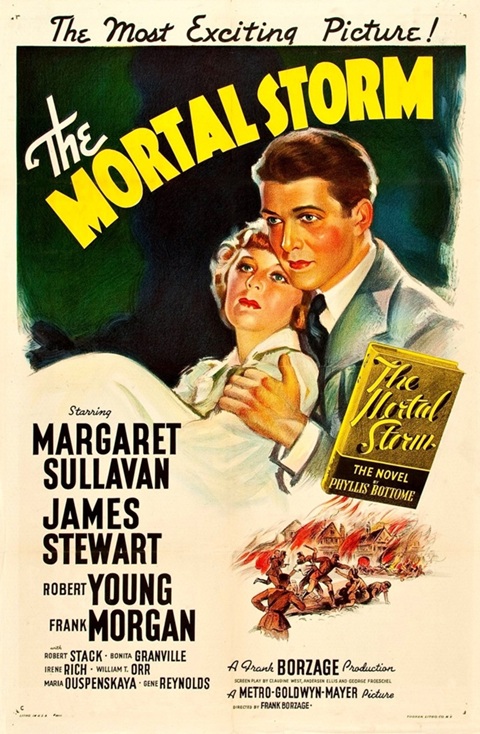
The Unnominated #16: The Mortal Storm (dir by Frank Borzage)


Though the Academy of Motion Picture Arts and Sciences claim that the Oscars honor the best of the year, we all know that there are always worthy films and performances that end up getting overlooked.  Sometimes, it’s because the competition too fierce.  Sometimes, it’s because the film itself was too controversial.  Often, it’s just a case of a film’s quality not being fully recognized until years after its initial released.  This series of reviews takes a look at the films and performances that should have been nominated but were, for whatever reason, overlooked.  These are the Unnominated.

Oh, how this movie made me cry!

Released in 1940, at a time when war was spreading across Europe, Asia, and Africa but the United States was still officially neutral, The Mortal Storm opens on January 30th, 1933.  In the mountains of Germany, near the Austrian border, Professor Viktor Roth (Frank Morgan) is celebrating his 60th birthday.  He starts the day being applauded by his students at the local college.  In the evening, he returns home for a celebration with his family, including wife (Irene Rich), his daughter Freya (Margaret Sullivan), his son Rudi (Gene Reynolds), and his two stepsons, Otto (Robert Stack) and Erich von Rohn (William T. Orr).  Also present are Freya’s fiancé, Fritz (Robert Young) and one of Roth’s students, a pacifist named Martin Breitner (James Stewart).  It’s a joyous occasion and the film takes its time introducing us to Prof. Roth and his extended family.  At first, everyone seems very kind.  They seem like people who most viewers would want to spend time with or live next to….

But then, the family’s maid excitedly enters the room and announces that it’s just been announced that Adolf Hitler is the new chancellor of Germany.  Otto and Erich are overjoyed and head out to celebrate with the other members of the Nazi Youth Leage.  Martin is less happy and excuses himself to return home.  Roth and his wife worry about what this means for people who do not agree with Hitler’s beliefs.  Freya says that they shouldn’t talk politics.  It is jokingly mentioned that Hitler has taken away Roth’s special day but Roth’s young son Rudi says that he’s learned in school that the needs of the individual will never be more important than the needs of the state.  If Hitler wants to take away your day, it’s your duty to give it up or face the consequences.

Based on a 1937 novel, The Mortal Storm was not the first Hollywood production to take a stand against Hitler and the Nazis but it was one of the best.  I say this despite the fact that the film only hints at the fact that Prof. Roth is Jewish, something that was made very clear in the book.  (In the movie, Roth and his wife worry what will happen to “Non-Aryans” and “freethinkers.”)  That said, the film perfectly captures how quickly and insidiously the authoritarian impulse can spread.  The town, which once seemed so friendly, becomes a very dark place as the students at the university put on their swastika armbands and start to hunt down anyone who dissents from the party line.  When Roth says that, as a scientist, he does not believe one race can be genetically superior to another, his students walk out on him.  A local teacher is beaten when he fails to return to the Nazi salute.  When Martin refuses to join the Party, Otto and Erich turn against him despite being lifelong friends.  When Martina and Freya flee for the border, Fritz pursues them.  And even after Prof. Roth is sent to a concentration camp, Otto and Erich continue to follow the orders of Hull (Dan Dailey), the sinister Youth Party Leader.

It’s a powerful film, one that remains just as relevant today as it was when it was first released.  Hull and Erich’s fanaticism would, today, find a welcome home on social media.  The scenes in which the townspeople eagerly threaten to report their former friends and neighbors for failing to salute or show proper enthusiasm for the government have far too many modern day equivalents for me to even begin to list them all.  This film was also the last the James Stewart made with frequent co-star Margaret Sullivan and they both give great performances.  (All-American Jimmy Stewart might seem a strange choice to play a German farmer but he is never less that convincing as Martin, one of the few people in the town not to surrender his principles and beliefs to the crowd.)  The film’s final moments, with the camera panning around the empty Roth home, brought very real tears to my eyes.

Despite being a powerful film, The Mortal Storm was not nominated for a single Oscar.  (Jimmy Stewart did win his only Oscar that year but it was for The Philadelphia Story.)  It’s temping to assume that, at a time when America was still divided about how to react to the war in Europe and when many Americans still remembered the trauma of the first World War, The Mortal Storm was too explicitly political and anti-Nazi to get a nomination but, the same year, The Great Dictator was nominated for Best Picture.  It seems more likely that, in those days when the studios ruled supreme, MGM decided to puts it weight behind The Philadelphia Story rather than The Mortal Storm.

That said, The Mortal Storm was definitely worthy of being nominated, for Picture, Director, Screenplay, Actress (Margaret Sullivan), Actor (Stewart), Supporting Actor (Frank Morgan and Robert Stack), and Supporting Actress (Irene Rich and, in the role of Stewart’s mother, Maria Ouspenskaya).  The film may not have been nominated but it remains a powerful and important work of art.
Previous entries in The Unnominated:
  1. Auto Focus 
  2. Star 80
  3. Monty Python and The Holy Grail
  4. Johnny Got His Gun
  5. Saint Jack
  6. Office Space
  7. Play Misty For Me
  8. The Long Riders
  9. Mean Streets
  10. The Long Goodbye
  11. The General
  12. Tombstone
  13. Heat
  14. Kansas City Bomber
  15. Touch of Evil

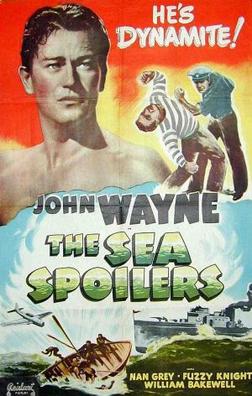
The Sea Spoilers (1936, directed by Frank R. Strayer)


Bob Randall (John Wayne) is a coast guard boatswain, headquartered in Alaska where he and the members of his crew battle evil seal poachers like oily Phil Morgan (Russell Hicks).  When Randall returns to port after his latest patrol, he has to deal with two disappointments.  First off, he is passed over for a promotion to commanding officer, even though everyone knows that he deserves it.  Instead, the promotion goes Lt. Commander Mays (William Blakewell), the son of a commander (George Irving).  Mays doesn’t even want the job.  He’s scared of the water and he’d rather fly airplane as a part of the Coast Guard’s aviation force.  Bob is disappointed but he’s a professional and he’s going to support Mays.  Secondly, Bob’s girlfriend (Nan Grey) witnesses a murder and is kidnapped by Phil Morgan.  Bob and his sidekick (dependable western mainstay Fuzzy Knight) go undercover as fisherman to try to find her.

The Sea Spoilers was the first of six B-movies that John Wayne did for Universal.  Wayne, who had been stuck in the B’s for a while, was trying to prove that he was more than just a singing cowboy so, in this one, he plays a tough and ready sailor.  Wayne is convincing in the role, even if the movie is really just a western set in what was then modern day Alaska.  Though only 30, Wayne shows the no-nonsense professionalism that would become his trademark once he became one of the world’s biggest movie stars.  Unlike some of Wayne’s early films, it’s possible to see the icon that John Wayne would eventually become while watching him here.  The Sea Spoilers is only 66 minutes long but fans of the Duke should enjoy it.

Finally, The Sea Spoilers was written by George Waggner.  Waggner would later go on to direct the original Wolf Man.

Lisa Marie Reviews An Oscar Nominee: In Old Chicago (dir by Henry King)


One of the ten films to be nominated for Best Picture of 1937, In Old Chicago tells the story of the O’Leary family.

When we first meet the O’Learys, they’re riding across the Illinois frontier in a covered wagon.  After patriarch Patrick O’Leary (J. Anthony Hughes) is killed in a freak accident, Hazel O’Leary (Alice Brady) decides to settle in the bustling town of Chicago.  Hazel and her three sons build a life for themselves in a poor, largely Irish neighborhood known as the Patch.  Hazel makes a living as a laundress and soon, her home is big enough for her to take in a cow named Daisy.  Better not put that lantern too close to Daisy, Mrs. O’Leary….

As for the O’Leary boys, they all build a life of their own in 19th century Chicago.

Free-spirited Dion (Tyrone Power) hangs out in the saloon owned by sinister Gil Warren (Brian Donlevy) and, to his mother’s consternation, he falls for a singer named Belle (Alice Faye).  Eventually, Dion and Belle open up their own saloon and go into competition with Warren.  Dion soon emerges as one of the leaders of the Patch, a rogue with a charming smile and zero ethics but a total love for his family.

The youngest, Bob (Tom Brown), falls in love with a German immigrant named Gretchen (June Storey).  Bob asks Gretchen to marry him while Mrs. O’Leary’s cow stares straight at camera.

Finally, the oldest of the O’Leary boys is Jack (Don Ameche).  Jack become a crusading lawyer and eventually, he runs for mayor on a reform ticket.  With Dion’s help, Jack is able to defeat Gil Warren.  But now that Jack is mayor, he immediately sets his sights on tearing down the Patch and, in his words, “starting over.”

In Old Chicago has a two-hour running time and a lot happens in those two hours.  Not only is there all the drama between the brothers but also there’s a handful of production numbers featuring Alice Faye.  (Considering that she’s performing at a saloon in the slums of Chicago, it’s impressive that Belle can put on such an elaborate show.)  Of course, anyone with a knowledge of history knows that every minute of In Old Chicago is building up to the moment when Mrs. O’Leary’s cow kicks over that lantern and all the wooden buildings in Chicago go up in flames.  In Old Chicago is an early disaster movie and, talented cast aside, the main reason that anyone will be watching will be for the recreation of the Great Chicago Fire.  As flames roar around them and cattle stampede through the streets, hundreds of extras run for their lives.  As Alice Brady, Tom Brown, and Alice Faye stare off to the horizon, the city of Chicago explodes in front of them.  Even today, the scenes of the city on fire are impressive.

As for the rest of the film, I enjoyed the melodramatic excess of it all.  The stars weren’t exactly the most dynamic actors of the 1930s but Tyrone Power and Don Ameche were both handsome and likable enough to carry the film and it’s easy to see why In Old Chicago was, at the time of its production, the most expensive film ever made.  It’s a big film, with ornate sets, hundreds of extras, and elaborate production numbers.  It’s entertaining, even though I did occasionally find myself growing impatient as I waited for the fire to finally start burning.

One thing this film is not is historically accurate.  Not only is it now generally agreed that Mrs. O’Leary’s cow was innocent of starting the fire but Mrs. O’Leary’s son was never mayor of Chicago.  It is true that Chicago caught fire in 1871 and that the mayor turned to General Philip Sheridan (played here by Sidney Blackmer) for help in both putting out the fire and keeping order in the streets.  For the most part, though, In Old Chicago is total fiction.  That didn’t bother me but then again, I don’t live in Chicago.

In Old Chicago was nominated for Best Picture of the Year but lost to The Life of Emile Zola.  However, Alice Brady won the Oscar for Best Supporting Actress.

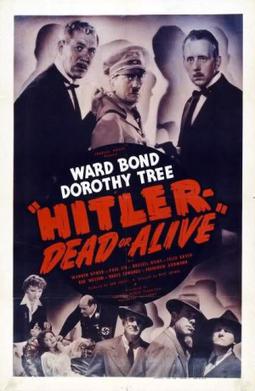
Film Review: Hitler — Dead or Alive (dir by Nick Grinde)


The 1942 film, Hitler — Dead or Alive, opens with two reporters visiting a prominent industrialist named Samuel Thornton (Russell Hicks).  They are curious about a statue of three men that stands outside of Thornton’s mansion.  Thornton proceeds to tell them the story of the three men.

In 1939, shortly after the Nazis invaded Poland and with the United States still pursuing a policy of neutrality, Thornton independently offered a million dollars to anyone who could bring Adolf Hitler to justice, dead or alive.  Accepting the offer were three ex-cons who had just been released from Alcatraz, Steve Maschick (Ward Bond), Hans “The Dutch” Havermann (Warren Hymer), and Joe “The Book” Conway (Paul Fix).  (As you may have guessed “The Book” is the intellectual of the group and yes, he wears glasses.)  After Thornton makes clear to them that they’re going to have to make sure that they either capture or kill the real Hitler and not one of his many doubles, the three men join the Royal Canadian Air Force and, along with ace pilot Johnny Stevens (Bruce Edwards), they head for Germany.

Made for an obviously low-budget, this B-movie is a bit of a curiosity.  It starts out as a comedy, with the three cooks cracking jokes about going straight and a lengthy sequence in which they try to work up the courage to parachute into Germany.  Even after they get caught by the Gestapo and sent to a prison camp, much of the film is played for laughs.  It’s not until they escape from the prison and Johnny sacrifices his life while shooting it out with the Nazis that the film starts to take a more serious turn.  Steve, who starts out the film only caring about the money, comes to realize that there are more important things than just finding a quick payday.

Steve, Hans, and Joe end up at the mansion of Else von Brandt (Dorothy Tree), a secret member of the German resistance who is so trusted by the Nazis that Hitler himself (played by Bobby Watson) will be stopping by for a visit.  By this point, Steve explains that he no longer cares about the money.  As far as he’s concerned, he’s now working for free.  After learning about all of the people who have been killed by Hitler, Steve is determined to stop him, even if it means sacrificing his own life.

There are still moments of humor to the found in the latter half of the film.  When Steve, Hans, and Joe confront Hitler, one of the first things that they do is shave off his mustache.  But the film’s conclusion is ultimately a very serious one and features one particular act of violence that I imagine stunned audiences in 1942.  Having told the story of the three men and their mission to get Hitler, Samuel Thornton ends the film by saying that it doesn’t matter whether Germany is being led by Hitler or Hitler’s double.  What matters is eradicating all of the Nazis from the Earth.  In the end, the message of the film is a simple one.  It’s okay to laugh.  It’s okay to joke.  But, in the end, everyone must do their part.

Hitler — Dead or Alive was made for an obviously low-budget and there are a few scenes, especially in the beginning, where the pace feels a bit off.  Just as with Beast of Berlin, the film’s version of a German prison camp feels like it could have been lifted from a dozen American crime films.  But Ward Bond is a strong hero and he delivers his lines with conviction, especially when he discusses why nothing is more important than stopping Hitler.  He gets good support from both Paul Fix and Warren Hymer.  The film may start out as a comedy but it’s anti-Hitler message comes through loud and clear.  Seriously, how can you not appreciate a film about defeating the Nazis?

Lisa Watches An Oscar Nominee: The Little Foxes (dir by William Wyler)


Little_foxesThat Bette Davis was an amazingly talented actress is something that we all already know.

However, she has become such an iconic figure that I think that it’s easy to forget just how versatile she could be.  She was ferocious in Of Human Bondage.  She was poignant in Dark Victory.  She was majestic in All About Eve.  Even when she eventually ended up appearing in stuff like Burnt Offerings, she still managed to command the screen.  Of course, nobody played evil with quite the style and power as Bette Davis at her prime.  And if you ever have any doubt about that fact, I would suggest watching the 1941 Best Picture nominee, The Little Foxes.

Based on a play by Lillian Hellman, The Little Foxes is a dark Southern melodrama that takes place in 1900.  The once mighty Hubbard Family has fallen on hard times.  Brothers Benjamin (Charles Dingle) and Oscar (Carl Benton Reid) have inherited their father’s money and Oscar has made himself even more wealthy by marrying the poignant alcoholic Birdie (Patricia Collinge).  However, when Oscar and Benjamin decide that they want to build a cotton mill, they discover that, even with their own fortunes, they are still $75,000 short.

They turn to their sister, Regina (Bette Davis).  As quickly becomes obvious, Regina is a hundred times more intelligent and clever than either one of her brothers.  However, because she’s a woman, Regina was not considered to be a legal heir to their father’s fortune.  As a result, after his death, she was left penniless.  In order to survive, Regina had to marry the wealthy but sickly Horace (Herbert Marshall).  When Regina asks Horace for the $75,000, Horace refuses.  He wants nothing to do with either one of her brothers.

With the reluctant help of Oscar’s son, Leo (Dan Duryea), the brothers steal the money straight from Horace’s bank account.  Regina, however, finds out about the theft and schemes to blackmail her two brothers….

For the majority of the film, you are totally on Regina’s side.  Despite the fact that Regina is ruthless and obviously taking advantage of Horace’s weakened state, you find yourself making excuses for her.  Her brothers are both so sleazy and greedy and Regina is so much smarter than her idiotic siblings that the film occasionally feels like a dark comedy.  It’s fun watching her get the better of them and you find yourself assuming (and hoping) that Regina will somehow be redeemed by the end of the movie.

And then it happens.

Aware of both Regina’s scheme and the fact that she never loved him, Horace announces that he’s going to change his will and he’s going to leave his entire fortune to their daughter, Alexandra (Teresa Wright, in her Oscar-nominated film debut).  He also tells Reginia that he’s going to say that he lent Leo the money, which would make it impossible for her blackmail scheme to work.

It’s while they’re arguing that Horace suddenly suffers a heart attack.  And as Horace struggles to climb up a staircase so that he can get his medicine, Regina calmly sits in a chair and shows not a hint of emotion as he dies.  It’s such an unexpected and effective moment, largely because Bette Davis’s performance was so good that it kept both the viewer and Horace from realizing just how monstrous Regina truly was.

It’s hard to think of any contemporary actress who could so totally and believably embody a character of Regina Gibbons.  It takes courage to commit so fully to playing such an evil and hateful character.  Bette Davis had that courage and her performance alone makes The Little Foxes worth watching.