Lionsgate takes on The Crow in a new Trailer!


As it’s been 30 years since Alex Proyas’ The Crow was released, a remake was inevitable. From Rupert Sanders (Ghost in the Shell), this version of The Crow has Bill Skarsgard (John Wick 4) taking on the role of Eric Draven, who is brought back to life when he and his girlfriend Shelley (FKA Twigs, The King’s Man) are brutally murdered. Aided by a Crow, Eric searches for vengeance and it looks like Danny Houston (30 Days of Night) may be Draven’s main target. The look of the film seems to be a mix of DMC: Devil May Cry with some John Wick classic shooting action sequences. That’s not entirely a bad thing. It’s a new story for a new generation. The writers on board here are Zach Baylin (Gran Turismo) and William Schneider, who has the upcoming Return to Silent Hill.

The Crow releases in theatres this Summer.

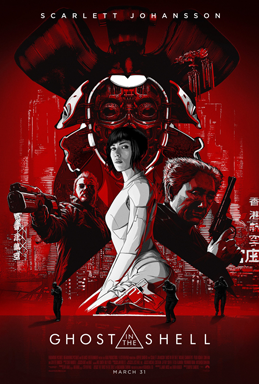
Film Review: Ghost in the Shell (dir by Rupert Sanders)


Last night, I finally saw Ghost in the Shell.

Now, before I start in on this review, I should admit that I’m hardly an expert on the manga on which Ghost in the Shell was based.  (In fact, as soon as I wrote that previous sentence, I called my boyfriend over and had him read it, just to make sure that I was using the term manga correctly.)  A few years ago, I did watch Mamoru Oshii’s 1995 film version.  And while I don’t remember a whole lot about the animated Ghost in the Shell, I do remember that I was never bored while watching it.  I wish I could say the same about the live action Ghost in the Shell.

Don’t get me wrong.  The live action, Westernized Ghost In The Shell is truly a visually impressive film.  It takes place in the near future, in the fictional Japanese city of New Port City.  New Port City basically looks like the city from Blade Runner, just with a somewhat more colorful visual scheme.  Everywhere you look, there are gigantic holographic advertisements and sleek, neon buildings.  But, as advanced as New Port City may look at first sight, it’s also full of dark allies, cramped apartments, and gray cemeteries.  Visually, it’s a perfect mix of  outlandish science fiction and brooding film noir.

Or, at least, it is the first time that you see it.  Unfortunately, director Rupert Sanders has a habit of using the visuals as a crutch.  It seemed as if, every time a new plot point was clumsily introduced, we would suddenly cut to another shot of New Port City at night, as if the film was saying, “Don’t worry about narrative coherence!  Look at the city!”

After about 15 minutes, I decided to take the film up on its suggestion.  I stopped paying attention to the slow-moving story and I focused almost exclusively on the visuals.  That’s a shame really because, from what I understand, both the manga and the original film are deeply philosophical works that balance style with thematic depth.  Unfortunately, since there’s no real depth to the live action Ghost in the Shell, you really have no choice but to focus almost exclusively on the style.

Ghost in the Shell takes place in a world where the line between human and machine has become blurred.  Everyone is getting cybernetic upgrades done.  One character, Batou (Pilou Asbæk), even gets new eyes halfway through the film.  Major (Scarlett Johansson) is unique because, while her brain is human, her body is totally cybernetic.  She is a member of Section 9, an anti-terrorism task force.  Major has only vague flashes of memory of who she used to be.  She’s been told that her parents were killed by terrorists but she doesn’t know if that’s true or if that’s just more manipulation from Cutter (Peter Ferdinando).  (It’s no spoiler to say that Cutter turns out to be a not nice guy.  He’s the CEO of a Hanka Robotics and when was the last time you saw a movie where a robotics CEO didn’t turn out to be a not nice guy?)  After Section 9 thwarts a cyberterrorist attack against Hanka Robotics, Major starts to wonder who she is and who she can trust.  Everyone tells her that, because she has a human brain, she’s also a human.  But Major still feels lost and without an identity.  When she starts to get too close to discovering her past, Cutter sets out to not only destroy her but all of Section 9 as well…

There’s a really good movie in which Scarlett Johansson plays a lost soul looking for her identity in Japan.  It’s called Lost in Translation.  Or, if you just want to see Scarlett playing someone who is learning more and more about herself and what she’s capable of, you could go watch Lucy.  (I don’t care much for that movie but some people seemed to like it.)  Or, if you want to see Scarlett play an enigmatic being who explores the world while hiding her true form in a human shell, you can always go watch Under the Skin.

(I highly recommend Under the Skin, which is as thought-provoking as Ghost in the Shell is shallow.)

This is what’s frustrating.  Scarlett Johansson gives a really good performance in Ghost in the Shell but she’s continually let down by a script that refuses to take the time to really explore anything.  We get a scene or two of Major wondering what it means to be truly human but the movie is always more interested in getting to the next action scene.  There’s a lot of talk about what it means to be human but there’s no real exploration.  Ghost in the Shell has all the depth of one of those old sci-fi shows where aliens (and, occasionally, androids) approach bemused humans and ask, “What is this thing that you call laughter?”

Ghost in the Shell ends with the hint of more films to come.  Personally, I’d rather see Scarlett Johansson in a Black Widow solo film.  When is that going to happen, Marvel Studios!?  Let’s get to it!  As for the live action Ghost in the Shell, it’s just frustrating and forgettable.

But the city looks really good!
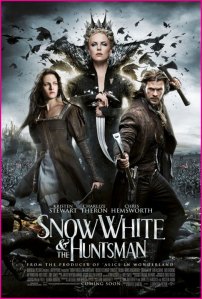
Trash Film Guru Vs. The Summer Blockbusters : “Snow White And The Huntsman”


Having proven yesterday how little I know about all things vampire with my review of Abraham Lincoln : Vampire Hunter, I figured I’d take a crack at another mythic genre, namely the fairy tale — or “folklore,” if you prefer — today. Why stop when you’re on a roll, right?

To be honest, though,  I guess what we’re here to talk about isn’t even “folklore” per se so much as the modern interpretation of a very popular piece of folklore indeed, since the film under our microscope this evening is first-time director Rupert Sanders’ Snow White And The Huntsman, the second “reimagining” of the Snow White legend to hit the screens this year following hot on the heels of Mirror, Mirror, and definitely the decidedly more “mature” of the two.

There were, frankly, a lot of reasons to be skeptical about this movie going in — Kristen Stewart sure isn’t my idea of perfect casting in the lead, for one thing — but on the whole, I actually walked out of this one pleasantly surprised. Not blown away, by any means — hell, not even bowled over — but it visually arresting enough and well-paced enough to sustain my interest throughout, even though the idea of Snow White as some kind of bad-ass warrior queen seems absurd to a guy like me who basically only knows the Disney version, and remembers it very faintly at that.

Sanders, who I understand got his start in music videos, definitely brings the kind of “these folks have a short attention span, so let’s not let up on the gas” attitude you’d expect from somebody fresh out of that milieu, and while he doesn’t really seem to be much of an actor’s director — Charlize Theron in given free reign to ham it up to the hilt with her interpretation of the evil Queen Ravenna, Chris Hemsworth is essentially just reprising his Thor role as the co-titular Hunstman, and Stewart does what she does “best,” namely look completely lost but somehow project an attitude that we’re supposed to think that’s “sexy,” and that we’re damn lucky she even inhabits the same planet as us mere mortals, as Snow White herself — but when he’s laying out a visual feast this scrumptious, I can live with a few of the ingredients being a bit sour and/or stale.

And what a feast it is! Yeah, there’s definitely a lot of liberal borrowing from the Tim Burton playbook going on here, particularly with little tricks like superimposing the heads of the likes of Bob Hoskins and Ian McShane onto CGI dwarves’ bodies, but Sanders’ overall vision of  the fantastic is considerably less color-saturated and joyful than Burton’s, and frankly a little edgier. When Burton goes “dark” or “morbid” he does so with his tongue firmly planted in his cheek, while Sanders really seems to mean it — this shit is supposed be more than just a little bit intimidating.

In that sense, he’s probably closer to the original intent of the Brothers Grimm and their contemporaries than he may even have consciously been aiming for, since “fairy tales” weren’t just designed to keep the young’uns of years gone by entertained, but to scare the shit out of them by illustrating the consequences of what would happen if they didn’t do as they were told, as well. There’s irony, I suppose, in the fact that this film, clearly billed as an “adult” take on the Snow White legend, actually ends up being closer, in tone and spirit, to the original than the decidedly more “family-friendly” Mirror, Mirror, but it’s the kind of irony I can certainly get behind, especially when the end result, while ultimately as disposable as most any other summer blockbuster fare (notice how pretty much all my praise here is aimed solely at the film’s visual sensibility and nothing else — there’s good reason for that, as the story is essentially exactly the kind of  hollow, by-the-numbers modern Hollywood take on the proceedings that you’d expect), is this downright fascinating to look at. Beneath the surface, there’s not much of anything going on in Snow White And The Huntsman, to put things as kindly as possible —but the surface is so damn lush, cryptic, and enthralling that you won’t realize, or even care, that you’ve pretty much been had until well after you leave the theater.