Retro Television Reviews: Fantasy Island 4.5 “The Love Doctor/The Pleasure Palace”


Welcome to Retro Television Reviews, a feature where we review some of our favorite and least favorite shows of the past!  On Tuesdays, I will be reviewing the original Fantasy Island, which ran on ABC from 1977 to 1986.  Almost the entire show is currently streaming is on Youtube, Daily Motion, and a few other sites.

This week, Roarke and Tattoo are still ignoring each other.

Episode 4.5 “The Love Doctor/The Pleasure Palace”

(Dir by Earl Bellamy and Cliff Bole, originally aired on November 22nd, 1980)

The plane has arrived and, once again, Mr. Roarke and Tattoo head down to the docks to meet their guests.  And, as with the previous season four episodes, it’s hard not to notice that neither Ricardo Montalban nor Herve Villechaize are willing to look at each other while delivering their lines.  I feel a little bit bad about having started almost every recent review by mentioning the obvious hostility between the two of them but it’s impossible not to notice.  Previously, one of the show’s greatest strengths was the playful banter between Roarke and Tattoo and, when it’s gone, it’s impossible not to notice the absence.

Speaking of hostility, Gordon Hughes (Gary Burghoff) seem to have a lot resentment against the world.  Thanks to the inheritance that he received from his grandmother, Gordon has graduated from law school and he is on the verge of joining a top law firm.  But, before he does so, he wants to go back in the past and discover how his grandmother made all of her money.  Mr. Roarke takes Gordon to a recreation of the saloon that his grandmother owned in turn-of-the-century San Francisco.  Gordon takes a sip of brandy and is transported into the past.  He quickly discovers that …. HIS GRANDMOTHER OWNED A BROTHEL!

At first, Gordon is upset about this discovery.  But then he falls in love with one of his grandmother’s employees, a waitress named Molly (Barbie Benton).  And then he stands up to a crooked cop (Dane Clark).  And then he meets his grandmother (Ruta Lee) and discovers that she was tough and refused to let anyone push her around.  Gordon realizes that he should be proud of his grandmother and his heritage and that he wants to be with Molly.  But then the San Francisco earthquake hits and Gordon is abruptly transported to the present.  Not to worry, though!  It turns out Molly was also a guest having a fantasy and she and Gordon board the airplane home together.

This fantasy — which featured a lot of nice clothes and period detail — would have been effective if not for Gary Burghoff’s rather off-putting performance as Gordon.  Seriously, Gordon came across as being such an uptight and self-righteous prig that it was difficult to have much sympathy for him.  Of course, that was kind of the point.  Gordon was supposed to be a snob but Burghoff made him such a convincing and such a committed snob that it was hard to believe that he could have changed his ways just over the course of a few days.

The second guest is actress Kim Holland (Loni Anderson), who is the biggest star in the world after appearing in only three movies.  She wants a break from being a star so Mr. Roarke arranges for her to serve as a nurse in a remote clinic that is run by the gruff Dr. Greg Miller (Christopher George).  Kim finds a purpose in life helping Dr. Miller but, when they’re kidnapped by a native tribe, Dr. Miller reveals that he has always known who Kim is.  Dr. Miller plays one of her movies for the tribe, convincing them that Kim is a goddess.  Miller goes on to explain that he’s been in love with Kim ever since he first saw her on screen.  Seeing as Kim’s fantasy was to not be recognized for a few days, it would seem that Roarke failed to keep up his end of the bargain.  But it doesn’t matter because Kim and Greg are in love.  This fantasy could have worked with perhaps a different actress in the role of Kim.  Loni Anderson gave such a blank performance as Kim that it was hard to really believe her either as a movie star or a nurse.

(Interestingly enough, the character of Kim Holland also appeared on the episode of The Love Boat that aired right before this episode.  So, if nothing else, this is the first Love Boat/Fantasy Island cross-over.  Incidentally, I’ll be reviewing that episode of The Love Boat in a few more months.)

This was a fairly forgettable episode.  The island was lovely to look at and I’m glad that everyone found love but I just wish Mr. Roarke and Tattoo could be friends again.

Late Night Retro Television Reviews: Highway to Heaven 1.4 “The Return Of The Masked Rider”


Welcome to Late Night Retro Television Reviews, a feature where we review some of our favorite and least favorite shows of the past!  On Thursdays, I will be reviewing Highway to Heaven, which aired on NBC from 1984 to 1989.  The entire show is currently streaming on Tubi and several other services!

This week, Jonathan and Mark clean up a troubled neighborhood!

Episode 1.4 “The Return of the Masked Rider”

(Dir by Michael Landon, originally aired on October 3rd, 1984)

This week, Jonathan and Mark end up a gym in a city.  Jonathan applies for a job as a cut man.  The gym’s owner, Mau Mau (Stoney Jackson), is doubtful because Jonathan can’t give him any references to call but then Jonathan magically heals a cut over a boxer’s eye.  Jonathan gets the job and just in time because this neighborhood needs to be protected.

The problem is that the neighborhood is being ruled by Thumper (Darin Taylor) and the Satan’s Helpers.  Everyone in the neighborhood is scared of the Satan’s Helpers and who can blame them when the gang literally identifies with Satan?  I mean, they’re not only fans of Satan but they’re helping him as well!  Anyway, the statewide boxing championship is coming up and Thumper is going to be fighting another neighborhood boxer, Joey (Chip MacAllister).  The Satan’s Helpers demand that Joey throw the fight and to make sure that Joey does so, they kidnap his grandfather (Hank Rolike)!

Mark suggests that Jonathan just “zap” the gang members and bring an end to the whole thing but Jonathan explains that their mission is not to take out the gang.  Their mission is to encourage the other residents in the neighborhood to take back the streets, “like the Guardian Angels!”  You heard it, folks.  God supports vigilantism.

Luckily, Morton Clay (John Agar) lives in the neighborhood as well.  Morton was once a movie star, playing the Masked Bandit.  Now retired and nearly forgotten, Morton lives in an apartment building with several of his former co-stars.  Jonathan encourages Morton and his friends to put on their old costumes and march down to the headquarters of the Satan’s Helpers.  The rest of the neighborhood is so amazed by the parade of old timey heroes, that they follow.

The Satan’s Helpers are so intimidated by sight of the entire neighborhood gathered together that they decide to stop helping Satan and they release the grandfather.  Yay!  Meanwhile, at the boxing match, Joey refuses to take a dive and he knocks out Thumper.  Yay!  The neighborhood is saved.

When people refer to Highway to Heaven as being a campy show, they are probably referring to episodes like this one.  Undoubtedly, the episode is well-intentioned.  Watching it, you can tell that Michael Landon was hoping that this episode would inspire people to take pride in the neighborhoods, just like the Masked Bandit and his friends!  But the episode’s extremely earnest approach feels a bit naïve.  There’s nothing particularly intimidating about the Satan’s Helpers and it certainly doesn’t help their credibility that they’re scare off by a bunch of elderly people wearing costumes.

Next week, Mark and Jonathan break into the country music world!

Love on the Shattered Lens: Coffy (dir by Jack Hill)


It may seem odd to describe Coffy as being a love story.

After all, this is a film that is perhaps best known for a scene in which Pam Grier (as Nurse Coffin, a.k.a. Coffy) shoots her lying boyfriend in the balls.  Coffy is often described as being the epitome of 70s grindhouse, a film in which Pam Grier takes on drug dealers, the Mafia, and a corrupt political establishment with a combination of shotguns and shanks.  Coffy is perhaps Grier’s best-known films and it features one of her best performances.  There’s nothing more empowering than watching Pam Grier take down some of the most corrupt, arrogant, and disgusting men to ever appear in a movie.  It’s a violent and gritty film, one that opens with a drug dealer’s head literally exploding and never letting up afterwards.  There are many different ways to describe Coffy but it’s rarely called a love story.

But here’s the thing.  A film about love doesn’t necessarily have to center around romantic love.  Coffy is about love but it’s not about any love that Coffy may have for her boyfriend, the duplicitous politician Howard Brunswick (Booker Bradshaw).  Instead, the love at the center of this film is the love that Coffy has for her sister, who died from a heroin overdose.  It’s her sister’s death that leads to Coffy first seeking revenge but that’s not the only love that motivates Coffy.  There’s also the love that Coffy feels for her community.  Throughout the film, we hear about how the black community is being destroyed by the drugs that are being pushed into their neighborhoods by white mafia dons like Arturo Vitronia (Allan Arbus, who was once married to the iconic photographer, Diane Arbus).  It’s not a random thing that, for all of Coffy’s anger, she saves her most savage revenge for the members of her community who are working with the white mobsters, men like the pimp, King George (Robert DoQui), and her own boyfriend, Howard.

Throughout the film, Coffy says that she feels like she’s “in a dream” and Pam Grier gives an intelligent performance that suggests that, even after her mission is complete, Coffy will never be the same.  She’s not a natural killer.  She’s a nurse and it’s her job to save lives.  But when she sets out to get revenge on those who killed her sister and who are destroying her community, Coffy shows no mercy.  When she violently interrogates another victim of the drug trade, Coffy shows the junkie no sympathy because sympathy isn’t going to solve the problem.  Coffy is determined and the reason why she succeeds is because none of her victims realize just how serious she is.  Coffy uses her beauty to distract them and then, when they aren’t looking, she strikes.  By the end of the film, she’s walking alone on the beach and the viewer is left to wonder what’s going on inside of her head.  After all the people that Coffy has killed, can she ever go back to simply working the night shift at the ER?  After you’ve seen life and death at its most extreme, can things ever go back to the way that they once were?

And listen, I’m generally a pacifist and I’m not a huge fan of real-life vigilante justice and I’ve signed many petitions against the death penalty but it’s impossible not to cheer for Coffy.  Pam Grier gives such a committed performance that it’s impossible not to get sucked into her mission.  (It helps, of course, that most of the people who she targets are legitimately terrible human beings.)  The brilliance of Grier’s performance comes in the quiet moments.  Yes, she’s convincing when she has to shoot a gun and she delivers vengeful one-liners with the best of them.  But the film’s best moments are the ones were Grier thinks about how her life has become a dream of violent retribution and where she allows us to see the love for her sister and her community, the same love that is motivating all of the bloodshed.

Coffy is a rightfully celebrated film.  For once, a cult film actually deserves its cult.  It’s one of the best of the old grindhouse films and, in fact, to call it merely an exploitation film actually does a disservice to how effective a film Coffy actually is.  It’s just a great film period.

http://www.youtube.com/watch?v=ZTugAPqacBs

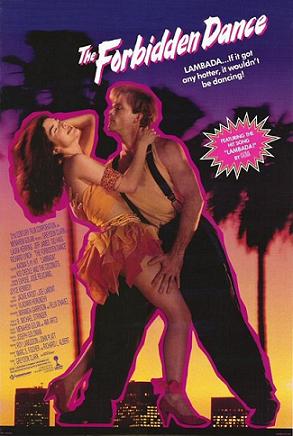
Embracing the Melodrama Part II #84: The Forbidden Dance (dir by Greydon Clark)


Forbidden_danceDANCE!

I love to dance, I loved to teach others how to dance, and I love watching other people dance.  If you’ve been reading my reviews for a while, then you know that I can not resist a film that features a lot of dancing.  It doesn’t matter if the director is inept.  It doesn’t matter if the script makes no sense.  It doesn’t matter if the actors don’t have a bit of acting talent to use to their advantage.  As long as the film features a lot of dancing, I’m happy.

Seriously, people, when in doubt … DANCE!

Let’s take the 1990 film The Forbidden Dance, for instance.  Now, if I wanted to be nit-picky, I could probably find a lot to criticize about this film.  I mean, this film even has a pro-environmental message and you know how annoyed I can get with message films.  And you know what?  You can do a google search and you can find all sorts of insanely negative reviews of this film.

But you know what?

I don’t really care about any of that.  This is, at heart, a dance film.  It features almost non-stop dancing, so I really can’t be too critical of it.  Add to that, it also features memorable performances from Sid Haig and the late Richard Lynch.  Unfortunately, neither Haig nor Lynch get out on the dance floor because, if they had, The Forbidden Dance would have been legendary.

The Forbidden Dance begins in the Brazilian rain forest.  A tribe of Native Brazilians is happily dancing and basically not bothering anyone.  As we learn later on in the film, the dance that they are doing is called the Lambada and apparently, the Brazilian government tried to ban it “because it was too sexy.”

(Amazingly enough and according to Wikipedia, the Lambada apparently was an actual dance craze back in 1990.  The Forbidden Dance came out on the exact same weekend as a competing film about the Lambada.  That film was called, appropriately enough, Lambada.  Strangely enough, two years ago, I randomly reviewed that film for this very site.)

Anyway, all the dancing and the fun is interrupted by the arrival of Benjamin Maxwell (Richard Lynch), a mercenary who works for a Big Evil Corporation.  Maxwell tells the tribe that they might want to stop dancing and leave because the rain forest is going to be destroyed.

Naturally enough, the tribe’s king responds to this by sending his daughter, Nisa (Laura Harring), to America.  Accompanying Nisa is Joa (Sid Haig), a witch doctor.  However, Nisa and Joa’s attempts to invade the headquarters of Big Evil Corporation results in Joa being arrested.

(Incidentally, you might recognize Laura Harring from David Lynch’s Mulholland Drive, where she played a similarly mysterious character who was lost and hunted in Los Angeles.)

Left to fend for herself, Nisa gets a job working as a maid for a wealthy family.  And while neither Mr. nor Mrs. Anderson has much interest in the backstory of the help, their son Jason (Jeff James) is a different story.  As Jason’s mother complains, Jason doesn’t have much interest in anything other than dancing.  And, when Jason spots Nisa dancing in her bedroom, he becomes intrigued with her.  Ignoring the snobbish reactions of his wealthy friends, Jason asks Nisa to teach him the Lambada!

And hey!  Guess what!  There’s going to be a dance contest and it’s going to be televised!  What better way to get a platform to protest the destruction of the Brazilian Rain Forest then by winning the contest?  Standing in the way of this plan: Benjamin Maxwell (who, in one icky scene, demands that Nisa dance for him), Jason’s parents and friends, and the fact that, through a complicated series of events, Nisa ends up being forced to dance in the sleaziest club in Los Angeles.

So, look — there’s all sorts of things that I could say about The Forbidden Dance but it features a lot of dancing so I’m inclined to be generous towards the film, especially since Laura Harring and Jeff James both know how to move and look really good dancing together.  I mean, the word Dance is right there in the title. The film promises dancing and it delivers.  Plus, it also delivers Sid Haig and Richard Lynch at their demented best.

So, why complain when you can … DANCE!?