Horror on the Lens: The Norliss Tapes (dir by Dan Curtis)


The Norliss Tapes (1973, dir by Dan Curtis)

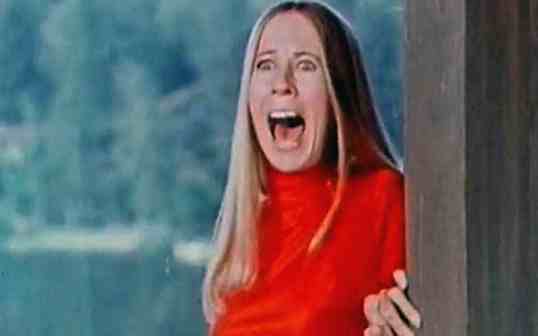
Today’s Horror on the Lens is The Norliss Tapes, a 1973 made-for-TV movie that was also a pilot for a television series that, unfortunately, was never put into production.

Reporter David Norliss (Roy Thinnes) has disappeared.  His friend and publisher, Stanford Evans (Don Porter), listens to the tapes that Norliss recorded before vanishing. (Stanford Evans, it must be said, is a great name for an editor.)  Each tape details yet another paranormal investigation.  (Presumably, had the series been picked up, each tape would have been a different episode.)  The first tape tells how Norliss investigated the mysterious death of an artist who apparently returned from the grave.

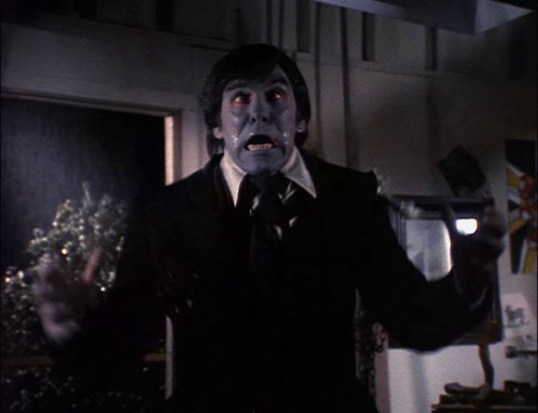
For a made-for-TV movie, The Norliss Tapes is pretty good.  It’s full of atmosphere and features a genuinely menaching yellow-eyed zombie monster. The film was directed by Dan Curtis, who was responsible for several made-for-TV horror films and who also created the deathless TV show, Dark Shadows. Curtis also directed a few feature films. Burnt Offerings, for instance, will be forever beloved for its scene of annoying little Lee Montgomery getting crushed by a chimney. If you ever get a chance to listen to the director’s commentary that Dan Curtis recorded for the Burnt Offerings DVD release, you must do so. Curtis comes across as the crankiest man on the planet and it’s actually kind of fascinating to listen to. His irritation when Karen Black keeps asking him if he knows the name of the actor who played the ghostly chauffeur is truly an amazing thing to here. (For the record, the actor’s name was Anthony James, he also had important supporting roles in two best picture winners — In The Heat of the Night and Unforgiven — and yes, he was one of the best things about Burnt Offerings. Karen Black knew what she was talking about.)

But back to The Norliss Tapes!

Admittedly, this is not the first Halloween in which I’ve shared The Norliss Tapes with our readers. Back in 2015, The Norliss Tapes was one of our “horrors on the lens.” Unfortunately, there’s only so many good quality, public domain horror films available on YouTube so, occasionally, a movie is going to show up more than once over the years. But, as long as it’s good film, who cares?

Enjoy The Norliss Tapes!

Horror on the Lens: Satan’s School for Girls (dir by David Lowell Rich)


For today’s horror on the lens, we have a 1973 made-for-TV movie called Satan’s School For Girls.

After her sister turns up dead, Elizabeth (Pamela Franklin) refuses to accept that official conclusion that it was a suicide.  Instead, Elizabeth is convinced that it was murder and that it has something to do with the exclusive school that her sister attended, the Salem Academy for Women.

Well, honestly, the Salem part is a dead giveaway.  I think we can all agree on that.

Anyway, this movie features a Satanic cult, an old school clique, and plenty of early of 70s fashion choices.  It may be silly but it’s also definitely entertaining.

Enjoy!

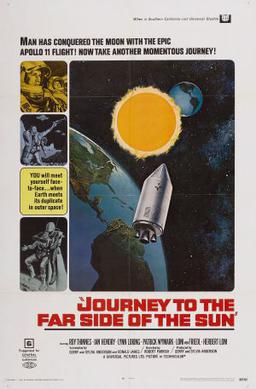
Journey to the Far Side of the Sun (1969, directed by Robert Parrish)


In the year 2069, the European Space Exploration Council discovers that there is a planet on the other side of the Sun, one that orbits the same path as the Earth.  Unfortunately, a spy transmits this information to the communists so America and Europe team up to make sure that they reach the planet before the Russians!

(Remember, production started on this movie in 1967, when America and Soviet Union were still competing to see who would be the first to land on the moon.  Of course, by the time Journey to the Far Side of the Sun was released in 1969, America had already landed on the moon and the Russian space program was no longer taken seriously.)

Two astronauts are assigned to a manned mission to explore the new planet.  Glenn Ross (Roy Thinnes) is American.  John Kane (Ian Hendry) is British.  After spending three weeks in suspended animation, Ross and Kane awaken to discover themselves orbiting a planet that appears to have much the same atmosphere as Earth.  When their ship crashes into the planet, Kane is fatally injured and Ross is retrieved by a human rescue team!  He’s told that the ship crashed in Mongolia.  Kane and Ross were orbiting Earth all along!

Or were they?  Even though Ross is reunited with his wife and debriefed by Jason Webb (Patrick Wymark), the head of the mission, he soon discovers that things are different.  People who were once right-handed are now left-handed and text is now written from right-to-left instead of left-to-right.  People drive on the wrong side of the road and, after Ross makes love to his wife, she feels like something was different about him.  Ross realizes that he’s on a counter-Earth!

It’s an intriguing premise but, unfortunately, Journey to the Far Side of the Sun doesn’t do much with it.  It’s not as if Ross has landed on the Bizarro world, where people say, “Bad Bye” and root for the bad guys at the movies.  Instead, it’s just a world where right-handed people are now left-handed and everyone drives on the opposite side of the road.  Ross theorizes that everything that happens on Earth also happens on Counter-Earth, which means that the other Ross is on Earth, realizing the exact same thing that the first Ross is realizing but who cares because there’s not really any major differences between the two Earths.  Maybe if Counter-Earth had an alternate history where Rome never fell or the Germans won World War II, the movie would be more interesting or at least more like an old episode of Star Trek.  Instead, the movie is all about Ross trying to convince the people on Counter-Earth that he didn’t intentionally abort the mission and that he should be given a chance to return to his Earth.   It’s the driest possible way to approach an interesting premise.

I will say that Journey to the Far Side of the Sun also has one of the strangest endings that I’ve ever seen.  I won’t spoil it here, other than to say that I wonder if the ending was written before or after 2001 made confusing conclusions cool again.

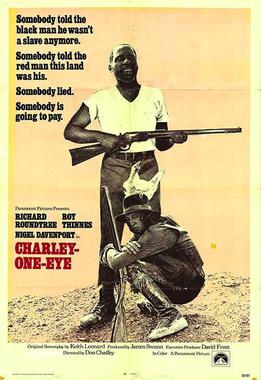
A Movie A Day #334: Charley One-Eye (1973, directed by Don Chaffey)


Welcome to the old west, where life is brutal and unpredictable.  Ben (Richard Roundtree) joined the Union Army so he could kill white men.  When his commanding officer caught Ben in bed with his wife, Ben was forced to commit murder and go on the run.  When Ben stumbles across an unnamed Indian (Roy Thinnes) with a bad leg, Ben forces the Indian to accompany him.  Despite Ben being loud, cruel, and mentally unstable, an unlikely friendship develops between Ben and the Indian, cemented by their mutual hatred of the white man.  When they find a deserted church, Ben and the Indian settle in and start to raise chickens.  The Indian’s favorite chicken is a one-eyed bird that he has named Charley.  Meanwhile, the Bounty Hunter (Nigel Davenport), a British racist, retraces their every step.

Richard Roundtree made Charley One-Eye after shooting to fame as John Shaft.  This film was his attempt to show that he was capable of playing more than just the black private dick that’s a sex machine to all the ladies.  Ben is a world away from Shaft.  There’s nothing smooth or charming about Ben, who never stop laughing or talking about how much he wants to kill a white man.  (Though the character introduces himself as being named “Ben,” the end credits simply read, “The Black Man … Richard Roundtree.”) The Indian is also half-crazy and given to fits of laughter.  The Bounty Hunter never laughs.  Whenever these three aren’t talking, the sound of buzzing flies is heard.  Death and decay are all around.

Don Chaffey was a British director who best known for films like Jason and the Argonauts and One Million Years B.C.  Charley One-Eye was a strange departure for him and he would never make another film like it.  It has elements of the Blaxploitation genre and Spaghetti western fans will recognize Aldo Sambrell in the tiny role of a Mexican bandit.  But it is really neither blaxploitation nor a western.  It’s a slowly paced, sometimes boring character study of two outsiders.  Both Roundtree and Thinnes give good performances, though their characters are sometimes hard-to-take.  The only thing that makes Ben and the Indian tolerable is that their enemies, like the Bounty Hunter, are a hundred times worse.  There is a weird religious subtext running through the entire movie and the ending will leave you wondering whether the director of Jason and the Argonauts was actually calling for armed revolution.  Charley One-Eye is uneven and it goes on for at least thirty minutes too long but it is still an intriguingly strange movie.

One final note: Charley One-Eye was produced by none other than David Frost, the British media personality whose post-presidency interview with Richard Nixon was recreated in Frost/Nixon.

Horror on the Lens: Satan’s School for Girls (dir by David Lowell Rich)


For today’s horror on the lens, we have a 1973 made-for-TV movie called Satan’s School For Girls.

After her sister turns up dead, Elizabeth (Pamela Franklin) refuses to accept that official conclusion that it was a suicide.  Instead, Elizabeth is convinced that it was murder and that it has something to do with the exclusive school that her sister attended, the Salem Academy for Women.

Well, honestly, the Salem part is a dead giveaway.  I think we can all agree on that.

Anyway, this movie features a Satanic cult, an old school clique, and plenty of early of 70s fashion choices.  It may be silly but it’s also definitely entertaining.

Enjoy!

Film Review: The Hindenburg (dir by Robert Wise)


80 years ago, on May 6th, 1937, the Hindenburg, a German airship, exploded in the air over New Jersey.  The disaster was not only covered live by radio reporter Herbert Morrison (whose cry of “Oh the humanity!” continues to be parodied to this day) but it was also one of the first disasters to be recorded on film.  Looking at the footage of the Hindenburg exploding into flame and sinking to the ground, a mere skeleton of what it once was, it’s hard to believe that only 36 people died in the disaster.  The majority of those who died were crew members, most of whom lost their lives while helping passengers off of the airship.  (Fortunately, the Hindenburg was close enough to the ground that many of the passengers were able to escape by simply jumping.)

Not surprisingly, there was a lot of speculation about what led to the Hindenburg (which has successfully completed 63 flights before the disaster) exploding.  The most commonly accepted explanation was that it was simply an act of God, the result of either lightning or improperly stored helium.  Apparently, there was no official evidence found to suggest that sabotage was involved but, even back in 1937, people loved conspiracy theories.

And really, it’s not totally implausible to think that the Hindenburg was sabotaged.  The Hindenburg was making its first trans-Atlantic flight and it was viewed as being a symbol of Nazi Germany.  One of the ship’s passengers, Captain Ernest Lehman, was coming to the U.S. in order to lobby Congress to give Germany helium for their airships.  With Hitler regularly bragging about the superiority of German industry, the theory was that an anti-Nazi crewman or passengers planted a bomb on the Hindenburg.  Since no individual or group ever stepped forward to claim responsibility, the theory continues that the saboteur must have perished in the disaster.

At the very least, that’s the theory put forward by a film that I watched earlier today, the 1975 disaster movie, The Hindenburg.

A mix of historical speculation and disaster film melodrama, The Hindenburg stars George C. Scott as Col. Franz Ritter, a veteran of the German air force who is assigned to travel on the Hindenburg and protect it from saboteurs.  Ritter is a Nazi but, the film argues, he’s a reluctant and disillusioned Nazi.  Just a few weeks before the launch of the airship, his teenage son was killed while vandalizing a synagogue.  Ritter is a patriot who no longer recognizes his country and George C. Scott actually does a pretty good job portraying him.  (You do have to wonder why a seasoned veteran of the German air force would have a gruff, slightly mid-Atlantic accent but oh well.  It’s a 70s disaster film.  These things happen.)

Ritter is assigned to work with Martin Vogel (Roy Thinnes), a member of the Gestapo who is working undercover as the Hindenburg’s photographer.  Tt soon becomes obvious that he is as much a fanatic as Ritter is reluctant.  Vogel is a sadist, convinced that every Jewish passenger is secretly a saboteur.  Thinnes is chilling in the role.  What makes him especially frightening is not just his prejudice but his casual assumption that everyone feels the same way that he does.

And yet, as good as Scott and Thinnes are, the rest of the cast is rather disappointing.  The Hindenburg features a large ensemble of actors, all playing characters who are dealing with their own privates dramas while hoping not to burn to death during the final 15 minutes of the film.  Unfortunately, even by the standards of a typical 70s disaster film, the passengers are thinly drawn.  I liked Burgess Meredith and Rene Auberjonois as two con artists but that was mostly because Meredith and Auberjonois are so charming that they’re fun to watch even if they don’t have anything to do.  Anne Bancroft has one or two good scenes as a German baroness and Robert Clary does well as a vaudeville performer who comes under suspicion because of his anti-Nazi leanings.  Otherwise, the passengers are forgettable.  Whether they die in the inferno and manage to make it to the ground, your main reaction will probably be to look at them and say, “Who was that again?”

Anyway, despite all of Ritter and Vogel’s sleuthing, it’s not much of mystery because it’s pretty easy to figure out that the saboteur is a crewman named Boerth (William Atherton).  Having seen Real GeniusDie Hard and the original Ghostbusters, I found it odd to see William Atherton playing a sympathetic character.  Atherton did okay in the role but his attempt at a German accent mostly served to remind me that absolutely no one else in the film was trying to sound German.

Anyway, the main problem with The Hindenburg is that it takes forever for the airship to actually explode.  The film tries to create some suspense over whether Ritter will keep the bomb from exploding but we already know that he’s not going to.  (Let’s be honest.  If you didn’t already know about the Hindenburg disaster, you probably wouldn’t be watching the movie in the first place.)  The film probably would have worked better if it had started with the Hindenburg exploding and then had an investigator working backwards, trying to figure out who the saboteur was.

However, the scenes of the explosion almost make up for everything that came before.  When that bomb goes off, the entire film suddenly switches to black-and-white.  That may sound like a cheap or even sensationalistic trick but it actually works quite well.  It also allows the scenes of passengers and crewmen trying to escape to be seamlessly integrated with actual footage of the Hindenburg bursting into flame and crashing to the ground.  The real-life footage is still shocking, especially if you’re scared of fire.  Watching the real-life inferno, I was again shocked to realize that only 36 people died in the disaster.

In the end, The Hindenburg is flawed but watchable.  George C. Scott was always at his most watchable when playing a character disappointed with humanity and the real-life footage of the Hindenburg disaster is morbidly fascinating.

Oh, the humanity indeed!

Horror on the Lens: The Norliss Tapes (dir by Dan Curtis)


Today’s Horror on the Lens is The Norliss Tapes, a 1973 made-for-TV movie that was also a pilot for a television series that, unfortunately, was never put into productions.

Reporter David Norliss (Roy Thinnes) has disappeared.  His friend and publisher, Stanford Evans (Don Porter), listens to the tapes that Norliss recorded before vanishing.  Each tape details yet another paranormal investigation.  (Presumably, had the series been picked up, each tape would have been a different episode.)  The first tape tells how Norliss investigated the mysterious death of an artist who apparently returned from the grave.

For a made-for-TV movie, The Norliss Tapes is pretty good.  It’s full of atmosphere and features a genuinely menaching yellow-eyed zombie monster.

Enjoy!