Doctor Who — The Tomb of the Cybermen (1967, directed by Morris Barry)


In 1966, Doctor Who changed forever.

William Hartnell was in failing health and having difficulty remembering his lines.  He was also not getting along with the current production team and was unhappy with the direction of the show.  (He felt that it was getting too violent and dependent upon the bug-eyed monsters who he had originally been told would have no part of the show.)  It became obvious that Hartnell would not be able to continue as the Doctor.  At the same time, Doctor Who was an unqualified hit and one that the BBC wanted to keep going.

Producer Innes Lloyd and story editor Gerry Davis decided that since the Doctor was an alien, they could just say that he could transform himself physically at will, which would allow them to recast the role.  Hearing the news, Hartnell is said to have replied, “There’s only one man in England who can take over, and that’s Patrick Troughton.”

William Hartnell was correct.  Patrick Troughton, 46 at the time, was a stage-trained character actor who had become a television mainstay.  As opposed to Hartnell, whose Doctor was stern and stubborn, Troughton played the Doctor as being “a comic hobo,” (to quote show creator Sydney Newman).  The Second Doctor enjoyed his travels and had an unquenchable curiosity.  Like an interstellar Lt. Columbo, The Second Doctor often played the fool to get the better of his enemies.  He also become a father figure to many of his companions, a role that Troughton also played offscreen as well.

Unfortunately, many of the Second Doctor’s adventures are missing or are only available in audio form.  When I was growing up, my father and I would watch Doctor Who on PBS.  PBS started with the Fourth Doctor and the Fifth Doctor before then going back to the Third Doctor and then finally broadcasting what they had of The First and Second Doctor.  There were so few of the Second Doctor’s serials available that it only took PBS a month and a half to finish up with Troughton.  People like me got to know Troughton’s Doctor more through his later guest appearances (The Three Doctors, The Five Doctors, The Two Doctors) than through his original adventures.

The Tomb of the Cybermen is the earliest serial known to exist in its entirety to feature Troughton as the Second Doctor.  In this 4-epiosde serial (which also launched the show’s fifth series), The Doctor and his companions Jamie (Frazer Hines) and Victoria (Deborah Watling) materialize on the desolate planet Telos and discover an expedition of humans are trying to enter the Tomb of the Cybermen.

In those days before The Master, The Cybermen were one of the Doctor’s main recurring enemies.  Former humanoids who sacrificed their emotions and individual personalities to become cyborgs, the Cybermen were relentless and ruthless and just as dangerous as the Daleks.  (The Cyberman also had something Daleks lacked, the ability to climb stairs.)  In Tomb of the Cybermen, the expedition assumes that the Cybermen buried in the underground tomb are no longer functioning.  It turns out that the Cybermen are just waiting for someone to revive them.

Tomb of the Cybermen is a classic Doctor Who serial.  The plot borrows considerably from the legends about mummies and cursed Egyptian tombs.  The expedition arrogantly enters the tomb, despite being warned not to.  It turns out that the expedition’s leaders want to use the Cybermen as their own army and their willing to sacrifice everyone with them to try to achieve that goal.  The revived Cybermen aren’t interested in an alliance.  The Doctor and his companions try to escape the crypt while also ensuring that the Cybermen will never escape again.  The plot is simple but exciting.  The Second Doctor pretends to be baffled by the tomb and its technology but later reveals that he always understood more than he let on.

The Tomb of the Cybermen is not only a great Troughton showcase.  It’s also historically important as one of the first serials to really upset Britain’s moral guardians.  Reportedly, British children were left terrified and unable to sleep after witnessing the Cybermen bursting forth from their tombs.  The infamous Mary Whitehouse would often cite Doctor Who as being detrimental programming for children.  The Tomb of the Cybermen was one of the serials that she often cited as just being too violent and frightening.

It’s a shame that we don’t have more of Patrick Troughton’s serials to watch because The Tomb of Cybermen reveals him to be the prototype for almost every Doctor who would follow.  (There’s a small moment where The Doctor, Jamie, and Victoria hold hands while stepping into the Tomb and it says so much about who the Doctor was, post-Hartnell.)  I’m glad, though, that we do have this showcase of the Second Doctor at his best.

Lisa Marie Reviews An Oscar Nominee: In Old Arizona (dir by Raoul Walsh and Irving Cummings)


in-old-arizona-warner-baxter

Since the Oscars are approaching, I thought I would devote February to continuing my never-ending quest to watch and review every single film nominated for best picture!

With that in mind, I recently watched the 1928 film In Old Arizona.  In Old Arizona is a bit of an oddity in Oscar history.  Even though it is considered to have been a best picture nominee, it was never officially nominated.  In fact, in 1929, there were no official nominees.  Instead, the Academy simply announced the names of the winners.  The winners were selected by a small committee of judges.  The committee’s intentions are particularly obvious when you notice that not one film won more than one Oscar in 1929.  At a time when the industry was struggling to make the transition from silent film to the talkies, the 1929 Oscars were all about spreading the wealth and reassuring everyone that they were doing worthwhile work.  In Old Arizona‘s star, Warner Baxter, was named the year’s best actor while Broadway Melody was declared to have been the best picture.

(At that year’s Oscar ceremony, the second in the Academy’s history, the awards were reportedly handed out in 10 minutes and nobody gave an acceptance speech.  If this all seems strange when compared to the annual extravaganza that we all know and love, consider that Louis B. Mayer originally formed the Academy in order to give the studio bosses the upper hand in a labor dispute.  The awards were largely an afterthought.)

Years later, Oscar historians came across the notes of the committee’s meeting.  The notes listed every other film and performer that the committee considered.  Before settling on Broadway Melody, the committee apparently considered In Old Arizona.  For that reason, In Old Arizona is considered to have been nominated for best picture of the year.

If it seems like I’ve spent a bit more time than necessary discussing the history behind the 1929 Oscars, that’s because In Old Arizona isn’t that interesting of a film.  It was a huge box office success in 1929 and it was an undeniable influence on almost every Western that followed but seen today, it’s an extremely creaky film.  Influential or not, there’s not a scene, character, or performance in In Old Arizona that hasn’t been done better by another western.

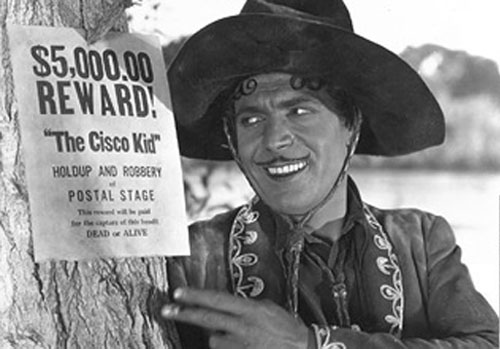
Based on a story by O. Henry, In Old Arizona tells the story of a bandit named The Cisco Kid (Warner Baxter).  Cisco may be an outlaw but he’s also a nice guy who enjoys a good laugh and occasionally sings a song while riding his horse across the Arizona landscape.  (California and Utah stood in for Arizona.)  The Cisco Kid may rob stagecoaches but he always does it with a smile.  Besides, he only needs the money so that he can give gifts to his girlfriend, Tonia (Dorothy Burgess).  What the Cisco Kid doesn’t know is that Tonia is bored and frustrated by his frequent absences and she has been cheating on him.  Then she’s approached by Sgt. Mickey Dunn (Edmund Lowe), the big dumb lug who has been ordered to bring the Kid in (dead or alive, of course).  Will Tonia betrayed the Kid?

If you’re watching In Old Arizona and hoping to be entertained, you’ll probably be disappointed.  Almost everything about this film has aged terribly.  Watching the film, it’s obvious that none of the actors had quite figured out how to adapt to the sound era and, as such, all of the performances were very theatrical and overdone.  Probably the easiest to take is Edmund Lowe, who at least managed to deliver his lines without screeching.  Sadly, the same cannot be said of Dorothy Burgess.  As for Warner Baxter, he may have won an Oscar for playing the Cisco Kid but that doesn’t make his acting any easier to take.

And yet, if you’re a history nerd like me, In Old Arizona is worth watching because it really is a time capsule of the era in which it was made.  In Old Arizona was not only the first Western to ever receive an Oscar.  This was also the first all-talking, all-sound picture.  Watching it today, without that knowledge, you might be tempted to wonder why the film lingers so long over seemingly mundane details, like horses walking down a street, the ticking of a clock, a baby crying, or a church bell ringing.  But, if you know the film’s significance, it’s fun to try to put yourself in the shoes of someone watching In Old Arizona in 1929 and, for the first time, realizing that film could not just a visual medium but one of sound as well.  For some members of that 1929 audience, In Old Arizona was probably the first time they ever heard the sound of a horse galloping across the landscape.

(I have to admit that, as a student of American history, I couldn’t help but get excited when one of the characters mentioned President McKinley.  McKinley may be forgotten today but audiences in 1929 would not only remember McKinley but also his tragic assassination.  By mentioning that McKinley was President, In Old Arizona not only reminded audiences that it was taking in the past but that it was also taking place during what would have been considered a more innocent time.  Much as how later movies would use John F. Kennedy as a nostalgic symbol of a more idealistic time, In Old Arizona uses William McKinley.)

In Old Arizona is no longer a particularly entertaining film but, as a historical artifact, it is absolutely fascinating.

James Bond Review: Live and Let Die (dir. by Guy Hamilton)


One year and one day ago the very first James Bond film to star Sir Roger Moore, Live and Let Die, in the title role was reviewed by Lisa Marie, and now it’s time to revisit the eight official film in the series.

With the previous Bond entry, Diamonds Are Forever, we finally see Sean Connery run out of gas when it came to playing the title role of James Bond. Yet, despite the obvious boredom Connery was having in the film the producers of the series were still wanting him to come back for another Bond film. Maybe it was his experience during the production of Diamonds Are Forever or Connery finally decided it was truly time to go the series’ producers didn’t get their wish and were in a rush to find someone new to wear the mantle o Agent 007.

They finally found their new James Bond in the form of English-actor Roger Moore and production on Live and Let Die began soon after.

Roger Moore, for me, has always been the start of the less serious, but much more fun era of the James Bond franchise. His films still had the intrigue and action of the Connery-era, but the writers and producers of the series put in more one-liners and humor in the story. We begin to see the start of this in the previous Bond film (not handled as well and came off as awkward at times), but it was in Live and Let Die and in Roger Moore that this change in the series’ tone finally hit it’s stride.

The film dials back the global domination attempts by the series of villians both SPECTRE and not. This time around Bond must investigate the deaths of three MI6 agents who had been investigating one Dr. Kananga, the despot of the fictitious Caribbean island of San Monique. Kananga (played by Yaphet Kotto) also has an alter-ego in the form of Mr. Big who runs a series of soul food restaurants as a front for his drug business. Every Bond film always tries to out-elaborate the previous one with it’s villains plans. There’s no attempts by Kananga/Big to dominate the world. His plans are pretty capitalistic in a ruthless sort of way. He wants to corner the drug market in the US by flooding the illegal drug market with his own heroin which he plans to give away for free thus bankrupting the other crime lords and drug dealers.

This plan by Kananga actually looks to be very sound and it helps that he has the beautiful seer Solitaire (played by a young and beautiful Jane Seymour) to help him outwit ad stay ahead of his competitors and the law. His plan would’ve succeeded if not for the meddling of one British super-spy named James Bond.

Live and Let Die might not have been as serious about it’s story as the early Connery films, but it definitely had a much more faster pace with more action to distinguish Moore from Connery. One particular famous action sequence involves Bond escaping from Kananga’s drug farm in the Louisiana Bayou country being chased not just by Kananga’s henchmen but by the local police in the form of Sheriff J.W. Pepper who plays the role of fool and comedy relief in the film. Even the smaller action scenes in the film had more life and fun to them like Bond escaping a gator pit by timing a run across the backs of a line of gators to safety.

Where the previous bond film’s attempt at injecting humor and more action into the story were more failures than successes in this film Roger Moore Bond film they worked in due part to Moore’s playful delivery of the one-liners and bon mots the role has become known for of late. Any trepidation that audiences and producers might have had about  Moore taking on the role that had been made famous by Connery  soon went away as this film played out.

Live and Let Die still remains my favorite of all the Roger Moore Bond films and saw it as the highlight of his time playing the character. While the follow-up films were good in their own right it was this initial Moore entry in the series where the writers, Moore and veteran Bond filmmaker Guy Hamilton were able to find the perfect balance of thrilling action and humor that the rest of the Moore-era films couldn’t replicate.

Next up for James Bond…The Man with the Golden Gun.