Daddy’s Girl is a forgotten film today but I swear that there was a two-month period in 1997 when it showed up every weekend on late night Cinemax and Showtime. Like many former late night cable mainstays, Daddy’s Girl never developed enough of a cult following to justify getting a DVD release so, if you want to see it, you either have to have a working VCR or the ability to search YouTube.
I’m surprised this film doesn’t have a following because it features two thing that were every popular on cable in the 90s, William Katt and an evil child. This time, William Katt plays Don, a toy designer who can’t get anyone to buy his creations. Because he’s struggling, his wife (Michele Greene) is having to support the family. Despite the fact that they’re not in great financial shape, they still decided to adopt 11 year-old Jodi (Gabrielle Boni). Jodi loves Don and he spoils her every chance that he gets. Jodi hates everyone else and tries to kill all of them.
What sets Daddy’s Girl apart from other crazy kid movies is just how far Jodi will go to kill anyone who might get between her and her adopted father. Don’t even think about recommending that Jodi go to a special school because Jodi will knock you off a ladder and then push over a bookcase so that it lands on top you! Don’t try to investigate her past because Jodi knows how to use a meat tenderizer as a deadly weapon! Even if you’re at the hospital as a result of Jodi’s actions, she’ll just go down there and pull the plug herself! And Jodie won’t just kill you. She’ll make a joke about it after she does it! Jodi is full of one liners. Is this kid a comedian or a killer? You’ll die laughing!
It’s hard to believe that no one would catch on to what Jodi is doing and I think the movie overestimates the physical strength of a typical 11 year-old girl but Daddy’s Girl isn’t bad. William Katt was one of the better actors to regularly appear in direct-to-video thrillers like this one and Gabrielle Boni is a trip as the clingy and crazy Jodi. Direct-to-video mainstays Mimi Craven and Whip Hubley also make welcome appearances. Daddy’s Girl is an enjoyable take on The Bad Seed.
The 1983 film, Testament, is about death. It’s about the death of a family, the death of a town, the death of a way of life, and the death of hope.
And you may be saying, “Well, gee, Lisa — that sounds like a really happy movie.”
Well, it’s not meant to be a happy movie. Testament is a painfully grim movie about the end of the world.
The movie takes place in the town of Hamelin, California, which we’re told is 90 minutes away from San Francisco. It’s a nice town, the type of place where everyone knows each other. Mike (Mako) runs the local gas station and cares for his disabled son, Hiroshi (Gerry Murillo). Elderly Henry Abhart (Leon Ames) spends his time on his radio, talking to strangers across the world. Fania (Lilia Skala) offers up piano lessons. Father Hollis (Philip Anglim) looks over the spiritual needs of the parish. It’s a normal town.
The town is home to the Weatherlys. Carol (Jane Alexander) is a stay-at-home mom who does volunteer work and who is directing the school play. Tom (William Devane) is a common sight riding his bicycle through town every morning before heading off to work in San Francisco. They have three children. Mary Liz (Roxanna Zal) is a teenager who is taking piano lessons. Brad (Ross Harris) is always trying to impress his father and is looking forward to his 14th birthday. Scottie (Lukas Haas, in his first film) is the youngest and never goes anywhere without his teddy bear. They’re a normal family living a normal life in a normal town.
And then, one day, everything changes. Scottie is watching Sesame Street when the program is suddenly interrupted by a clearly terrified anchorman who announces that New York has been bombed. The president is about to speak but, before he can, there’s a bright flash of light, an distant explosion, and the entire town loses power.
At first, the people of Hamelin try to remain hopeful. Though Tom works in San Francisco and San Francisco is among the many cities that have apparently been bombed (by who, we never learn), he also left a message on the family’s answer machine, telling them that he was on his way home. Even with Tom missing, Carol continues to insist the he’ll be coming home at any minute.
Tom doesn’t come home.
The rest of the film follows the slow death of the town. Even though the town was not damaged by the blast, the fallout soon hits. Cathy (Rebecca De Mornay) and Phil (Kevin Costner) bury their newborn baby after it falls ill from radiation poisoning. Mike, Henry, and Fania all start to grow physically ill and, in some cases, dementia sets in. Father Hollis goes from being hopeful to being tired and withdrawn as he tries to attend to each and every death. Larry (Mico Olmos), a young boy whose parents have disappeared, briefly moves in with the Wetherly family. He disappears about halfway through the movie and we never learn if he left or if he died. All we know is that no one mentions him or seems to notice that he’s gone.
Over the course of the film, Carol buries two of her children. By the end of the film, her remaining child is starting to show signs of being sick, as is she. Testament, which opened with bright scenes of a happy town, ends in darkness, with only a handful of people left among the living. Even those who are alive are clearly dying and can only speak of the importance of remembering all of it, what they had and what they lost.
Sounds like a really happy film, right? Well, it’s meant to be depressing. It was made at a time when nuclear war was viewed as being not just probable but also inevitable. Testament is a film that portrayed what a lot of people at the time were expecting to see in the future and, as a result, it’s not meant to be a particularly hopeful movie. It’s a film that accomplishes what it set out to do, thanks to a great (and Oscar-nominated) performance from Jane Alexander and Lynne Littman’s low-key direction. Unlike a lot of atomic war films, Testament does not feature any scenes of burning buildings or excessive gore. That actually what makes it even more disturbing. Even after the war, Hamelin still looks like it did beforehand, with the exception that many of the houses are now empty and that all of the residents are slowly dying.
(Would I have reacted as strongly to the film if I hadn’t watched it at a time when many people are afraid to go outside? Perhaps not. But this pandemic has brought extra power to a lot of films that may not have had as much of an impact in 2018.)
Testament is a powerful film, though not necessarily one that I ever want to watch again.
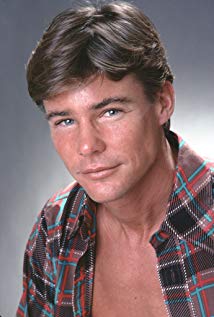
When Jan-Michael Vincent died on February 10th, we lost a legend.
For obvious reasons, the life and career of Jan-Michael Vincent is often held up as a cautionary tale. Vincent went from being a rising star in the 70s to being nearly unemployable in the 90s. When you watch Vincent in one of his early film, like The Mechanic or Big Wednesday, you see an actor who had both the talent and the looks to be a major star. He was such a natural and deceptively low-key performer that it is not a surprise that he was twice cast as Robert Mitchum’s son. He could play everyone from a hippie to a cowboy to a surfer to an assassin. Unfortunately, once the 80s rolled around, Vincent became better known for his struggles with drugs and alcohol than for his talent. After a brief but profitable stint starring in Airwolf, Jan-Michael Vincent found himself appearing mostly in straight-to-video action films. By the mid-90s, he was a mainstay on late night Cinemax. Even though the films had gotten smaller and his famous good looks had been ravaged by years of hard living, Vincent was still capable of giving a good performance.
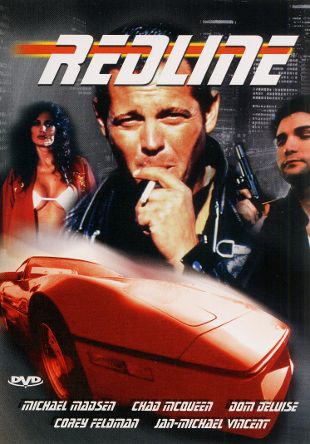
It is impossible to talk about the legend of Jan-Michael Vincent without talking about Red Line. In this direct-to-video car chase film, Vincent was cast as a gangster named Keller. When an auto mechanic named Jim (Chad “Son of Steve” McQueen) makes the mistake of taking one of Keller’s cars for a joyride, Keller blackmails Jim into stealing a corvette from a police impound lot. Red Line was typical of the type of films that Vincent was usually offered in the 90s, an action-filled crime film with a handful of recognizable faces.
It was also a film that Vincent nearly didn’t live to make. Two days before filming was to begin, Jan-Michael Vincent was nearly killed when he crashed his motorcycle. Vincent suffered severe facial lacerations and he would later tell Howard Stern that his eye was nearly popped out of his head as a result of the accident. Vincent was rushed to the hospital and put in intensive care.
However, Jan-Michael Vincent still had a movie to make. So, what did he do? Two days after his accident, he checked himself out of the hospital and, unexpectedly, showed up on set. With his face noticeable bruised and swollen and with the stitches and sutures still visible, Vincent played the role of Keller. If you watch carefully, you can even spot his hospital ID, still hanging around his wrist. The script was hastily rewritten to explain Vincent’s injuries and, though he could barely speak or walk, he still delivered his lines and filmed his scenes. And goddamn if Jan-Michael Vincent didn’t steal the entire movie. Even after years of hard-living (not to mention just two days after nearly dying), Jan-Michael Vincent still had it. Even though he had to whisper his lines and film most of his scenes sitting down, Vincent was still credibly threatening in the role of Keller. He even points out his own injuries, saying, “I’m sick of looking like Frankenstein!”
Jan-Michael Vincent in Red Line
The rest of the cast was made up of an eclectic collection of familiar faces. Dom DeLuise played Chad McQueen’s boss. Michael Madsen and Corey Feldman (!) both played rival gangsters while Roxanna Zal played the young woman who becomes McQueen’s partner in crime. B-movie fans will want to keep an eye out for Julie Strain, Robert Z’Dar, and Chuck Zito. None of them make as much of an impression as Vincent, though.
Red Line was meant to be an homage to the type of car chase films that Steve McQueen made famous. Chad McQueen even gets to drive a replica of the car that his father drove in Bullitt. Some of the chase scenes are exciting but Chad doesn’t have his father’s screen presence and the film never overcomes its low-budget. Watching the movie is a lot like watching someone else play Grand Theft Auto. Red Line is a forgettable movie but it will always be remembered as an important chapter in the legend of Jan-Michael Vincent.
In his film guide, Heavy Metal Movies, Mike McPadden describes the disturbing 1987 teen crime drama River’s Edge as being “666 Candles“. It’s a perfect description because River’s Edge appears to not only be taking place in a different socio-economic setting than Sixteen Candles and The Breakfast Club but perhaps on a different planet as well.
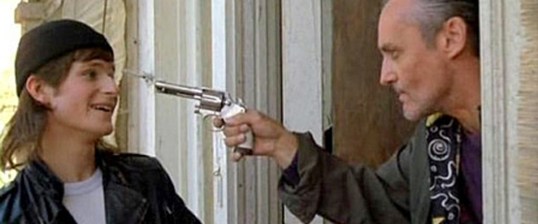
River’s Edge opens with a close-up of a dead and naked teenage girl lying on the edge of a dirty, polluted river and it gets darker from there. The dead girl was the girlfriend of the hulking John Tollet (Daniel Roebuck, playing a character who is miles away from his role in Cavegirl). As John explains to his friends, he strangled her for no particular reason. His friends, meanwhile, respond with detachment. Their unofficial leader, the hyperactive Layne (Crispin Glover), insists that since nothing can be done about the dead girl, their number one concern now has to be to keep John from getting caught. While Layne arranges for John to hide out with a one-legged drug dealer named Feck (Dennis Hopper), two of John’s friends, Matt and Clarissa (played by Keanu Reeves and Ione Skye), consider whether or not they should go to the police. Oddly enough, John really doesn’t seem to care one way or the other.
Seriously, River’s Edge is one dark film. If it were made today, River’s Edge would probably be directed by someone like Larry Clark and, in many ways, it feels like a distant cousin to Clark’s Bully. The teenagers in River’s Edge live in a world with little-to-no adult supervision. Matt’s mom is more concerned with whether or not Matt has been stealing her weed than with the fact that Matt might be covering up a murder. The local high school teacher is a former hippie who won’t shut up about how much better his generation was compared to every other generation. In fact, the only adult with any sort of moral code is Feck and he’s usually too busy dancing with a sex doll to really be of much help. It’s a world where no one has been raised to value their own lives so why should they care about a dead girl laying out on the banks of the river?
The film features good performances from Keanu Reeves, Ione Skye, and Daniel Roebuck but really, the entire movie is stolen by Crispin Glover and Dennis Hopper. In the role of Layne, Glover is a manic wonder, speaking quickly and gesturing even when he isn’t making a point. When Layne first shows up, he seems like he’s just overly loyal to his friend John but, as the film progresses, it becomes more apparent that he’s less concerned about protecting John and more interested in ordering other people to do it. For Layne, protecting John is ultimately about maintaining power over Matt, Clarissa, and the rest of their friends.
As for Dennis Hopper — well, this is one of those films that you should show to anyone who says that Hopper wasn’t a great actor. The role of a one-legged drug dealer who lives with a sex doll sound like exactly the type of role that would lead Hopper to going totally over-the-top. Instead, Hopper gave a surprisingly subtle and intelligent performance and, as a result, he provided this film with the moral center that it very much needs.
 Daddy’s Girl is a forgotten film today but I swear that there was a two-month period in 1997 when it showed up every weekend on late night Cinemax and Showtime. Like many former late night cable mainstays, Daddy’s Girl never developed enough of a cult following to justify getting a DVD release so, if you want to see it, you either have to have a working VCR or the ability to search YouTube.
 It is impossible to talk about the legend of Jan-Michael Vincent without talking about Red Line. In this direct-to-video car chase film, Vincent was cast as a gangster named Keller. When an auto mechanic named Jim (Chad “Son of Steve” McQueen) makes the mistake of taking one of Keller’s cars for a joyride, Keller blackmails Jim into stealing a corvette from a police impound lot. Red Line was typical of the type of films that Vincent was usually offered in the 90s, an action-filled crime film with a handful of recognizable faces.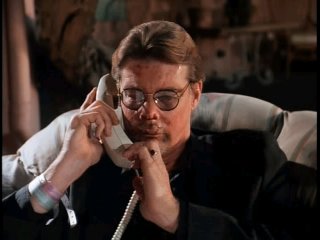

 Through the Shattered Lens