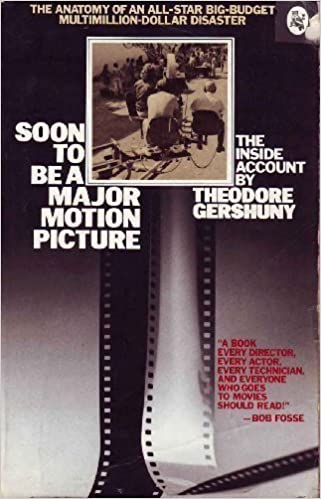
Book Review: Soon To Be A Major Motion Picture by Theodore Gershuny


In 1975, United Artists released a political thriller called Rosebud.

Rosebud was based on a best-selling novel.

Rosebud dealt with terrorism, an important topic both in 1975 and today.

Rosebud was directed by Otto Preminger, an acclaimed, award-winning filmmaker who was known for making controversial movies and who had a showman’s flair for publicity.

Rosebud had an international cast of screen veterans and up-and-coming stars.  Peter O’Toole, Richard Attenborough, Cliff Gorman, Peter Lawford, Raf Vallone, Adrienne Corri, Lalla Ward, Claude Dauphin, Isabelle Huppert, and Kim Cattrall all had key roles.  Former New York City Mayor and presidential candidate John V. Lindsay made his acting debut as a U.S. senator.

Rosebud was released with a good deal of publicity.

And, finally, Rosebud is almost totally forgotten today.  Not only did Rosebud receive less-than-stellar reviews, it’s box office failure pretty much spelled the end of Preminger’s directorial career.  (He directed one more film after Rosebud.)  Rosebud sunk into such obscurity that, for years, it wasn’t even available on anything other than VHS tape.  It was finally given a Blu-ray release in 2021 but, unlike some of Preminger’s other films, Rosebud isn’t going to end up getting a Criterion release anytime soon.  (That said, it can currently be streamed for free on a few sites.  So, go watch it after you finish this review.)

Having seen Rosebud, I can tell you that the film wasn’t forgotten because it was a disaster or anything like that.  Instead, Rosebud was forgotten because it was thoroughly mediocre.  There’s nothing particularly terrible about it but there’s nothing particularly good about it.  Instead, it’s a slowly-paced and flatly directed film.  There are a few interesting scenes, the majority of which involve Richard Attenborough’s terrorist.  But otherwise, it’s just a mediocre film from a director who was past his prime.

Interestingly enough, Rosebud’s mediocrity is what makes the 1980 book, Soon To Be A Major Motion Picture, such an interesting read.  While directing Rosebud, Otto Preminger allowed journalist and filmmaker Ted Gershuny to observe every detail of the production.  From Erik Lee Preminger’s attempt to write a workable script to the casting sessions to the film’s eventual release, Gershuny was there.  Soon To Be A Major Motion Picture tells the story of how a group of talented people ended up making a thoroughly forgettable film.  There have been plenty of books written about the production of terrible movies.  There’s been even more books written about the making of classic films.  But Soon To Be A Major Motion Picture is one of the few books to take a serious and detailed look at what it’s like to make a thoroughly mediocre film.  And let’s be honest, most films are mediocre.  Most films are more likely to be Rosebud than they are to be The Godfather, Goodfellas or Battlefield Earth.

The book, not surprisingly revolves around Otto Preminger.  The Preminger described in the book is a complex figure, a proud man and an occasionally sensitive artist who is also frequently a bully.  As the book makes clear, Preminger can be kind but he also came of age at a time when it was common place for directors to yell and be autocratic.  Preminger’s habit of shouting rubs more than a few crew and cast members the wrong way.  When he’s not yelling, Preminger comes across as thoughtful and witty but there’s also an undercurrent of sadness to him as Preminger realizes that the film industry is changing and that he’s getting left behind.  The fact that he directed films like Anatomy of a Murder, Laura, Exodus, and The Cardinal didn’t matter in the new Hollywood.  The same things that had once led to Preminger being branded a rebel and an innovator now led to him being branded as being out-of-touch.  Rosebud was Preminger’s attempt to remain relevant, both artistically and politically.  Unfortunately, the 70s were a brutal decade for the directors who previously defined Hollywood’s Golden Age.  Some, like John Huston, were eventually able to adjust and make a few more good films before their careers were ended by either retirement or death.  Most, however, were like Preminger, too engaged to quit but too old-fashioned to keep up with the younger filmmakers.  Still, even when it becomes obvious that Rosebud is not going to work as a film, Preminger refuses to give up or surrender.  He’s going to make his movie.

Also making a huge impression is Robert Mitchum.  Mitchum was originally cast in the film’s leading role and, having seen Rosebud, it’s easy to understand why Mitchum would seem like the ideal choice to be play Larry Martin, a cynical and hard-boiled journalist and CIA asset.  When Mitchum first appears in the book, he’s a breath of fresh air.  Even on the printed page, it’s easy to see that Mitchum’s no-nonsense style invigorated the disorganized production.  However, Mitchum quickly becomes disillusioned, walks off the film, and is hastily replaced by Peter O’Toole.  Not even Gershuny seems to be sure what specifically caused Mitchum quit the film, though it’s suggested that Mitchum felt that he had been personally slighted by Preminger.  (At one point, Mitchum claims that Preminger accused him of being drunk when he was sober.  At another point, it’s suggested that Mitchum walked because he realized that film wasn’t going to be any good and he felt he was wasting his time.)  O’Toole does his best to take Mitchum’s place, though his poor health proves to be almost as much of a challenge as Mitchum’s bad attitude.

(That said, O’Toole’s apparent frailty disappeared after the production received a bomb threat that is later revealed to have been a hoax.  The book suggests that O’Toole and his entourage tracked down the hoaxer and essentially beat the Hell out of him.)

It’s a highly interesting and well-written book, one that will make you appreciate the effort that goes into making even a forgettable film.  Used paperback copies can ordered off of Amazon for $22.00.  I found my copy at Recycled Books in Denton, Texas and paid $3.00 for it.  Support you local independent book stores, people.
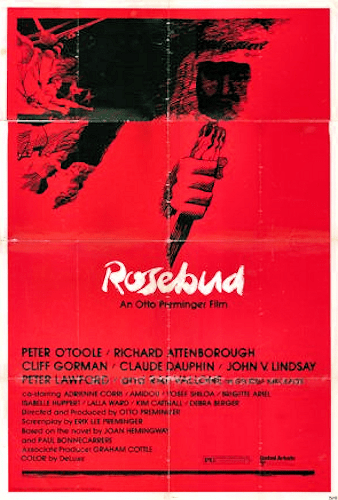
Shattered Politics #37: Rosebud (dir by Otto Preminger)


Rosebud_-_1975_-_Film_Poster

Before I review the 1975 film Rosebud, allow me to tell you about how I first discovered the existence of this particular film.

The greatest used bookstore in the world is located in Denton, Texas.  It’s called Recycled Books and it is three stories of pure literary goodness!  (Plus, there are apartments on the top floor where I attended some pretty interesting parties but that’s another story….)  When I was attending the University of North Texas, I used to stop by Recycled Books nearly every day.  One day, I happened to be searching the Film and TV section when I came across a beat-up paperback called Soon To Be A Major Motion Picture.

This book, which was written by Theodore Gershuny, told the story of how the previously acclaimed director Otto Preminger attempted to make a film about terrorism.  Starting with the attempts of Preminger’s son, Erik Lee Preminger, to come up with a workable script and then going on to detail how Peter O’Toole came to replace Robert Mitchum as the star of the film and ending with the film’s disastrous release, Soon To Be A Major Motion Picture proved to be a fascinating read.

After finishing the book, I simply had to see Rosebud for myself.  Unfortunately, at that time, Rosebud had not yet been released on Blu-ray or DVD.  So, I actually ended up ordering an old VHS copy of it.  The tape that I got was not in the best condition but it played well enough and I can now say that, unlike the majority of people in the world, I’ve actually seen Rosebud!

Which is not to say that Rosebud is any good.  It’s not the disaster that I had been led to expect.  In fact, it probably would have been more fun if it had been a disaster, as opposed to being just a forgettable film from a director who was probably capable of better.  Preminger started his career in the 30s and was considered, at one point, to be quite innovative.  He directed Laura and Anatomy of a Murder, two great films.  Unfortunately, there’s really nothing innovative about his direction of Rosebud.  In Gershuny’s book, Preminger comes across like an intelligent and thoughtful man who was too set in his ways to realize that what was shocking in 1959 was no longer that big of a deal in 1975.  (And, needless to say, it’s even less of a big deal in 2015.)

As for what Rosebud‘s about, it’s about a man named Sloat (Richard Attenborough), a former journalist who now lives in a cave in Israel and dreams of establishing a worldwide terrorist network.  Under Sloat’s direction, terrorists storm a yacht named the Rosebud and take the girls on board hostage.  The girls are wealthy and privileged.  Their fathers are judges, senators, and businessmen.  CIA agent Larry Martin (Peter O’Toole) is tasked with tracking down and rescuing the girls.  If it sounds like an action film — well, it’s not.  This is not a prequel to Taken.  Instead, it’s a very talky film that has a few isolated good moments and performances but otherwise, is fairly forgettable.

That said, the film does have an interesting cast.  Peter O’Toole seems bored by his role (and who can blame him?) but Attenborough briefly livens things up in the role of Sloat.  As for the girls being held hostage, they’re not given much to do.  One of them is played by a young Isabelle Huppert.  Long before she would play Samantha on Sex and the City, Kim Cattrall plays a hostage here.  The English hostage is played by Lalla Ward, who is now married to Richard Dawkins.

And then there’s the girl’s parents, who are played by an odd assortment of character actors.  Raf Vallone, an Italian, plays a Greek.  (His daughter, meanwhile, is played by the French Isabelle Huppert.)  Peter Lawford, looking somewhat dazed, shows up as Lalla Ward’s father.  (One of the sadder scenes in Gershuny’s book deals with Lawford’s attempts to remember his lines.)  And than, in the role of Cattrall’s father, we have a very distinguished looking man named John Lindsay.

John Lindsay was the former mayor of New York City, a man who ran for President in 1972 and, three years later, attempted to launch a new career as an actor.  Rosebud was his both his first and final film.  (Rumor has it that Martin Scorsese attempted to convince Lindsay to play Senator Palatine in Taxi Driver but Lindsay turned the role down.)  Lindsay is not particularly memorable in Rosebud.  It’s not so much that Lindsay gives a bad performance as much as it’s just the fact that he has a very bland screen presence.  That blandness probably served him well as a politician but, as an actor — well, let’s just say that John Lindsay was apparently no Fred Thompson.

And so that’s Rosebud.  It’s a film that, much like Maidstone, you can only appreciate if you know what went on behind the scenes.  I can’t really recommend Rosebud but, if you ever come across a battered old copy of Soon To Be A Major Motion Picture in a used bookstore, be sure to buy it!

Seriously, you will not be sorry.

Poll: Which Movie Should Lisa Marie Watch on March 20th?


Anyone who knows me knows that sometimes I just can’t help but love being dominated. 

That’s why, on occasion, I’ll give you, our beloved readers, the option of telling me which film to watch and review.  In the past, you’ve commanded me to watch and review Anatomy of a Murder, Eternal Sunshine of the Spotless Mind, and Logan’s Run

Well, here’s your chance to, once again, tell me what to do.  I’ve randomly selected 12 films from my film collection.  Whichever film gets the most votes will be watched and reviewed by me next Tuesday, March 20th.

Here are the films up for consideration:

1) Black Jesus (1968) — This Italian film stars Woody Strode as an African rebel leader who is captured by his country’s right-wing, American-backed dictatorship. 

2) Capote (2005) — Philip Seymour Hoffman was an Oscar for best actor for playing writer Truman Capote in this film that details how Capote came to write his true crime classic, In Cold Blood.  This film was also nominated for best picture.

3) Chappaqua (1966) — In this underground cult classic, drug addict Conrad Rooks seeks treatment in Switzerland while being haunted by a scornful William S. Burroughs.  This film features cameo from Allen Ginsberg, The Fugs, and just about every other cult figure from 1966.

4) Crazy/Beautiful (2001) — Jay Fernandez and Kirsten Dunst have lots and lots of sex.  This was like one of my favorite movies to catch on cable back when I was in high school. 🙂

5) An Education (2008) — In my favorite movie from 2008, Carey Mulligan is a schoolgirl in 1960s England who has a secret affair with an older man (played by Peter Sarsgaard), who has plenty of secrets of his own.  Co-starring Rosamund Pike, Emma Thompson, Alfred Molina, and Dominic Cooper (who is to die for, seriously).

6) Female Vampire (1973) — In this atmospheric and ennui-filled film from the infamous Jesus Franco, a female vampire spends the whole movie wandering around naked and dealing with the lost souls who want to join the ranks of the undead. 

7) Nightmare City (1980) — In this gory and fast-paced film from Umberto Lenzi, an accident at a nuclear plant leads to a bunch of blood-thirsty zombies rampaging through both the city and the countryside.  Hugo Stiglitz plays Dean Miller, zombie exterminator!  Nightmare City is probably most remembered for introducing the concept of the fast zombie and for serving as an obvious inspiration for Danny Boyle’s 28 Days Later.

8) The Other Side of Midnight (1977) — Based on a best-selling novel, The Other Side of Midnight tells the story of a poor French girl who becomes a world-famous actress and who ends up sleeping with apparently every wealthy man in the world.  Meanwhile, the man she loves ends up marrying Susan Sarandon.  Eventually, it all ends with both a hurricane and a murder.  Apparently, this film cost a lot of money to make and it was a notorious box office bomb.  It looks kinda fun to me.

9) Peyton Place (1957) — Also based on a best-selling novel, Peyton Place is about love, sex, and scandal in a small town.  Lana Turner is a repressed woman with a past who struggles to keep her daughter from making the same mistakes.  At the time it was made, it was considered to be quite racy and it was even nominated for best picture.  This film is a personal favorite of mine and it’s pretty much set the template for every single film ever shown on Lifetime.

10) Rosebud (1975) — From director Otto Preminger comes this film about what happens when a bunch of rich girls on a yacht are taken hostage by Islamic extremists.  The film’s diverse cast includes Peter O’Toole, Richard Attenborough, Cliff Gorman, former New York Mayor John Lindsay, former Kennedy in-law Peter Lawford, Raf Vallone, Adrienne Corri, Lalla Ward, Isabelle Huppert, and Kim Cattrall.

11) Valley of the Dolls (1967) — Oh my God, I love this movie so much!  Three aspiring actresses move to the big city and soon become hooked on pills and bad relationship decisions. Every time I watch this movie, I spend hours yelling, “I’m Neely O’Hara, bitch!” at the top of my lungs.

12) Zombie Lake (1981) — From my favorite French director, Jean Rollin, comes this extremely low budget film about a bunch of Nazi zombies who keep coming out of the lake and attacking the nearby village.  Some people claim that this is the worst zombie films ever made.  I disagree.

Please vote below for as many or as few of these films as you want to.  The poll will remain open until March 20th and whichever film gets the most votes will be watched and reviewed by me.

Happy voting!

My Top Ten Books About The Movies


I love movies and I love books so I guess it would stand to reason that I love books about movies the most of all.  (I also love movies about books but there are far fewer of those, unfortunately.)  Below are my personal favorites.  I’m not necessarily saying that these are the ten greatest film books ever written.  I’m just saying that they’re the ones that I’m always happy to know are waiting for me at home.

10) Soon To Be A Major Motion Picture by Theodore Gershuny — This is one of the great finds of mine my life.  I found this in a used bookstore and I bought it mostly because it only cost a dollar. Only later did I discover that I had found one of the greatest nonfiction books about the shooting of a movie ever written!  Gershuny was present during the filming of a movie called Rosebud in the early 70s.   I’ve never seen Rosebud but, as Gershuny admits, it was a critical disaster that managed to lose a ton of money.  The book provides a fascinating wealth of backstage gossip as well as memorable portraits of director Otto Preminger and actors Robert Mitchum (who was originally cast in the lead role), Peter O’Toole (who took over after Mitchum walked off the set), and Isabelle Huppert.   If nothing else, this book should be read for the scene where O’Toole beats up critic Kenneth Tynan.

9) Suspects by David Thomson — A study of American cinema noir   disguised as a novel, Suspects imagines what would happen if George Bailey from It’s a Wonderful Life fell in love with Laura from the movie of the same name.  Well, apparently it would lead to Sunset Boulevard’s Norma Desmond having an affair with Chinatown’s Noah Cross and to one of George’s sons, sensitive little Travis, getting a job in New York City as a Taxi Driver.  And that’s just a small sampling of what happens in this glorious mindfuck of a novel.

8 ) Profondo Argento by Alan Jones — Long-time fan Alan Jones examines each of Dario Argento’s films (even Argento’s obscure historical comedy The Five Days of Milan) and proceeds to celebrate and (in many cases) defend Argento’s career.  Jones also interviews and profiles several of Argento’s most frequent collaborators — Daria Nicolodi, Asia and Fiore Argento, Simon Boswell, Claudio Simonetti, Keith Emerson, George Romero, Lamberto Bava, Michele Soavi, and many others.  Jones’ sympathetic yet humorous profile of Luigi Cozzi is priceless.

7)  Spaghetti Nightmares by Luca Palmerini — Spaghetti Nightmares is a collection of interviews conducted with such Italian filmmakers as Dario Argento, Ruggero Deodato, Umberto Lenzi, Lucio Fulci, and others.  Among the non-Italians interviewed are Tom Savini (who, as always, comes across as appealingly  unhinged) and David Warbeck.  (Sadly, both Warbeck and Fulci would die shortly after being interviewed.)  What makes this interesting is that, for once, Argento, Fulci, et al. are actually being interviewed by a fellow countryman as opposed to an American accompanied by a translator.  As such, the subsequent interviews turn out to be some of the most revealing on record.

6) Sleazoid Express by Bill Landis and Michelle Clifford — Landis and Clifford’s book is both a history and a defense of the old grindhouse theaters of New York City.  Along with describing, in loving and memorable detail, some of New York’s most infamous grindhouses, they also write about some of the more popular movies to play at each theater.  Along the way, they also offer up revealing profiles of such legendary figures as David Hess and Mike and Roberta Findley.  Reading this book truly made me mourn the fact that if I ever did find myself in New York City, I won’t be able to hit the old grindhouse circuit.

5) Beyond Terror: The Films of Lucio Fulci by Stephen Thrower — Fulci has always been a terribly underrated director and, indeed, it’s easy to understand because, in many ways, he made movies with the specific aim of alienating and outraging his audience.  It requires a brave soul to take Fulci on his own terms and fortunately, Stephen Thrower appears to be one.  Along with the expected chapters on Fulci’s Beyond Trilogy and on Zombi 2, Thrower also devotes a lot of space to Fulci’s lesser known works.  Did you know, for instance, that before he became the godfather of gore, Fulci specialized in making comedies?  Or that he also directed two very popular adaptations of White Fang?  Thrower also examines Fulci’s often forgotten westerns as well as his postapocalyptic sci-fi films.  And, best of all, Thrower offers up a defense of the infamous New York Ripper that, when I read it, actually forced me to consider that oft-maligned film in a new light.  That said, Thrower does admit to being as confused by Manhattan Baby as everyone else.

4) Immoral Tales by Cathal Tohill and Pete Toombs — Tohill and Toombs offer an overview of European “shock” cinema and some of the genre’s better known masters.  The book contains perhaps the best critical examination of the work of Jean Rollin ever written.  The authors also examine the work of Jesus Franco and several others.  This is a great book that reminds us that the Italians aren’t the only ones who can make a great exploitation film.

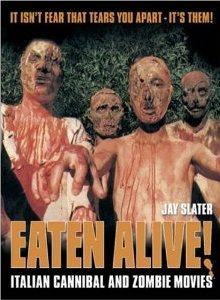
3) Eaten Alive by Jay Slater — This book offers an overview of the Italian film industry’s legendary cannibal and zombie boom.  Along with reviewing every Italian movie to feature even the slightest hint of cannibalism or the living dead (this is one of the few books on Italian cinema that discusses both Pasolini and Lucio Fulci as equals), Eaten Alive also features some very revealing interviews with such iconic figures as Catriona MacColl, Ian McCullough, and especially Giovanni Lombardo Radice.  Radice, in fact, also contributes a memorable “guest” review of one of the movies featured in the book.  (“What a piece of shit!” the review begins.)  Memorable reviews are also contributed by Troma film founder Lloyd Kaufman who brilliantly (and correctly) argues that Cannibal Holocaust is one of the greatest films ever made and Ramsey Campbell who hilariously destroys Umberto Lenzi’s infamous Nightmare City.

2) The Book of the Dead by Jamie Russell — If, like all good people, you love zombies then you simply must do whatever it takes to own a copy of this book.  Starting with such early masterpieces as White Zombie and I Walked With A Zombie, Russell proceeds to cover every subsequent zombie film up through George Romero’s Land of the Dead.  Russell offers up some of the best commentaries ever written on Romero’s Dead films, Fuci’s Beyond Trilogy, Rollin’s Living Dead Girl, and Spain’s Blind Dead films.   The pièce de résistance, however, is an appendix where Russell describes and reviews literally ever zombie film ever made.

1)  All The Colors Of the Dark by Tim Lucas  — This is it.  This is the Holy Grail of All Film Books.  If you’ve ever asked yourself if any book is worth paying close to 300 dollars, now you have your answer.  This one is.  Tim Lucas offers up the most complete biography of director Mario Bava ever written.  In fact, this may be the most complete biography of any director ever written!  Lucas examines not only Bava’s life but also every single movie that Bava was ever in any way connected to, whether as a director or as a cameraman or as the guy in charge of the special effects.  This is 1,128 pages all devoted to nothing but the movies.  This is the type of book that makes me thankful to be alive and I owe a huge debt of gratitude to Tim Lucas for writing it.