Film Review: The Snowman (dir by Tomas Alfredson)


So, I finally watched the 2018 thriller, The Snowman, and my main reaction to the film is that it featured a lot of snow.

That’s understandable, of course.  The film takes place in Norway and it’s called The Snowman so, naturally, I wasn’t expecting a lot of sunshine.  Still, after a while, the constant shots of the snow-covered landscape start to feel like almost some sort of an inside joke.  It’s almost as if the film is daring you to try to find one blade of grass in Norway.  Of course, the snow is important because the film’s about a serial killer who builds snowmen at the sites of his crimes.  They’re usually pretty big snowmen as well.  It’s hard not to be a little impressed by the fact that he could apparently make such impressive snowmen without anyone noticing.

Along with the snow, the other thing that I noticed about this movie is that apparently no one knows how to flip a light switch in Norway.  This is one of those films where every scene seems to take place in a dark room.  I found myself worrying about everyone’s eyesight and I was surprised the everyone in the film wasn’t wearing glasses.  I can only imagine how much strain that puts on the eyes when you’re constantly trying to read and look for clues in the dark.

Michael Fassbender plays Harry Hole, a Norwegian police inspector who may be troubled but still gets results!  He’s upset because his ex-girlfriend (Charlotte Gainsbourg) has a new boyfriend (Jonas Karlsson).  He’s also upset because his son (Michael Yates) doesn’t know that Harry is actually his father.  Or, at least, I think that Harry’s upset.  It’s hard to tell because Fassbender gives a performance that’s almost as cold as the snow covering the Norwegian ground.  Of course, he’s always watchable because he’s Fassbender.  But, overall, he doesn’t seem to be particularly invested in either the role or the film.

Harry and his new partner (Rebecca Ferguson) are investigating a missing person’s case, which quickly turns into a multiple murder mystery.  It turns out that the crimes are linked to a bunch of old murders, all of which were investigated by a detective named Gert Rafto (Val Kilmer).  Gert was troubled but he still got results!  Or, at least, Harry thinks that he may have gotten results.  Nine years ago, Rafto died under mysterious circumstances…

Now, I have to admit that when, 30 minutes into the film, the words “9 years earlier” flashed on the screen, I groaned a bit.  I mean, it seemed to me that the movie was already slow enough without tossing in a bunch of flashbacks.  However, I quickly came to look forward to those brief flashbacks, mostly because they featured Val Kilmer in total IDGAF mode.  Kilmer stumbles through the flashbacks, complete with messy hair and a look of genuine snarky bemusement on his face.  Kilmer gives such a weird and self-amused performance that his brief scenes are the highlight of the film.

Before it was released, The Snowman was hyped as a potential Oscar contender.  After the movie came out and got roasted by the critics, director Tomas Alfredson replied that the studio forced him to rush through the production and that 10 to 15% of the script went unfilmed.  Considering Alfredson’s superior work on Let The Right One In and Tinker, Tailor, Soldier, Spy, I’m inclined to give him the benefit of the doubt.  The film’s disjointed style would certainly seem to back up Alfredson’s claim that there was originally meant to be more to the film than actually ended up on the screen.

The Snowman is one of those films that doesn’t seem to be sure what it wants to be.  At times, it aspires to David Lynch-style surrealism while, at other times, it seems to be borrowing from the morally ambiguous crime films of Taylor Sheridan.  Ultimately, it’s a confused film that doesn’t seem to have much reason for existing.  At the same time, I’ve also been told that the Jo Nesbø novel upon which the movie is based is excellent.  The same author also wrote the novel that served as the basis for 2011’s Headhunters, which was pretty damn good.  So, read the book and ignore the film.
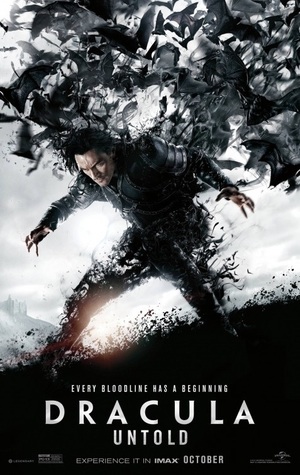
Horror Film Review: Dracula Untold (dir by Gary Shore)


Dracula_Untold_poster

Last night, I finally got a chance to see Dracula Untold, the new film that claims to show us not only who the world’s most famous vampire used to be but also how he became a vampire in the first place.  And I have to admit that I had strong hopes for Dracula Untold.  I certainly did not think that it would be a great film but I was hoping that it would at least be fun.

And can you blame me?

After all, it is October and what better time of the year is there to see a film about the early days of a horror icon?  Add to that, the film’s commercials all hinted that, at the very least, Dracula Untold would be full of over-the-top action, melodramatic performances, and ornate costumes.  Sure, there was no hint to be found that Dracula Untold would actually turn out to be a good movie but how can you go wrong with the promise of a little baroque spectacle?

As well, who doesn’t love vampires?  Who hasn’t, at some point, been intrigued by the mix of romance and morbid dread that epitomizes the vampire legend?  And, of course, long before there was ever an Edward Cullen or a Lestat, there was Dracula.

So, yes, I had high expectation for Dracula Untold but I don’t think they were unrealistic.  Ultimately, I was just hoping to see a fun and entertaining vampire film.

And, in all fairness, there were a few moments when Dracula Untold managed to be just that. Unfortunately, those moments were few and far between.  For the most part, this latest Dracula film turned out to be rather bland and predictable, a well-produced film that failed to leave much of an impression.  It was neither good enough to be memorable nor bad enough to be enjoyable.  Instead, it just kind of was.

Dracula Untold opens in the Middle Ages, with the man that we know as Vlad the Impaler (Luke Evans) ruling Transylvania.  Despite his fearsome reputation, we quickly see that Vlad is actually a very wise and benevolent king who truly loves his wife (Sarah Gadon) and his young son (Art Parkinson).  However, when the new sultan of Turkey (played by Dominic Cooper) demands that Transylvania send him 100 young men to serve as slaves (much as Vlad himself was forced to do when he was younger), Vlad goes to war against the Ottomon Empire.

With his forces outnumbered, Vlad does what any self-respecting ruler would do.  He goes to a cave and he talks to the Master Vampire (Charles Dance, under a ton of makeup).  The Master Vampire agrees to give Vlad all the powers of a vampire but there’s a condition.  In order to become human again, Vlad must go for three whole days without drinking any blood.  If Vlad does drink blood, he will be cursed to be a vampire for the rest of his life.

Vlad takes the deal, fully intending not to drink any blood.  As a result, Vlad can do all sorts of neat CGI tricks, like turning into a bat and fighting his enemies in slow motion.  However, he can’t go out in the sun without his skin starting to burn and silver causes his eyesight to go all blurry.  And, of course, he starts to crave blood almost immediately.  As Vlad tries to defeat the Turks before losing his special powers, he also discovers that his own soldiers now fear him and his dark powers…

I don’t want to be too hard on Dracula Untold because, while my overall reaction was one of disappointment, there are still bits and pieces of the film that works.  Charles Dance, for instance, gives a great performance as the Master Vampire.  Dominic Cooper camps it up as the film’s nominal villain and, as a result, he’s a lot of fun to watch.  Luke Evans is pretty to look at.  The final showdown between Evans and Cooper is well-directed.

But, ultimately, the things that worked in Dracula Untold were the exception to the rule.  For the most part, Dracula Untold is uninspiring and forgettable.  Clocking in at 92 minutes, Dracula Untold is almost too short and quick for its own good.  You never really find yourself becoming immersed in the film’s world and the majority of the film’s supporting characters were so thinly drawn that I struggled to keep straight who was who.  (I swear, at first, it seemed as if one of Dracula’s friends was actually killed three separate times.  It was only afterward, as I looked over the film’s credits, that I discovered that “friend” was actually three different characters who were so indistinguishable from each other that I had just naturally assumed that they were all meant to be the same guy.)  There are occasionally hints of an intriguing political and sexual subtext, particularly in the scenes between Evans and Cooper, but the film is always in such a hurry to get to the next battle scene that those hints are often pushed to the side within minutes of having been brought up.  It becomes obvious early on that Dracula Untold was mostly made to serve as the cornerstone of a new franchise and, as such, the film ultimately feels like a 90-minute prologue to a story that you’re not really sure will be worth all the build-up.

It’s not so much that Dracula Untold was a terrible film as much as it was just a painfully generic and predictable one.  And a character as iconic as Dracula deserves better.