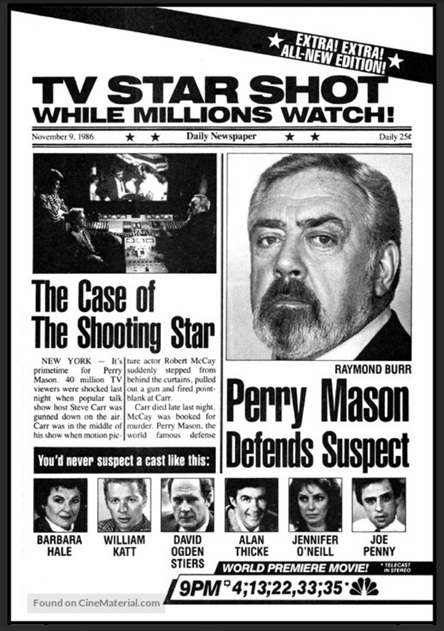
So, I Watched Perry Mason: The Case Of The Shooting Star (1986, Dir. by Ron Satlof)


Actor Robert McCay (Joe Penny) decides that it would be hilarious to shoot talk show host Steve Carr (Alan Thicke) on live television.  McCay thinks that the gun is loaded with blanks but, before he goes on the show, someone slips a live round into the gun.  McCay kills Steve Carr and there are a million witnesses who see him do it.  Time to call in Perry Mason (Raymond Burr)!

The third Perry Mason movie isn’t as good as the first two.  Shooting someone on television as a joke and then leaving the studio immediately afterwards is a really stupid thing to do.  As my sister pointed out while we were watching, even if Robert McCay wasn’t guilty of premeditated murder, he was probably guilty of negligent homicide for not bothering to double check whether or not there was a live round in the gun.  McCay goes right back to shooting his movie, even while he’s on trial for murder.  As for the trial, it was ridiculous.  How many people can confess under cross examination in one trial?  “Mistrial!” my sister yelled whenever Perry pulled one of his stunts and I agreed.

Paul (William Katt) teams up with a photojournalist (Wendy Crewson) and his investigation somehow leads to him playing a priest in a cheap vampire movie.  For once, Perry didn’t give Paul a hard time about anything.  Maybe he realized Paul’s scenes were the best part of The Case of the Shooting Star.
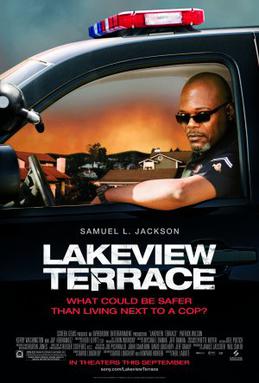
Lakeview Terrace (2008, directed by Neil LaBute)


Chris and Lisa Mattson (Patrick Wilson and Kerry Washington) move in to a large house in the Lakeview Terrace neighborhood of Los Angeles.  It’s a good house in a good neighborhood and it’s just too bad that their neighbor, Abel Turner (Samuel L. Jackson), is a corrupt cop who hates interracial couples.

I remember that Lakeview Terrace caused a brief stir when it was released in 2008.  It was hardly the first film about an interracial couple being harassed by a bigot but it was one of the few where the bigot in question was a black man.  Abel hates white people.  He says it’s because his wife was cheating on him with a white man when she was killed in a car accident.  He does not appreciate Chris listening to rap music and dropping his cigarettes on the street. When Abel’s children spot Chris and Lisa having sex in their swimming pool, that’s all Abel needs to justify his dislike of the couple and his feelings that he doesn’t want this couple living next door.  When Chris asks if Abel could turn off the floodlights that shine into their bedroom window, Abel refuses.  When Chris tries to plant privacy trees, Abel cuts them down.  What starts out as a neighborhood feud escalates as Abel orders one of his informants to break into Chris and Lisa’s house.  Unfortunately, that third act twist also signals the moment that Lakeview Terrace goes from being a reasonably intelligent social satire to being a standard thriller.  Neil LaBute is a director who specializes in making people uncomfortable so it is too bad that Lakeview Terrace ends in a way designed to conform to what audiences have come to expect from thrillers.

Abel’s a hateful figure but Samuel L. Jackson is just as charismatic as ever and the passive-aggressive way that he initially responds to Chris and Lisa will be familiar to anyone who has ever had a bad neighbor or who has to deal with a cop having a bad day.  Patrick Wilson and Kerry Washington, neither one of whom is really that interesting an actor to begin with, are both stuck in bland roles and struggle to keep up with Jackson.  (Wilson and Washington even get out-acted by Ron Glass, playing Lisa’s disapproving father.)  It throws the movie off-balance.  At the same time, Jackson is such an actor who projects so much intelligence that it’s hard to believe that Abel would make the stupid mistakes that he makes towards the end of the movie.  Lakeview Terrace starts out fairly strong but loses its way towards the end.