October True Crime: Deadly Vows (dir by Alan Metzger)


The 1994 made-for-TV movie Deadly Vows opens with a football game.

It’s just a friendly football game in the park.  The majority of the players appear to be frat boys.  They’re muscular and athletic and they play hard but they’re not professional athletes.  However, there is one player that sticks out.  Tom Weston (Gerald McRaney) is taking the game very seriously and he is determined to win.  He continually begs his team’s quarterback to throw him the ball.  When he’s tackled, he staggers back up and run back to the huddle, even though he’s limping and out-of-breath.  Again, Tom is taking the game very seriously.  Tom is also nearly twenty years older than the other players.

Tom is desperate to prove that he can still keep up with the young guys around him, even though it’s obvious that he can’t.  Tom also drives a truck for a living and spends his time on his CB radio, bragging about how good he is at his job and trying to pick fights with anyone who he feels doesn’t treat him with enough respect.  Incidentally, Tom is not driving a big truck.  He’s driving a small truck.  It’s actually more of a van than a truck…..

In other words, Tom is having a midlife crisis.

I think everyone either knows or has, at least, come across someone like Tom Weston.  He’s the balding, forty-something guy who brags about how he’s in the best shape of his life and who shamelessly flirts with every young woman that he sees, despite the fact that he’s married to a woman his own age, Nancy (Peggy Lipton).  Nancy, for her part, tries to be understanding.  Like a lot of insecure men, Tom is a very active gaslighter.  Indeed, when Nancy first meets Bobbi (Josie Bisset), she believes Tom when he says that Bobbi is just a friend.  Of course, the truth of the matter is that Tom is having an affair and he even married Bobbi a few weeks earlier.  Tom’s not just a guy having a mid-life crisis.  He’s also a bigamist.  And eventually, he’s a murderer.

Deadly Vows is based on the true story of Robert Harnois, a man who is currently in prison for murdering one wife and trying to kill the other.  When this film was made, Harnois had not yet been convicted of the murder which is why the character’s name was changed to Tom Weston.  The film itself is slightly ambiguous as to the circumstances that led to the murder.  While we see Tom reading about it in prison and smirking, we don’t actually see him taking the contract out on the victim’s life.  But, in a safely made-for-TV style, it’s pretty clearly implied that Tom hired someone to carry out the murder.  (And, in real life, that’s exactly what happened.)

Deadly Vows is, in many ways, a typical made-for-TV true crime film.  What sets it apart from other entries in the genre is Gerald McRaney’s chilling performance as Tom Weston.  McRaney plays Weston as the type of sociopath who thinks that he can charm his way out of any situation.  Instead, most people can see right through him and his manipulative bluster.  Indeed, the film portrays Tom as being a very stupid and pathetic man.  Unfortunately, one doesn’t have to be smart to hurt other people.  Peggy Lipton and especially Josie Bisset both give good performance as well but this film is ultimately dominated by McRaney’s performance as a murderous loser who simply cannot accept that he’s not 22 anymore.
The Films of 2024: Wanted Man (dir by Dolph Lundgren)


Johansen (Dolph Lundgren) is a San Diego cop who remains on the force despite the fact that most of his old friends and former partners have retired.  When he’s filmed beating up a Mexican man on the highway, he becomes the latest target of the Defund The Police movement.  It doesn’t matter that the man was a human trafficker who was driving truck full of kidnapped women.  Johansen has become an embarrassment.

Normally, you would think this would lead to Johansen being fired or, at the very least, suspended.  Instead, his bosses decide to send him to Mexico to escort two prisoners back to the United States.  Rosa (Christina Villa) and Leticia (Daniela Soto-Brenner) are two sex workers who witnessed the murder of a group of DEA agents.  Their testimony could be key to identifying the killers.  Despite his friend and former partner, Brynner (Kelsey Grammer), telling him that he should just retire rather than allow the police department to continually push him around, Johansen heads down to Mexico.

It turns out that bringing the women back to the United States is not going to be easy.  A roadside ambush leaves Leticia dead and Johansen severely wounded.  Though Rosa’s initial instinct is to abandon Johansen in the desert, she eventually takes him to the home of her cousin, a police officer named Miguel (Rocko Reyes).  As Johansen recovers, he discovers that the people who want Rosa dead are not going to give up and that he cannot trust anyone.

Let’s give some credit where credit is due.  Dolph Lundgren knows how to direct an efficient B-movie.  He has an adequate visual eye, he makes good use of the arid desert setting, and he gets believable performances out of the majority of his cast.  Christina Villa especially does a good job as the tough but ultimately kind-hearted Rosa.  The movie has a bit more going on underneath the surface than the typical B-action film.  Johansen is forced to reconsider his own prejudices while the film’s villains argue that they were forced into their actions by a society that refuses to take care of those who are expected to risk their lives to protect the status quo.  It’s not a dumb movie, though it does feature a lot of characters doing rather dumb things and the big twist demands that the viewer accept one too many coincidences.

Lundgren not only directed but co-wrote the script.  Apparently, he first came up with the idea of the film in 2006.  Interestingly, it’s obvious that the film went into production when Defund The Police was still a strong and powerful political movement and the film itself ultimately suggests that the police should be, if not defunded, at least massively reformed.  Of course, by the time the film was released in January, the Defund movement was considerably less powerful and was being blamed for the sharp increase in crime across the nation.  Chants of “Defund the police” have been replaced by cries of “Fund the police, for the love of God!”  That’s the danger which trying to make a film with a political subtext in an age with a 24-hour news cycle.  What was popular when a film goes into production will often be a spent force by the time the film actually gets released.

As for Wanted Man, it’s an efficient B-movie that gets the job done.  If nothing else, the sight of Dolph Lundgren and Kelsey Grammer playing best friends is just weird enough to keep things watchable.

October True Crime: Judgment Day: The John List Story (dir by Bobby Roth)


In 1971, a 46 year-old account named John List committed a shocking crime.

To the outside world, John List was a normal suburbanite.  He was perhaps a little bit strict but then again, it was 1971 and all of the traditional morals that John List had grown up with were being challenged in the streets and in the movies.  Neither he nor his family were particularly sociable but again, it was assumed that they just liked the privacy that was afford to them by the mansion in which they lived.  List was married to Helen.  They lived with their three teenage children and List’s 84 year-old mother.  John List was a hard worker, he taught Sunday School, and, again, he was seen as being perfectly normal.

On November 9th, 1971, John List methodically murdered his wife, his children, and his mother.  He left his mother in her upstairs apartment while the rest of his family was laid out, in sleeping bags, in the ballroom.  (Detectives later surmised that List stopped in the middle of his murder spree to have lunch and then attended his son’s soccer game before taking him home and killing him.)  List left behind several notes, explaining that he was in a bad financial situation and that he feared that his family was heading down an immoral path that would have condemned their souls to Hell if he hadn’t killed them first.  And then, John List vanished.

For the rest of the 70s and the 80s, John List was phantom.  Some speculated that he had committed suicide while others thought that he had changed his identity and had probably remarried.  In 1987, the classic thriller The Stepfather was released in theaters.  Inspired by List’s crimes, The Stepfather starred Terry O’Quinn as Jerry Blake, a real estate agent who was obsessed with creating the perfect family.  The Stepfather imagined its killer as a friendly but rigid man who snapped whenever his illusion of perfection was threatened.  It also imagine him as someone who moved from town to town, searching for a new family that wouldn’t let him down.

As for the real John List, it turned out that those who suspected him of having changed his identity were correct.  And, just as The Stepfather suggested, he had remarried and was actually now a real stepfather.  List remained free until his story was included in a 1989 episode of America’s Most Wanted.  A forensic scientist included a bust of what John List might have looked like in 1989 and a viewer realized that the bust looked a lot like an accountant named Bob Clark.  “Bob Clark” was arrested and eventually, he confessed that he was actually John List.  Despite his attorney’s attempt to argue that he was not guilty by reason of insanity, John List was eventually convicted of five counts of murder.  He spent the rest of this life in prison, dying of natural causes in 2008.

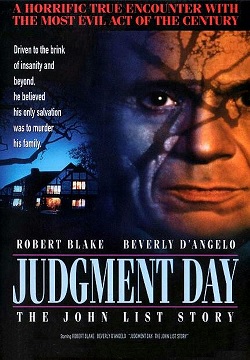
The 1993 film Judgement Day: The Story of John List tells the story of List’s crimes and his subsequent attempt to build a new life for himself.  John List is played by Robert Blake, which turns out to be a bit of a problem as Blake gives such a twitchy and obviously unstable performance that it’s hard to believe that he could have successfully gone into hiding for 18 years.  Carroll Baker and Beverly D’Angelo are not given much to do as, respectively, List’s mother and List’s first wife while David Caruso appears as the detective who is determined to catch List.  Though this film was made long before CSI: Miami, I still found myself expecting Caruso to say something quippy and put on his sunglasses.

Judgment Day doesn’t add much to the story of John List.  It certainly doesn’t offer up any new insight into what led to List becoming a murderer, beyond the fact that List himself was just kind of a jerk.  It’s pretty much a by-the-numbers production that’s only interesting today because of Blake’s subsequent legal problems.  (For the record, I’ve always felt Robert Blake was innocent.)  When it comes to John List films, stick with The Stepfather.