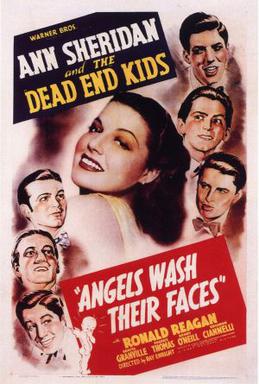
Angels Wash Their Faces (1939, directed by Ray Enright)


Gangster William Kroner (Bernard Nedell) and his henchman Martino (Eduardo Ciannelli) frame teenager Gabe Ryan (Frankie Thomas) for setting several buildings on fire.  Because Gabe has just gotten out of reform school and is a member of a local neighborhood gang, they know that no one will believe him or his sister, Joy (Ann Sheridan).

What Kroner and Martino did not count on were the Dead End Kids (Billy Halop, Bobby Jordan, Leo Gorcey, Gabriel Dell, Huntz Hall, and Benard Punsley).  They’re not going to sit by while the adults send their friend to jail.  Plus, one of their friends was killed in one of the fires.  The kids are out for revenge and sympathetic district attorney Pat Remsen (Ronald Reagan) is on their side.

As a publicity stunt, the city is holding an election for “Kid Mayor.”  The Kid Mayor gets to run the city for a week.  What could go wrong?  Billy Halop decides to run for Kid Mayor so that he can order the arrest of Kroner and then beat a confession out of him.

Angels Wash Their Faces was one of the last of the studio-made Dead End Kid films.  After this one, they would be sent down to Poverty Row and their films would be more obviously comedic.  Angels Wash Their Faces starts out as a juvenile delinquent drama, with Gabe struggling to rebuild his life and keep on the right track.  Then it becomes a goofy comedy, with Billy Halop running for mayor and unleashing vigilante justice on the bad guys.  I’m not sure that any city would actually give the “kid mayor” the power to lock people up.  Whoever came up with the idea of a kid mayor should be run out of politics.

On the positive side, Ann Sheridan is beautiful.  Future president Reagan is his usual friendly self.  On the negative side, the movie, overall, lacks the edge that made the first few Dead End Kids films memorable and the Dead End Kids themselves seem to be pretty much interchangeable.  Huntz Hall would have made a better mayor.


Horror On The Lens: The Mad Monster (dir by Sam Newfield)


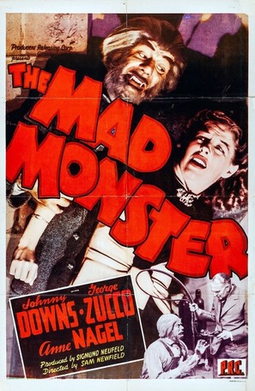
In the 1942 film, The Mad Monster, the great George Zucco plays Dr. Cameron.  Dr. Cameron is a mad scientist who has a few issues with his colleagues and who makes the decision to deal with those issues by transforming his simple-minded handyman (Glenn Strange, who played Frankenstein’s Monster in a number of Universal films) into a wolfman.

The Mad Monster is one of the many horror films that were produced by Producers Releasing Corporation, which was one of the most poverty-stricken of the poverty row production companies.  To me, the interesting thing about the film is that Cameron initially wants to use his werewolf formula to help in the war effort.  He wants to help the United States win the war by turning soldiers into wolfmen.  It’s only after his plans are dismissed as being ludicrous that he starts using his wolfman to get revenge.  Unfortunately, the wolfman itself turns more savage and bloodthirsty with each act of revenge so I guess it’s a good thing that it wasn’t deployed on the battlefield because who knows what type of state the soldiers would have been in when they finally came home.

Here is 1942’s The Mad Monster!

Horror Film Review: The Walking Dead (dir by Michael Curtiz)


In this 1936 film (which has absolutely no relation to the AMC zombie show), Boris Karloff plays John Ellman.  John Ellman is perhaps one of the unluckiest guys ever.  Seriously check this out:

John Ellman was once an acclaimed concert pianist.  However, he was wrongly convicted of killing his wife and spent ten years in prison.  Now that he’s finally been paroled, he can’t get anyone to hire him.  Meanwhile, the judge who originally sent him to prison is in the news for having defied the mob and sentenced a well-known gangster to prison.  The mob is out for revenge but, rather than take the fall themselves, they’d rather frame a patsy.  And who could be a better patsy than a man who everyone already knows has a grudge against the judge?

Nolan (Ricardo Cortez), a crooked lawyer, arranges for Ellman to be given a job.  Ellman is told that he simply has to spy on the judge for a few nights to determine whether the judge is having an extramarital affair.  Ellman agrees and soon finds himself being set up.  The gangsters kill the judge and plant the body in Ellman’s car.  Ellman is arrested and sentenced to die.  It doesn’t matter that there are witnesses who know that Ellman’s innocent.  No one is willing to cross the mafia.

Ellman is convicted and promptly executed but his story isn’t over.  A scientist named Dr. Beaumont (Edmund Gwenn, who later played the man who might be Santa Claus in Miracle on 34th Street) knows that Ellman is innocent.  He takes Ellman’s body and, through an artificial heart and a bunch of other science-y things, he manages to revive Ellman.  John Ellman lives again!  Of course, he’s a bit of a zombie now and he doesn’t have any memory of his former life.  And yet, he instinctively knows who set him up to be executed and he sets out for revenge.

What’s interesting is that Ellman doesn’t kill anyone.  Even after he’s revived and presumably has no concept of right and wrong, John Ellman remains a rather passive zombie.  For the most part, the racketeers die because of how they react to the sight of the previously dead Ellman coming towards them.  For that matter, Beaumont isn’t the typical mad scientist that you might expect to turn up in a film like this.  He’s a benevolent man who was simply doing what he thought was the right thing.  Though the film ends with a warning about playing God, one can’t hep but get the feeling that, unlike Frankenstein, the film is overall very supportive of the idea of reviving the dead.

Directed by Michael Curtiz (who also did Casablanca, Mildred Pierce, The Adventures of Robin Hood, and countless other classic films), The Walking Dead is a combination horror/gangster film.  The film’s plot is a bit too convoluted for its own good but, overall, The Walking Dead works because of Boris Karloff’s performance.  He’s poignantly pathetic as the living John Ellman and then rather chilling as the vengeance-driven, recently revived Ellman.  The film’s most effective scenes are the ones where he just stares at his enemies, fixing them with a gaze that takes no prisoners and offers no hope.  It’s a great performance that elevates an otherwise uneven film.