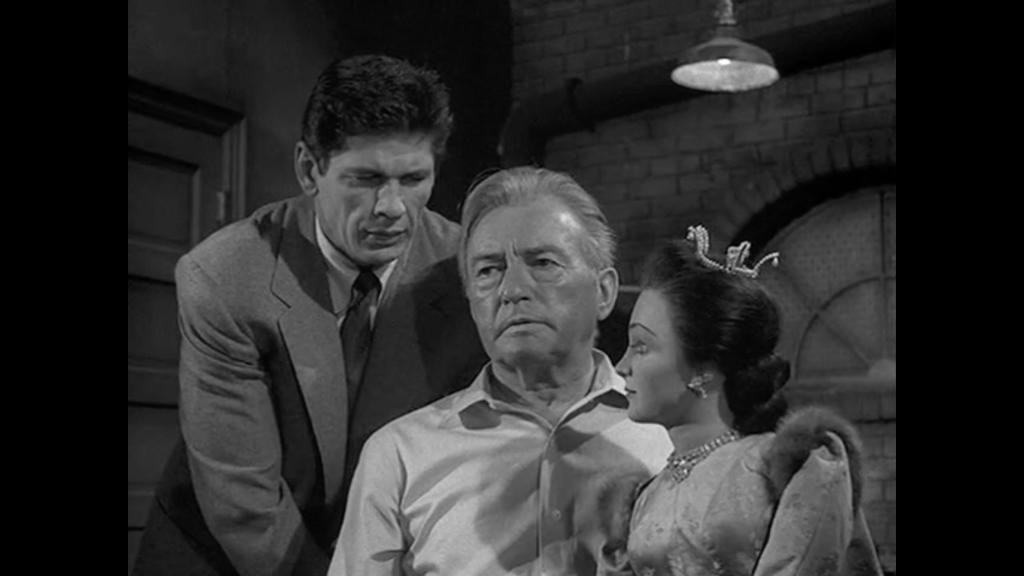
ALFRED HITCHCOCK PRESENTS (TV Series) – S1, E20: “And So Died Riabouchinska,” starring Claude Rains and Charles Bronson!


I’ve never been a rabid consumer of horror films, but I do love Alfred Hitchcock. And when you consider that Charles Bronson was featured three times in his TV series, ALFRED HITCHCOCK PRESENTS, you know I’m all in. Bronson first appeared in the season 1 episode, “And So Died Riabouchinska” which starred the Invisible Man himself, Claude Rains! I thought it would be fun to revisit this early episode from the classic TV series. 

When a juggler named Ockman is found dead in the basement of a vaudeville theater, Detective Krovitch (Charles Bronson), a no-nonsense police investigator, is on the case. The prime suspect quickly emerges to be John Fabian (Claude Rains), a ventriloquist whose act revolves around his beautiful female dummy, Riabouchinska, who we find out is modeled after a long, lost love. As Krovitch interrogates Fabian and all of those around him, including his embittered wife Alyce (Wynne Miller), and her lover, the shady manager Douglas, it becomes clear that the ventriloquist has a dark and dangerous past. We discover a Fabian who is lost in a world of obsession, self delusion and even perversion, a world that the now deceased Ockman was threatening to expose.  Without giving too much away, this episode blends psychological horror with police procedural and spits out an episode that still resonates loudly on the freaky-meter!

Adapted by Mel Dinelli from Ray Bradbury’s short story, “And So Died Riabouchinska” is an exceptional entry in Season 1 of the ALFRED HITCHCOCK PRESENTS TV series. Claude Rains is incredible as Fabian. It’s a thespian tour-de-force, with Rains creating a role that’s creepy, pathetic, and oddly relatable all at the same time. I haven’t seen many of Rains’ most notable works, but based on his performance here, I do know that he’s amazing. Charles Bronson, whose strong screen presence was as obvious as the nose on his face, even this early in his career, goes toe to toe with Rains (and Riabouchinska) and helps ground the episode in something resembling the real world. It’s not a showy role for the legendary tough guy, but he conveys the toughness and authority that would go on to define his career. Performances aside, the episode is truly set apart with an emotional storyline that plumbs the depths of the human psyche in a way that seems daring for 1956 television. There are parts of this episode that will definitely make you squirm in your seat! 

Overall, in my opinion, “And So Died Riabouchinska” is an essential episode of the ALFRED HITCHCOCK PRESENTS series. It’s a lot of fun seeing Hitchcock introduce the show at the beginning and wrap it up at the end, but the best part is the fact that the story that takes place in-between is creepy, clever, and compulsively re-watchable.
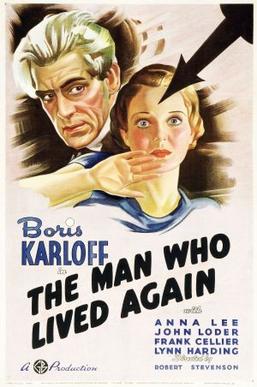
Horror On The Lens: The Man Who Changed His Mind (dir by Robert Stevenson)


In this film from 1936, Anna Lee plays Dr. Clare Wyatt, who leaves behind her reporter boyfriend (John Loder) so that she can accept a job working with the eccentric scientist, Dr. Laurience (Boris Karloff).  Dr. Laurience lives in a spooky mansion with a sarcastic, wheelchair-bound assistant (Donald Calthorp).  It turns out that Dr. Laurience believes that he has discovered how people can switch minds and bodies.  The scientific community ridicules Dr. Laurience but soon, Laurience is putting his theories to the test.  Dr. Laurience finds himself falling in love with Clare but he knows that she’s in love with her suspicious boyfriend.  What if Dr. Laurience changed his mind?

This is an entertaining British production, featuring almost the entire cast playing more than one role as various minds are moved into different bodies.  That said, the film is dominated by the great Boris Karloff, who gives one of his most enjoyable performances as the mad Dr. Laurience.  Though Karloff became a star playing the Monster, he always seemed happier whenever he got to play the mad scientist.

The Fabulous Forties #36: Dishonored Lady (dir by Robert Stevenson)


40s

15 to go!

That’s what I find myself thinking as I begin this review of the 35th film in Mill Creek’s Fabulous Forties box set.  I’ve only got 15 more of these reviews to go and then I will be finished with the Fabulous Forties.

Oh, don’t get me wrong.  Over the past two months, I’ve seen some very good movies from the 1940s — The Black Book, The Last Chance, Trapped, and a few others.  However, I have also had to sit through things like Jungle Man, Freckles Comes Home, and Lil Abner.  The Fabulous Forties has been an uneven collection, even by the standards of Mill Creek.  However, the important thing is that I’m getting to discover films that I probably would otherwise have never known about.  I love watching movies, even ones that don’t quite work.

Fortunately, the 35th film in the Fabulous Forties does work.

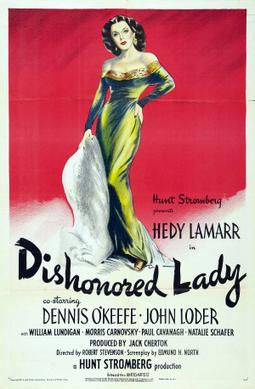
Dishonored_Lady_poster

The 1947 film Dishonored Lady stars the beautiful Hedy Lamarr as Madeline Damien.  Madeline would appear to have it all.  She’s wealthy, she’s socially well-connected, she lives in Manhattan, and she has a glamorous job as the fashion editor of a slick magazine called Boulevard.

So, if Madeline’s life is so perfect, why does she end up crashing her car outside of the house of psychiatrist Richard Caleb (Morris Carnovsky)?  Madeline says it was just an accident but Dr. Caleb immediately understands that she wrecked her car as part of a suicide attempt.  He takes Madeline as a patient and we quickly learn that Madeline is actually on the verge of a nervous breakdown.  When she’s not working, she’s usually drinking.  When she’s not drinking or working, she’s having sex with almost every man she meets.

(Or, as the film primly insists, “making love” to every man she meets.)

And what’s remarkable is that, for a 1947 film, Dishonored Lady is rather sympathetic to Madeline.  While it portrays her lifestyle as being self-destructive, it doesn’t condemn her.  It doesn’t attempt to argue that her problems are a fitting punishment for her decisions, as opposed to so many other 1940s films.  Even when Dr. Caleb’s counseling leads to Madeline quitting her job, the film refrains from criticizing Madeline for wanting to have a career.  Instead, it simply suggests that Boulevard is a toxic environment, almost entirely because of the sleazy men that Madeline has to deal with on a daily basis.

Madeline ends up renting a small apartment and rediscovering her love for painting.  Speaking of love, she also falls in love with her neighbor, Dr. David Cousins (Dennis O’Keefe).  At first, she doesn’t tell David anything about her past but, when she’s falsely accused of murder, she has no choice but to tell him everything.  Will David stand by her or will he prove to be yet another disappointment?  And will Madeline be able to prove her innocence even while her past in put on trial?

I really liked Dishonored Lady.  It’s a surprisingly intelligent film and Hedy Lamarr gives a great performance in the role of Madeline.  Dishonored Lady proved to be a pleasant surprise and you can watch it below!