The TSL Grindhouse: Mitchell (dir by Andrew V. McLaglen)


I come here to defend Mitchell.

First released in 1975, Mitchell does not have a great reputation.  It’s often described as being one of the worst of the 70s cop films and Joe Don Baker’s performance in the lead role is often held up to ridicule.  A lot of that is due to the fact that Mitchell was featured on an episode of Mystery Science Theatre 3000.  Last year, for my birthday, my friend Pat McCurry actually hosted a showing of the MST 3K version of Mitchell.  I laughed all the way through it.  It was a funny show and most of the jokes uttered by Joel and the Bots landed.  That said, I wish they hadn’t been so hard on Joe Don Baker.  Baker was an outstanding character actor, one whose good ol’ boy persona sometimes kept people from realizing just how fiercely talented he actually was.

Here’s the thing with Mitchell.  Just because a film is snarkable, that doesn’t mean that it’s a bad film.  Just because there are moments in a film that inspire you to talk back to the screen, that doesn’t make it a bad film.  Some of the most enjoyable films that I’ve ever watched were enjoyable specifically because they were made to inspire the audience to talk back to the characters.  Whatever flaws you may want to find in Mitchell, it’s an entertaining film.  The plot may be impossible to follow but who cares?  When you’ve got Joe Don Baker, John Saxon, and Martin Balsam all in the same film, does the plot really matter?

This is a film that you watch for the personalities involved.  Balsam plays a wannabe drug lord who always seems to be somewhat annoyed.  Someone once describes Bernie Sanders as always coming across as if he was about send his meal back to the kitchen because it was too cold and that’s a perfect description of Balsam’s performance in Mitchell.  John Saxon plays a sleazy rich guy who murders a burglar and then tries to cover up his crime.  Saxon is calm, cool, collected, and completely confident that his wealth will get him out of anything.  And then you’ve got Joe Don Baker as Mitchell, wearing an ugly plaid suit, drinking beer the way that I drink Diet Coke, and continually pretending to be dumber than he actually is.  There’s an interesting subtext to these three characters and how they interact.  Saxon and Balsam play criminals who are both rich and who both think they can get away with anything because they’ve got money.  Mitchell is a complete and total slob, a guy with a cheap apartment, a cheap suit, and absolutely no refinement at all.  Mitchell uses his good old boy persona to get the bad guys to continually underestimate him.  He ultimately turns out to be smarter and actually more ruthless than any of them.
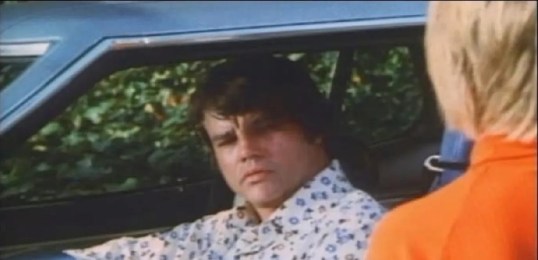
Joe Don Baker throws himself into the role of Mitchell and there’ actually a lot of intentional humor to be found in his performance.  Baker doesn’t play Mitchell as being a supercop.  Instead, he plays Mitchell as being a blue collar guy who gets absolutely no respect.  Even when he’s on a stakeout, a random kid starts arguing with him.  (Mitchell loses the argument.)  Mitchell’s a jerk who busts his hooker girlfriend (Linda Evans) for having weed on her but he’s also the only one who could stop Balsam from doing whatever it is that Balsam thinks he’s trying to do.  (Again, don’t spend too much time trying to understand the plot.)  Mitchell’s super power is that he’s a slob who doesn’t give up.  To paraphrase Road House‘s Dalton, he plays dumb until it’s time not to be dumb.

As I said, it’s an entertaining film.  Where else are you going to see a not particularly high-speed chase between two station wagons?  Where else are you going to see John Saxon in a dune buggy or Joe Don Baker in a helicopter or Martin Balsam as the captain of a yacht?  Where else are you going to see a film that features its hero saying, “Yep, that’s grass,” before arresting his lover?  Mitchell is fun and entertaining and I’ll always defend both the movie and its star.
A Movie A Day #156: Slaughter (1972, directed by Jack Starrett)


The Mafia just pissed off the wrong ex-Green Beret.

After his father is blown up by a car bomb, Captain Slaughter (Jim Brown) single handily wipes out the Cleveland mob.  Only one gangster, Dominic Hoffo (Rip Torn), escapes to South America.  The Treasury Department (represented by Cameron Mitchell) sends Slaughter and two other agents (Don Gordon and Marlene Clark) after Hoffo.  Along with being a ruthless gangster, Hoffo is a viscous racist and is convinced that he will be able to easily take care of Slaughter.  Hoffo does not understand how much trouble he’s in.  No one stops Slaughter.

Produced by American International Pictures, Slaughter is one of the classic blaxploitation films. While it may not have the political subtext of some of the best blaxploitation films, Slaughter is a fast and mean action film, directed in a no nonsense manner by B-movie veteran Jack Starrett.  There is not a wasted moment to be found in Slaughter.  It starts and ends with cars exploding and, in between, it doesn’t even stop to catch its breath.

In the 1970s, Richard Roundtree was John Shaft, Ron O’Neal was Superfly, Jim Kelly was Black Belt Jones, Fred Williamson was Black Caesar, and Jim Brown was Slaughter.  Whatever skills Jim Brown lacked as an actor, he made up for with sheer presence.  He commanded the screen.  Whether he was playing football on television or beating down the Mafia in the movies, no one could stop Jim Brown.  Slaughter is Brown at his toughest.  Rip Torn is the perfect villain, screaming out racial slurs even when Slaughter has him trapped in an overturned car.   Jim Brown has said that, of all the films he has made, Slaughter is one of his three favorites.  (The other two were The Dirty Dozen and Mars Attacks!)

Slaughter‘s cool factor is increased by the presence of Stella Stevens, playing the role of Ann, Hoffo’s mistress.  It only takes one night with Slaughter for Ann to switch sides.  Nothing stops Slaughter.

Shattered Politics #33: Detroit 9000 (dir by Arthur Marks)


Detroit9000

Pity poor Detroit!

For the past few years, it seems that, whenever someone has wanted to make the argument that America is heading in the wrong direction, Detroit gets mentioned.  The once thriving city and industrial center is now best known for high unemployment, high crime, and a declining population.  After years of civic mismanagement, Detroit went bankrupt.  Fairly or not, many people will always view Detroit as being the city that can’t afford to keep the lights on and where citizens can’t afford to pay their water bill.  It doesn’t matter how many “Detroit is making a comeback!” commercials run during the Super Bowl.

I have to admit that, for someone like me who lives on the other end of the country, Detroit might as well be on another planet.  (And that planet is called Michigan.)  I have no way of knowing what Detroit was like before the media started to bombard me with stories about the city’s decline.  And that’s one reason why I have to feel sorry for the city of Detroit.  Anything positive about Detroit will never be reported but you can rest assured that anything negative will be recorded, reported, and repeated until everyone in the country can recite the details by memory.

If I’ve got Detroit on the mind, it’s because I recently watched a fairly memorable crime film from 1973 that was set and filmed in Detroit.  It was a film that — long before Only Lovers Left Alive — attempted to use the city itself as a metaphor for the political issues and social concerns of the day.  In fact, the city was such an important part of the film that the film itself was even named Detroit 9000.

(Reportedly, the film was originally meant to be set in Chicago but, when the Chicago political establishment objected to the film’s violence, production was relocated to Detroit, where apparently the script’s violence was not a problem.)

Detroit 9000 opens with a fundraiser for Congressman Aubrey Hale Clayton (Rudy Challeneger), who is running for governor of Michigan.  A group of masked gunmen break into the hotel and rob the fundraiser.  (While the guests are forced to kneel on the floor while being robbed, a woman stands on stage and sings a gospel song, which just adds to the surreal feel of the scene.)  To investigate the case, the laid-back, casually corrupt Lt. Danny Basset (Alex Rocco) is partnered up with upright Sgt. Jesse Williams (Hari Rhodes).  Because Clayton is the first black man to ever have a real chance to be elected governor and because everyone robbed at the fundraiser was black, Williams believes that there had to be a racial motivation behind the robbery.  Danny, meanwhile, insists that it was just an ordinary robbery.

Detroit 9000 is a favorite film of Quentin Tarantino’s and, watching it, you can see why.  From the soundtrack to the hard-edged dialogue to the morally ambiguous heroes, Detroit 9000 is a masterpiece of 1970s exploitation.  The film ends with a genuinely exciting chase through the streets (and cemeteries) of Detroit that eventually gets so excessively violent that it takes on an oddly operatic beauty of its own.

And, in the underrated style of so many so-called grindhouse and exploitation films, Detroit 9000 has a lot more on its mind than most mainstream film.  Even today, I think you’d have a hard time finding a big-budget, studio production that would be willing to take as honest a view of race relations as Detroit 9000 does.  Beneath all of the exploitation trapping, there lies a film that was actually saying something about the way life was being lived in 1973 and which still has a lot to say about how life is being lived today in 2015.

And, much like Jim Jarmusch in Only Lovers Left Alive, director Arthur Marks finds a strange sort of life in Detroit’s abandoned buildings and dark alleys.  As odd as it may seem, this cynical and violent film will actually make you love Detroit more than a hundred “Detroit is making a comeback!” super bowl commercials ever could.