Retro Television Review: The American Short Story #9: Soldier’s Home


Welcome to Retro Television Reviews, a feature where we review some of our favorite and least favorite shows of the past!  On Saturdays, I will be reviewing The American Short Story, which ran semi-regularly on PBS in 1974 to 1981.  The entire show can be purchased on Prime and found on YouTube and Tubi.
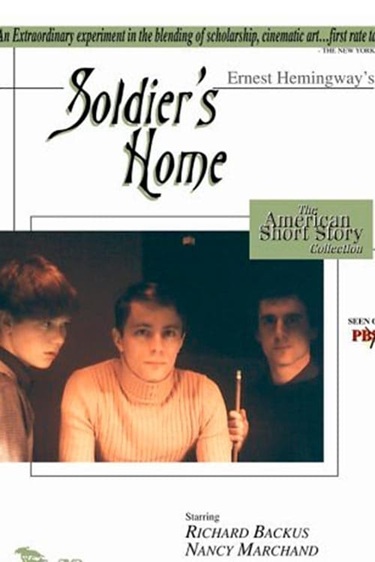
This week, we have an adaptation of a short story by Ernest Hemingway.

Episode #9 “Soldier’s Home”

(Dir by Robert Young, originally aired in 1977)

Having gone from attending college to serving in the Army during the Great War, Harold Krebs (Richard Backus) returns home to Oklahoma.  He arrives home later than most of the other soldiers who served.  (He stayed in Europe until 1919.)  As a result, there’s no big parade waiting for him.  Everyone in town seems to have moved beyond the war and they no longer have much of a desire to talk about it.

Harold, who was once a popular and optimistic member of the town’s social set, no longer feels that he fits in.  He feels detached, watching people as they go about their lives but never feeling any desire to join them.  His mother (Nancy Marchand) pushes him to go out and date and have a good time but Harold feels lost, regardless of how much she prays for him.

Ernest Hemingway’s short story was one of the first to realistically deal with the feelings of soldiers returning from combat.  Though Harold doesn’t talk much about his experiences, one can tell that he saw and experienced things that left him scarred.  After surviving the horror of The Great War, there’s no way Harold can just slip back into his normal routine.

The adaptation sticks closely to Hemingway’s story.  Unfortunately, it doesn’t really find the visual style necessary to capture the power of Hemingway’s words.  Hemingway was a deceptively simple storyteller and Robert Young’s film is a fairly straight-forward portrait of a young man who doesn’t want to do anything, one that fails to truly capture the subtext of Hemingway’s story.  Richard Backus’s blank-eyed acting style worked well when he was playing a member of the undead in Deathdream but, in this one, he just makes ennui seem boring and petulant.  Nancy Marchand, not surprisingly, is far stronger in the role of his well-meaning but clueless mother.

As was almost always the case when it came to attempts to adapt Hemingway, it’s best just to read the original.

Film Review: This Island Earth (dir by Joseph M. Newman and Jack Arnold)


Oh, those poor aliens!

Ever since the 1950s, intergalactic diplomats, soldiers, and explorers have come to Earth looking for help.  Some of them have come from planets that orbit dying stars.  Some represent civilizations that have been destroyed by war or pollution.  Some of them have come here looking to inspire us to be more peaceful and less destructive.  Others were just looking for something to eat.

What they all have in common is that they all came to Earth and things really didn’t work out that well.  Occasionally, they ran into humans who, due to cynicism and skepticism, simply weren’t willing to help.  Often, the aliens arrived just to discover that the humans had no interest in being conquered.  Remember what Eros yelled at the Plan 9 From Outer Space?  “Your stupid, stupid minds!”  Oh yeah?  Well, our menfolk kicked your ass and blew up your flying saucer.  So there.

Consider the sad case of Exeter (Jeff Morrow), the alien at the center of 1955’s This Island Earth.  Exeter has come to Earth with his associates and disguised himself as a human.  Despite the fact that they all have remarkably high foreheads and a total inability to relate to actual humans, no one seems to suspect that Exeter and his friends are from outer space.  Even when he starts recruiting leading scientists to come hang out at his isolated headquarters, it doesn’t seem to occur to anyone that they should be too concerned.  Exeter’s just a little bit weird.  Why worry?

Well, Dr. Carl Meacham (Rex Reason) is worried!  He’s a pilot and a scientist and he’s got a square jaw and one of those deep, 1950s American male voices.  Everything that Dr. Meacham says sounds authoritative.  When you hear that confident, take-no-prisoners voice, you have no doubt that Eisenhower’s in the White House and everything’s going to be alright.  Carl doesn’t trust Exeter and he suspicions are proven correct when he and Dr. Ruth Adams (Faith Domergue) are taken to Exeter’s war-ravaged planet.  Not only is the planet on the verge of blowing up but the whole place is crawling with mutants!

Unfortunately, it takes a while for Carl, Ruth, and Exeter to reach the planet.  This Island Earth is an oddly structured film.  The first third of the film deals with Carl and his squirmy associate, Joe (Robert Nichols), building something called an interocitor.  Once Carl has shown that he can follow the alien instruction booklet, Carl is allowed to meet Exeter.  (For some reason Joe is left behind.)  Once Carl arrives at Exeter HQ, it’s another lengthy wait before he, Ruth, and Exeter are launched into space.

Still, on the plus side, one of the scientists gets to drive this really cool car:

(Unfortunately, the car doesn’t make it to the end of the movie.)

The movie gets a lot better once the action moves to Exeter’s home planet.  The planet was a gloriously realized world, a pop art masterpiece:

And then there were the mutants!  Look at this thing:

Anyway, despite the slow start, This Island Earth is a classic of 1950s science fiction, one that manages to maintain a perfect balance between the sublime and the ludicrous.  Rex Reason and Faith Domergue are inoffensively bland as Carl and Ruth but Jeff Morrow brings a weary and even tragic dignity to the role of Exeter.  If nothing else, it lives up to its title by suggesting that Earth actually is just one insignificant island in the vast ocean of the universe and that both humans and aliens are mere slaves to fate.  For all of his deep-voiced authority, Carl really doesn’t accomplish much over the course of the film.  By that same token, for all of his efforts and his integrity, there’s little that Exeter can do to alter the destiny of his planet.  At times, This Island Earth is almost existential in its portrayal of both human and extraterrestrial inability to alter the whims of fate.  Of course, it’s also a frequently silly film that will be a lot of fun for anyone who appreciates a good B-movie.

On Saturday night, I watched This Island Earth with my friends in the Late Night Movie Gang.  After last week’s experience with Disco Beaver From Outer Space, I decided to play it safe this week.  We had a lot of fun with This Island Earth.  In case you want to learn how to make an interocitor of your very own, the film is available on YouTube.

Embracing The Melodrama #12: Giant (dir by George Stevens)


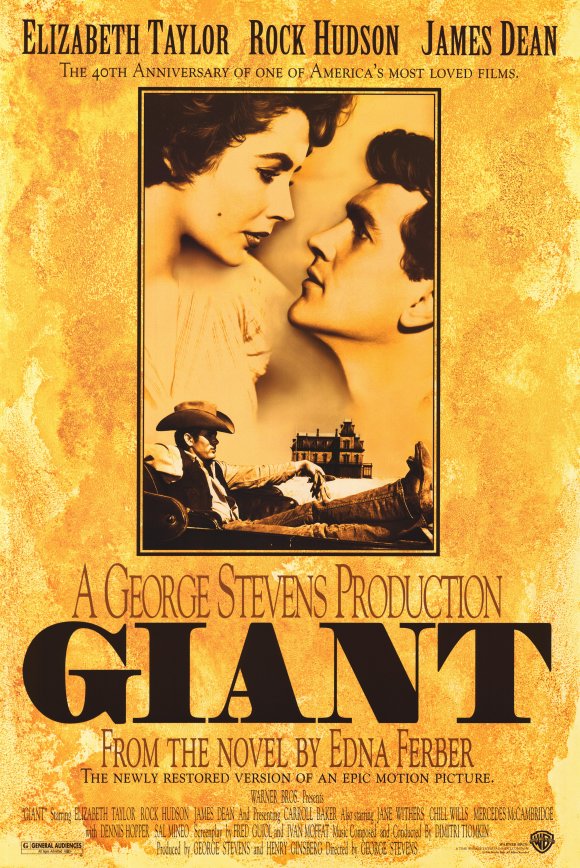
Giant

Let’s continue to embrace the melodrama by taking a look at the 1956 best picture nominee, Giant.

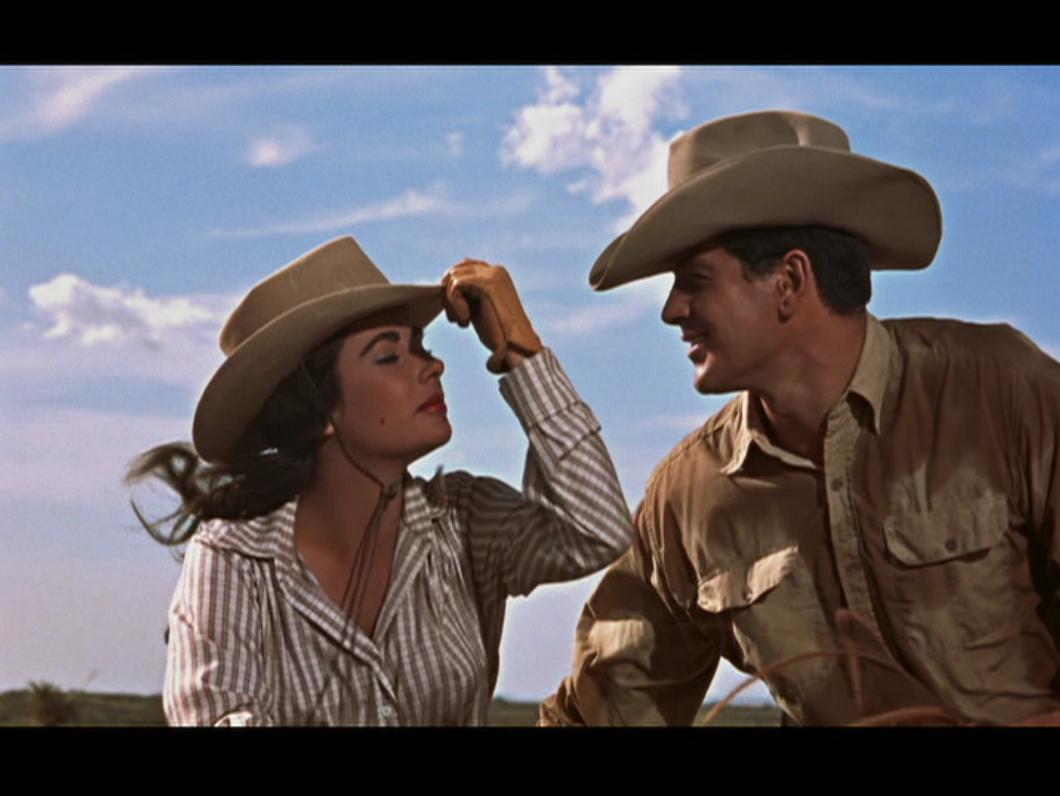
Giant is a film about my home state of Texas.  Texas rancher Bick Benedict (Rock Hudson) goes to Maryland to buy a horse and ends up returning to Texas with a bride, socialite Lesley Lynnton (Elizabeth Taylor).  At first, Lesley struggles to adapt to the harsh and hot Texas landscape.  Bick’s sister, Luz (Mercedes McCambridge) takes an instant dislike to Lesley and Bick is annoyed by Lesley’s concern over the living conditions of the Mexicans that work on Bick’s ranch.  It sometimes seems like the only person who appreciates Lesley is Jett Rink (James Dean), an ambitious ranch hand who secretly loves her and who is planning on becoming a rich man.  That’s exactly what happens when oil is found on the land around Bick’s ranch.  While Bick stubbornly clings to the past, oilman Jett represents both the future of Texas and the nation.  Meanwhile, Bick and Lesley’s son (played by a very young Dennis Hopper) challenges his father’s casual bigotry when he falls in love with a Mexican girl.

Taylor and Hudson

Giant is appropriately named because it is a huge film.  Clocking in at 201 minutes, Giant tells a story that spans several decades and features a big cast that is full of familiar faces, all struggling for their chance to somehow stand out from everyone else around them.  Even the film’s wonderful panoramic shots of the empty Texas landscape only serve to remind us of how big the entire film is.  To a certain extent, the size of Giant‘s production is to be understood.  In the 1950s, Hollywood was having to compete with television and they did this by trying to make every film into a major event.  You watch a movie like Giant and you practically hear the old Hollywood moguls shouting at America, “See!?  You can’t get that on your precious TV, can you!?”

For those of us watching Giant today, the length is both a blessing and a curse.  It’s a curse because the movie really is too damn long.  The opening scenes drag and many of them really do feel superfluous.  It’s hard not to feel that the real story doesn’t really start until about 90 minutes into the movie.  And once the story really does get started,  there’s still way too much of it for it all to be crammed into one sitting.  Oddly enough, you end up feeling as if this extremely long film is still not telling you everything that you need to know.  If Giant were made today, it would probably be a two-part movie on either HBO or Lifetime and it would definitely feature a lot more sex.

However, to be honest, one of the reasons that I did enjoy Giant was because it was as big as it was.  I mean, the film is about Texas so of course it should be a little excessive!  Everything’s bigger in Texas and that includes our movies.  Add to that, Giant may be too long but it uses that length to deals with issues that are still relevant today — oil, immigration, and racial prejudice.  Rock Hudson may not have been a great actor but he is at least convincing as he transitions from bigotry to tolerance.

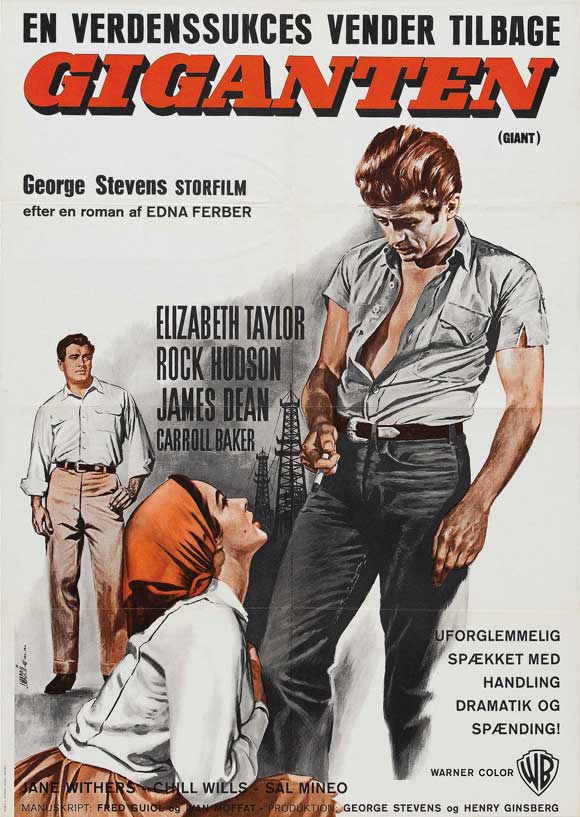
But really, when it comes to Giant, most people are only interested in James Dean.  And they definitely should be because Dean gives a great and compelling performance here.  Dean brings all of the emotional intensity of the method to material that one would not naturally associate with method acting and the end result is amazing to watch.  Giant was released after Dean had been killed in that infamous car wreck.  I can only imagine what it must have been like to be sitting in a theater in 1956 and to see this compelling and charismatic actor towering above the world on the big screen while aware, all the time, that his life had already been cut short and he would never been seen in another film.

James Dean

Even better, Dean’s new style of acting clashes perfectly with Hudson’s old style of acting, making the conflict between Bick and Jett feel all the more real and intense.  Much as Bick represents old Texas and Jett represents the new Texas, Hudon and Dean represented the two sides of Hollywood: the celebrity and the artist.  Needless to say, Dean wins the battle but, surprisingly, Hudson occasionally manages to hold his own.

I can’t necessarily say that Giant is an essential film.  A lot of people are going to be bored by the excessive length.  But if you’re a fan of James Dean or if you’re from Texas, Giant is a film that you need to see at least once.

elizabeth_taylor_giant_swedish_movie_poster_2a