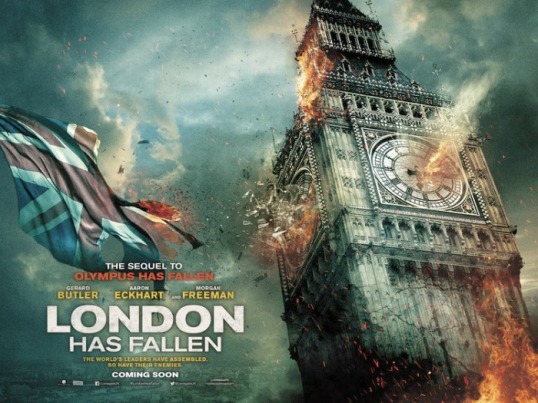
The White House under siege film Olympus Has Fallen from 2013 was a surprise hit and pretty much took the prize in the match-up between it and the bigger-budgeted White House Down starring Channing Tatum and Jamie Foxx. What the latter didn’t have was the presence of Morgan Freeman, the steadfastness of Aaron Eckhart and the utter badass that is Gerard Butler. Olympus Has Fallen had all three and thus was the better of the two films.
It didn’t take long for the studio who made Olympus Has Fallen to start on a sequel with the three core figures from the first film (Freeman, Eckhart and Butler) back to fight the evil of terrorism on all freedom-loving citizens. I think the studios just thought the audience who saw the first film loved just how much Gerard Butler’s character kept stabbing people in the face.
Here’s to hoping London Has Fallen didn’t try to fix what wasn’t broken…and more Gerard Butler stabbing people in the face.
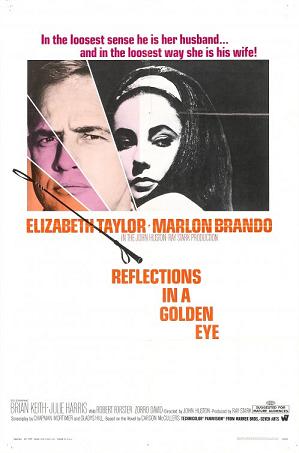
For the past two weeks, I’ve been reviewing, in chronological order, 126 cinematic melodramas. I started in the 1920s with Sunrise and Wings and now, 33 reviews later, we have finally reached the end of the 1960s. And what better way to end the 60s than by taking a mercifully brief look at the 1969 film, Reflections in a Golden Eye.
Now, before I get too critical of this film, I should acknowledge that there are some critics who absolutely love Reflections in a Golden Eye. They think very highly of Marlon Brando’s performance as Maj. Weldon Penderton, a closeted homosexual who is stationed at a military base in the South. They think that Elizabeth Taylor’s performance as Brando’s wife isn’t somewhat embarrassing. And they think that the script isn’t overwritten and that director John Huston doesn’t try way too hard to prove himself worthy of the title auteur. They feel that Reflections in a Golden Eye is a secret masterpiece that does not deserve to be known as an infamous flop.
I’m definitely not one of those people but they do exist. There are some very respectable and intelligent critics who happen to love Reflections in a Golden Eye.
Well — vive la différence!
Earlier in this series, I pointed out that the 60s were not a great time for old school Hollywood directors trying to compete with both American television and European film. It was a time when talented directors found themselves trying to keep up with the times and appeal to new audiences. As a result, Joseph L. Mankiewicz ended up making Cleopatra. Edward Dmytryk did The Carpetbaggers. Elia Kazan directed The Arrangement. William Wyler did The Liberation of L.B. Jones. Stanley Kramer made RPM.
And John Huston made Reflections in a Golden Eye.
This painfully slow film follows the affairs of six people on that Southern army base. Brando is emotionally repressed and spend most of the movie mumbling in one of the worst Southern accents ever. Taylor is obsessed with horses and spends most of the movie yelling in one of the worst Southern accents ever. Robert Forster is the object of Brando’s repressed desire, a soldier who likes to ride horses while naked and who is obsessed with sniffing Elizabeth Taylor’s underwear. Brian Keith is in charge of the army base and is having an affair with Taylor. Julie Harris is Keith’s suicidal wife. Zorro David is Harris’s houseboy who, at one point, is nice enough to give this film a title by mentioning something about a golden eye.
What’s particularly insane is that Huston took the idea of making this film a reflection in a golden eye literally. The entire film is tinted a sickly gold color. Whenever the characters step outside, the sky looks like the sun has just exploded. Whenever the characters are inside, they all look like they have jaundice. On the one hand, you have to respect the fact that Huston so committed himself to potentially alienating the audience. On the other hand, the yellow-tinting renders almost every image so grotesque that I actually found myself growing physically ill as I watched the film.
Watching Reflections in a Golden Eye, I could understand why The Godfather was such a huge comeback for Marlon Brando. I wouldn’t necessarily say that Brando gives a bad performance here. He’s watchable throughout the entire film. But it’s still a performance that’s so strangely modulated (and which features a Southern accent that is just amazingly bad) that it ultimately distracts from the film itself. If anything, Brando gives a performance that suggests what happens when a talented and eccentric man gets bored with what he’s doing.
(If you want to see a good Brando performance from 1969, see Burn.)
Reflections in a Golden Eye is a pretentious mess but fortunately, both Huston and American film would make a comeback in the 1970s. We’ll start on that decade tomorrow.
(Yes, this video is a spoiler but it’ll allow you to see the gold tinting.)
(The film was also released in an untinted version.)
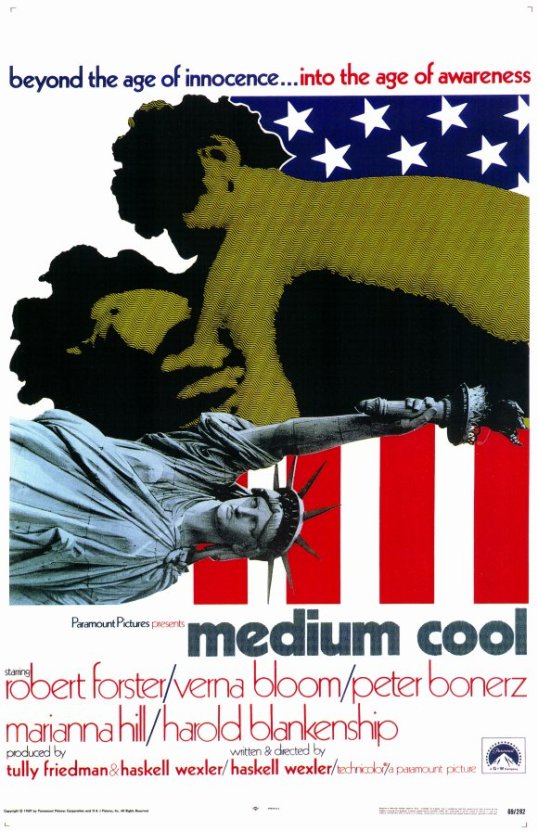
For the past few days, I’ve been chronologically reviewing 94 films about politicians and, to a lesser extent, politics. Four days ago, I started in on the 60s by taking a look at Sunrise at Campobello, one of the most traditional-minded and pro-American movies ever made. And now, I’m closing out the decade by taking a look at 1969’s Medium Cool, a film that is — in style, ideology, and content — the exact opposite of Sunrise at Campobello.
I should admit that I’m cheating a bit by including Medium Cool in this series of reviews. When I first started Shattered Politics, I said that I would be reviewing films about politicians. While Medium Cool is a fiercely political film, there are few elected officials to be seen on screen. That said, it was shot during the infamous 1968 Democratic National Convention and, as such, the politicians are present regardless of whether or not they’re seen.
Plotwise, the film follows a news cameraman, John (Robert Forster), and his sound guy (Peter Bonerz) as they go around Chicago, searching for stories. Along the way, they interview the disturbingly cheerful owner of a gun club (played, in his film debut, by Peter Boyle), several people who volunteered on Robert Kennedy’s presidential campaign, and, in one of the film’s best and most awkward scenes, a group of Black Panthers.
Throughout the first half of the film, John remains detached from the stories that he covers. He’s more concerned with getting the footage and getting a good soundbite than in really listening to what anyone is saying. (In many ways, he’s like a less sociopathic version of the character played by Jake Gyllenhaal in Nightcrawler.) It’s not until John discovers that his station is sharing his footage with the FBI that John finally starts to show some political awareness. Unfortunately, he also shows some anger and ends up losing his job as a result.
Now unemployed, John meets Eileen (Verna Bloom), a single mother who has recently moved to Chicago from West Virginia. Now that he’s free from the detachment of his job, John actually starts to develop feelings for both Eileen and her son, Harold (Harold Blankenship). When Harold runs away, Eileen and John search Chicago for him. Unfortunately, their search happens at the same time as the 1968 Democratic Convention. While John and Eileen search, the Chicago police are busy beating protestors in the street.
(The video below is long, but worth watching, as is the entire film.)
Now, I know that, in the past, I’ve been critical of many of the counter culture films of the late 60s and early 70s, describing their politics as being shallow, trendy, and faux Leftist. (And if you doubt me, read my reviews of Getting Straight, Zabriskie Point, and R.P.M.) However, Medium Cool is an exception to those films, in that it actually works. Medium Cool was directed by famed cinematographer, Haskell Wexler. Wexler began his career shooting documentaries and, in many ways, that’s exactly what Medium Cool is. Though Robert Forster may be an actor, many of the people that he interviewed in the film were not. When he talks to the former Kennedy campaign workers, he’s talking to actual volunteers and getting their true feelings, as opposed to something written for them by an out-of-touch screenwriter. When we see John and Eileen trying to survive the violence outside the Democratic Convention, we’re also seeing Robert Forster and Verna Bloom attempting to do the same thing. The protestors being attacked were real. The cops doing the attacking were real. The violence was real.
And, considering that Medium Cool was released 46 years ago, the issues raised by the film are still real. When the Black Panthers suspiciously view John and his sound guy, we’re reminded of the protestors in Ferguson demanding that the national media get out of their way. When we see the protests outside the 1968 Democratic Convention, how can we not compare them to the protests that we still see every day? When the cops line up in military precision and we hear that orders must be followed, are we watching Medium Cool or are we watching CNN?
During one of Medium Cool‘s better known moments, an off-screen voice is heard to shout, “Look out, Haskell! It’s real!,” warning director Haskell Wexler that the violence he’s filming is actually happening. And that’s a warning that’s still appropriate and relevant today. We may be watching from the safety of our homes but it’s still real.
(Of course, it should be mentioned that, according to Wexler himself, “Look out, Haskell! It’s real!” was actually added to the scene in post production.)
It’s perhaps indicative of how much American culture changed in the 60s that a decade that started with Ralph Bellamy playing Franklin D. Roosevelt would end with Medium Cool. Fortunately, Medium Cool gives us plenty of evidence about how that change happened.
“The most protected building on Earth has fallen.”
Die Hard has become it’s very own subgenre of action films since it was first released in 1988. It was a simple enough story that combined the “one against many” type of story with the “siege tale”. It was a perfect combination that has since been copied, imitated, but truly never duplicated to the highest level of success the original film had upon release. There’s been a few films that added their own unique take on this action film template. There was “Die Hard on a boat” with the underappreciated Under Siege. Then we have Air Force One which was “Die Hard on a plane”. The latest action film to try and put a new spin on the Willias-McTiernan classic is Antoine Fuqua’s latest film, Olympus Has Fallen.
The film pretty much takes what worked with the three films before it that’s been mentioned above and combines them to make a film. We have a lone, highly skilled operative in the form of Secret Service Agent Mike Banning in the role that made Bruce Willis famous and, for a time, resuscitated Steven Seagal’s career. Then we have the Presidential angle but instead of Air Force One it’s the White House this time around. The plot of the film is simple enough that even a person not well-versed in film could follow it. A group of dedicated and highly-trained North Korean terrorists do a surprise attack on the White House as the President of the United States and his South Korean counterpart try to find a way to defuse a situation that’s been growing in the DMZ between the two Koreas. It’s now up to Agent Banning, on his own, to try and stop whatever plans the terrorists have brewing with the President as hostage while also dealing with an inept group of higher-ups trying to deal with it far from the action.
Olympus Has Fallen doesn’t break new ground with the way it’s story unfolds and it’s characters develop. The film was pretty much beat-for-beat and scene for scene lifted from the three other films mentioned above. The characters may be different and the circumstances they find themselves in somewhat different, but the screenwriters played everything safe except the action sequences part of the film. It’s these action scenes which brings Olympus Has Fallen to a new level of violent artistry that the previously mentioned films never reached.
To say that this film was violent would be an understatement. Where other films of this type a certain cartoonish tone to it’s violence this time around Fuqua goes for a much more serious and, at times, disturbingly difficult to watch level of violence to make the film stand out from the rest of it’s kind. The assault on the White House itself and the surrounding area has less a look of a fun action film and more of a war film. People die in droves and it doesn’t matter whether they’re Secret Service, police, terrorists or innocent civilians. All were fair game in this film.
Even the action once we get to Banning playing the Willis role looked more brutal than what Willis and even Seagal ever got to do. Gerard Butler may not have had the charisma and wit of Willis in the same role, but he convincingly played his role as more Jack Bauer than Officer McClane. Butler as Banning was all business and efficiency while Willis as McClane was more the witty, smartass who just keeps finding himself in the wrong place at the wrong time.
Olympus Has Fallen won’t be hailed as one of the best films of 2013. It won’t even be talked about as one of the top action films this year, but despite the story being a derivative of every Die Hard and it’s clones before it the film does succeed in being a very enjoyable piece of popcorn flick. It was full of tension and big action setpieces (though the CG effects looked very cheap at times) that Fuqua has gradually become known for. The characters in the film were just a step above being one-dimensional and the story itself becomes less eye-rolling and more worrisome considering the real tensions coming out of the Korean Peninsula at this very moment.
One thing I’m sure of is that of the two “Die Hard-in-the-White-House” films this year (there’s the bigger-budgeted White House Down later this summer from Roland Emmerich) I have a feeling that Olympus Has Fallen might be the more fun. It’s probably going to be the more violent of the two and that’s an assumption I’m willing to make without even seeing how Emmerich’s film turns out.
I’ve always wondered why Gerard Butler hasn’t been tapped to be an action hero star since his turn as Leonidas in 300. He definitely has the looks and physicality to pull off such films and do so without being snarky about it. He has instead been stuck doing romantic comedies and the brooding anti-hero roles. This pattern may just change depending on how well his next film does.
Olympus Has Fallen is the next film from Antoine Fuqua (Training Day, King Arthur, Shooter) and looks like a new take on the Die Hard template of “one against many” that’s worked well with some films and turned out bad with others. This time around the film looks to be “Die Hard in the White House” type of story with Gerard Butler in the role of Bruce Willis. Though from some of the dialogue shown in the trailer it also sounds like a version of Under Siege (one of the better Die Hard clones)
The White House used as a setting for a siege has rarely been used (though the tv series 24 did it in it’s later seasons). The trailer show’s a bit of back story to Butler’s Secret Service character and what brings him back to the fold after a tragedy in his professional past puts him on ice.
Olympus Has Fallen is set for a March 22, 2013 release date.
One thing that always happens at Oscar season is that certain films will be so embraced by the critical establishment that even daring to challenge their opinion to even the slightest degree will be interpreted as some sort of cinematic heresy. These are the films that make you feel as if Roger Ebert is standing directly behind you, holding a gun to your head and commanding you to enjoy and be moved by what you’re watching. Last year, that film was The Social Network. This year, at least for me, it’s The Descendants.
One reason why The Descendants has been so praised by the critics is because it’s seen as being a film about “real people” and “real life.” It’s advertised as a film with no easy villains and no easy heroes. This is the type of film that people tend to praise for not falling into specific genre. However, those critics are wrong because The Descendants is a pure genre film, make no mistake about it. It is the latest entry in the Mediocre White Man film genre. The MWM genre tends to center on middle-aged white guys who are comfortably upper middle class, have quirky relatives, and have been afflicted by ennui. The protagonist of the MWM film usually narrates the action for us and tends to spend a lot of time explaining how he’s managed to structure his life for maximum efficiency while, at the same time, shutting himself off emotionally from the rest of the world. Over the course of the MWM film, the protagonist is usually forced to deal with some crisis that makes him realize that 1) he’s getting old, 2) his safe life has become a prison, and 3) there’s not much he can do about it. The MWM film will feature at least one or more scenes featuring our protaganist either aimlessly running or standing still on an escalator with a blank expression on his face while some old song from the 60s or 70s plays on the soundtrack.
MWM films tend to do well critically because most critics are mediocre white men themselves. They also do well with the Academy, probably for the same reason. And, don’t get me wrong. There have been some excellent MWW films released over the past decade. Sideways, Up in the Air, Thank You For Somoking, and even Michael Clayton are all excellent MWM films. The problem isn’t that The Descendants is a MWM film, the problem is that it doesn’t really bring anything new to genre and even the film’s most effective moments feel awfully familiar.
In The Descendants, George Clooney (a mainstay of MWM genre) plays Matt King, a wealthy attorney living in Hawaii. Matt’s wife is in a boating accident that leaves her brain-dead. Matt, who has always been “the backup parent,” finds himself forced to take care of his two daughters (Amara Miller and Shailene Woodley) while going from island to island to inform people of Elizabeth’s impending death. Along the way, he discovers that Elizabeth has been having an affair with a sleazy real estate agent (Matthew Lillard) and he’s forced to confront the fact that he hasn’t always been the best husband or father. There’s a lot of quirky and funny moments and there’s a lot of sad moments but they’re never feel quite as genuine as the film seems to believe. Instead, they often feel more like they were just put there to satisfy the demands of the MWM genre. The end result is a film that too often seems to mistake ambiguity for insight and which ultimately seems to be more safe than honest.
That doesn’t necessarily mean that The Descendants is a bad film. Much like The Social Network, it’s a good film that also happens to be very overrated. Director Alexander Payne keeps the story moving and, as predictable as the film may be, it’s still well-acted and occasionally well-written. Though I thought a lot of the dialogue was a bit too spot-on perfect (this is a film where even the inarticulate characters sound calculated), the script features enough good one-liners to keep the film entertaining. Amongst the cast, Robert Forster is poignant as Elizabeth’s grieving father (and his “I’m going to hit you line,” is perfectly delivered) and Judy Greer makes the most of the thankless role of Lillard’s wife.
In the end, I guess the Descendants is a lot like an old middle school crush. He’s so cute and appealing that it takes a while of digging and soul searching before you can admit that there’s really not much going on there.

 Through the Shattered Lens