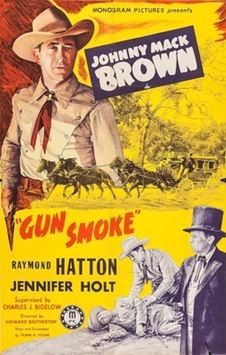
On the frontier, a stagecoach has been overturned and both the passenger and the driver have been killed by outlaws. The passenger was Hinkley, an archeologist. Who would want to kill a harmless archeologist? That’s what Marshals Nevada Jack McKenzie (Johnny Mack Brown) and Sandy Hopkins (Raymond Hatton) set out to discover. While Nevada Jack asks questions in the nearby town, Sandy disguises himself as a medicine man.
It all links back to an old Indian site that is said to be full of gold relics. Jane (Jennifer Holt), the daughter of Hinkley’s partner, reveals that the only other person who knows the location of the site is an old Indian named Shag (Dimas Sotello). Jack and Sandy have to try to track down Shag before he’s found the gang that killed Hinkley.
Yes, it’s another Johnny Mack Brown western. Despite the title, this has nothing to do with the television series that featured James Arness and Amanda Blake. GunSmoke is still a solid western, featuring a determined performance from Johnny Mack Brown and some memorable villains from the usual poverty row western stock company. Once again, Frank Ellis shows up as a henchman, though the identity of the main villain is actually a little more interesting than was typical for these films. Johnny Mack Brown is a little more serious than usual, throwing punches with authority. For fans of B-westerns, GunSmoke is an above average entry in Johnny Mack Brown’s seemingly endless filmography.
Marshal Tom Nightlander (Douglass Dumbrille) shows up in a lawless frontier town, tasked with bringing peace. He could sure use the help of Dr. John Poole (Johnny Mack Brown), a former gunslinger who has set his weapons aside and now works as the town doctor. Dr. Poole has sworn off guns but with corrupt businessman Wilson (Harry Woods) and his gang determined to keep their town lawless, Poole is soon forced to reconsider.
This B-western from Monogram is better than many of the other low-budget, poverty row westerns of the era. While the plot is another example of a corrupt businessman and his gang making life difficult for peaceful settlers, the characters in Flame of the West are a little more complex than usual. Brown stands out playing a character who, for once, doesn’t want to fight and believes that it’s better to talk than to shoot. Of course, this being a B-western, he soon sees the error of his ways. Dumbrille was usually cast as a villain so this film is a chance to see him in a likable and heroic role and he’s very convincing as a Wyatt Earp-style marshal.
Of course, even a serious B-western is still a B-western so songs and entertainment are provided by the gorgeous Joan Woodbury and Pee Wee King and his Golden West Cowboys. (Don’t worry, I had never heard of them before, either.) Joan Woodbury plays a saloon owner who wants to bring a higher class of entertainment to the frontier and she provides the film with enough sex appeal that 1945 audiences probably didn’t mind having to sit through the musical numbers before getting to the inevitable showdown between Johnny Mack Brown and Harry Woods.
Flame of the West is a good B-western that shows what dependable actors like Johnny Mack Brown and Douglass Dumbrille were capable of when given the opportunity.
Steve Godfrey (Charles Starrett) is in trouble again. He has been accused of stealing another payroll and the only man who can clear his name has just been murdered. Steve thinks that he is being set up by outlaws who want to take control of the dead man’s ranch, which is now owned by Mary Ann Jarvis (Adele Roberts).
Luckily, Steve’s old friend, Smiley Burnette, is working as a cook at the Jarvis Ranch. When Smiley isn’t singing songs with the Colorado Hillbillies, he tries to help Steve clear his name. He explains that Mary Ann Jarvis won’t listen to Steve but maybe she’ll listen to Steve’s alter ego, The Durango Kid!
Durango rides again in this movie, though, the majority of the hour runtime is made up of Smiley Burnette singing songs and making jokes. Smiley Burnette is not for everyone. I enjoy the broad humor he brought to these films but I can understand why others might not. Whenever Smiley sings a song, it does bring the action to a halt but that’s true of every Durango Kid film. If you’re a fan of the series, you either like Smiley or you can at least tolerate him. Smiley does do more than just sing in this movie. He also throws black pepper in the eyes of one of the bad guys.
Even with all of the attention paid to Smiley, The Desert Horseman delivers all of the expected horse chases and gunfights. The story is a little more interesting than usual. Steve has been framed for not one but two crimes that he didn’t commit and that adds some urgency to the proceedings. Charles Starrett, as always, is a believable western hero and he takes the role seriously.
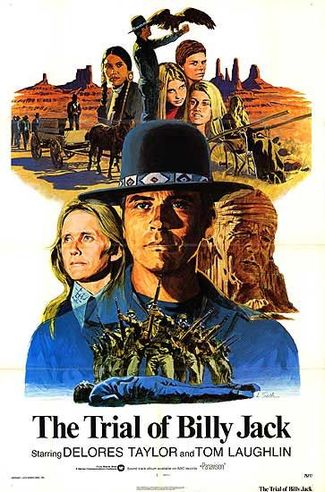
For the past week, I’ve been in the process of reviewing 94 films about politicians and, to a lesser extent, politics. I’ve recently taken a look at Born Losers and Billy Jack, the first two segments in the cinematic life of future U.S. Sen. Billy Jack. Today, I’m taking a look at the third part of the Billy Jack saga, 1974’s The Trial of Billy Jack!
I have to admit that, when you’re watching these first three films, it’s a little hard to see how Billy Jack is ever going to end up in the U.S. Senate. After all, The Born Losers ended with Billy getting shot in the back by an overeager deputy sheriff. Billy Jack ended with Billy shooting at the National Guard and then getting arrested for murder. And then, in Trial of Billy Jack, Billy gets released from prison but promptly kills yet another member of the Posner family and then eventually, the National Guard shows up (again!) and ends up gunning down at least half of the students at the Freedom School.
If I didn’t already know that Trial would be followed up Billy Jack Goes To Washington, I think I’d be justified in being a little pessimistic about Billy’s future.
But anyway, let’s talk about The Trial of Billy Jack. After the surprise box office success of Billy Jack, Tom Laughlin and Delores Taylor set about to make a sequel that would not only revisit the themes of Billy Jack but which would touch on literally every single other political issue of the day as well. The result is a three-hour mess of a film that, despite the excessive length and a generally preachy tone, remains oddly watchable.
Despite the film’s title, the actual Trial of Billy Jack only takes up a few minutes of screen time. The prosecution lays out its case, which is that Billy Jack killed Bernard Posner. The defense calls Billy to the stand and, instead of asking him about the events that led to Bernard’s death (i.e., the fact that Bernard was a rapist and that Billy caught him with a 13 year-old girl), they instead allow Billy to give his opinions on the political issues of the day. And, since this film was released in 1974, we get a lengthy flashback to the Vietnam War where we see Billy refusing to take part in a civilian massacre.
And then Billy Jack is sent to prison. And it’s actually quite some time before he shows up in the film again. This actually took me by surprise because, when it comes to people directing films starring themselves, I’m more used to the narcissistic style of Norman Mailer. But, in Laughlin’s case, he was actually willing to stay off-screen for close to an hour and allow the film to focus on Jean (Delores Taylor) and the Freedom School.
And that is one reason why I can never be as critical of the Billy Jack films as maybe I should be. They really are such sincere films. Laughlin was willing to stay off-screen and allow the film to be about the issues and for that he should be commended. However, at the same time, Laughlin was not only the best actor in most of the Billy Jack films. He was also usually the only good actor in the films as well. So, while you respect Laughlin for not being a narcissist, you also kind of wish that maybe the film could have been more about him and less about the students at the Freedom School (which, to judge from the performances in this film, did not have much of a drama department).
When I reviewed Billy Jack, I mentioned that, if anything could cause me to transform from being the politically moderate girl that you all know and love to being a right-wing extremist, it would be having to spend any amount of time with the smug and self-righteous students at the Freedom School. Well, by the end of the first half of The Trial of Billy Jack, I had spent so much time with those students that I was on the verge of ordering a Sarah Palin bumper sticker to put on my boyfriend’s car.
(Fortunately, Billy Jack got out of jail before I went that far but seriously…)
Of course, they’re not just students at the Freedom School anymore. No, in the Trial of Billy Jack, the Freedom School suddenly has the power and resources to launch its own independent television station. The kids are now crusading journalists. They’re first expose is on a local businessman who repossessed a woman’s furniture after she failed to make the payments and … well, wait a minute. Is that really an expose? When you’re paying something off, aren’t you supposed to keep up with the payments? If the students were trying to raise money to help the woman pay off her bills, that would be one thing. But, instead, their expose seems to be that if you break a contract, there will be consequences. Uhmmm…
BUT ANYWAY! Best not to think too much when the powers of crusading righteousness are on display!
We also discover that one of the students has invented a machine that will tell you whether or not someone on television is lying. Which again … what? I mean, that’s a pretty powerful machine but it’s just kind of mentioned and then never really brought up again….
And then, for some reason, the students hold a big carnival in town and demand to know why the national media isn’t down there covering it.
Listen, this film is occasionally confusing. It’s not three hours long because it’s an epic or anything. Instead, it’s three hours long because, apparently, Tom and Delores just stuck every thought they ever had into the script. Some of those thoughts — like the TV lie detector — are abandoned as soon as they are brought up. Other thoughts — like the National Guard showing up and shooting up the Freedom School — are returned to over and over again.
Fortunately, Billy does eventually get out of jail and returns to the Freedom School. Again, he finds himself debating non-violence with Jean and he also finds himself being harassed by yet another evil Mr. Posner (Riley Hill). However, during the film’s undeniable high point, Billy goes on a vision quest. He sees a bearded professor type and smacks him. Then he sees Jesus Christ and smacks him too.
No, I’m not making that up!
However, Jesus forgives Billy and Billy learns that nonviolence is the way to go. But then the National Guard shows up and starts shooting up the Freedom School and…
(Actually, what’s funny is that one of the National Guardsmen is played by William Wellman, Jr., who also played an evil biker named Child in The Born Losers. I like to think that, after the events of Born Losers, Child cleaned up his act, got married, had a baby, and then joined the Guard. And then he ended up shooting up the Freedom School, little realizing that his old enemy Billy Jack was just a few miles away “gettin’ hassled by The Man.”*)
Like I said, The Trial of Billy Jack is a mess but I’m still going to recommend because it really is a one-of-a-kind mess. It’s one of those films that everyone should sit through at least once. Full of pretentious dialogue, half-baked political posturing, and some of the most preachy end titles ever seen, The Trial of Billy Jack ultimately stands as a tribute to the determination of Tom Laughlin to both preach to the already converted and to preserve his own unique vision.
And you know what?
Good for him! The Trial of Billy Jack may not be a good film but at least it’s a film that refuses to compromise.
Both Tom Laughlin and Billy Jack would return three years later in Billy Jack Goes To Washington!
 On the frontier, a stagecoach has been overturned and both the passenger and the driver have been killed by outlaws. The passenger was Hinkley, an archeologist. Who would want to kill a harmless archeologist? That’s what Marshals Nevada Jack McKenzie (Johnny Mack Brown) and Sandy Hopkins (Raymond Hatton) set out to discover. While Nevada Jack asks questions in the nearby town, Sandy disguises himself as a medicine man.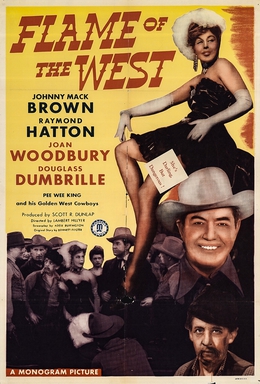

 Through the Shattered Lens