Film Review: Conan The Destroyer (dir by Richard Fleischer)


As you can probably tell just from looking at everything that’s been posted on the site today, I love the Oscars. That said, I realize that the Oscars aren’t for everyone. Some people find Oscar-nominated movies to be boring. Some people find the ceremony to be unbearably pompous. Every year, there’s the lament of “The truly entertaining films always get snubbed!”

Well, fear not! If you’re not into the Oscars, there are alternatives! For instance, you can go over to Prime right now and rent the 1984 film, Conan the Destroyer!

Conan The Destroyer is the sequel to the original Conan the Barbarian, with Arnold Schwarzenegger returning as Conan and Mako returning as the sorcerer who narrates the events of Conan’s life. This film is a continuation of the adventures of the barbarian who would become king, a trip to a world much different from our own, and a study of savagery vs civilization. Of course, to most viewers, Conan The Destroyer is just the film where a weird lizard monster picks up Arnold Schwarzenegger by his feet and spins him around in circles. Have you seen that meme where it’s made to appear as if Kate Winslet is spinning around a helpless Schwarzenegger? Along with Titanic, this is the film that you have to thank for it.

Conan The Destroyer picks up from where Conan the Barbarian ended. Conan is still wandering around the desert, working as a thief and a mercenary. He’s still praying to Crom and missing Valeria. He’s picked up a companion, a cowardly thief named Malak (Tracey Walter). When Conan and Malk are captured by Queen Taramis (Sarah Douglas), Taramis offers to bring Valeria back to life if Conan will escort the Queen’s niece, Jehna (Olivia D’Abo), to a temple so that she can retrieve a gem that will be used to …. you know what? I’m just going to be honest here. I have absolutely no idea what the quest is about. It’s just one of those things where Conan and his crew have to break into a castle or a temple and steal something so that a god can either be awakened or defeated. The film, to be honest, is a bit vague about how it all works but then again, the mission is less important than the journey.

It turns out that, with the exception of her insanely tall bodyguard Bombaata (Wilt Chamberlain), Jehna has never seen an actual man before and, needless to say, she is quickly fascinated by Conan. (She asks Bombaata if Conan is as handsome as he appears to be, Bombaata reluctantly agrees that he is.) However, Conan only cares for the deceased Valeria. As he leads Jehna, Malak, and Bombaata to the castle where they’ll find the gem, he picks up some other traveling companions. The wizard Akiro (Mako) joins them as does the fierce warrior Zula (Grace Jones). Of course, it turns out that Taramis has an agenda of her own and it all ends in a lot of shouting, swordplay, and muscle flexing.

If Conan the Barbarian was distinguished by the grim and girtty approach that it took to material that others would have played for camp, Conan the Destroyer takes the opposite approach. Of course, a lot of that is because director/screenwriter John Milius did not return to oversee Conan the Destroyer. Instead, Conan the Destroyer was directed by Richard Fleischer, who was one of those veteran directors who made a countless number of films in all sorts of genres but who never really developed a signature style of his own. Fleischer takes a semi-comedic approach to Conan and his quest. As opposed to the brutal warrior and conqueror who appeared in Milius’s film, the Conan in this film is a well-meaning rogue who punches out a camel and who also gets tongue-tied whenever he has too much to drink or when Jehna flirts with him. There’s little of the first film’s violence in this sequel and none of the emotional stakes.

That said, Conan the Destroyer is definitely entertaining. It’s just such a silly movie that you can’t help but enjoy it. Schwarzenegger, apparently understanding that the film is never going to make any sense, cheerfully goes through the motions and he actually does a pretty good job with some of his more comedic lines. The allies and the villains who he collects through the film are all memorably flamboyant. Sarah Douglas is especially entertaining as the over-the-top villainous. If you’re going to be evil in a film like this, you might as well go all out.

Conan The Destroyer was not nominated for an Oscars but it’s still a fun movie.

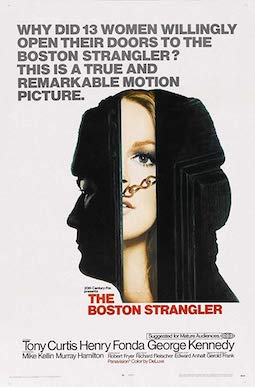
Film Review: The Boston Strangler (dir by Richard Fleischer)


Between June 14, 1962 and January 4, 1964, 13 women between the ages of 19 and 85 were murdered in the Boston area.  It was felt that they had all been killed by the same man, a monster known as The Boston Strangler.  Though the police investigated many suspects, they never made an arrest.  (One should remember that this was before the time of DNA testing or criminal profiling.  The term “serial killer” had not even been coined.  Today, sad to say, we take the existence of serial killers for granted.  In the 60s, it was still an exotic concept.)

In October of 1964, a man named Albert DeSalvo was arrested and charged with being “the Green Man,” a serial rapist who pretended to be a maintenance man in order to gain access to single women’s apartments.  After he was charged with rape, detectives were surprised when DeSalvo confessed to being the Boston Strangler.  When confessing to the murders, DeSalvo got a few minor details wrong but he also consistently included other details that the police hadn’t released to the general public.  Even when put under hypnosis, DeSalvo’s recalled those previously unreleased details.  Because DeSalvo was already going to get a life sentence on the rape charges and because there wasn’t any physical evidence that, in those pre-DNA, could have conclusively linked DeSalvo to the crimes, he was never actually charged with any of the murders.  Still, with his confessions, the cases were considered to be closed.

In 1966, before DeSalvo was even sentenced for the Green Man rapes, Gerold Frank wrote The Boston Strangler, a book about the murders, the investigations, and DeSalvo’s confessions.  It was one of the first true crime books and, in 1968, it was adapted into one of the first true crime films.

Directed by Richard Fleischer (whose filmography somehow includes not only this film but also Dr. Dolittle, Fantastic Voyage, 20,000 Leagues Under the Sea, Conan The Destroyer, and Red Sonja), The Boston Strangler is really two films in one.  The first half deals with the crimes and the police (represented by Henry Fonda, George Kennedy, Murray Hamilton, and James Brolin) investigation.  This half of the film is pulpy and crudely effective, full of scenes of the cops rounding up every sex offender who they can find.  There’s a scene where Henry Fonda talks to a prominent man in a gay bar that’s handled with about as much sensitivity as you could expect from a 1960s studio film.  (On the one hand, the man is portrayed with respect and dignity and he’s even allowed to call out the patron saint of 1960s mainstream liberal piety, Henry Fonda, for being close-minded.  On the other hand, everyone else in the bar is a stereotype and we’re meant to laugh at the idea that anyone could think that Henry Fonda could be gay.)  Director Richard Fleischer makes good use of split screens, creating an effective atmosphere of paranoia.  The scene where a woman tries to keep an obscene caller on the phone long enough for the police to trace his location made my skin crawl and served as a reminder that perverts predate social media.  Another scene where a flamboyant psychic tries to help the police goes on for a bit too long but, at the same time, you’re happy for a little relief from crime scenes and terrified, elderly women discovering that their neighbors have been murdered.

The second half of the film features Tony Curtis as Albert DeSalvo.  Curtis is effective as DeSalvo, playing him as being a self-loathing brute who is incapable of controlling his impulses.  (Before committing one of his crimes, DeSalvo watches the funeral of John Kennedy, his face wracked with pain.  Is the film suggesting that DeSalvo murdered to deal with the stress of life in America or is it suggesting that the hate that killed Kennedy was a symptom of the same sickness that drove DeSalvo?  Or is the film just tossing in a then-recent event to get an easy emotional reaction from the audience?)  As one might expect from a mainstream film made in 1968, The Boston Strangler takes something of a wishy washy approach to the question of whether DeSalvo’s crimes were due to sickness or evil.  Yes, the film says, DeSalvo was bad but it’s still society’s fault for not realizing that he was bad.  It’s the type of approach designed to keep both the law-and-order types and the criminal justice reformers happy but it ultimately feels a bit like a cop out.  Still, the shots of DeSalvo isolated in his padding cell have an undeniable power and Curtis is both pathetic and frightening in the role.  In its more effective moments, the second half of the film works as a profile of a man imprisoned both physically and mentally.

Watching the film today, it’s hard not to consider how different The Boston Strangler is from the serial killer films that would follow it.  DeSalvo is not portrayed as being some sort of charming or interesting Hannibal Lecter or Dexter-type of killer.  Instead, he’s a loser, a barely literate idiot who struggled to articulate even the simplest of thoughts.  The cops aren’t rule-breakers or renegades.  Instead, they’re doing their jobs the best that they can.  Though the film ends with a title card saying that it’s important for society to make more of an effort to spot people like DeSalvo before they kill, The Boston Strangler has a surprising amount of faith in both the police and the law and it assumes that you feel the same way.  It’s a film that takes it for granted the audience respects and trusts authority.  It’s portrayal of the police is quite a contrast to the rebel cops who dominate pop culture today.

After the film came out, DeSalvo recanted his confessions and said that he had never killed anyone.  He was subsequently murdered in prison in 1971, not due to his crimes but instead because he was independently selling drugs for prices cheaper than what had been agreed upon by the prison’s syndicate.  After his death, many books were written proclaiming that DeSalvo was innocent and that the real Boston Strangler was still on the streets.  Others theorized that the actual Strangler was DeSalvo’s cellmate and DeSalvo, knowing he was going to prison for life regardless, confessed in return for money being sent to his family.  That said, in 2013, DNA evidence did appear to conclusively link DeSalvo to the murder of 19 year-old Mary Sullivan.  Of course, that doesn’t mean that DeSalvo necessarily committed the other 12 murders.  In fact, from what we’ve since learned about the pathology of serial killers, it would actually make more sense for the murders to have been committed by multiple killers as opposed to just one man.

Regardless of whether DeSalvo was guilty or not, The Boston Strangler is an uneven but ultimately effective journey into the heart of darkness.

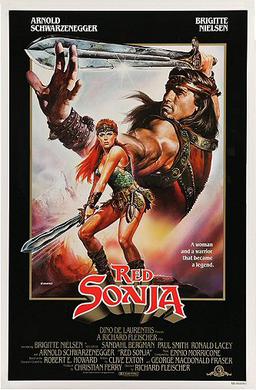
The TSL’s Grindhouse: Red Sonja (dir by Richard Fleischer)


The 1985 film, Red Sonja, invites us to take a journey to a forgotten age, a time of a mythical kingdoms, evil sorcery, epic sword fights, and annoying little child kings who spent a lot of time shouting.  It’s a time of wonder, danger, heroism, and, of course, Arnold Schwarzenegger.

Reportedly, the once and future governor of California has frequently named Red Sonja as being the worst film in which he ever appeared.  When you consider some of the other films that have featured Gov. Schwarzenegger, that’s indeed a bold statement.  In Red Sonja, Schwarzenegger plays Lord Kalidor.  Interestingly enough, Lord Kalidor is absent for the majority of the film.  He shows up briefly at the beginning of the film and then he vanishes for quite a bit of Red Sonja‘s 89-minute running time.  Whenever Schwarzenegger does show up, he wears the smirk of a man who knows that he’s going to get paid a lot of money for doing very little actual work.

The majority of the film focuses on Sonja (Brigitte Nielsen), a warrior who lives in one of those vanished ages, perhaps after the War of the Rings but before the sinking of Atlantis.  When we first see her, she’s being spoken to by what appears to be a puff of smoke, which is apparently meant to be some sort of warrior goddess.  The puff of smoke fills tells Sonja about everything that happened to her before the start of the movie, though we never do learn why Sonja needs to be told her own backstory.  After rejecting the sexual advances of the evil Queen Gedren (Sandahl Begman), Sonja was forced to watch as her parents and brother were murdered and then she was raped and left for the dead by the Gedren’s soldiers.  The Goddess promises to make Sonja into a superior warrior, on the condition that Sonja agree to never have sex with a man unless that man can first beat her in fair combat.  Sonja agrees and is sent off to get trained by the Grand Master.  It’s kinda like Kill Bill, if Bill was a puff of smoke.

Jump forward to …. well, I’m not sure how many years pass.  To be honest, it’s next to impossible to really discern any sort of coherent logic to the film’s narrative progression so let’s just give up on that.  What’s important is that there’s this temple and, inside the temple, there’s a glowing green talisman.  Apparently, the talisman created the world but now it needs to be carefully watched over before being destroyed.  Only women are allowed to handle the talisman (Yay!) but they’re not allowed to destroy it unless directed by a man.  (Booooo!)  The temple priestesses are waiting for Lord Kalidor to arrive so that they can get rid of the talisman.  However, Queen Gedren shows up first.  Not only does she steal the talisman but she kills the priestesses as well.

One of the priestesses was Varna (Janet Agren, who you might recognize from Lucio Fulci’s City of the Living Dead).  Varna just happens to be the sister of Sonja.  (Sonja is now known as Red Sonja, because she had red hair.  From now on, I want to be known as Red Lisa.)  Now, Sonja has yet another reason to want to kill Gedren!  Rejecting Kalidor’s help, Sonja heads off for revenge.  Along the way, she meets an annoying child king named Tarn (Ernie Reyes, Jr.), who is upset that Gedren previously destroyed his kingdom.  Despite hating him, Sonja allows Tarn and his guardian, Falkon (Paul L. Smith), to tag along with her.  Despite not being an official member of the revenge party, Kalidor decides to follow after them because he wants to beat Red Sonja in fair combat, if you get what I mean.

Red Sonja is a spectacularly silly film.  The dialogue is stilted.  Even by the standards of the 1980s ,the special effects are poorly executed.  This the type of film where the evil Queen nearly destroys the world not because she has any sort of grand scheme but instead, just because she’s evil and that’s what evil people do.  Brigitte Nielsen delivers her lines with a forced solemnity while Schwarzenegger, Bergman, and the great Paul L. Smith seem to be struggling not to start laughing.

And yet, there’s a sneaky charm to be found in all of the silliness.  For instance, when Sonja does finally reach the queen’s castle, she has to cross a bridge that appears to basically be the skeleton of giant rhinoceros.  No none in the film seems to be surprised to come across a skeleton a giant rhinoceros and, to be honest, there’s no reason for it to be there.  It’s just there and it’s so wonderfully out-of-place that it becomes rather fascinating.  Add to that, while the portrayal of the evil lesbian queen is problematic in all sorts of ways, this is a film about a strong female warrior who doesn’t need a man to rescue her and that was probably even more rare in 1985 than it is today!

Watching Red Sonja, you get the feeling that nobody involved in the film took it all that seriously and that perhaps the best way to handle the movie is to just sit back and have a laugh.  It’s dumb, it’s campy, it often makes no sense but, at the same time, it’s still a lot easier to follow than Game of Thrones.   Like many bad films, it’s only bad if you watch it alone.  Watch it with a group of your snarkiest friends and you’ll have a totally different experience.

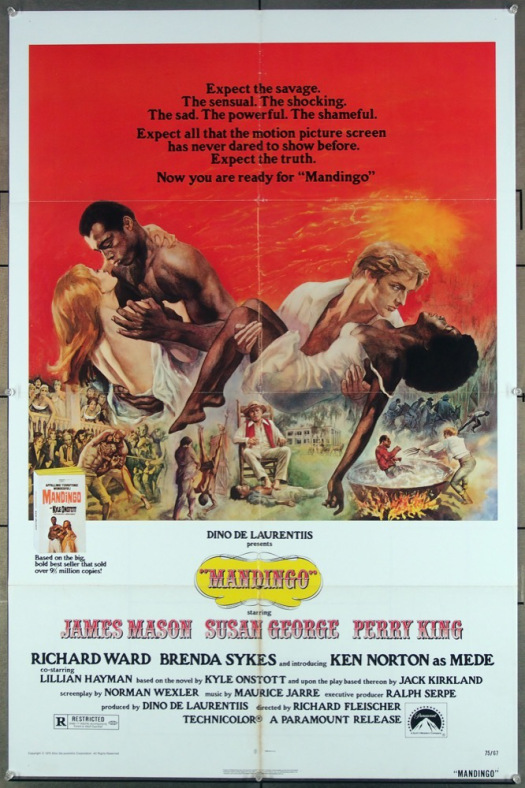
Gone With The Whaaat?: MANDINGO (Paramount 1975)


gary loggins's avatarcracked rear viewer

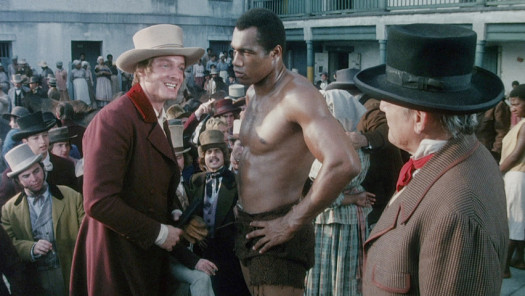
If you’ve never seen MANDINGO, be prepared for loads of gratuitous sex, violence, debauchery, depravity, racism, incest, nudity, and other such unsavory stuff! Some people today discuss the film in a scholarly manner, dissecting the sociological implications of pre-Civil War decadence in the deep South, the plight of the abused slaves, the overindulgent cruelty of the slave owners, and blah blah blah. I’m gonna talk about what the movie really is: pure, unadulterated Exploitation trash, in which some scenes will have your jaw dropping in shock, while others will leave you laughing at the exaggerated overacting and ludicrous dialog!

The movie centers around the Maxwell family and their plantation home, Falconhurst. It’s no Tara; Falconhurst is a run-down, gloomy, decrepit mansion that looks like it belongs in one of those “hillbilly horror” schlockfests of the 60’s or 70’s. Family patriarch Warren Maxwell wants a grandson to carry on the family…

View original post 771 more words

Dirty Deeds Done Dirt Cheap: ARMORED CAR ROBBERY (RKO 1950)


gary loggins's avatarcracked rear viewer

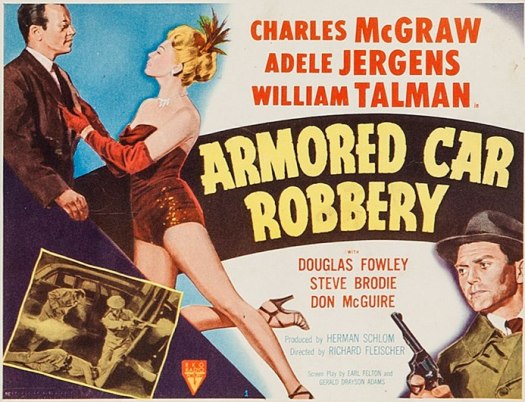
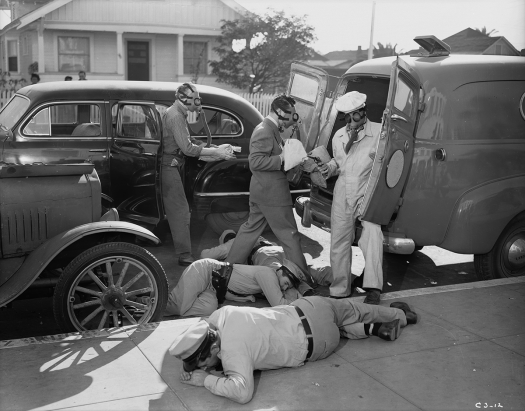
Looking for a tough, no-frills ‘B’ crime drama? Look no further than ARMORED CAR ROBBERY, which is just what it says it is, the planning, execution, and aftermath of said dirty deed, with a cast of rugged mugs and hard-hearted dames directed by Richard Fleischer during his salad days at RKO. The movie echoes Robert Siodmak’s CRISS CROSS in its heist scene, and I’m sure Stanley Kubrick watched and remembered it when he made his film noir  masterpiece THE KILLING .

Make no mistake, ARMORED CAR ROBBERY isn’t on a par with those two films. It is, however, an enjoyable little 67 minutes of cops vs crooks. Criminal mastermind Dave Purvis assembles a gang of low-lives to pull the caper off, killing a cop in the process. The cop’s partner, Lt. Jim Cordell, is now determined to hunt the crooks down and avenge him. One of the participants, Benny McBride…

View original post 402 more words

Film Review: Barabbas (dir by Richard Fleischer)


Who was Barabbas?

The simple answer to that is that Barabbas was the prisoner who, according to the Gospels, Pontius Pilate released during Passover.  As the story goes, Pilate gave the people the choice.  He could either release Barabbas or Jesus.  For what crime was Barabbas being held?  The Gospel of Matthew merely says that Barabbas was a “notorious prisoner.”  Mark and Luke both write that he was involved in a recent riot and that he was a murderer.  The Gospel of John refers to him as being a bandit, which may have been another term for revolutionary.  Regardless of what crime he had committed, the people overwhelmingly called for Barabbas to be released and for Jesus to be crucified.  What happened to Barabbas after he was set free is not recorded but has been the subject of a good deal of speculation over the centuries.

(Of course, there are some scholars who believe that the Barabbas story was simply an invention of later writers, designed to shift the responsibility for the crucifixion away from the Romans.  There’s also some who say that Jesus and Barabbas were actually the same person and that the inclusion of the Barabbas story was meant to indicate that Jesus was actually a revolutionary who was working to free Judea from Roman role.  I imagine Dan Brown will eventually base a novel on this theory, so look forward to hearing your grandma debating the historicity of Barabbas at some point in the future.)

Back to the original question, who was Barabbas?

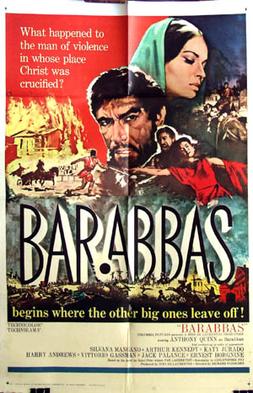
According to the 1961 film of the same name, Barabbas was Anthony Quinn.

Based on a novel by the Nobel Prize-winning Swedish author, Pär Lagerkvist, Barabbas opens with Pilate (Anthony Kennedy) making his infamous offer.  Barabbas or Jesus?  Perhaps the only person more shocked than Pilate by the people’s decision is Barabbas himself.  A brutish and violent man, Barabbas is looking forward to returning to his old life but, as he leaves the prison, he finds himself fascinated by the sight of Jesus stoically carrying the cross, heading to the fate that Barabbas was spared.  Later, Barabbas witnesses the Crucifixion and is shaken when, upon Jesus’s death, the sky turns black.

(Director Richard Fleischer shot the Crucifixion during an actual solar eclipse, so that the sky actually did turn black during filming.  It’s a stunning scene.)

For the rest of his life, Barabbas is haunted by both his narrow escape from death and his subsequent notoriety.  When Barabbas tries to reunite with his former lover, Rachel (Silvana Mangano), he discovers that not only does she now want nothing to do with him but that she has also become a follower of Jesus.  (Later, in a surprisingly graphic scene, Rachel is stoned to death.)  Barabbas becomes convinced that he cannot die and he becomes increasingly reckless in his behavior.  Over the next few decades, he finds himself sold into slavery and forced to spend 20 years working in the harsh sulfur mines of Sicily.  He befriends a Christian named Sahak (Vittorio Gassman) and, with him, is trained to be a gladiator by the sadistic Torvald (Jack Palance).  Eventually, Barabbas finds himself rejected by both the Romans and the Christians while Rome burns all around him.

Barabbas is a film that really took me by surprise.  I’ve seen a lot of Biblical and Roman films from the 50s and 60s and I was expecting that Barabbas would be another sumptuously produced but slow-paced epic, one that would inevitably feature stiff dialogue and overly reverential performances.  I mean, don’t me wrong.  I happen to love spectacle and therefore, I enjoy watching most of those old historical and religious epics.  But still, for modern audiences, these films can often seem rather … well, hokey.

But Barabbas was totally different from what I was expecting.  As wonderfully played by Anthony Quinn, Barabbas wanders through most of the film in a state of haunted confusion.  Even at the end of the film, after he’s met St. Peter (Harry Andrews), Barabbas doesn’t seem to fully understand what he believes or how he’s become one of the most notorious men in Rome.  Quinn plays Barabbas almost like a wild animal, one that has been cornered and trapped by his own infamy.  The more Barabbas struggles against his fate, the more trapped he becomes.  Barabbas may be a brute but, the film suggests, even a brute can find some sort of redemption.  Quinn gets good support from the entire supporting cast.  Jack Palance is perfectly evil as Torvald while Vittorio Gassman, Silvana Mangano, and Ernest Borgnine bring some needed nuance to characters who, in lesser hands, could have just been cardboard believers.

Barabbas is a surprisingly dark film.  When Rachel is stoned, the camera doesn’t flinch from showing just how cruel an execution that was.  Nor does the camera flinch from the violent brutality of the gladiatorial games.  When Barabbas is sold into slavery, the sulfur mines of Sicily are depicted in Hellish detail and practically the only thing that saves Barabbas from spending the rest of his life being smothered under a cloud of sulfur is a giggly Roman woman who decides to buy Barabbas so that he can serve as a good luck charm.  The scenes of Barabbas’s skill of a gladiator are contrasted with the bloodthirsty crowd demanding and cheering death.  Even when Barabbas joins the Christians in the Roman catacombs, he discovers that they want nothing to do with him, suggesting that they believe in forgiveness for everyone but him.  The spectacle of Rome is displayed but so is the terror of what lies underneath the city’s ornate surface.  If Barabbas is occasionally a ruthless or unsentimental character, one need only look at the world he lives in to understand why.

With the exception of a few slow scenes at the start of the film, director Richard Fleischer does a good job of keeping the action moving.  It’s a long film but it never becomes a boring one.  In the end, thanks to Quinn’s performance and the film’s unflinching portrayal of life in ancient Rome, Barabbas is a biblical epic for people who usually don’t like biblical epics.


A Movie A Day #293: See No Evil (1971, directed by Richard Fleischer)


After a rain, a car drives through a puddle and splashes mud on a man’s designer boots.  The owner of the boots follows the car back to a country manor and murders everyone inside.  (Did he really kill everyone in the house because his boots get muddied?  It is never really clear.  Before his boots got splashed on, he was looking at violent comic books in a shop.  Maybe Wertham was right.)  Later, Sarah (Mia Farrow), the niece of the car’s driver, arrives at the house.  As the result of a recent horse riding accident, Sarah is blind.  She walks through the house, unaware that she is surrounded by dead bodies and unaware that the owner of the boots left behind a bracelet that he will soon be returning to retrieve.
Obviously inspired by Wait Until Dark, See No Evil is a well-done cat-and-mouse game between Sarah and her unseen stalker.  Mia Farrow is great as the blind woman and the scenes of her unknowingly walking past the dead bodies of her family while being followed are tense and suspenseful.  See No Evil has been overshadowed by Farrow’s other two horror films, Rosemary’s Baby and Full Circle, but it is definitely worth a look.

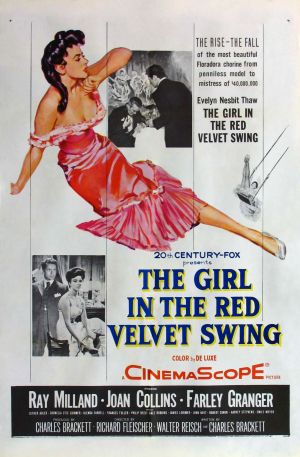
Lisa Cleans Out Her DVR: The Girl In the Red Velvet Swing (dir by Richard Fleischer)


(Lisa is currently in the process of cleaning out her DVR!  How long is it going to take?  Forever!  For instance, she recorded 1955’s The Girl In the Red Velvet Swing off of FXM on February 1st and has now gotten around to actually watching and reviewing it.)

The story of Evelyn Nesbit is an interesting one, even if it is now a largely forgotten one.

In 1901, Evelyn Nesbit was a showgirl in New York City.  While she always claimed that she was 16 at the time, there are some historians that think it more likely that she was only 14.  One night, the beautiful Evelyn was introduced to Stanford White.  At the time, White was 47 years old and the most successful and prominent architect in New York City.  White was also a notorious womanizer and Evelyn soon became his latest mistress.  He moved her into one of his many apartments.  Years later, when the details of their relationship became public knowledge, people were shocked to hear that Stanford White kept a red velvet swing in the apartment and that he enjoyed watching Evelyn swing back and forth.  They would be even more scandalized by the news that Stanford also had a “mirror room.”  As Evelyn would later testify, she “entered the room a virgin” but did not come out as one.

Though Evelyn occasionally claimed that she and Stanford were truly in love, she never married him.  (Indeed, Stanford White apparently never married anyone over the course of his life.)  Instead, she ended up meeting and marrying Harry K. Thaw.  Harry was the heir to a 40 million dollar fortune.  He also had a long history of mental illness.  When he learned that, before meeting him, Evelyn had lost her virginity to Stanford White, he was outraged.

(It’s debatable how well Stanford and Harry knew each other.  Some historians claim that they were barely acquainted.  Other accounts claim that Harry and Stanford were business rivals even before Evelyn Nesbit arrived in New York.)

In 1906, Harry and Evelyn ran into Stanford White at Madison Square Garden.  Harry promptly pulled out a pistol and, in front of hundreds of witnesses, shot Stanford dead.

Harry’s subsequent trial was reportedly the first to ever be described as being “the trial of the century.”  Because hundreds of people had seen Harry Thaw shoot Stanford White and the Thaw family was adamant about not publicizing Harry’s history of mental illness, Harry’s defense team attempted to make the trial about Stanford White.  The defense attempted to portray Stanford as being such a depraved predator that Harry really had no other option but to shoot him in cold blood.  Evelyn took the stand and testified to every single detail of her relationship with Stanford White.  The details appeared in every major newspaper in America.

In the end, Harry was found not guilty by reason of insanity and was committed to the  Matteawan State Hospital for the Criminally Insane.  (Reportedly, due to his great wealth, he had the best room in the hospital.)  Meanwhile, Evelyn became one of America’s first reality stars.  Her notoriety led to her appearing in several silent films.  It’s a fascinating story, one that very much feels ahead of his time.  If Evelyn was a star in 1906, just imagine how famous she would be today.

The Girl in the Red Velvet Swing is about Evelyn Nesbit and her relationships with both Stanford White and Harry Thaw.  It’s a shame that the film isn’t as interesting as the real life story.  Ray Milland plays Stanford White.  Farley Granger is Harry Thaw.  Joan Collins is Evelyn Nesbit.  They all give good performances, especially Farley Granger.  But the film itself is just so bland.  Perhaps because it was made in the 1950s, it leaves out the majority of the sordid details that made the story so fascinating to begin with.  For instance, the red velvet swing appears but, in this film, no time is spent in the mirror room.  This true life story is pure tabloid material but The Girl In The Red Velvet Swing is way too respectful for its own good.  By refusing to come down firmly on the side of Harry Thaw or Stanford White, the film feels shallow and a bit empty.  (All good melodramas — even fact-based ones — need a good villain.)  And poor Evelyn Nesbit!  In real life, she was a savvy self-promoter who knew exactly how to manipulate the press.  In this film, she’s just an innocent ingenue.  Considering the facts of the case, the film version is unforgivably dull.

So, I don’t recommend The Girl In The Red Velvet Swing but I do recommend Paula Uruburu’s fascinating 2008 biography, American Eve: Evelyn Nesbit, Stanford White, The Birth of the ‘It’ Girl, and the ‘Crime of the Century.’  It goes into all of the fascinating details that were left out of this film.

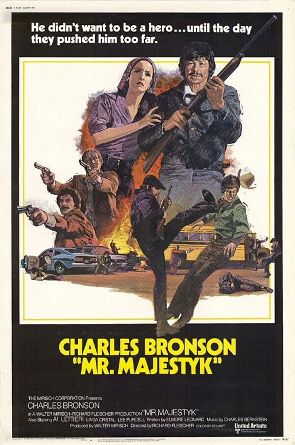
More Of Bronson’s Best: Mr. Majestyk (1974, directed by Richard Fleischer)


Mr_Majestyk_movie_posterWhat happens when you combine the great tough guy writer Elmore Leonard with the great tough guy actor Charles Bronson?
You get Mr. Majestyk, one of Bronson’s finest films.

Vince Majestyk (Bronson) may be a former U.S. Army Ranger instructor and a decorated Vietnam vet but now that he has returned home to Colorado, all he cares about is running his watermelon farm.  With a lucrative harvest approaching, Majestyk hires a group of unionized Mexican migrant workers, led by the fiery Linda Chavez (Linda Cristal), to pick his crops.  When a local criminal named Bobby Kopas (Paul Koslo) shows up and demands that Majestyk hire his drunken crew instead, Majestyk does what Bronson does best.  He gives Kopas an ass-kickin’ beat down.

After Kopas charges him with assault, the local police arrest Majestyk and, despite his request that he be allowed three days to finish harvesting his crop, Majestyk is thrown in jail.  Also in the jail is a Mafia hitman named Frank Renda (Al Lettieri).  Renda may be a tough guy but nobody’s tougher than Vince Majestyk.  When Renda’s associates attempt to hijack a prison bus, Majestyk ends up hijacking it instead.  Majestyk plans to hold Renda hostage until the police agree to give him his three days of freedom so he can get back to his farm.  Renda even offers to pay him off but Majestyk doesn’t care about his money.  He just cares about melons.

Because he was the only 1970s action star who could be believable as both a decorated combat veteran and a no-nonsense watermelon farmer, Charles Bronson is the only actor who could have brought Mr. Majestyk to life.  Before he became an actor, Bronson worked for a living.  From the age of ten until he enlisted in the Army, Bronson worked in the Pennsylvania coal mines, earning one dollar for each ton of coal that he mined.  Though Bronson was never a great actor, his legitimately working class background allowed him to bring an authenticity to a role like Vince Majestyk that most other actors would have lacked.  When Bronson says that all he cares about is bringing in the harvest on time, you believe him just as much as you believe him when he’s beating up Paul Koslo or hijacking a prison bus.

The rest of the cast is full of good 1970s actors who have never really been given their due.  Al Lettieri may be best known for playing Sollozzo in The Godfather but he also does a good job as Frank Renda.  Paul Koslo plays another one his sleazy villains here and does a great job as Bobby Kopas.

Mr. Majestyk was directed by Richard Fleischer but, with its colorful characters, working class hero, and modernized brand of frontier justice, the film is clearly the work of Elmore Leonard. Though Mr. Majestyk is credited as being based on a novel by Leonard, Leonard actually wrote the screenplay before the novel.

The combination of Elmore Leonard and Charles Bronson makes Mr. Majestyk one of the best action films of the 1970s.

majestyk_rifle


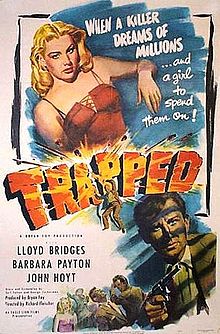
The Fabulous Forties #6: Trapped (dir by Richard Fleischer)


220px-Trapped_1949

After being disappointed with Guest In The House, I decided to go ahead and watch the sixth film in Mill Creek’s Fabulous Forties box set and I’m glad that I did.  1949’s Trapped turned out to be an entertaining little discovery.

Much like Port of New York, Trapped opens with documentary footage of the government at work and an official sounding narrator explaining to us that we are about to see a film about the hardworking agents of the Treasury Department.  In fact, the narrator goes on for so long about the Treasury Department that he starts to sound downright worshipful.  There’s nothing that the Treasury Department cannot do!  Who protects the President?  The Treasury Department!  Who tracks down counterfeiters?  The Treasury Department!  Who protects the coast?  The Coast Guard but guess what? The Coast Guard is actually a part of The Treasury Department!  The tone of the narration is so worshipful that it could almost pass for a Scientology recruiting film.  Just as only the Sea Org can protect us from Evil Lord Xenu, only the Treasury Department can stop phony money pushers!

Eventually, the narration ends and the actual movie begins.  Fortunately, the rest of Trapped more than makes up for that awkward introduction.  The film opens with a bunch of Treasury agents looking over a phony twenty-dollar bill.  The bill is almost perfect and the agents believe that it was printed using plates designed by one of the world’s greatest counterfeiters, Tris Stewart (Lloyd Bridges).  The only problem is that Stewart is in prison.  Obviously, someone else has gotten their hands on Stewart’s plates.

Stewart is upset that someone is getting rich off of his work.  So, he strikes a deal with the Treasury Department.  In return for being released, he will help them track down his plates.  The Treasury Department agrees and arranges for Stewart to “escape” during a phony prison break.

However, Stewart has plans of his own.  As soon as he’s out of jail, he knocks out his handler and escapes for real.  Tris is not only planning on tracking down his plates but he’s also going to go back into business printing and passing phony money.  He also reunites with his girlfriend, nightclub hostess Meg Dixon (Barbara Payton).

When he meets Meg, he discovers that she has a new admirer.  Johnny Hackett (John Hoyt) likes to hang out whenever Meg’s working.  Even though Johnny appears to have a thing for Meg, he and Tris still become friends.  Tris is even willing to bring Johnny in on the operation but, what Tris doesn’t realize, is that Johnny Hackett is actually Treasury agent John Downey (John Hoyt)…

Needless to say, violence, betrayal, and death follows.

Shot on location in some of the seediest parts of 1940s Los Angeles, Trapped is a fast-paced and exciting film noir.  (This is one of those films, like The Black Book, where shadows are literally everywhere.)  Lloyd Bridges (who, as a young man, could have passed for Kirk Douglas’s brother) gives a great performance as the charming but ultimately cold-hearted Tris Stewart while John Hoyt does a fairly good job as the conflicted Downey.  Barbara Payton, one of the more tragic figures from Hollywood’s Golden Age, does such a good job as Meg that it’s even more tragic to consider that, just a few years after making Trapped, her career would be destroyed by alcoholism and personal scandal and she would eventually end up as a homeless prostitute on Sunset Boulevard.

Trapped was a good discovery and you can watch it below!