Lisa Cleans Out Her DVR: Change of Habit (dir by William A. Graham)


(Lisa is currently in the process of cleaning out her DVR!  How long is it going to take?  Some would say forever but, here at the Shattered Lens, we’re hoping that she might have it all done by August.  Anyway, she recorded the 1969 film Change of Habit off of Starz on March 20th!)

It’s Elvis vs. God for the heart of Mary Tyler Moore!

(Okay, so that may be a little bit glib on my part but, seriously, that pretty much sums up Change of Habit.)

Change of Habit opens with three nuns walking through New York City.  There’s the forgettable nun, Sister Barbara (Jane Elliott).  There’s the black, streetwise nun, Sister Irene (Barbara McNair).  And then there’s the idealistic and wholesome nun, Sister Michelle (Mary Tyler Moore).  Because they’re nuns, even notoriously rude New Yorkers are nice to them.  They walk across a busy intersection and all of the cars stop for them.  A cop sees them jaywalking and just smiles and nods at them.  In case you were ever wondering why someone would become a nun, it’s because nuns always have the right-of-way and they don’t have to obey arbitrary laws.  It’s a good life.

The sisters are shopping and, as the opening credits roll, the three of them duck into a dressing room and change into contemporary civilian clothing.  Obsessively, the camera keeps zooming in on everyone’s bare legs.  You can literally hear the film’s producers telling all the boys in the audience, “This may be a G-rated Elvis film but that’s not going to stop us from implying nun nudity!”

It’s Sister Michelle’s idea that the nuns should wear contemporary clothing, the better to relate to the Godless youth of the 1960s.  Unfortunately, now that they’re dressed like everyone else, they have to actually obey traffic laws.  When they attempt to cross the street for a second time, cars honk at them and the cop yells at them for jaywalking.

Michelle, Irene, and Barbara get jobs working at a free clinic.  The clinic is run by John Carpenter (Elvis Presley).  Carpenter is looking for aspiring actresses to appear in a movie about a babysitter being stalked by a masked murderer on Halloween and … oh sorry.  Wrong John Carpenter.  This John Carpenter is a no-nonsense doctor who will stop at nothing to bring peace and good health to the most poverty-stricken neighborhoods in New York!

That’s right.  It’s an Elvis film with a social conscience!

And that probably sounds like a joke but Change of Habit‘s heart is in the right place.  It’s intentions are good.  At least a few of the people involved in the film were probably trying to make the world a better place.  There’s a subplot involving an autistic child that, when you consider this film was made in 1969, is handled with unusual sensitivity.  Of course, that doesn’t mean that the rest of Change of Habit doesn’t feel totally and completely out-of-touch.  The entire film feels so dated that I imagine it probably even felt dated when it was initially released.  This is one of those films where the local black militants give Sister Irene a hard time about being a sell-out, just to eventually admit, during a block party, that maybe white folks aren’t so bad after all.  By the end of the movie, they’re even joking with the cops.  All that was needed was for Elvis to sing a song or two.  To be honest, there are times when Change of Habit feels like the 1969 version of Kendall Jenner’s Pepsi commercial.

Of course, the majority of the film deals with Elvis falling in love with Mary Tyler Moore.  He doesn’t know that she’s a nun and, as she falls in love with him, she’s forced to make a difficult choice.  Does she follow God or does she follow Elvis?  Actually, the film ends before she officially makes that choice but there’s little doubt as to what she’s going to eventually do.  In his final non-concert film appearance, Elvis is totally miscast as a serious-minded doctor and, it must be said, he looked miserable throughout the entire film.  You get the feeling he’d rather be doing anything than starring in Change of Habit.  (Maybe he was already thinking about how much he wanted a special FBI badge.)  Mary Tyler Moore is a bit more believable as a nun.  Fortunately, both Moore and Elvis were likable performers and their likability makes Change of Habit, as ludicrous as it often is, far more watchable than it has any right to be.

In the end, Elvis may not have saved society but he did get to sing a gospel song or two.
Horror on TV: Thriller 2.26 “Kill My Love” (dir by Herschel Daugherty)


Tonight’s excursion into televised horror is Kill My Love, an episode of Thriller that originally aired on March 26th, 1962!

In this episode, Richard Carlson plays Guy Guthrie.  To the outside world, Guy looks like the perfect husband and father.  However, he’s actually a cruel sociopath.  When his mistress threatens to expose him, he murders her.  When his wife realizes what Guy has done, he murders her as well.

But then Guy’s beloved son (David Kent) starts to figure out what his father has done and Guy is forced to decide just how far he’s willing to go to hide his secrets…

This episode, of course, is introduced by the one and only Boris Karloff!

Enjoy!

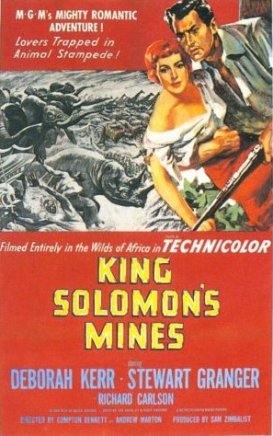
Lisa Reviews An Oscar Nominee: King Solomon’s Mines (dir by Compton Bennett and Andrew Marton)


Kingsolomonsmines1950

So, this is a weird one.

As we all know, today is Oscar Sunday!  As I wait for the big show to begin, I’ve been watching some of the Oscar-nominated films that I have collected on the DVR over the past month.  For instance, this morning, I watched 1950’s King Solomon’s Mines.

King Solomon’s Mines was nominated for best picture of the year and watching it … well, you really have to wonder why.  It’s an adventure film, one that was shot on location in Africa and it features a lot of footage of wild animals.  It also features several scenes that were shot in actual African villages and a good deal of time is devoted to documenting tribal rituals.  It’s true that the film has a plot but, for the most part, it’s a travelogue.  One gets the feeling that it was mostly sold as a chance for American and European audiences to see a part of the world that, up until that point, they had only read about.  Not only would they get to experience Africa from the safety of the neighborhood movie theater but they’d get to see it in a color as well!

(Seriously, it’s difficult to watch the nature footage in King Solomon’s Mines without imagining a serious voiced narrator saying, “However, one gazelle has strayed too far from its mother.  The lion cubs will eat tonight…”)

As for the plot, King Solomon’s Mines is based on a novel by British adventure enthusiast H. Rider Haggard.  Allan Quartermain (Stewart Granger) is an experienced guide and hunter.  When we first meet him, he’s helping two rich Englishmen hunt an elephant.  It’s a disturbing scene, largely because it’s obvious the footage of the elephant dying is real.  Allan prevents his clients from killing more than one elephant and later talks about how much he hates his job but still, it’s pretty much to impossible to really like him after watching that elephant die.

Anyway, Allan gets hired by Elizabeth Curtis (Deborah Kerr) and her brother John (Richard Carlson).  It seems that Elizabeth’s husband disappeared in Africa while searching for a legendary treasure.  Allan tells Elizabeth that her husband is probably dead.  Elizabeth still insists on searching for him…

…and, from that point on, you can pretty much predict everything that is going to happen.  Though the footage of Africa looks great, it’s just not a very interesting film.  Playing the type of role that would probably be played by Gerard Butler if the movie was made today, Stewart Granger comes across as being bored with it all.  For that matter, even the great Deborah Kerr seems as if she’d rather be hanging out with Robert Mitchum.

Still, it is interesting to note that Hugo Haas shows up as a villain.  Who is Hugo Haas?  He was a Hungarian actor who, after playing a bad guy here, went on to direct several idiosyncratic B-movies, like Hold Back Tomorrow, The Girl On The Bridge, Bait, and One Girl’s Confession.  If nothing else, watching King Solomon’s Mines has inspired me to, someday, do a little Hugo Haas film festival here on the Lens.

King Solomon’s Mines seems like an odd best picture nominee.  Its triumphs are largely technical and even those successes no longer seem that special.  It was, however, a big hit at the box office and I imagine that probably has something to do with its nomination.  However, when the Oscars were awarded, best picture went to All About Eve.

Stewart Granger was no match for Bette Davis.

Horror on The Lens: The Maze (dir by William Cameron Menzies)


For today’s Horror on the Lens, we offer up The Maze, a film from 1953 that originally released in 3D.

Directed by noted set designer William Cameron Menzies, The Maze is an atmospheric haunted castle story, one that will prevent you from ever looking at a frog the same way again.  A few months ago, I watched this with my friends in the Late Night Movie Gang and we all greatly enjoyed it.

As I watched The Maze, I couldn’t help but think about some of the truly impressive hedge mazes that I made in my Sims game.  Of course, I always placed some fireworks at the end of the maze, which, unfortunately, often led to both the maze and my sims being consumed by fire.  Oh well.

Anyway, enjoy The Maze!

http://www.youtube.com/watch?v=Cp_6Bw_uHBc

Lisa Watches An Oscar Nominee: The Little Foxes (dir by William Wyler)


Little_foxesThat Bette Davis was an amazingly talented actress is something that we all already know.

However, she has become such an iconic figure that I think that it’s easy to forget just how versatile she could be.  She was ferocious in Of Human Bondage.  She was poignant in Dark Victory.  She was majestic in All About Eve.  Even when she eventually ended up appearing in stuff like Burnt Offerings, she still managed to command the screen.  Of course, nobody played evil with quite the style and power as Bette Davis at her prime.  And if you ever have any doubt about that fact, I would suggest watching the 1941 Best Picture nominee, The Little Foxes.

Based on a play by Lillian Hellman, The Little Foxes is a dark Southern melodrama that takes place in 1900.  The once mighty Hubbard Family has fallen on hard times.  Brothers Benjamin (Charles Dingle) and Oscar (Carl Benton Reid) have inherited their father’s money and Oscar has made himself even more wealthy by marrying the poignant alcoholic Birdie (Patricia Collinge).  However, when Oscar and Benjamin decide that they want to build a cotton mill, they discover that, even with their own fortunes, they are still $75,000 short.

They turn to their sister, Regina (Bette Davis).  As quickly becomes obvious, Regina is a hundred times more intelligent and clever than either one of her brothers.  However, because she’s a woman, Regina was not considered to be a legal heir to their father’s fortune.  As a result, after his death, she was left penniless.  In order to survive, Regina had to marry the wealthy but sickly Horace (Herbert Marshall).  When Regina asks Horace for the $75,000, Horace refuses.  He wants nothing to do with either one of her brothers.

With the reluctant help of Oscar’s son, Leo (Dan Duryea), the brothers steal the money straight from Horace’s bank account.  Regina, however, finds out about the theft and schemes to blackmail her two brothers….

For the majority of the film, you are totally on Regina’s side.  Despite the fact that Regina is ruthless and obviously taking advantage of Horace’s weakened state, you find yourself making excuses for her.  Her brothers are both so sleazy and greedy and Regina is so much smarter than her idiotic siblings that the film occasionally feels like a dark comedy.  It’s fun watching her get the better of them and you find yourself assuming (and hoping) that Regina will somehow be redeemed by the end of the movie.

And then it happens.

Aware of both Regina’s scheme and the fact that she never loved him, Horace announces that he’s going to change his will and he’s going to leave his entire fortune to their daughter, Alexandra (Teresa Wright, in her Oscar-nominated film debut).  He also tells Reginia that he’s going to say that he lent Leo the money, which would make it impossible for her blackmail scheme to work.

It’s while they’re arguing that Horace suddenly suffers a heart attack.  And as Horace struggles to climb up a staircase so that he can get his medicine, Regina calmly sits in a chair and shows not a hint of emotion as he dies.  It’s such an unexpected and effective moment, largely because Bette Davis’s performance was so good that it kept both the viewer and Horace from realizing just how monstrous Regina truly was.

It’s hard to think of any contemporary actress who could so totally and believably embody a character of Regina Gibbons.  It takes courage to commit so fully to playing such an evil and hateful character.  Bette Davis had that courage and her performance alone makes The Little Foxes worth watching.

The Daily Drive-In: The Creature From The Black Lagoon (dir. by Jack Arnold)


As anyone who knows me can tell you, Lisa Marie doesn’t do water.

Seriously, I have a very intense fear of drowning and, while I might enjoy laying out by the pool during the summer, you’re never going to catch me actually going anywhere near the deep end.  I’m the epitome of the girl who loves the beach but hates the ocean.  As a result, I have a hard time with movies the feature swimmers thrashing about in the water or ancient monsters coming up to the surface in search of swimsuit-clad victims.

For lack of a better term, these films freak me out.

Sometimes, however, it’s fun to be freaked out.  Perhaps that’s why I so love the 1954 monster classic, The Creature From The Black Lagoon.

Like all good B-movies from the 1950s, The Creature From The Black Lagoon starts off with a lot of stock footage and a stuffy narrator telling us about how the Earth was created and how mankind originally evolved from a creature that crawled out of the sea.  The narrator manages to cover all the bases by including a few Biblical quotes with his explanation of how evolution works.

From the beginning of mankind, we fast forward to the 1950s.  A fossilized claw has been discovered in the Amazon and a group of scientists think that it could be evidence of the missing link in human evolution.  Mark (Richard Denning), who is kind of a jerk, funds an expedition to the Amazon to search for more evidence.  Accompanying Mark is hunky young scientist David (Richard Carlson) and David’s girlfriend, Kay (Julie Adams).  Traveling on a boat captained by the rather gruff Lucas (Nestor Paiva), they go to the camp where the fossil was originally discovered.  However, once they arrive, they discover that everyone in the camp has been killed.  Lucas suggests that the camp was attacked by a jaguar.

Lucas, needless to say, is totally incorrect.  The film isn’t called The Jaguar From The Black Lagoon.  It’s called The Creature From The Black Lagoon and the creature, also known as the Gill-Man (played by Ben Chapman when on land and by Ricou Browning whenever he’s underwater), is none too happy about these strangers invading his home.  Soon, the Gill-Man is stalking the expedition as they move up and down the Amazon River.

The Creature From The Black Lagoon is probably best known for the dream-like sequence in which Kay, wearing a white bathing suit that is simply to die for, swims in the Amazon River without realizing that the Creature is following just a few feet below her.  This scene (which does little to help with my aquaphobia) is one of the most iconic in the history of monster cinema.  Expertly framed by director Jack Arnold, this scene is distinguished by the graceful movement of both Julie Adams and Ricou Browning.  It’s as close as a monster movie has ever gotten to duplicating ballet.

Ultimately, like all good monster films, the Creature from the Black Lagoon is on the side of the monster.  The members of the expedition are, for the most part, interchangeable and, when the Gill-Man attacks, he’s acting more out of self-defense than out of hostility.  The expedition, after all, has invaded his home.  Like many 50s B-movies, the theme for The Creature From The Black Lagoon is not that people should be careful while investigating mysteries but that most mysteries are best left unsolved.

When you combine one of the genre’s most iconic monsters with Jack Arnold’s atmospheric direction, the end result is one of the best B-movies ever made.