Film Review: The Death of Stalin (dir by Armando Iannucci)


2017’s The Death of Stalin opens in Moscow in 1953.  Joseph Stalin (Adrian McLoughlin) calls into Radio Moscow and demands that he be sent a recording of the piano concerto that has just been performed live.  The only problem is that no one bothered to record it while it was being performed.  In a panic, the head of Radio Moscow announces that no one — not the musicians, not the exhausted conductor, and certainly not the audience — is allowed to leave until the orchestra has performed again.

Indeed, one of the recurring themes of The Death of Stalin is that everyone is terrified of their beloved dictator.  The orchestra fears being executed for failing to recreate their performance.  The members of the Central Committee fear being the next person to be purged from the ranks of Stalin’s government.  The two guards that are posted outside of Stalin’s bedroom are so terrified of interrupting Stalin and getting on his bad side that they don’t investigate when they hear Stalin collapsing to the floor.  When Stalin is found unconscious, the only doctors available are young and inexperienced because Stalin recently exiled all of the good doctors from Moscow.  Even after Stalin dies from a cerebral hemorrhage, his reign of terror continues as all the members of his household staff are promptly executed to keep anyone from learning either the exact details of Stalin’s death or the way that the members of the Central Committee responded to his passing.

The Death of Stalin is a dark comedy that follows the members of the Central Committee as they scramble to protect their own positions after Stalin’s death.  The humor comes from watching historical figures like Nikita Khrushchev, Vyacheslav Molotov, Lavrenti Beria, and Georgy Malenkov act like panicked junior executives who are desperately trying to save their own jobs during a corporate takeover.  Of course, the stakes are a bit higher.  Whoever succeeds Stalin will undoubtedly want to execute every other contender for the post.  As with so many of Armando Iannucci’s works, the humor comes from watching very powerful people act in very immature and petty ways.  While Malenkov (Jeffrey Tambor) tries to convince people that he actually is in charge, the brutal Beria (Simon Russell Beale) tries to bully his way into power and the wily Khrushchev (Steve Buscemi, giving one of his best performances) waits for his moment to strike.  (Beria, it should be noted, is one of history’s greatest monsters and the film, while a comedy, does not shy away from his depravity.)  Molotov (a hilarious Michael Palin) is so loyal to the Party that he says that Stalin was absolutely correct to have his wife executed just to then have Beria show up and reveal that Molotov’s wife is still alive.  Meanwhile, Stalin’s idiot son (Rupert Friend) claims that it’s all an American plot while the rest of the Central Committee laughs at him behind his back.  Only Georgy Zhukov (Jason Isaacs) seems to have full control of his emotions and his actions and it’s not a surprise to learn that, long after the events depicted in this film, purged from the Party.  In The Death of Stalin, the leaders of Russia are obviously scared of anyone who is too competent at their job.

The Death of Stalin is not only a satiric portrayal of petty bureaucrats.  It’s also a darkly humorous look of life in a dictatorship, where everyone is at the whim of whoever happens to be in charge at any given time.  The film is full of power-hungry narcissists who use their ideology and their nationalism as a shield for their own ambitions.  Everyone wants to control someone else.  Even as mourners pass by Stalin’s coffin, they’re given orders on how to properly grieve and move.  The film ends with a series of pictures of various people either having their faces scratched or, in some cases, just vanishing.  In a free country, failure leads to humiliation.  In a dictatorship,  it leads to non-existence as the formerly prominent are suddenly erased from a history that no longer has a place for them.  Ironically, of all the original leaders of communist Russia, it was Molotov who lived the longest.  He was 96 when he died in 1986.  If not for Stalin’s sudden death, he probably would have been purged and executed at the age of 63.

On this May Day, with so many people currently trying to rehabilitate the reputations of the 20th Century’s worst dictators, The Death of Stalin is must-watch.


The Films of 2025: Laws of Man (dir by Phil Blattenberger)


Laws of Man opens with two U.S. marshals driving through the desert of Utah.  Tommy Morton (Jackson Rathbone) is young and impulsive, a Korean war vet who is quick to open fire.  Frank Fenton (Jacob Keohane) is older and more cautious.  He also served in the military, though his service was during World War II.  Frank is haunted by flashbacks to a particularly gruesome battle.  Tommy and Frank may spend most of their time wearing black suits in the desert but neither one breaks a sweat.

The year is 1963.  Kennedy is in the White House.  The communists are on the move.  And Tommy and Frank are busy executing arrest warrants in the most desolate part of the country.  An attempt to arrest Mormon cult leader Crash Mooncalf (Ricard Brake) leads to a bloody shootout that leaves Mooncalf and his followers dead.  Their next assignment leads them to a small town in Nevada, where Bill Bonney (Dermot Mulroney) and his violent family is suspected of killing local ranchers and stealing their land.

From the minute that Tommy and Frank arrive in Nevada, something feels off.  They stay at a cheap motel, where Tommy picks up a woman named Dinah (Ashley Gallegos) and Frank spends his time talking to a bartender named Callie (Kelly Lynn Reiter).  An old rancher named Don Burgess (Forrie J. Smith) shows off his gun and says that he would rather suffer a violent death than give up his land.  A traveling preacher named Cassidy Whitaker (Harvey Keitel) approaches Frank in the parking lot and starts talking about sin and redemption.  Meanwhile, FBI agent Galen Armstong (Keith Carradine) appears to be curiously unconcerned with the Bonneys and their reign of violence.  As for the sheriff (Graham Greene), he spending his time sitting outside a burned-out ranch house.  The charred bodies of the owners are still inside, seated around the dinner table.

An attempt to arrest Bill Bonney at his home leads to a violent shootout, one in which no one is killed but Bill is still not happy about having a bunch of bullet holes in his roof.  Tommy and Frank attempt to serve the arrest warrant, just to discover that it’s not going to be as easy as they thought.  Frank, whose World War II flashbacks are getting more and more intense, wants to leave town.  Tommy, however, is obsessed with discovering what exactly everyone is hiding.

And, through it all, people who know their history will notice that the film is taking place in November of 1963 and the 22nd is rapidly approaching….

Laws of Man gets off to a strong start but begins to meander about halfway through.  Luckily, the film’s final third features a wonderfully insane twist that recaptures the viewer’s attention.  No matter what you may think is going on in the film, it can’t prepare you for just how weird things eventually get.  Laws of Man is an entertaining film, one that is occasionally a bit too self-consciously quirky for its own good but which ultimately works.  Jackson Rathbone and Jacob Keohane both give strong performances in the lead roles and the familiar faces in the film’s supporting cast all do their best to bring the film’s often surreal world to life.  Dermot Mulroney and Keith Carradine give especially strong performance while Harvey Keitel appears to be having fun as the offbeat preacher.

Laws of Man managed to truly take me by surprise.  For fans of paranoid cinema, it’s definitely worth making time for.


Quick Review: The Last Stop at Yuma County (dir. by Francis Galluppi)


This review might be a bit biased, as I’m a fan of actor Jim Cummings’ work. I loved The Wolf of Snow Hollow and his brief cameo in Halloween Kills. The moment Francis Galluppi’s Last Stop at Yuma County was released on Apple Films, I bought it. Not even a rental. At 90 minutes, it’s a short crime thriller that fits in well with those late night gems you may come across.

On his way home to celebrate his daughter’s birthday, a Knife Salesman (Cummings) arrives at a gas station in Yuma County, Arizona, only to find that the station’s gas truck is a bit delayed. He decides to wait for the truck in the the gas station’s diner. Additionally, the news on the radio is going around about a recent heist of a nearby bank. Similar to movies such as Legion or Tales From the Crypt Presents : Demon Knight, the Diner makes a great setting for a standoff when the two robbers make an appearance – played by Richard Brake (Barbarian) and Nicolas Logan (I Care a Lot). Can the Knife Salesman and the local waitress, Charlotte (Jocelin Donahue, The House of the Devil) make it through the day and save themselves?

For his first production, Galluppi handled things well, I felt. The shots are evenly paced, well lit and framed in such a way where it doesn’t feel like the camera lingers too much or is too shaky. The strongest part of The Last Stop in Yuma County are the characters. Cummings, Brake, and Logan are the stand outs, but everyone contributes to the story in their way. The film dances between drama and comedy pretty quick, which had me chucking in moments before getting jolted back to reality with the ever changing situation.

If the movie has any kind of drawback, it’s that some of the story’s elements aren’t fully closed up by the time the film ends. It’s not a terrible thing, considering where the focus of the story moves, but a little more closure would have been nice. Outside of that, The Last Stop at Yuma County is worth the watch.

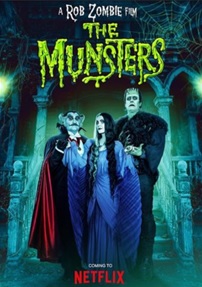
The Munsters (2022, directed by Rob Zombie)


Have you ever wondered how Herman and Lily Munster came to live at 1313 Mockingbird Lane?

No?

That’s too bad, because Rob Zombie is going to tell you anyways.

Rob Zombie’s The Munsters is a prequel to the 60s sitcom of the same name.  It shows how Herman Munster (Jeff Daniel Phillips) came to be created, how he became a Rob Zombie-style rock star, and how he overcame the opposition of the Count (Daniel Roebuck) and married Lily (Sheri Moon Zombie).  It also shows how Lily’s brother, Lester (Tomas Boykin), tricked Herman into signing over the deed for the Count’s castle in Transylvania.  There’s not much of a plot but there was never much of a plot when it came to the original sitcom either.  Just like the show that the movie is based on, The Munsters exists to show classic monsters making corny jokes and freaking out at the prospect of dealing with what the rest of the world considers to be normalcy.  Unlike the multi-faceted Addams Family, The Munsters have always been a one-joke family.

There have always been elements of satire and subversive humor in everything that Rob Zombie has done, as both a musician and a director.  Those who claim that Rob Zombie does not have a sense of humor are mistaken.  However, the comedy in The Munsters is deliberately broad and vaudevillian, like the show on which the movie is based.  As a director, Zombie doesn’t always seem to know how to best present that type of humor.  The Munsters is the rare movie that would have benefitted from a laugh track because the jokes are definitely sitcom-level.  They were designed to be followed by canned laughter.  Zombie’s affection for the material and the characters come through and the deliberately artificial production and costume design actually works better than I was expecting but, at nearly two hours, The Munsters often feels directionless.  

Jeff Daniel Phillips and Daniel Roebuck do adequate imitations of Fred Gwynne and Al Lewis, respectively, but its Sheri Moon Zombie who steals the show, bringing a lot of mischievous energy to Lily.  Of the principle cast, Sheri Moon Zombie is the only one makes her character feel like something more than just a tribute to an old sitcom.  The camera loves her and she convinces us that she loves Herman, no matter how childishly he behaves.

One final note: Sylvester McCoy — the seventh doctor, himself! — plays the Count’s assistant, Igor.  McCoy doesn’t get to do much but it was still good to see him.  Igor was the type of role that Tom Baker used to specialize in before he was cast as the Fourth Doctor.  By casting McCoy as Igor, it almost felt as if Zombie was keeping the role in the family.

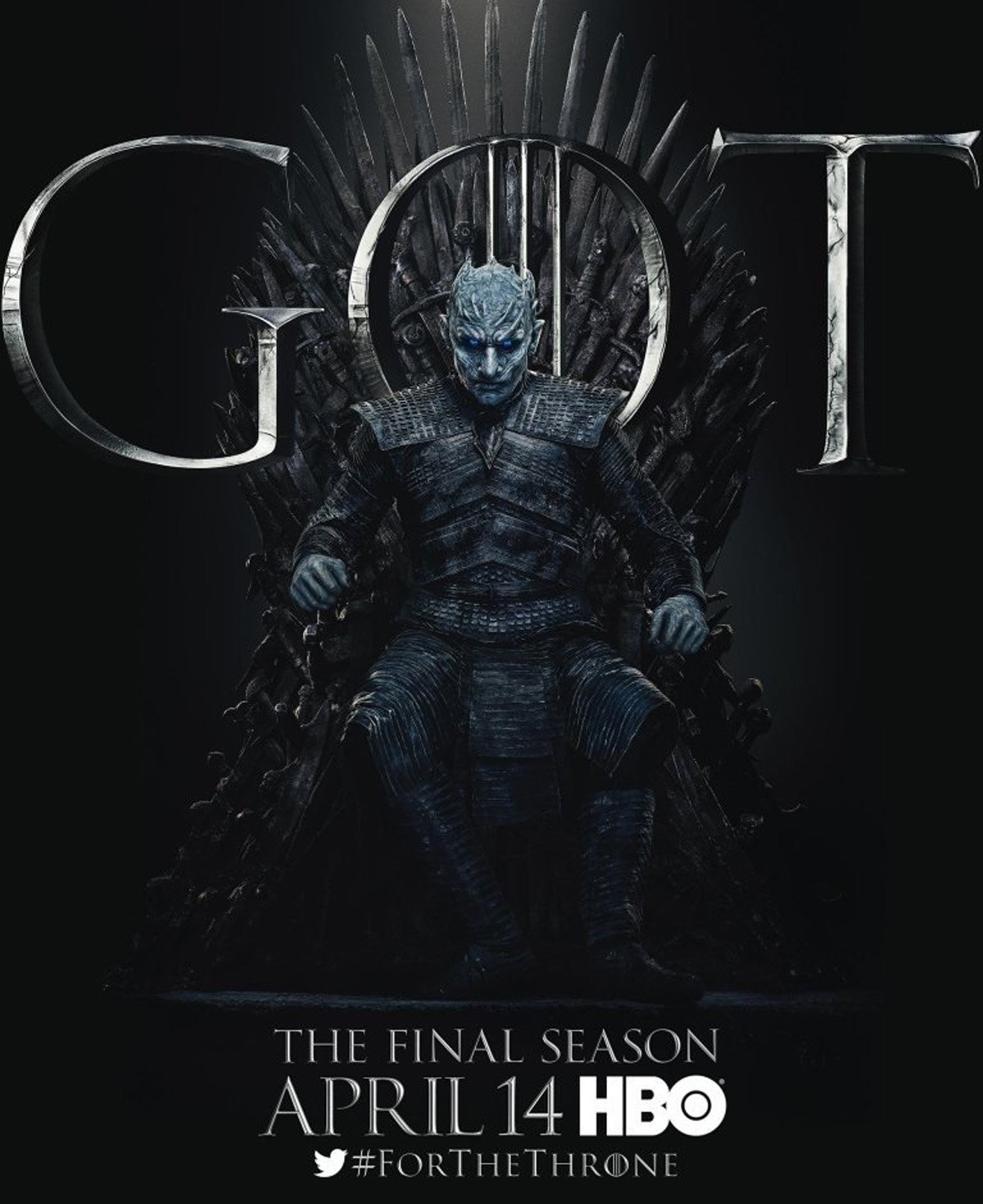
Trailer: Game of Thrones Season 8


Got 8 Night King

Well, we are now at the home stretch of what has been 9 or so years following the events of a little place called the Seven Kingdoms. It’s been a very long wait since the Season 7 ended in the summer of 2017.

When it was announced that there would be over a year of waiting before the final season of Game of Thrones would air, there was a lot of grumbling and bemoaning the fact that such a wait was just too long. Especially since the ending of Season 7 saw the final pieces on the chessboard finally begin to move towards a final showdown between all the different factions.

On one side we have the consummation of the Alliance of House Targaryen and House Stark. On another side we have Queen Cersei in King’s Landing still scheming to try and get the upper hand on all comers. Yet, all must contend with the threat that has just passed through a broken Wall and heading south as the Night King finally invades the Seven Kingdoms.

The series began in 2010 with the tag line, ‘Winter Is Coming,” and Season 7’s finale made a great show of it as winter has even come as far south as King’s Landing. It looks like Season 8 will show everyone that Winter has arrived and fans cannot wait to get on that ride come hell or high water.

Season 8 of Game of Thrones arrives worldwide on April 14, 2019.

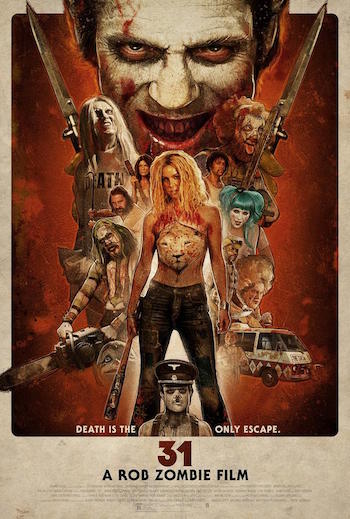
The TSL’s Daily Horror Grindhouse: 31 (dir by Rob Zombie)


31_film_poster

Are you scared of clowns?  Sure, you are.  All good people fear clowns.  However, if you somehow do not find clowns to be frightening, you may change your mind after seeing Rob Zombie’s latest film, 31.

Of course, that’s assuming that you actually see 31.  31 is not a film for everyone.  In fact, if you’re not a fan of Rob Zombie or his style of horror, you should probably stay miles away from 31.  Bloody, intense, violent, and occasionally rather nihilistic, 31 is perhaps the Rob Zombiest of all the films that Rob Zombie has ever made.

However, if you’re a fan of extreme horror, you’ll appreciate 31.  It may not always be easy to take but then again, that’s kind of the point.

The film takes place in the 70s, which means that it has a really kickass soundtrack.  A group of carnival workers are driving across the desert in a van when they are attacked and kidnapped.  They find themselves in a dark building, being lectured by three people who are dressed like 18th century French aristocrats.  The leader of the aristocrats (played by Malcolm McDowell) informs them that they are going to playing a game called 31.  For the next twelve hours, they will be locked away in a maze.  They will be hunted by five murderous clowns.

Yes, you read that right.  Not just one murderous clowns — FIVE!  (Even worse, a sixth bonus clown eventually joins the game.)

If they can survive for 12 hours, they win.  What do they win?  Other than freedom, the film is never particular clear on this point.  The motives of the aristocrats remain a mystery for the majority of the film.  Are they just sadists, are they perhaps devote fans of The Purge who were so disappointed with Election Year that they decided to recreate the second film on their own, or is there some bigger reason behind this game of 31?  The film leaves the question for us to answer.

The rest of the film is a collection of progressively more violent fights between the carnival workers and the clowns.  For the most part, the carnival workers are all likable and you don’t want to see any of them harmed.  The clowns, meanwhile, are just about the freakiest collection of killers that you’ve ever seen.  When one of them is cornered, he pathetically begs, “We’re all pawns!  We don’t want to do this!” but you never quite believe him.  The deadliest of the clowns is Doom-Head (Richard Brake) and his evil smirk will give you nightmares.

31 is an incredibly intense film and it’s definitely not for the faint of heart.  Everything from the acting to the set design to the costumes to David Daniel’s stark cinematography comes together to make 31 into a harrowing horror film.  If you can’t stand Zombie’s trademark mayhem, I would suggest avoiding 31.  However, if you’re a fan of Zombie’s films, you’ll find 31 to be perhaps the purest distillation of his artistic vision.