Horror Novel Review: College Weekend by R.L. Stine


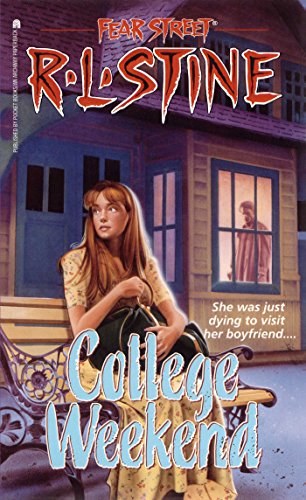
The 1995 YA novel, College Weekend, opens with Tina in a superexcited mood.

She is going to be spending the weekend up at Patterson College, where she’ll finally be reunited with her boyfriend, Josh!  Josh is a year older than Tina and, while she’s finishing up her senior year at Shadyside High, Josh has been busy in college, collecting rocks and studying geology.  Tina is so excited to have the chance to spend the weekend with Josh that she’s even willing to agree to her parents’ demand that she take her boy-crazy cousin Holly with her.

Awwwwwwwwww!  Long distance relationships are so sweet!

Unfortunately, when Tina arrives on campus, she is met not by Josh but instead by Josh’s roommate, Chris.  Chris explains that Josh is up in the mountains on a Geology field trip.  He thought he would be home in time to pick up Tina but apparently, he had car trouble.  Chris volunteers to show Tina and Holly around the campus and Tina agrees, even though she can’t help but feel that there’s something that Chris isn’t telling her.  (This is one of those books that could only have been written in the days when everyone was dependent on landline phones.)  Chris, Tina, Holly, and some others go to a party that night and …. HOLLY DISAPPEARS!

Tina is definitely concerned but Chris tells her not to worry about it.  In fact, having heard that Tina is an aspiring model, Chris explains that he’s related to a famous photographer and that he has his own studio.  In fact, Chris is willing to take some professional-quality pictures of Tina.  He even has some clothes for her to wear, clothes that belonged to a former girlfriend who just happened to look a lot like Tina …. yikes!

You can probably guess where all of this is leading.  Let’s just say that this turns out to be one truly traumatic college weekend and I have a feeling that Tina will probably want to apply to a different university.  That said, this book does a really good job of capturing just exciting visiting a college campus can seem when you’re still in high school and you’re plotting out your future.  My sisters and I visited a lot of campuses, both during their senior years and mine.  I always enjoyed getting to see all of the different campuses and getting to imagine what it would be like to live on each one.  Of course, I eventually ended up at a school that had a boring campus but a fun student body.

In the end, College Weekend is a fast-paced and entertaining trip to the campus of your nightmares.
October True Crime: Chicago Massacre: Richard Speck (dir by Michael Feifer)


Richard Speck was the worst of the worst.

A petty criminal-turned-drifter, Richard Speck fled Texas to avoid being sentenced to prison for his part in a grocery store robbery.  He eventually ended up in Chicago, where he lived with his sister and her husband and found occasional work as a seaman.  When he couldn’t get work on a boat, the alcoholic Speck supported himself by mugging and burglarizing.  It’s not known when he committed his first murder, though it is suspected that it occurred back in Texas.  It is known that, in July of 1966, Speck’s sister and brother-in-law finally got sick of dealing with him as a houseguest and Speck ended staying in a series of rooming houses and homeless shelters.  On July 13th, the 24 year-old Speck mugged and raped at 53 year-old woman before then breaking into a townhouse that was occupied by nine student nurses.  Over the course of the night, he raped and murdered eight of nurses.  The only survivor hid underneath a bed until Speck left.  She later told police that Speck spoke with a soft Southern accent, had an acne-scarred face, and a tattoo that read Born to Raise Hell.

It was the tattoo that led to his capture.  Two days after the murders, with the city of Chicago in an uproar and the police launching a city-wide manhunt to catch the killer, Richard Speck attempted to kill himself by slitting his wrists.  He was taken to Cook County Hospital, where Dr. LeRoy Smith saw Speck’s tattoo and called the police.

Though protesting his innocence, Speck was convicted of the murders and sentenced to die.  He was spared the death sentence when the Supreme Court briefly outlawed capital punishment.  From prison, Speck eventually admitted that he had killed the nurses but he claimed that he was so drunk and high that he had no idea what he was doing.  After Speck died of heart failure in 1991, a videotape would emerge of a cocky Speck telling his fellow prisoners that he knew exactly what he was doing and he never felt a bit of guilt.  “Just wasn’t their night,” was Speck’s explanation for why the murders happened.  Speck also said that if the public knew how much fun he was having in prison, they would have released him for sure.  Richard Speck is the type of evil specter who seems to exist to specifically challenge those of us who are opposed to the death penalty.  If anyone has ever deserved to be executed in the most painful way possible, it was Richard Speck.

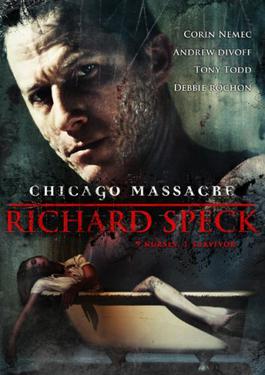
The 2007 film Chicago Massacre stars Corin Nemec as Richard Speck and the film’s makeup department deserves a lot of credit for transforming the handsome and normally quite personable Corin Nemec into the horribly poc-marked Richard Speck.  Sometimes, monsters truly do look like monsters and that was definitely the case of Speck.  Nemec plays Speck as being a natural-born deviant, a soulless sociopath who has no control over his impulses and who never seems to understand why the world is so disgusted by his crimes.  It’s a truly frightening performance.

The rest of the film is a flawed and heavily fictionalized account of Speck’s crimes, imagining that Speck was actually a casual acquaintance of one of the nurses that he killed and suggesting that she was the main reason why he broke into the townhouse to begin with.  The history nerd of me cringed when a police chief (Tony Todd) announced that his lead detective (Andrew Divoff) only had two days to solve the murders because the Democratic Convention was coming up.  (Speck committed the murders in 1966, two years before the Democrats came to Chicago for their ill-fated convention.)  Todd’s police chief says that he’ll be forced to sweep the murders under the rug if they’re not solved quickly but I’m not really sure how that would happen, given the enormity of the crime and the panic that reportedly swept through Chicago as a result.  As much as I hate to single out any one performer for criticism (because I usually assume that a bad performance has more to do with the director and the editor than the actor), Joanne Chew, cast in the role of the sole survivor of Speck’s rampage, delivers her dialogue so awkwardly that it sabotages what should have been some of the strongest moments of the film.  (Then again, even the best actress would perhaps be challenged by a line like, “I will look the devil in the eye.”)

Filled with flashbacks to both the murder of the nurses and Speck’s life as Texas criminal, Chicago Massacre is an undeniably icky film but given that it’s about Richard Speck, it really should be.  When it comes to a criminal like Richard Speck, it’s always tempting to try to look at his life for clues as how to prevent a future Richard Speck from committing a similar crime.  But, with Speck, there’s little to be learned beyond the fact that he did what he did because he had no conscience or sense of guilt to mitigate his impulses.  Speck had a terrible childhood but many people have had terrible childhoods without turning into mass murderers.  Speck was mentally unwell but many people deal with their mental health without turning into mass murderers.  In the end, he was a monster.  Thankfully, he was also enough of a dumbass to get a tattoo that made it impossible for him to hide from his crimes.

Horror Film Review: Mothra vs. Godzilla (dir by Ishiro Honda)


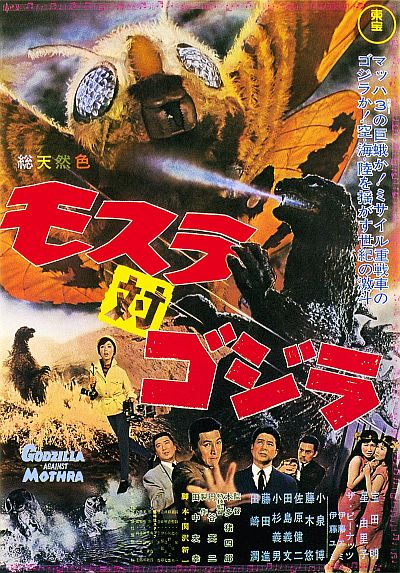
The 1964 film, Mothra vs. Godzilla, opens with a beach in Japan getting hit by a typhoon.

It’s certainly not the worst disaster that has ever hit Japan, though a government bureaucrat does show up to take credit for the recovery effort.  Instead of covering his speech, a reporter and a photographer stumble across a mysterious egg that has washed up on the beach.  The egg is beautiful and a local entertainment company, Happy Enterprises, has decided that they are going to build an entire amusement park and center it around the egg.

Then, the Shobijin, two twin fairies, show up and inform everyone that the egg belongs to Mothra, a giant moth who has actually been a pretty good friend to humanity in the past.  They explain that the egg was washed away from Mothra’s home on Infant Island.  Mothra really needs the egg back because the current Mothra is coming to the end of her lifespan and the egg contains the larvae who will become the newest version of Mothra.  Unfortunately, the Happy Enterprisises businessmen say that they’re going to keep the egg and that they really don’t care what Mothra wants.  Mothra flies over to Japan and takes the faeries back to Infant Island.  As they leave, the faeries say, “Goodbye, sorry you were so selfish!”

Unfortunately, shortly after Mothra and the faeries leave, Godzilla suddenly appears on the beach and starts destroying buildings and people with his radioactive breath.  Realizing that the only way to stop one monster is to bring in another monster, the humans head out to Infant Island and ask Mothra to help them.  When they arrives at Infant Island, they discover that the island itself has been turned into a wasteland by frequent nuclear testing.  The natives tells their visitors that they have no desire to allow Mothra to help them out with Godzilla.  The faeries say, “Tough.”  However, in the end, it’s Mothra’s decision whether or not to save humanity and Mothra, being the kindest of all the monsters, takes off to stop Godzilla.

It’s not really October without watching at least Godzilla film and Mothra vs. Godzilla is a good example of an old school Godzilla film, one that was released by Toho before Godzilla was reimagined as being a friend of humanity.  Indeed, a major message of Mothra vs. Godzilla seems to be that humanity doesn’t really deserve any friends.  It takes some nerve to refuse to allow Mothra to have her egg and to then expect Mothra to battle Godzilla for you.  That Mothra is willing to help is a reminder that, of all the big Japanese monsters, Mothra was the most friendly and willing to give humanity a second chance.  Godzilla, meanwhile, is just in a permanent bad mood.  In this film, he still represents the trauma of a nation that, less than 20 years previously, had been hit by two atomic bombs.  Godzilla fully represents the destructive power of the atomic age while Mothra, who is continually sacrificing her life so that she can be reborn, represents the hope for some sort of renewal.  In the end, both monsters fight their battle for the benefit of humanity and it’s exciting and fun to watch.  For a giant moth, Mothra is an agile combatant.  That said, most viewers will probably be Team Godzilla because he’s reminding humanity of the randomness of fate.  Myself, I was just happy with the knowledge that, regardless of who won the fight, they would both be back for future films.

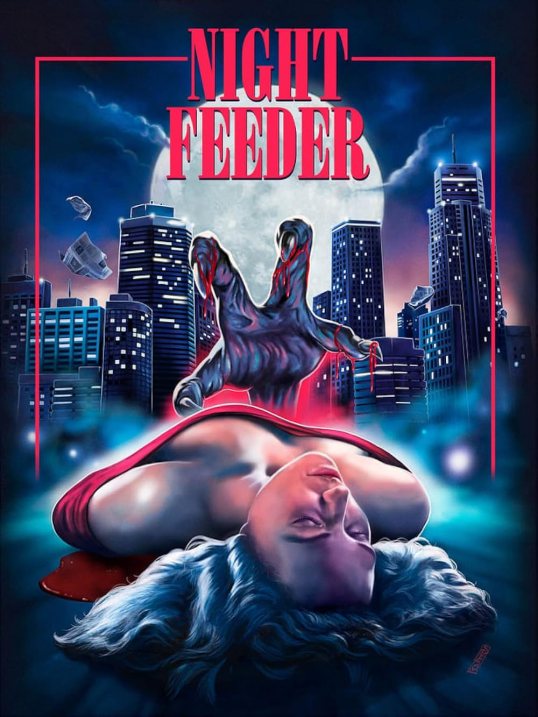
Horror Film Review: Night Feeder (dir by Jim Whiteaker)


This obscure 1988 film takes place in San Francisco.

Specifically, it takes place in the underground San Francisco art scene, a world where zoned out hipsters gather in a small clubs and listen to bands like Disease.  Disease (played by a real-life San Francisco band that was called The Nuns) sings songs that encourage the listeners to slit their wrists.  The police don’t care much for Disease and even several of the locals think that Disease is bad news.  Rumor has it that three Disease groupies died under mysterious circumstances.

While Disease sings, their fans get hooked on the drug DZS, which is also pronounced Disease.  (Yes, it gets a little bit hard to keep track of.)  DZS was developed to battle schizophrenia but it can also be used as a party drug and cause overdoses.

Speaking of death, there’s people dying all over San Francisco and Inspector Bernardo (Jonathan Zeichner) thinks that it’s because Disease isn’t just a band but also a brain-stealing cult.  Bodies are being found without huge sections of their brain.  Apparently, the murderer gouges out its victim’s eye and then sucks the brain out through the eye socket.  It does this while the victim is still alive.  Ouch!

Also investigating the murders is a reporter named Jean (Kate Alexander).  Jean has just recently left her husband so that she can be a member of the underground art scene.  She’s currently living with the lead singer of Disease, though he insists that their relationship is totally casual and that there’s no commitment involved.  Needless to say, Jean is not happy when Inspector Alonzo suggests that the band might be behind the murders.  (For one thing, traces of DZS are found on the majority of the victims.)  Jean’s investigation leads her to discover that not only is the city crawling with potential murderers but there’s also a mutant baby to deal with….

That’s right, a mutant baby.

Anyway, Night Feeder was shot on video and, from what I’ve been able to gather online, it was specifically sold in San Francisco video stores.  It was a regional production, meaning that the cast was populated with local actors and the production crew was largely local as well.  It was shot on location at clubs around the city, making the film into a bit of a time capsule if nothing else.  Oddly enough, the movie somehow found its way to Poland, where it became something a cult hit among Polish horror fans.  That’s just one of the many oddities of the film distribution.  You never know where your low-budget, shot-on-video movie might become a hit.

But, you may be asking — is the movie itself any good?  Eh …. it’s okay.  I mean, it’s a low-budget film that was shot on video and, even more importantly, it looks like it was shot on video.  It has the aesthetic quality of a student film.  The majority of the actors deliver their lines stiffly, though I did appreciate the energetic performance of Kate Alexander.  She did the best that one probably could with the material that she was given.  That said, the special effects were done by a guy who was a part of the VFX crew for David Cronenberg’s The Fly and, even for a straight-to-video production, some of the imagery is memorably grotesque.  So, if nothing else, the film has that going for it.

That said, I have a weakness for low-budget regional productions, especially ones that serve as a time capsule of a very particular time and place.  Night Feeder definitely does that and, as such, it’s worth watching just for the chance to see how people once lived.

Horror Film Review: The Mummy’s Tomb (dir by Harold Young)


1942’s The Mummy’s Tomb picks up 30 years after the end of The Mummy’s Hand.

Archeologist Steve Banning (Dick Foran) is now living a peaceful life in the small town of Mapleton, Massachusetts.  As the film opens, he is telling his guests about the time that he and his friend, Babe Hanson (Wallace Ford), went to Egypt and discovered the tomb of an Egyptian princess.  He tells them how Andoheb (George Zucco) tried to use the ancient mummy, Kharis, to protect the tomb.  Steve assures everyone that Andoheb is now dead and Kharis is no longer a threat to anyone.

The film then travels to Egypt where we discover that Steve was not quite correct.  Adoheb survived being shot at the end of The Mummy’s Hand.  He’s now an old man, dying but still obsessed with getting revenge.  He instructs his disciple, Mehemet Bey (Turhan Bey), to travel to America with Kharis (now played, under a bunch of bandages, by Lon Chaney, Jr.) and to get revenge on the remaining members of the Banning expedition.

Bey and Kharis travel to Massachusetts and soon, the entire town of Mapleton is gripped in fear as Kharis starts to murder people.  Steve Banning is the first victim.  Then Steve’s sister, Jane (Mary Gordon). Kharis even kills Babe Hanson, whose role in the previous film was largely comic relief.  Seriously, not even Frankenstein’s Monster killed the comic relief.  Kharis is a ruthless and unstoppable killer and, in a performance that is totally focused on his hulking physicality, Lon Chaney, Jr. makes for a frightening mummy.  Kharis moves slowly, dragging one foot behind him.  But when he does attack, he’s relentless.  This movie reminded me of why the mummy has, to me, always been the scariest of the old Universal monsters.

Despite the fact that Kharis is leaving bandages and ancient mold all over the place, the authorities are not quite convinced that an ancient mummy has come to their small town.  However, the townspeople have no doubt what’s happening and, since this is a Universal film, they are soon running around with torches and pitchforks.  Meanwhile, Steve’s son, John (John Hubbard), tries to figure out how to destroy the mummy and how to protect his fiancée, Isobel (Elyse Knox).  Bey has decided that he’s in love with Isobel and he orders Kharis to bring her to him.  Even under all the bandages, Kharis’s facial expression still suggests that he knows this isn’t a good idea.

The Mummy’s Tomb suffers from the same problem that afflicted The Mummy’s Hand.  It feels like it takes forever to actually get to the good stuff.  This is only a 60-minute film and ten of those minutes is taken up with a flashback to The Mummy’s Hand.  But no matter!  Once Kharis arrives in America, the pace of the film picks up and it becomes an effective little horror film.  Lon Chaney, Jr. is frightening Kharis.  I wouldn’t want him following me down a dark alley!

Previous Universal Horror Reviews:

  1. Dracula (1931)
  2. Dracula (Spanish Language Version) (1931)
  3. Frankenstein (1931)
  4. Island of Lost Souls (1932)
  5. The Mummy (1932)
  6. The Invisible Man (1933)
  7. The Bride of Frankenstein (1935)
  8. Dracula’s Daughter (1936)
  9. Son of Frankenstein (1939)
  10. Black Friday (1940)
  11. The Invisible Man Returns (1940)
  12. The Mummy’s Hand (1940)
  13. The Wolf Man (1941)
  14. Ghost of Frankenstein (1942)
  15. Invisible Agent (1942)
  16. Frankenstein Meets The Wolf Man (1943)
  17. Son of Dracula (1943)
  18. House of Frankenstein (1944)
  19. The Invisible Man’s Revenge (1944)
  20. House of Dracula (1945) 
  21. Creature From The Black Lagoon (1954)

Horror on the Lens: Robot Monster (dir by Phil Tucker)


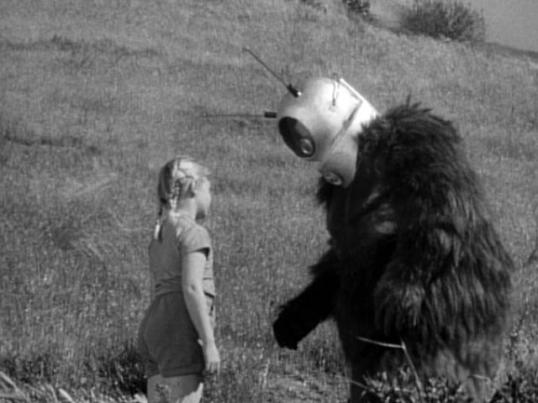
Today’s horror film is a true classic of its kind, the 1953 science fiction epic Robot Monster.

Now, I should admit that this is not the first time that I’ve shared Robot Monster in October.  I share it every year and, every year, YouTube seems to pull the video down in November.  That sucks because Robot Monster is one of those weird films that everyone should see.  So, I’m going to share it again.  And, hopefully, YouTube will let the video stay up for a while.

As for what Robot Monster is about…

What happens with the Earth is attacked by aliens?  Well, first off, dinosaurs come back to life.  All of humanity is killed, except for one annoying family.  Finally, the fearsome Ro-Man is sent down to the planet to make sure that it’s ready for colonization.  (Or something like that.  To be honest, Ro-Man’s exact goal remains a bit vague.)

Why is Ro-Man so fearsome?  Well, he lives in a cave for one thing.  He also owns a bubble machine.  And finally, perhaps most horrifically, he’s a gorilla wearing a diver’s helmet.  However, Ro-Man is not just a one-dimensional bad guy.  No, he actually gets to have a monologue about halfway through the film in which he considers the existential issues inherent in being a gorilla wearing a diver’s helmet.

Can humanity defeat Ro-Man?  Will Ro-Man ever get his intergalactic supervisor to appreciate him?  And finally, why are the dinosaurs there?

Despite the film’s reputation for being borderline incoherent, most of those above questions actually are answered if you pay attention to the first few scenes of Robot Monster.  In fact, one could even argue that Robot Monster is maybe a little bit more clever than it’s often given credit for.  Of course, it’s still a zero-budget mess of a film but it’s also undeniably fun and, in some sections, unexpectedly dark.  If you’ve never seen it before, you owe it to yourself to set aside an hour and two minutes in order to watch it.  You’ve never see anything like it before.

Finally, I should note that Robot Monster’s hero was played by George Nader, who actually did go on to appear in several mainstream films.  Despite his good looks and talent (which may not be obvious in this film but which he did have), George Nader struggled to get starring roles in Hollywood, where he was often dismissed as just being a member of Rock Hudson’s entourage.  (It’s been theorized that Nader struggled because the studios feared that giving him too big of a role would lead to the gossip magazines writing about Nader’s relationship with Hudson, though the two were just friends.  Nader was in a relationship with Hudson’s private secretary, Mark Miller, from 1947 until Nader’s death in 2001.)  Nader finally left Hollywood and went on to have a pretty successful career in Europe.  He was perhaps best known for playing secret agent Jerry Cotton in a series of films in the 60s.

Enjoy Robot Monster!

October Positivity: Step Over The Edge (dir by Bruce Lood)


Oh, Trevor.

Played by Scott Wallace, Trevor is the main character and the narrator of the 1976 film, Step Over The Edge.  Trevor is a young Christian who gets involved with something called the Vanguard Program.  In Vanguard, young people are taken to the wilderness and are forced to go on hikes and climb mountains and brave rapids, all so that they can then spend three days alone with their thoughts and a journal.  Trevor, writing in his journal, informs us that he knows that it’s weird for a guy to keep a diary but he’s glad that he did.

At the start of the program, Trevor was a bit of a jerk.  He didn’t like any of the other campers.  None of them measured up to his standards of what a mature and intelligent believer should be.  The girls were either too giggly or too insecure or too popular.  They either cared too much or cared too little.  Either way, Trevor didn’t think much of them.  As for the other boys, Trevor judged most of them to be idiots who were always either complaining or making stupid jokes.  Trevor was especially hard on CJ, who Trevor judged to be too close to his mother and a “loser.”  When CJ didn’t want to rappel down a mountain, Trevor acted like it was a personal affront.  When another camper nearly died in the rapids, Trevor acted like it was everyone’s fault but his own.

Fortunately, Trevor spends his three days alone thinking about his behavior and staring at the sunset and he suddenly comes to realize that he was indeed being too judgmental.  The film is only 65 minutes long and Trevor doesn’t actually go off by himself until about 55 minutes in.  So, that means that the viewer has to sit through nearly an hour of Trevor being a jerk just to get to ten minutes of Trevor having a sudden epiphany.  Watching the film, I got the feeling that perhaps the Vanguard Program was a real thing and this movie was meant to be a bit of infomercial for it.  The film seemed to be saying, “Look at what we were able to do for even this jerk!”

To be honest, horror films have pretty much ruined me when it comes to viewing films like this through innocent eyes.  Whenever I see any movie that features a bunch of teenagers camping in the wilderness, I automatically start looking for Jason Voorhees hiding behind a tree.  Step Over The Edge features a perfectly innocent scene in which everyone sits around a campfire and talks.  Rather than appreciating the fact that everyone was opening up, I was sitting there waiting for a monster to come jumping out of the woods.

Step Over The Edge is a low-budget film with grainy cinematography and imperfect performances.  The film’s message, which essentially came down to “Don’t judge others,” was a positive one but, in the end, the film really only succeeded in making me happy that I’ve never been one for camping.

Seriously, you never know what might be hiding out there.

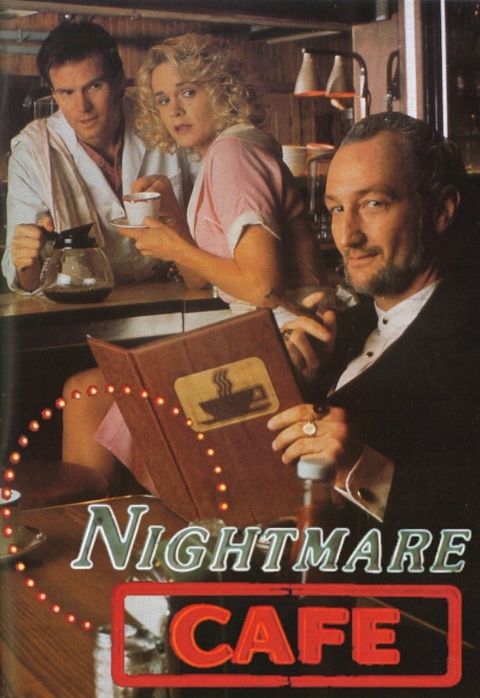
Late Night Retro Television Reviews: Nightmare Café 1.2 “Dying Well Is The Best Revenge”


Welcome to Late Night Retro Television Reviews, a feature where we review some of our favorite and least favorite shows of the past!  On Mondays, I will be reviewing Nightmare Cafe, which ran on NBC from January to April of 1992.  The entire show is currently streaming on YouTube!

This week, Frank and Fay get involved in a case of ghost noir!

Episode 1.2 “Dying Well Is The Best Revenge”

(Dir by Armand Mastroianni, originally aired on March 6th, 1992)

This week’s episode of Nightmare Café begins with Frank and Fay feeling pretty comfortable in their new roles of working at the café under the watchful eye of Blackie.  I guess some time has passed since the pilot, as both Frank and Fay seem to be totally okay with the fact that they’re both dead and destined to spend the rest of their existence working as, respectively, a cook and a waitress.

Don’t get me wrong, of course.  There’s nothing wrong with being a cook or a waitress.  If I was a waitress, I would definitely want to work for Robert Englund and get to wear a cute uniform like Fay does.  I think what is throwing me is that Fay and Frank seem to be so comfortable with the idea of being dead.  It would take me a bit longer to accept that.

As for tonight’s episode, the action starts when a sultry woman named Angela (Beth Toussaint) enters the café and asks for a cup of coffee.  Frank immediately starts flirting with her and Angela flirts back in typical film noir fashion.  All of the flirting ends, though, when Angela’s husband, Edward (Justin Deas), stumbles into the café, his face bloodied from apparently being attacked outside while he was waiting for Angela.  Angela and Edward leave but Angela later returns so that she can talk to Frank.

Angela claims that Edward is abusive.  Frank leaves the café so that he can visit Angela at home and eventually sleep with her.  (Fay and Blackie watch on the television.)  Fay doesn’t trust Angela, especially after her previous lover — a country club tennis pro (Andrew Airlie) — is mysteriously run over by a hit-and-run-driver.  As Fay puts it, she thinks that Frank could be putting his life at risk.  But, the thing with that is that Frank and Fay are already dead.  That was established in the pilot.  So, if Frank is already dead, how is he putting his life at risk?  For that matter, if Frank and Fay are dead and the Nightmare Café is basically a dimensional portal, how are they both able to casually leave the café and walk around town?  I mean, are they dead and in purgatory or not?  Seriously, what are the rules of the Nightmare Café?

Eventually, Edward confronts Frank and Angela and Frank …. SHOOTS HIM!  Well, I guess since Frank is dead, he can be a murderer.  Except, in a clever twist, it turns out that Edward was already dead and the Nightmare Café gave him a second chance to prove that Angela was the one who set up his murder.  When Angela tries to put Edward in the trunk of her car, Edward suddenly gets out of the trunk and Angela shoots him several times.  Edward pretends to die once again, allowing the police to arrest Angela for murder.  The episode ends with Angela in prison, with Edward as her ghostly companion.

So, as I said earlier, I’m still not sure what the rules of the Nightmare Café are supposed to be and, in this episode, it felt like Frank and Fay could basically just do whatever was convenient to the plot.  That’s a bit of a problem because, when there are no rules, there aren’t any stakes either.  That said, this episode was helped immensely by the friendly charm of Robert Englund.  Blackie didn’t really get involved in the storyline but he did break the fourth wall and talk directly to the audience a few times and Englund delivered the lines with just the right amount of cheery sarcasm.  Robert Englund definitely kept things entertaining!

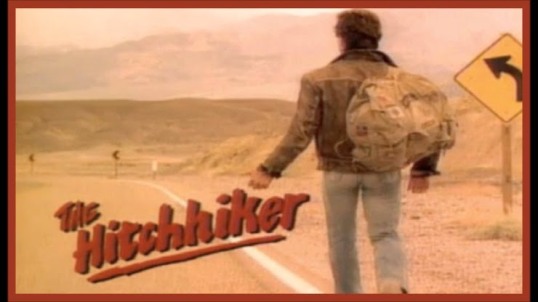
Horror on TV: The Hitchhiker 5.2 “In Living Color” (dir by John Laing)


On tonight’s episode of The Hitchhiker, the title character (Page Fletcher) continues to come across the worst people on the planet.

This time, that person is Eric Coleman (Ray Sharkey), a once great photographer who now makes a disreputable living taking pictures of celebrities and tragedies.  When Eric has a chance to stop a woman’s suicide, he instead decides to take pictures.  His new assistant goes out of her way to make Eric feel the error of his ways.

This episode features a convincingly sleazy performance from Ray Sharkey.  Eric Coleman is a character who you will definitely want to see receive his comeuppance.

This episode originally aired on April 29th, 1989.

October Hacks: X-Ray (dir by Boaz Davidson)


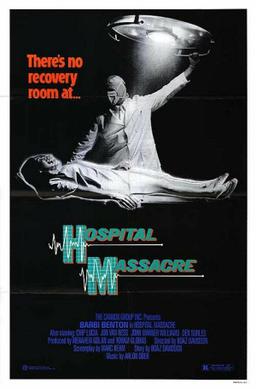
The 1982 film X-Ray (also known was Hospital Massacre) opens in the early 60s.  A nerdy kid named Harold gives a Valentine’s Day card to a popular girl named Susan.  Susan takes one look at the card and laughs.  Harold responds by taking Susan’s friend, David, and hanging him from a coat rack.  Yikes!

The film then jumps forward by 19 years.  Susan (Barbi Benton) is an upper class, divorced mom who has just received a promotion at work.  As a part of the promotion, she was required to get a medical exam for insurance purposes.  On Valentine’s Day, she heads to the hospital so that she can get the results of that exam.  It should be a routine thing that only takes a few minutes.  Susan may be a  chain smoker but, otherwise, she’s in good health.

Unfortunately, Harold is now working at the hospital and he finally sees his chance to give Susan “a piece of my heart.”  Harold fakes Susan’s test results and then murders her doctor.  Susan finds herself being checked into the hospital, pretty much against her will.  Since Harold didn’t do a very good job at faking her results, the doctors are all confused by Susan’s results.  Some of them want to operate.  Some of them just want to hold her for observation.  Susan desperately wants to leave, especially when she comes to realize that Harold is killing people in the ward.  As the doctors and nurses strap Susan down to her bed and prepare to operate, Harold goes on a rampage….

Produced by Cannon Films and directed by Boaz Davidson, X-Ray is an effectively frightening slasher film.  While the film’s plot doesn’t always hang together (for instance, Susan is remarkably untraumatized by the fact that, when she was a child, her best friend was hung from a coat rack), the hospital itself is a thoroughly creepy location and the supporting characters are all either extremely strange or extremely callous.  This is a slasher film that works less because of the blood that’s spilled but instead because it captures the dread that everyone feels at the prospect of having to spend any time at the hospital.  Even the doctors who aren’t trying to kill Susan come across as being cold and unfeeling.  The scene where Susan finds herself being ordered to undress so that she can be examined by a brusque doctor who she only met a few minutes before is, quite frankly, just as nightmarish as anything that we see Harold doing to any of his victims.  The fact that no one is willing to tell Susan what’s wrong and that everyone refuses to listen to her when she gets upset over the way she’s being treated is something to which many viewers will immediately relate.  And, of course, it’s not just that Susan has a madman stalking her through the hospital.  It’s also that all of the other patients seem to be so strange, from the guy who wanders around with his flask of bourbon to the three old women who share a hospital room with her and who talk about how, while Susan is beautiful on the outside, the inside of her body is slowly decaying.

Violent but quirky, X-Ray plays out like a filmed nightmare and it’s one of the most effective slasher films over the early 80s.