For today’s music video of the day, the Shattered Lens has got this wonderfully creepy and dream-like offering by Ha Vay.
Are you the wolf?
Enjoy!
For today’s music video of the day, the Shattered Lens has got this wonderfully creepy and dream-like offering by Ha Vay.
Are you the wolf?
Enjoy!
Welcome to Late Night Retro Television Reviews, a new feature where we review some of our favorite and least favorite shows of the past! On Fridays, I will be reviewing Friday the 13th: The Series, a show which ran in syndication from 1987 to 1990. The show can be found on YouTube!

How many more people must die before the Quilt of Hathor is stopped!? Let’s find out.
Episode 1.20 “The Quilt of Hathor: The Awakening”
(Dir by Timothy Bond, originally aired on May 9th, 1988)
We pick up where the previous episode ended. Ryan is still living with the ultra-religious Pentites and is still viewed with suspicion by the majority of them. He is still in love with the Reverend Grange’s daughter, Laura. And Effie Stokes still has the quilt that she can use to enter the dreams of others and kill them.
However, Effie is not the main villain here. Instead, it is the Reverend Grange (Scott Paulin) who is corrupted by the quilt. When the community’s elders tell Grange that it is important that he select a wife, he finally selects Effie. Effie is overjoyed but, as soon becomes clear, she intends to use the quilt to kill Grange on their wedding night so that she can take over the community. However, in the dream, Grange gets the upper hand and kills Effie instead. Soon, Grange is using the quilt to go after anyone in the community with whom he has a grudge. And when the members of the community suspect that witchcraft is afoot, he casts the blame on Ryan.
This is the episode where Ryan nearly gets burned at the stake. Fortunately, Micki and Chris show up just as Ryan is about to be set on fire. They distract the Pentites long enough for Laura to discover Effie’s body and to reveal that Grange is the murderer. A long chase ends with Grange falling out of a barn to his death.
That, of course, also kills Laura and Ryan’s romance. Ryan realizes that he has a holy duty to help Chris and Micki track down cursed antiques. And Laura says that she has to stay behind to help the community rebuild. Personally, I think she’s just reluctant to declare her love for the man who killed her father. That’s understandable.
This was not a bad episode. I liked the way that, for once, we got to see how a formerly good and reasonable person could be corrupted by one of the cursed antiques. Laura and Ryan’s romance was a bit too obviously lifted from Witness but still, John D. LeMay and Carolyn Dunn had a likable chemistry together. Just as with the first part of the story, the surreal nightmares were well-done and genuinely frightening.
Next week, Ryan and Micki search for a haunted camera!

Remember CODA?
I ask that because this 2021 film often seems to be forgotten about when people discuss the films that have won the Oscar for Best Picture. Indeed, when the Oscar nominations were first announced for that year, many commentators treated the film’s nomination as an afterthought. It was pointed out that CODA only had a total of three nominations, for Picture, Adapted Screenplay, and Best Supporting Actor. It was expected that Troy Kostur would win Best Supporting Actor but it was also felt that Best Picture would be won by one of the big nominees, like The Power of the Dog, Belfast, or West Side Story.
But, interestingly enough, the momentum began to shift shortly after the nominations were announced. The nomination brought the film to an entirely new audience, all of whom could stream the movie on Apple TV+. The members of the Academy who hadn’t seen the film before the nominations were announced watched the film and many reportedly fell in love with the simple but touching story of a teenage girl who must decide whether to go to music school or to stay at home with her deaf parents and older brother. By the time the Academy Awards were held, CODA had become the new front runner.
How did this happen? A lot of it had to do with the fact that CODA was an unabashedly emotional story, one that was specifically made to bring tears to the eyes of the audience. CODA was more humanistic than the remote and cold Power of the Dog. Whereas both West Side Story and Belfast were obviously made with Oscar glory in mind, the low-budget CODA felt as if it simply wanted to tell a good story. Unlike Dune, CODA was not made to launch a franchise and, unlike King Richard, it was about more than just one performance. Its straight-forward approach provided quite a contrast to the stylized flourishes of Nightmare Alley and Licorice Pizza. (Incidentally, Nightmare Alley and Licorice Pizza were my two favorite films of the year.) It should also be remembered that CODA, like the previous year’s Nomadland, was watched while many people were still hiding their faces behind masks, terrified of catching COVID. It was a time when many people were yearning for something that would just make them feel good.
And whatever else one might say about CODA, it’s definitely a feel good movie. From the wonderful moments when Ruby (Emilia Jones) discovers her love for singing to the slyly humorous and emotionally honest performances of Troy Kostur, Marlee Matlin, and Daniel Durant as Ruby’s parents and brother, CODA is a film that will make you smile and think about the people who you consider to be your family. It’s a sweet movie, one that reminds us that it’s okay to get emotional and that it’s okay to tell people that you love them and that, as an artform, film can be used for something other than just comic book adaptations.
That’s not say it’s a perfect film, of course. Those who complained that CODA had the flat look of a made-for-TV movie were not incorrect and the fact that most people ended up watching the movie on TV (or, in my case, on a laptop) did not help with the issue. As Ruby’s music teacher, Eugenio Derbez gives a rather broad performance that often fells at odd with the more realistic work of the rest of the cast. The film had its flaws but it also made me smile and the end brought real tears to my mismatched eyes and there’s something to be said for that. During a year when many people were still afraid to get close to anyone else, CODA was a film that celebrated love, family, and community.
Did CODA deserve to win Best Picture? Like I said, I would have given the Oscar to either Nightmare Alley or Licorice Pizza but I liked CODA and, looking back, I certainly prefer its positive vibes to the well-made emptiness of Power of the Dog. The low-key CODA is probably destined to join The Artist and Argo as one of the best picture winners that people tend to forget but no matter. It’s a film that holds up well and, in 2021, it was exactly the film that a lot of people needed.
Welcome to Retro Television Reviews, a new feature where we review some of our favorite and least favorite shows of the past! On Fridays, I will be reviewing T. and T., a Canadian show which ran in syndication from 1987 to 1990. The show can be found on Tubi!

It’s ninja time!
Episode 2.19 “Family Honour”
(Dir by Ryszard Bugajski, originally aired on May 15th, 1989)
First things first, I have to admit that I smiled when I saw the title “Family Honour” flash on the screen. T and T was a Canadian-produced show that always desperately tried to convince viewers that it was actually taking place in the United States. But that “Honour,” which no one on the production staff probably even gave a second thought to, totally gives the game away. It’s like when a Yankee trying to pretend to be from the South says that they’ve been waiting “in line” instead of “on line.”
(Of course, Texans like me also have little tells that give away our place of origin. Me, I drop the g’s on “ing” so casually that I don’t even realize that I’m doin’ it half the time.)
Anyway, this episode begins in medias res. Mrs. Shimada (Brenda Kamino) has invited Amy and T.S. to her home so that she can thank them by serving them tea. Apparently, Amy arranged for a centuries-old Samurai sword to be returned to the Shimada family. T.S., meanwhile, has been guarding the sword because of how valuable it is. Still, that doesn’t stop a ninja from breaking into the house and trying to kill Kim (Lisa Jai), the ten year-old to whom the sword has been gifted. Fortunately, Turner is there to run him off.
Mr. T vs. ninjas!? Hell yeah!
Unfortunately, there aren’t really many scenes of Mr. T fighting the ninjas. There’s one scene where he gets flipped onto his back by an apprentice ninja. And there’s another where T.S. grabs a sword out of a ninja’s hand and then knocks him out with one punch. That was pretty cool. But, considering the potential here, it’s hard to be disappointed by the fact that Mr. T himself never put on a ninja outfit or flew through the air.
Instead, T.S. confronts Kim’s uncle, Ikuta (Denis Akiyama). Having left Japan after bring shame onto the family, Ikuta relocated to Canada and opened up his own ninja training academy in Toronto. T.S. thinks that Ikuta wants the sword for himself and he also thinks that Ikuta is trying to kill his own niece so that he can be rewarded with special ninja powers. (Uhmm …. okay, then.) Ikuta says that’s ludicrous and it turns out that T.S. was too quick to judge Ikuta. It’s not Ikuta who is trying to steal the sword. It’s Ikuta’s main student, James (David Orth)! Ikuta proves his worth by defending Kim from James. Turner, more or less, just observes.
That seems to be a pattern with the last few episode of T and T. As of late, Turner hasn’t been as active a participant as in the past. Instead, it’s hard not to feel that he’s mostly just there so that the show can introduce new characters, all of whom could potentially be spun off into another series. This episode felt much like a backdoor pilot for a show that would have followed Ikuta as he regained his honour. That said, this was still a marked improvement over last week’s episode. You really can’t go wrong with ninjas.
Today is the 80th birthday of Who vocalist Roger Daltrey so it seems only appropriate to pick one of The Who’s most recognized songs for today’s song of the day. Enjoy Teenage Wasteland!
Okay, just kidding. I know the name of the song is Baba O’Riley. But seriously, there are thousands of people out there who think that this song is called Teenage Wasteland and, when I first wrote the first draft of my review of Summer of Sam, I may have actually been so exhausted that I actually referred to it as being Teenage Wasteland but, fortunately, if that did indeed happen, Jeff pointed out my mistake before I hit that publish button. Pete Townshend, who wrote the song, later said that the reference to a “teenage wasteland” was inspired by the audience Woodstock and it was not meant to be complimentary.
This performance, featuring Daltrey’s amazing vocals, is taken from the 1979 concert film, The Kids Are Alright.
The graffiti on the wall reads, “Capitalism sucks,” so I can only assume that this song and Sum 41’s Heaven :x: Hell will both be given away for free at some point in the near future. (The irony of being anti-capitalism while paying homage to the Ramones will probably be missed by most of the people who watch this video.)
That said, this music video deserve some major credit for bringing some chaos to the punk rock museum. Punk rock was never meant to be mainstream but somehow, that is what it has become.
Enjoy!
Welcome to Late Night Retro Television Reviews, a feature where we review some of our favorite and least favorite shows of the past! On Thursdays, I will be reviewing Highway to Heaven, which aired on NBC from 1984 to 1989. The entire show is currently streaming on Freevee and several other services!

This week, Jonathan encourages an elderly man not to give up.
Episode 1.23 “The Right Thing”
(Dir by Victor French, originally aired on March 27th, 1985)
Elderly Harry Haynes (Lew Ayres) lives with his son (Michael Durrell), his daughter-in-law (Marcia Rodd), and his grandson, Matt (Matthew Labyorteaux). When Harry wets the bed one too many times, his daughter-in-law demands that he be moved to a nursing home. (I suppose it’s a sign of the time that, too modern ears, that may sound like the set up for a tasteless joke but it’s actually how the episode begins and Lew Ayres does such a good job portraying Harry’s shame and panic that your heart just breaks for him.) Harry isn’t happy about going to the nursing home and he’s on the verge of giving up on life. Fortunately, the new orderly is Jonathan Smith and Harry is the week’s mission. Jonathan isn’t just in the nursing home to pass out magazines and books. He’s also there to encourage Harry not to give up hope.
This episode is the epitome of what most people would probably come up with if they were asked to describe a typical episode of Highway to Heaven. It’s sentimental, emotional, and so achingly sincere that it’s hard not to get caught up in it, regardless of how heavy-handed and occasionally simplistic the storytelling may be. With Jonathan’s encouragement, Harry starts to run with his grandson. Harry and Matt enters a grandparent/grandson relay race together. Harry’s son says that, if Harry wins, he’ll be allowed to move back home. Harry does win but it turns out that no one told his daughter-in-law about the deal. To the show’s credit, Harry’s daughter-in-law is not monster. She’s just exhausted from having to take care of the house, her teenage son, and an elderly man. Harry realizes that it wouldn’t be fair to her for him to move back in so, instead, he announces that he’s going to travel and see as much of the world as he can in the time he has left.
There was nothing subtle about the plot of this episode but Lew Ayres gives a sensitive and honest performance as Harry and Matthew Labyorteaux matches him as Harry’s grandson. (Lew Ayres was an excellent actor whose career began in the early days of Hollywood. He starred in the Oscar-winning All Quiet on The Western Front but his own pacifist beliefs led to him being temporarily blacklisted when he registered as a conscientious objector. He later made a comeback, appearing in films like Johnny Belinda and Advise and Consent but never receiving an Oscar nomination, due to the controversy over his beliefs.) This is a sweet episode, even if it is perhaps a bit simplistic with its message that old age can be held off by simply not giving up. Sad to say but aging is going to get us all eventually.
Welcome to Retro Television Reviews, a feature where we review some of our favorite and least favorite shows of the past! On Thursdays, I will be reviewing King of the Building, which aired on CBS in 1987. The entire show is currently streaming on YouTube!
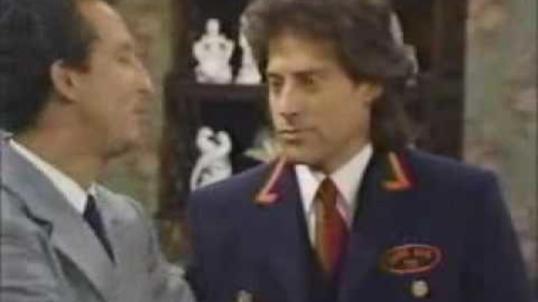
This week, Richard Lewis is a doorman.
Episode 1.1 “Pilot”
(Dir by James Komack, originally aired on July 31st, 1987)
Joey (Richard Lewis) is the …. KING OF THE BUILDING!
Well, no. Actually, he’s just a doorman for a Park Avenue apartment building. The owner of the building, Mr. Jamison (Simon Jones), is the real king of the building but the elderly residents all prefer to deal with Joey. That’s because Mr. Jamison is greedy and venal and always looking for an excuse to kick people out of their apartments. His latest target is Mrs. Gladstone (Billie Bird), who has dementia and thinks that Joey is her son, Elliot.
(Mrs. Gladstone has a sitcom form of dementia, where all of her mistakes are quirky and she never loses her temper or gets paranoid or disappears for hours on end.)
When Mr. Jamison brings in a social worker (Lora Staley) to try to get Mrs. Gladatone ruled incompetent, Joey and the other workers at the building conspire to make it appear as if all of Mrs. Gladstone’s confusion is due to Mr. Jamison keeping her apartment in disrepair. The social worker declares that Mrs, Gladstone will be fine as long as Joey is working at the building.
(Personally, I would think this would lead to Mr. Jamison just firing Joey so he could then get rid of Mrs. Gladstone but that doesn’t seem to occur to him. Of course, Joey also mentions that he’s a member of a union so maybe Joey has his job for life. I hope it pays well.)
This was a pilot for a series that presumably would have followed Joey as he protected the elderly residents from Jamison. It only aired once and it didn’t lead to a series. Watching the pilot, it’s easy to see why. Richard Lewis, who passed away two days ago, was a comedian who was acclaimed and famous for his ability to comedically explore what it meant to be truly neurotic. There’s not really anything neurotic or obsessive or even particularly interesting about Joey. He gets nervous and he complains a lot but, in the end, he’s just a blue collar doorman who doesn’t like his boss. Lewis is likable but miscast in the role. Watching him, one gets the feeling that Lewis was holding back all of his natural instincts to play the rather subdued and sensible Joey.
Despite the failed pilot, Richard Lewis would continue to appear in television and moves for the rest of his life and he became a bit of a cultural institution. On Curb Your Enthusiasm, he often played the voice of reason to Larry David and proved that one could play sensible without losing his edge. And, of course, a generation will always remember him as King John.
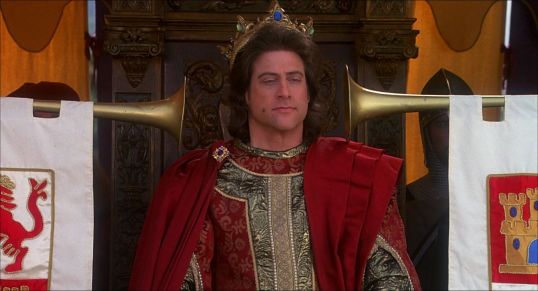
Rest in peace, Richard Lewis.
For today’s music video of the day, we have the latest from Fallout Boy. This song has a very surreal, otherworldly feel to it and, as such, it is ideal for a day like February 29th, a day that only exists every four years.
Enjoy!
Welcome to Late Night Retro Television Reviews, a feature where we review some of our favorite and least favorite shows of the past! On Wednesdays, I will be reviewing Monsters, which aired in syndication from 1988 to 1991. The entire show is streaming on Tubi.

Odd episode, this week.
Episode 1.22 “Satan In The Suburbs”
(Dir by Warner Shook, originally aired on May 13th, 1989)
Despite having graduated from Yale (and having the sweatshirt to prove it), Xantipe Finch (Deborah Strang) is struggling. Unable to interest any publishers in any of her books and raising her son, Marty (Danny Gerard), alone, Xantipe is forced to make extra money through baking and selling cookies. The bill collectors keep calling and threatening to turn off her electricity and to kick her and Marty out onto the streets.
Then a mysterious man (played by a young Chris Noth) materializes in her kitchen. The man says that he’s come from Hell. Because he won a football bet with Satan, the man has been allowed to come to Earth and to recruit Xantipe to write his autobiography. If the book is published, the man will continue to be a happy demon. If the book fails, he’ll be either demoted or turned into a low-level angel. Huh? What? I don’t know. It didn’t make any sense while the man was explaining it and it doesn’t make any sense now that I’m typing it up.
Reluctantly, Xantipe helps the man. The man, for his part, deals with the bill collectors and also starts to corrupt both Xantipe and her son. The book gets written and published but Xantipe rejects the devil’s influence, even though it means returning to a life of struggling to pay the bills. The episode ends with Xantipe back in her kitchen, baking cookies. The man is also there but he now has tiny angel wings on his back.
Yeah, I don’t know what any of it means either. It makes even less sense when you watch it.
This was not a great episode. It was never really explained why the book has to be written, why Xantipe had to be the one to help write it, or why the man turned into an angel. The episode ended with a suggestion that Xantipe and the man were now in love but there was nothing in the 20 minutes that preceded it that would have set the audience up for that ending. Chris Noth was adequate as the demon and Deborah Strang was likable as Xantipe but otherwise, this episode felt like filler.
 Through the Shattered Lens