I watched an episode on Sunday. A woman was suing her former friend for smelling like marijuana when they got pulled over for failing to use their turn signal in Texas. The patrolman searched their car, found even more weed, and issued both of them citations. The woman felt that the friend should pay her ticket because the patrolman wouldn’t have searched the car if she hadn’t smelled like weed. The friend pointed out that the patrolman wouldn’t have stopped the car in the first place if the woman has used her turn signal. Personally, I didn’t think the woman really had a case because it was her car and she knew the marijuana was there even before she was pulled over. Judge Williams partially agreed, ruling that the friend should only have to pay half of the woman’s ticket as opposed to the entire ticket.
Saved By The Bell: The New Class (Prime)
This continues to be my go-to cure for insomnia.
The Simpsons (Disney+)
I watched two Christmas episodes. In one, Bart got caught shoplifting. That one made me cry. The second one featured Gil moving in with The Simpsons. “Eggs a la Harold Stassen, because they’re always running.” That made me laugh.
My nephew told me that he liked the film BARBARIAN (2022) when we were hanging out at the family cabin for Christmas. This particular nephew loves movies and every time we get together we talk about our favorite films, and he knows his stuff. We didn’t really talk about what happens in this movie, but he just casually mentioned it was a film he thought was good. As such, the title caught my attention when I was scrolling through my Hulu app today. Knowing nothing about the plot of the film, my wife and I settled in for our initial viewing….
BARBARIAN’s setup feels quite ordinary. Tess (Georgina Campbell) arrives in Detroit for a job interview, only to discover her Airbnb has been double-booked with a stranger, Keith (Bill Skarsgård). Through a variety of circumstances, the two end up agreeing to share the house for the night. Needless to say, it takes a bit for the two to get comfortable with each other. Every polite smile, every offered cup of tea, or glass of wine for that matter, feels loaded with possibility. Is he harmless? Is she overreacting? What in the hell is about to happen? Director Zach Cregger milks these scenes beautifully, allowing the tension to build until they finally seem to find a reason to trust each other. And just when you think you’re starting to understand where the movie is going, it begins throwing curveballs at you by introducing new characters and new perspectives to everything that has been introduced thus far. Justin Long’s character of AJ McBride, the owner of the Airbnb who arrives about halfway through the film, is especially inspired as it provides both a break in the tension and another unique personality to the mix.
By the time BARBARIAN starts to come to its full conclusion, it has truly become the stuff that nightmares are made of, but it doesn’t feel completely evil. As outrageous as it all is, I actually understood why the characters behave the way they do, so there’s almost a sense of sadness under the horror. There’s real danger, but that danger is brought on by unimaginable cruelty and neglect. It’s ugly and gross, but it’s also somewhat realistic since the filmmakers have taken the time to set up both the hows and the whys of their horrific scenario.
At the end of the day, I enjoyed BARBARIAN. I’ve never been the kind of movie watcher who searches out horror movies. When I was a kid, I watched scary movies at sleepovers with friends. As an adult, I’ll watch them with my friends at #ScarySocial on X, or when they’re recommended to me as is the case here, but then I’ll seamlessly move back to my world of action or comedy films. Such is the case with BARBARIAN. With its freaky images and multiple jump scares, my wife and I were both glad that we watched the movie when it was still daylight. It’s one of those films that crawls under your skin and hangs out with you for a while even after the closing credits. I’ll have to watch some football or a Charles Bronson movie just to get my head straight!
Though Magazine Dreams did not get a brief theatrical release until 2025, the film first made an impression two years earlier. At the 2023 Sundance Film Festival, Magazine Dreams was one of the most buzzed about entries. A film about a mentally unbalanced body-building fanatic, the film starred Jonathan Majors. Majors was on top of the world at that time. Not only was he being groomed to be the new center of the Marvel Cinematic Universe but he was also just a few months away from playing the antagonist in the highly anticipated Creed III. The U.S. Army was using Majors in recruitment commercials. Both Magazine Dreams and Majors’s performance were lauded at Sundance. Some critics started to say that Majors had, at the very least, an Oscar nomination in his future.
Then, on March 25th, 2023, Jonathan Majors was arrested and charged with assaulting his ex-girlfriend. Several other women came forward and said that they had also been abused physically and emotionally by Majors. The Army stopped airing his commercials. Marvel announced that Majors would no longer be appearing in their films and that the storyline around his character would simply be abandoned. (Indeed, the fallout over Majors’s arrest was so much a problem for Marvel that they eventually resorted to bringing back Robert Downey, Jr. to try to staunch the bleeding.) Creed III took on a whole new meaning as the relatively likable Michael B. Jordan beat the hell out of Jonathan Majors’s snarling ex-con.
As for Magazine Dreams, it fell into limbo. Fox Searchlight had acquired the film at Sundance and had given it an Oscar-friendly December release date. After Majors’s arrest, Searchlight removed the film from its schedule and, eventually, the rights were sold back to the film’s producers. Eventually, Briarcliff Entertainment released the film on March 21st, 2025. The film made barely a million at the box office.
With all of the behind the scenes drama, it’s tempting to overlook the most important question. Was the film itself any good?
It’s …. okay. Jonathan Majors plays Killian Maddox, a grocery store worker who, as a child, was traumatized by the murder-suicide of his mother and father. Maddox is obsessed with body building. He studies body building magazines the way that some people study ancient texts. One gets the impression that Maddox feels that having the perfect body will make up for all of the imperfections in his life. He shoots steroids. He uploads painfully earnest videos to YouTube. He doesn’t know how to express his emotions, allowing his anger to come out at inappropriate times. He wants to connect with someone but he doesn’t know how to do it.
To the film’s credit, it understands just how intimidating Killian Maddox can be. A scene in which Maddox confronts the nephew of his boss initially seems as if it’s going to be about Maddox standing up for himself but instead becomes increasingly disturbing as Maddox upsets the man’s family. Martin Scorsese’s Taxi Driver was obviously an influence on the film but Magazine Dreams doesn’t have that film’s wit or its subversive edge. There are scenes that work. The scene where a bloody Killian Maddox tries to compete despite being seriously injured is effective, even if it does owe a debt to Whiplash. Another scene, in which Killian reads the trolling comments that have been left on one of his YouTube videos, actually does make you feel a bit of sympathy for him. Ultimately, though, the film is so downbeat and unpleasant that you start to wonder why it was made in the first place. Was Killian Maddox really so interesting a character that the audience needed to spend two hours with him? Is there really anything to be learned from Killian Maddox and his experiences?
As for Jonathan Majors, he gives a believable performance. He was a good actor, even if he couldn’t quite make Killian Maddox into a truly compelling character.
When the infamous epic Caligulawas first released back in 1979, a disco version of Caligula’s love theme — We Are One — was also released as a promotional gimmick.
This song is so over-the-top, so blatantly exploitive, so insidiously catchy, and so totally inappropriate for so many reasons that become clear after you watch the film it was written for that it simply cannot be ignored. To me, this song represents everything that makes the Grindhouse great.
(As well, I hope whoever was playing bass got paid extra…)
I’ve always appreciated any made-for-TV movie that’s absolutely shameless about ripping off a big budget feature film and, as such, I did appreciate the chutzpah of Taken At A Basketball Game. I mean the word “TAKEN” is right there in the title! D.B. Woodside plays Wayne Edwards, an ex-cop who is now the head of security for a casino. Wayne is haunted by a shooting that left an innocent girl dead. Wayne is also middle-aged and struggling to relate to his teenage daughter, Robyn (Claire Qute). When Robyn is abducted by sex traffickers at a basketball game, Wayne sets out to track her down and rescue her. It probably will not surprise you to hear that there’s a scene where Wayne explains that, even before he was a cop, he was a member of Special Forces and, as such, he knows how to get information out of people.
That said, it’s been quite a while since Taken was first released. The first film came out in 2008 and it can be somewhat surprising to remember how excited everyone was about it. At that time, Liam Neeson was best-known for appearing in prestige pictures so there was something enjoyably subversive about him playing a relentless torturer on a mission. A lot of people were also under the impression that Taken was based on a true story. A sequel followed in 2012 and, by that point, people were much more used to the idea of Liam Neeson killing people. The third (and, to date, final) Taken film came out in 2015 and no one really cared. There was a television series that sputtered along for two seasons. There were countless Taken rip-offs, many of which starred Nissan himself. The initial cultural footprint of Taken was huge but, by the start of the 2020s, it had pretty much evaporated. Taken At A Basketball Game comes out at a time when even Liam Neeson has started parodying his image.
This is my long-winded way of saying that Taken At A Basketball Game would probably have worked better as a parody than a straight action film. At this point, whenever an actor starts to give a monologue about how he’s been given very special training, it’s hard not to laugh because it’s a scene that has shown up in so many movies that it’s basically been done to death. Everyone thinks that they can do a perfect impersonation of Liam Neeson reciting the Taken speech. Of course, what originally sold the speech in 2008 was that Neeson delivered it with an intensity and a commitment that kept it from sounding like a bunch of empty boasts. Listening to Neeson in that first film, you sincerely believed that he could and would kill someone if he felt like it. D.B. Woodside, who is probably best-known for playing the less interesting of 24‘s two President Palmers, comes across as being a bit too mild-mannered to give a convincing “I’ve been trained to inflict pain” speech. For most of the film, he seems like he’d rather just go back to his office and maybe sell someone some insurance.
The other problem with Taken At A Basketball Game is that very little of it actually takes place at the basketball game. Don’t get me wrong. I’m not a fan of basketball. Those squeaky shoes give me a migraine. But the stadium was a good location and it’s easy to imagine a fairly entertaining film could have been made out of Woodside spending 90 minutes running from one level to another, searching for his daughter and fighting off various bad guys. (Yes, I realize this would have made the film into a Die Hard rip-off instead of a Taken rip-off but Die Hard rip-offs still work whereas Taken reached its expiration date years ago.) Instead, the film abandoned the game early on and just went through the motions for the remainder of its running time.
Oh well. Maybe Liam Neeson will make a basketball movie someday….
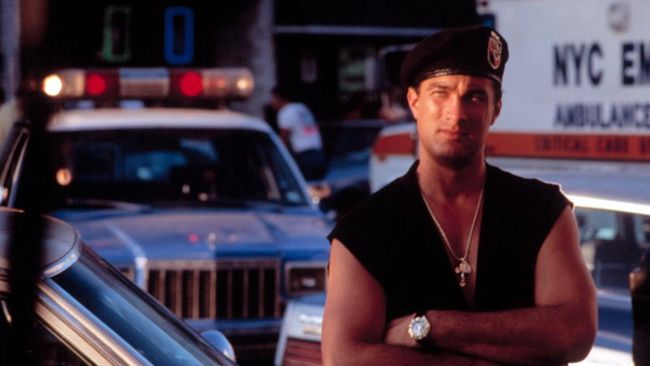
17 year-old Brad Crain was at the movie theater in April of 1991 to see Steven Seagal’s latest action film, OUT FOR JUSTICE! Seagal’s career had shot out of a cannon with his first three films being the highly successful movies ABOVE THE LAW (1988), HARD TO KILL (1990), and MARKED FOR DEATH (1990). As a guy who loved action movies, Seagal (with his pony tail) was a cool new action star, and I was down for it.
Steven Seagal plays Detective Gino Felino, a Brooklyn cop called into duty when a guy who grew up with him in their neighborhood, mob enforcer Richie Madano (William Forsythe), goes completely off the rails. Hooked on drugs and looking to settle some personal scores, Richie murders Gino’s partner, and begins turning their neighborhood into a war zone, even pulling a woman out of her car and blowing her away in broad daylight over a simple traffic incident. Convinced that Richie will not leave the neighborhood he grew up in, Gino talks Captain Ronnie Danziger (Jerry Orbach) into letting him have an unmarked police car, a shotgun, and his approval to engage in a manhunt for the drugged out psycho. From that point forward, Gino shakes down Richie’s family members and associates to try to find out where he is. As bodies and broken bones pile up, Gino is determined to do whatever it takes to bring Richie to justice!
I’ll just say up front that OUT FOR JUSTICE is my personal favorite Steven Seagal film. It’s not the crowd pleaser or the box office champ that the next year’s UNDER SIEGE (1992) would be, and film critics largely blew it off when it first hit cinemas, but it does feature the star at his most charismatic, something that would all but disappear after the mid-90’s. I love the way Seagal plays Gino. Sure he’s tough, but he talks more, he laughs more, and it feels like he’s actually enjoying himself. His Gino isn’t just a badass cop, he’s a neighborhood guy, a former street punk who grew up and made something positive out of himself. Seagal’s performance here truly works, and he plays the role with so much confidence that it’s a shame that he didn’t remain this engaged in future performances.
OUT FOR JUSTICE is a badass action film. After it opens with Richie’s horrific murders, it then follows Gino’s hunt for the killer into smoky bars filled with wannabe tough guys who know more than they’re letting on. They get their asses handed to them. It follows Gino as Richie’s goons attack him at various places, from meat shops to apartment buildings, and he dispatches them with calm precision, but often in gruesome ways. I still wince when I see the results of meat cleaver fights and close quarter shotgun blasts. OUT FOR JUSTICE is a throwback to an era when action films featured men with integrity who kick ass and take names. While the movie does have some melodrama and humor, at the end of the day, this is tough-guy cinema done right.
I did want to shout out a few other things about OUT FOR JUSTICE that helps put it over the top for me. William Forsythe is incredible as Richie Madano. He’s sweaty, twitchy, cruel, and completely unhinged. He makes you believe that he’s literally capable of doing anything, and it seems like his goons may be following more out of fear than anything else. His Richie is a man who doesn’t expect that he’ll be alive that much longer, so he’s willing to cross every line that may have once mattered in his life. Director John Flynn captures the urgency of the film’s action very well, and we can feel the tension as Gino tries to locate the crazy Richie as quickly as possible before more innocent people are killed. He isn’t afraid to show the brutality of the violence as part of Gino’s quest, either. This shouldn’t be surprising when you recognize that Flynn directed the revenge classic ROLLING THUNDER (1977) about fifteen years earlier. The one last thing I wanted to point out about OUT FOR JUSTICE is that it was written by R. Lance Hill, who wrote the brutal Charles Bronson hitman film THE EVIL THAT MEN DO (1984). These are talented guys who know how to tell tough stories about even tougher men who are willing to do what it takes to get justice when no one else can.
At the end of the day, Steven Seagal would go on to make a lot more movies, but I don’t think he ever quite recaptured the balance of charisma and toughness that he shows here. And OUT FOR JUSTICE is a badass action movie that doesn’t really care what movie critics think, either. Buoyed by Seagal’s performance, the film’s action is angry, focused, unapologetic, and still hits hard over thirty years after it was originally released.
Let’s hear it for War of the Worlds, the 2025 film that took one of the greatest science fiction novels ever written and then re-imagined it as something really stupid.
It takes a certain amount of balls to take a book that was written in the 19th century and to adapt it as a low-budget screenlife film. Plus, the idea of making the protagonist an employee of the DHS who abuses his power to monitor his children, and his daughter’s boyfriend? That’s actually kind of clever. Good for you, movie! Way to point out just how invasive our current surveillance state is. It always kind of amazes me that, here in America, we’ve given up so much of the freedom that people died for but, whenever you point that out to people, you just kind of get an apathetic shrug.
You know what isn’t a good idea? Casting Ice Cube as the DHS employee in question.
Ice Cube plays Will Radford, the straight-laced and uptight DHS employee and 90% of the film is basically just shots of him staring at the screen of his laptop. During the day, he argues with his kids and tries to ascertain the identity of a mysterious hacker. He also checks in with Clark Gregg (who plays the head of the DHS) and with a NASA scientist who is played by Eva Longoria. Let’s give some credit where credit is due and admit that Clark Gregg seems to understand exactly what type of film that he’s in and, as such, he gives about as good a performance as anyone could in the role. Eva Longoria, on the other hand, comes across as if she’s just killing time until the next Democratic convention comes around.
But let’s get back to Ice Cube. Ice Cube is not a bad actor. When cast in the right role, he can bring an unbeatable authenticity to the screen. That said, Ice Cube does not have a particularly wide range. When he was cast as the Captain Dickson in 21 Jump Street, the intentional miscasting made for one of the best jokes in the film. In War of the Worlds, when Will starts yelling at his daughter’s boyfriend, it’s hard not to be reminded of Captain Dickson reacting to Jonah Hill dating his daughter in 22 Jump Street. The only problem — well, not the only problem — is that War of the Worlds is not meant to be a comedy.
So, what is War of the Worlds meant to be? It’s not easy to say. It’s certainly not meant to be any sort of tribute to H.G. Wells and his classic novel. If anything, the film seems to take a perverse joy in not caring about the source material. It can be argued that the film is meant to be a commercial for Amazon, seeing as how an Amazon drone plays a key role in the film’s conclusion. Considering that the film was released on Prime, that certainly seems to be a fair interpretation. In the end, even though the villains are ultimately revealed to be some of Will’s colleagues, the film still feels like a perhaps unintentional endorsement of the Surveillance State. Where would be without Ice Cube watching over us?
In 2011, the news broke that 51 year-old Doug Hutchinson had married 16 year-old Courtney Stodden. I can still remember my initial reaction.
“Who?”
Though the stories all made Doug Hutchinson out to be a some sort of household name, I wasn’t sure who he was. This was despite the fact that I had seen The Green Mile and Lost and a few other shows in which he had roles. With the exception of The Green Mile‘s Percy Wetmore, the majority of Hutchinson’s roles were small and he never made enough of an impression for me to really remember him. Doug Hutchinson was not a big star and yet, all of the initial stories about his marriage to Courtney focused on Doug and not on the 16 year-old girl that he had married. The stories often mentioned that Courtney was blonde and a few found an excuse to list her measurements but few really seemed to give much thought to how a 16 year-old ends up married to a 51 year-old. Courtney’s mother was often portrayed as being the ultimate stage mom, pushing her daughter into marrying an older man out of a belief that it would help her career (as if Doug Hutchinson was some sort of power player as opposed to being an occasionally employed character actor).
Today, it’s fashionable for everyone to claim that they were outraged from the moment that they heard about the Hutchinson/Stodden marriage. At the time the story came out, though, most people treated it as just another bit of a salacious gossip from “Hollyweird.” Doug and Courtney appeared on reality shows, including quite a few that featured them getting marriage counseling while the cameras rolled. If Doug was usually portrayed as being an old lech, Courtney was often portrayed as being a young gold digger. (Again, the fact that Doug Hutchinson was hardly a star rarely seemed to factor into these portrayals. He was an actor who had co-starred with Tom Hanks and hence, people assumed he had money.) It’s only now, with the marriage over, that people have really started to acknowledge that Courtney Stodden was a victim of both Doug Hutchinson’s grooming and the world’s tabloid culture.
Lifetime’s I Was A Child Bride: The Courtney Stodden Story dramatizes the story of Courtney’s life and her marriage to Dough Hutchinson. The film was produced by Stodden and she also provides the narration, commenting on what’s happening onscreen and trying to explain what was going through her head at the time. In the dramatization, she’s played by Holly J. Barrett while Doug Hutchinson is played, to creepy perfection, by Doug Savant. Maggie Lawson plays Krista Stoddard, Courtney’s mother. The film follows Courtney as she goes from being pushed into stardom by her mother to then being ordered to give up her career by Doug. When the story of Doug and Courtney’s marriage comes out, Doug mourns that his career is over while Krista excitedly pulls up every online story. When Courtney points out that most of the stories are bad, Krista chirps that all publicity is good publicity. (The film implies that Krista is the one who leaked the details of Courtney and Doug’s marriage to the press.) Soon, teenage Courtney is the breadwinner for both her 51 year-old husband and her mother.
The film is ultimately effective, even if it’s sometimes just as salacious as the tabloids that the movie criticizes. I was proud of Courtney for having finally broken free from Doug. That said, the story leaves quite a few unanswered questions, especially about the extent of the role that Krista played in Doug and Courtney getting married. Parents are always told to be aware of who their children are talking to online. But what do you do when the parents know and just don’t care?
For Carly (Tommi Rose) and her friend, Simone (Nikki Nunziato), that means heading down to Florida so that they can drink, dance, and party on the beach.
For Carly’s mom, Beverly (Tori Spelling), it means staying up all night and worrying about her daughter.
Beverly owns a diner and she’s worked hard to put Carly through college. Carly appears to be super responsible and she’s got a bright future waiting for her. She’s going to go to medical school and becoming a doctor. Compared to Simone, Carly can be a bit naive. No sooner has she arrived in Florida than she’s accidentally insulted a local named Luke (Joseph Cannon). Later, when Simone introduces her to the obviously sleazy and tattooed Pete (Nick Flaig), Carly’s first impulse is to ask him what college he goes to.
Pete doesn’t go to college. Instead, he lives in an isolated Everglades cabin. That’s where Carly ends up, tied to a chair and blind-folded after an attempt to humiliate her and Simone goes wrong. Pete, it turns out, is related to Luke. And a plan to simply embarrass a snobbish college student has instead led to Carly getting abducted and Simone ending up in a coma at a local hospital.
When Beverly attempts to report her daughter missing, the local authorities tell her to calm down. It’s Spring Break. College students come down to Florida and forget to check in all the time. Carly’s probably just drunk somewhere. “Not my daughter!” Beverly says and soon, she’s in Florida searching. Helping her out is Ray (Luke Ballard), a hot and rugged local boatman. Even if Beverly doesn’t find her daughter, it looks like maybe she’s found a new husband!
Advertised as being based on a true story, Abducted In The Everglades tells a familiar Lifetime story. That said, as I’ve explained in the past, the familiarity is often the point when it comes to Lifetime movies. One doesn’t necessarily watch a Lifetime movie to be surprised. Instead, one watches to see how the film will embrace the melodrama. There’s a comfort to watching a Lifetime movie. Watching a Lifetime movie is like visiting an old friend who never changes and who always delivers what they’ve promised.
For a lot of viewers, the main appeal of this film will be the chance to see Tori Spelling playing the mother. Back in the 90s, Spelling almost always played the naive daughter who ended up getting kidnapped (Mother, May I Sleep With Danger?) or the snooty popular girl who upset the wrong person (Death of a Cheerleader). Now, Spelling is the one worrying about her college-age daughter. Tori Spelling has never been much of an actress. She wasn’t particularly good in any of her earlier movies and she’s not particularly believable as a blue collar mom in this film. But oddly, that’s part of the appeal of Tori Spelling. It’s not just that she’s a bad actor. It’s that she’s so spectacularly bad that it becomes fascinating to watch.
The rest of the cast is a bit better, especially Luke Ballard and Nick Flaig. That said, the real stars here are the Everglades, the cottonmouths, and the alligators. They all do their bit to bring this Florida film to life. I should note that Jeff and I spent the first half of our summer vacation in Florida and we absolutely loved it. It’s a beautiful state. If Texas ever brings back the state income tax, I know where I’m moving.





 Through the Shattered Lens