Film Review: Deep Blue Sea (1999, dir by Renny Harlin)


Since I’m going to be watching Deep Blue Sea 2 on the SyFy network later tonight, I figured that I should rewatch the first Deep Blue Sea beforehand.

This 1999 shark attack film takes place on a laboratory that’s floating out in the middle of the ocean.  It’s the weekend so the majority of the people who work at the lab are gone.  Only a skeleton crew, made up of recognizable actors, remains.  There’s Susan McAlester (Saffron Burrows) and Jim Whitlock (Stellan Skarsgard), two brilliant scientists.  (Susan is passionate and committed.  Jim is drunk and cynical.)  There’s a marine biologist named Jan (Jacqueline McKenzie), who is such a positive presence that, from the minute she first shows up, you know that there’s no way she’s going to be alive at the end of the movie.  Tom (Michael Rapaport) is an engineer.  Brenda (Aida Turturro) is in charge of communicating with the outside world.  Preacher (LL Cool J) is a chef who acts a lot like LL Cool J.  And then there’s Carter Blake (Thomas Jane), the shark wrangler with a past.  Carter is obviously going to be our hero because, with a name like Carter Blake, there’s no way that he couldn’t be.

Finally, there’s Russell Franklin (Samuel L. Jackson).  Russell is the businessman who has been funding all of the research at the lab.  Even though he doesn’t quite understand what Susan and Jim are doing, he’s been very generous.  However, after a shark escapes and nearly eats four generic teens, Russell decides that he better find out what exactly is being done with his money.

Jim and Susan are trying to develop a cure for Alzheimer’s.  Susan says that, if their experiments are successful, one pill will be able to reverse the disease.  They’ve been running tests on sharks and … well, let’s just say that Susan and Jim haven’t exactly been honest or ethical about their experiments.  (Movie scientists always cut corners, don’t they?)  Basically, they’ve been genetically engineering the sharks to increase the size of their brain.

The end result?

SUPER SHARKS!

To paraphrase the film’s poster, these sharks are big, fast, smart, and mean!  And needless to say, they’re sick of being held captive.  Soon, the lab is besieged by angry sharks and no one is safe!

That includes Samuel L. Jackson.  Deep Blue Sea is best known for the scene where Samuel L. Jackson gives a rousing speech, in which he exhorts everyone to keep fighting and not give up, right before a shark jumps out of the water and eats him.  It’s a great scene, one that makes brilliant use of Samuel L. Jackson.  I mean, let’s be honest.  You don’t expect Samuel L. Jackson to get eaten by a shark and, as soon as he’s gone, you look at the survivors and you think to yourself, “So, now you’re depending on LL Cool J and Thomas Jane to save you?  Y’all are so screwed…”

And yet, it’s also significant that the only scene from Deep Blue Sea that people really remember is that shark eating Samuel L. Jackson.  With the exception of the one moment, Deep Blue Sea is an incredibly predictable movie.  From the minute you see that Jim is played by Stellan Skarsgard, you know that he’s doing something wrong with the sharks.  The dialogue is often cringe-worthy and the characters are all thinly drawn.  The sharks are occasionally impressive but the movie doesn’t really do enough with the idea of them of being super smart.  Was I hoping for scenes of the sharks talking to each other?  I guess I was.

That said, as I watched Deep Blue Sea, I was surprised to discover that I had forgotten just how likable and efficient the movie was.  Director Renny Harlin doesn’t waste any time trying to convince us that we’re watching anything more than just a slightly silly shark movie.  Wisely, Harlin unapologetically embraces Deep Blue Sea’s B-movie roots and, with the help of a game cast, the end result is a film that is enjoyably unpretentious and straight forward.  Samuel L. Jackson was not devoured in vain.
A Movie A Day #270: Prison (1987, directed by Renny Harlin)


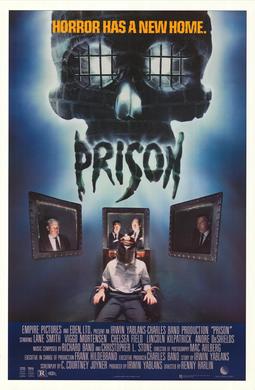
In 1964, the state of Wyoming executed Charles Forsythe (Viggo Mortensen) for killing another inmate at Creedmore State Prison.  Forsythe was innocent of the crime but the only other two people who knew, a prisoner named Cresus (Lincoln Kilpatrick) and a guard named Eaton Sharpe (Lane Smith), kept silent.  Twenty-three years later, Cresus is still an inmate and Sharpe has been named the new warden of Creedmore.  When a group of prisoner open up the old execution chamber, Forsythe’s electrified spirit escapes into the prison and starts to kill the prisoners and the guards, one-by-one.  A convict named Burke (also played by Mortensen) understands what is going on but can he get anyone to believe him?

If the idea of an executed murderer turning into an electrified spirit sounds familiar, that’s because the exact same idea was used in Destroyer, The Horror Show, and Wes Craven’s Shocker, all of which went into production and were released at roughly the same time.  Why did the late 80s see so many director making movies about convicts coming back to life after being sent to the electric chair?  We may never know.

Of the four electric ghosts movies, Prison is the best.  Lane Smith is a great villain and Prison makes good use of its claustrophobic setting.  Since Charlie is stalking inmates instead of horny teenagers, there literally is no way for anyone to escape him.  (It never makes sense, though, why Charlie is killing “innocent” prisoners when Sharpe, who hates all of this prisoners, is the one that Charlie is targeting for revenge.)  The best scenes are the ones where the warden desperately tries to force the inmates to confess to the murders so he won’t have to confront the truth about Charlie’s revenge.  Lane Smith, who would later be best known for playing Richard Nixon in The Final Days, acts the hell out of those scenes.

Prison was the first American film to be directed by Finnish director Renny Harlin and it is a hundred times better than many of the overproduced action films that Harlin would later be best known for.  Of course, it’s no Die Hard 2 but I would gladly watch Prison over Cutthroat Island.

4 Shots From 4 Films (William Atherton): Ghostbusters (1984), Real Genius (1985), Die Hard (1988), Die Hard 2 (1990)


Yesterday, Arleigh spotlighted Everybody Wants To Rule The World by Tears for Fears. I grew up listening to the song all the time because it was featured in one of my all-time favorite movies: Real Genius (1985). At the heart of the movie is a slimy embezzling college professor who is taking advantage of smart kids to build a special laser for the government to assassinate people from space. However, this wasn’t the first, or last time that Atherton was cast as a scumbag in the 1980s. I thought it would be fun to spotlight four of them, including his turn as Professor Hathaway in Real Genius.

Ghostbusters (1984)

Ghostbusters (1984, dir. Ivan Reitman)

Real Genius (1985)

Real Genius (1985, dir. Martha Coolidge)

Die Hard (1988, dir. John McTiernan)

Die Hard (1988, dir. John McTiernan)

Die Hard 2 (1990, dir. Renny Harlin)

Die Hard 2 (1990, dir. Renny Harlin)

Two Late Reviews: The Legend of Hercules (dir by Renny Harlin) and Pompeii (dir by Paul W.S. Anderson)


As I mentioned in a previous review, I’ve only got a few months left before I’m going to have to make out my list of the 16 worst and the 26 best films of 2014.  With that in mind, I really need to get caught up on reviewing some of the films that might appear on those two lists.  For the most part, I try to review every single movie that I see but, occasionally, a movie or two will slip through the cracks.  And now, with Oscar season approaching but not quite arrived, seems like as good as time as any as to try to get caught up by reviewing two films that came out earlier this year: Renny Harlin’s The Legend of Hercules and Paul W. S. Anderson’s Pompeii.

Hercules_(2014_film)_poster

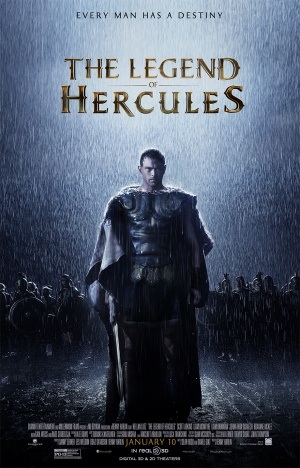
The Legend of Hercules is a film that I first saw with my BFF Evelyn way back in January.  And while I meant to review it after I first saw it, I simply never got around to actually doing so.  Some of that is because, when Kellan Lutz first showed up on screen, Evelyn said, “Nice tits,” and I ended up laughing so hard that I nearly fell out of my seat.  This led to Evelyn spending the entire film trying to make me laugh again and, in between all of the whispering and the giggling, we undoubtedly missed out on a lot of the film.

However, I recently rewatched The Legend of Hercules on Cinemax and I was quickly reminded about the other reason that I hadn’t gotten around to reviewing it.  There’s really just not that much to say about The Legend of Hercules.  It’s just not a very good film but yet it’s not bad in a fun way either.  It’s just boring.  As played by Kellan Lutz, Hercules wanders through the ancient world and he does all the stuff that you would expect Hercules to do.  Actually, he does all the stuff that you would expect any character in a rip-off of 300 to do.  The film could have just as easily been called The Legend of Eammon, an Irishman in Greece.  

In fact, I’d really like to see a movie called The Legend of Eammon, an Irishman in Greece.  Get on it, someone.

According to Wikipedia, The Legend of Hercules had a budget of 70 million dollars, which makes it a bit odd that the film itself just looks cheap and generic.  At one point, Hercules fights a lion and the CGI is so bad that, for a few minutes, the movie looks like one of those senior projects that students occasionally upload to YouTube.  (I was half-expecting to see a comment apologizing for the “crappy special effects” flash across the screen.)  During the film’s many fight scenes, director Renny Harlin does that thing where every punch is shown in slow motion.  It gets annoying after the hundredth time.

A few words about Kellan Lutz.  I happen to like Kellan Lutz.  I think he’s been likable in other roles.  But, in The Legend of Hercules, he really did spend the entire movie looking like he was wishing that he could be anywhere else.  But can you blame him?

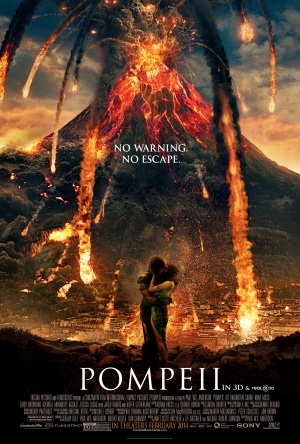
Pompeii-posterFor a far more enjoyable trip into the past, allow me to recommend a film that came out a few months after The Legend of Hercules, Pompeii. 

Now, before I review Pompeii, I should admit that, as you all know, I am a history nerd and, as you all might not know, I’ve always been fascinated by the Roman Empire.  The summer after I graduated high school, I took a trip to Italy and I actually walked through the streets of Pompeii.  My two main memories of Pompeii: while we were touring an ancient brothel, an Australian man lay down on one of the slabs.  My other memory is that it was a very windy day and I was wearing a skirt so I can legitimately say that not only have I visited Pompeii but I’ve flashed Pompeii as well.

Anyway, Pompeii the Movie tells the story of the final days of Pompeii the City.  A Celtic slave and gladiator named Milo (Kit Harrington) is sent to Pompeii where he, in quick order, meets and romances the noble Cassia (Emily Browning), establishes a friendly rivalry with fellow gladiator Atticus (the always intimidating Adewale Akinnuoye-Agbaje), spots the evil Roman General (Kiefer Sutherland) who killed Milo’s mother, and then eventually has to run for his life as a cloud of ash and a river of lava crashes down on Pompeii.

Pompeii is a lot of fun.  Harrington and Browning have a lot of chemistry, all of the actors are obviously having a good time with their melodramatic dialogue, and Kiefer Sutherland was born to play an evil Roman.  As opposed to the Legend of Hercules, Pompeii looks good and the eruption of Mt. Vesuvius is genuinely impressive.  Perhaps best of all, the film actually allows things to play out to their natural and logical conclusion.  For once, history is not changed just to force a happy ending on the viewers and Pompeii is all the better for it!

So, in conclusion: forget about The Legend of Hercules and give Pompeii a chance.  Actually, you’ve probably already forgotten about The Legend of Hercules so just try not to suddenly remember it.  But seriously, Pompeii is better than you might think.