4 Shots from 4 Films is just what it says it is, 4 shots from 4 of our favorite films. As opposed to the reviews and recaps that we usually post, 4 Shots from 4 Films lets the visuals do the talking!
In honor of Marlon Brando’s birthday, here’s…
4 Shots From 4 Films
A Streetcar Named Desire (1952, dir by Elia Kazan)
Today would have been Marlon Brando’s 94th birthday so it seems appropriate that today’s music video should be for a song that was, at least partially, inspired by Marlon Brando’s career!
In 2014 interview, Scott Walker explained the idea behind this song, saying that he found that there were several movies that features scenes of Marlon Brando being physically assaulted. Along with detailing some of the assaults that Brando suffered on screen, the song serves as a tribute to sadomasochism in general.
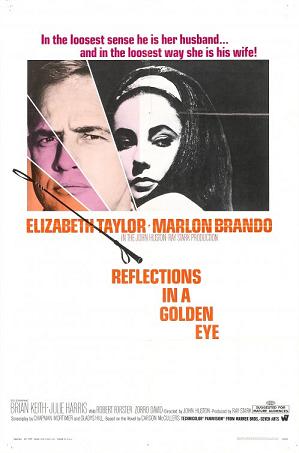
In the third verse, there are several references to Brando’s films. First there’s mention of Brando getting beat up by John Saxon in The Appaloosa. “I took it from dad” is probably a reference to One-Eyed Jacks, the only film that Brando ever directed. Fat Johnny Friendly was the racketeer played by Lee J. Cobb in On The Waterfront while the three vigilantes are a reference to Brando’s role in The Chase. “I took it for The Wild One” is obviously a reference to the film of the same name. As “Lizbeth,” that’s presumably a reference to Elizabeth Taylor, who beat Brando with a riding crop in Reflections in a Golden Eye.
For the past two weeks, I’ve been reviewing, in chronological order, 126 cinematic melodramas. I started in the 1920s with Sunrise and Wings and now, 33 reviews later, we have finally reached the end of the 1960s. And what better way to end the 60s than by taking a mercifully brief look at the 1969 film, Reflections in a Golden Eye.
Now, before I get too critical of this film, I should acknowledge that there are some critics who absolutely love Reflections in a Golden Eye. They think very highly of Marlon Brando’s performance as Maj. Weldon Penderton, a closeted homosexual who is stationed at a military base in the South. They think that Elizabeth Taylor’s performance as Brando’s wife isn’t somewhat embarrassing. And they think that the script isn’t overwritten and that director John Huston doesn’t try way too hard to prove himself worthy of the title auteur. They feel that Reflections in a Golden Eye is a secret masterpiece that does not deserve to be known as an infamous flop.
I’m definitely not one of those people but they do exist. There are some very respectable and intelligent critics who happen to love Reflections in a Golden Eye.
Well — vive la différence!
Earlier in this series, I pointed out that the 60s were not a great time for old school Hollywood directors trying to compete with both American television and European film. It was a time when talented directors found themselves trying to keep up with the times and appeal to new audiences. As a result, Joseph L. Mankiewicz ended up making Cleopatra. Edward Dmytryk did The Carpetbaggers. Elia Kazan directed The Arrangement. William Wyler did The Liberation of L.B. Jones. Stanley Kramer made RPM.
And John Huston made Reflections in a Golden Eye.
This painfully slow film follows the affairs of six people on that Southern army base. Brando is emotionally repressed and spend most of the movie mumbling in one of the worst Southern accents ever. Taylor is obsessed with horses and spends most of the movie yelling in one of the worst Southern accents ever. Robert Forster is the object of Brando’s repressed desire, a soldier who likes to ride horses while naked and who is obsessed with sniffing Elizabeth Taylor’s underwear. Brian Keith is in charge of the army base and is having an affair with Taylor. Julie Harris is Keith’s suicidal wife. Zorro David is Harris’s houseboy who, at one point, is nice enough to give this film a title by mentioning something about a golden eye.
What’s particularly insane is that Huston took the idea of making this film a reflection in a golden eye literally. The entire film is tinted a sickly gold color. Whenever the characters step outside, the sky looks like the sun has just exploded. Whenever the characters are inside, they all look like they have jaundice. On the one hand, you have to respect the fact that Huston so committed himself to potentially alienating the audience. On the other hand, the yellow-tinting renders almost every image so grotesque that I actually found myself growing physically ill as I watched the film.
Watching Reflections in a Golden Eye, I could understand why The Godfather was such a huge comeback for Marlon Brando. I wouldn’t necessarily say that Brando gives a bad performance here. He’s watchable throughout the entire film. But it’s still a performance that’s so strangely modulated (and which features a Southern accent that is just amazingly bad) that it ultimately distracts from the film itself. If anything, Brando gives a performance that suggests what happens when a talented and eccentric man gets bored with what he’s doing.
(If you want to see a good Brando performance from 1969, see Burn.)
Reflections in a Golden Eye is a pretentious mess but fortunately, both Huston and American film would make a comeback in the 1970s. We’ll start on that decade tomorrow.
(Yes, this video is a spoiler but it’ll allow you to see the gold tinting.)
(The film was also released in an untinted version.)
I was at work this afternoon when my boss — who had just gotten to the office after spending the day in court — approached my desk and said, “Lisa, you like old movies, don’t you?”
“Kinda sorta,” I replied and I tried to say that with just a hint of a coy little smile to let him know that I absolutely love movies — new and old — but I’m not sure if he noticed.
“Did you know Elizabeth Taylor died today?” he asked. I guess I didn’t answer quickly enough because he then added, “She was a movie star, might have been a little bit before your time.”
Well, just for the record, I do know who Elizabeth Taylor was. And even though she pretty much retired from acting before I was even born, she was hardly before my time because — whether it was by appearing in classic films like A Place in the Sun and Giant or films like Cleopatra and Reflections in a Golden Eye that were so bad that they somehow became good — she became one of those timeless icons.
I think there’s probably a tendency to be dismissive of Elizabeth Taylor as an actress because her private life, in so many ways, seemed to epitomize every cliché of old school Hollywood scandal and glamorous excess. However, you only have to watch her films from the 50s to see that Elizabeth Taylor actually was a very talented actress who, even more importantly, had the type of charisma that could dominate the screen.
I think that’s why it was so strange to hear that Elizabeth Taylor had died. It was a reminder that, as opposed to just being an image stored on DVDs that can be viewed as often or as little as one might choose, she was actually a human being just like the rest of us.


 Through the Shattered Lens