October True Crime: Hostage (dir by Frank Shields)


First released in 1983, Hostage is an Australian film about Christine (Kerry Mack) and Walter Maresch (Ralph Schicha).

Christine is a young woman who escapes from her abusive father by going on the road with a traveling carnival.  She runs the dart-throwing booth.  It’s a simple life but she’s happy with it.  She has friends and she has freedom.  When Walter, an enigmatic German drifter, joins the carnival, there’s an immediate attraction between him and Christine.  Christine sleeps with him a few times but she makes it clear that she’s not looking for anything serious or permanent.  Walter announces that, if Christine doesn’t marry him, he’s going to shoot himself.  Christine rolls her eyes and leaves his trailer, just to hear a gunshot as she walks away.  At the hospital, Walter refuses to get treated until Christine promises to marry him.

Christine does marry Walter, both to keep him from dying and also because she’s pregnant.  Walter survives his gunshot wound and turns out to be the type of husband who alternates between being wildly romantic and being coldly abusive.  Walter wants to have lot of a children.  He’s upset when Christine gives birth to a girl.  “The next one will be a son!” he announces.  Walter also spends a lot of time complaining about how weak the Australians are compared to the Germans.  And, of course, there’s another huge issue with Walter.

HE’S A NAZI!

Walter is a neo-Nazi.  For whatever reason, it takes Christine forever to figure this out.  Walter drags to Christine to Germany and then gets mad when Christine doesn’t stand along with all of his friends while watching The Triumph of the Will.  Christine opens up Walter’s keepsake box and finds a picture of his father wearing a Nazi uniform and also an iron cross.  Walter’s friends are all blonde Aryan types who are constantly talking about how Germany has lost its way.  And yet Christine doesn’t really seem to get that Walter is a Nazi until Walter starts talking about blowing up buildings and robbing banks.

Eventually, back in Australia, Walter and Christine rob a string of banks and the tabloids are soon describing them as being a modern-day Bonnie and Clyde.  Walter is happy but Christine just wants to grab her daughter and escape from him.  That proves to be easier said than done.  Walter’s not just a Neo-Nazi.  He’s also totally insane….

Amazingly enough, this is based on a true story.  Christine wrote about her ordeal and her book was adapted into Hostage, a film that may look like a typical exploitation film but which is actually a rather engrossing drama about a naive girl who finds herself trapped with a monster.  The film is full of moments that stick with you, like when a policeman comes by Christine’s trailer and manages to totally miss her signals that she’s currently being held, at gunpoint, by Walter.  Kerry Mack and Ralph Schicha both give strong performances as Christine and Walter.  Schicha especially deserves a lot of credit for turning Walter into a believable villain as opposed to just a caricature.  One reason why Walter is so dangerous is because he’s such an idiot and Schicha does a great job of showing what happens when stupidity mixes with confidence.  In one of the film’s more over-the-top moments, Walter and his friend Wolfgang drag Christine to Turkey.  At first, Walter and Wolfgang are cocky but the trip becomes a violent and (literally) bloody disaster.

Hostage brings a real nightmare to life.  Sadly, even after she freed herself of Walter, Christine continued to live a difficult life.  She died of hypothermia in 2019.

Film Review: The Gorgon (dir by Terence Fisher)


Medusa, who is probably the best-known of the Gorgons who haunt Greek mythology, is a scary creation.

That may seem like a rather obvious statement to make but seriously, let’s consider just how scary Medusa is.  First off, there’s the fact that her hair is made out of snakes.  Snakes are frightening in general.  The other day, Doc caught a grass snake and tried to give it to me by dropping it at my feet.  I have never been quicker to jump away from a cat.  It’s not just Texas grass snakes that frighten me, though.  There’s the rattlesnakes that I used to see when my family was living in New Mexico.  There’s the water moccasin that I once saw swimming in Boggy Creek when I was up in Arkansas.  I’m pretty sure that I once saw a cobra slithering through downtown Denton but all of my friends insist that it was just a water hose that somebody left out.  Well, no matter!  Snakes are scary on their own but they’re even scarier when they’re growing out of someone’s head!

And then there’s the fact that if you look at Medusa or any of her sisters, you turn to stone!  I mean, it just takes one look and boom!  You’re a statue!  I imagine the process of transforming would feel terrible.  Can you even imagine?  Even worse would be someone trying to move your body and accidentally dropping you.  I mean, you could lose a finger!  I guess it wouldn’t matter since you would be dead but still, that would totally suck to lose a finger that way.

First released in 1964 and having since achieved a certain immortality based on frequent TCM showings, The Gorgon is a production of Hammer Film.  The usual Hammer monsters are replaced by Mageara (played by Prudence Hyman), a Gorgon who has somehow found herself in a typical, isolated Hammer village.  Neither Dracula nor Baron von Frankenstein are present in this film, though the actors who played them do have roles.  Christopher Lee is Prof. Karl Meister.  Peter Cushing is Dr. Namaroff.  Together, they solve crimes and hunt the monsters!

Villagers are getting turned to stone and innocent artists are being condemned to die.  We know that it’s all due to the Gorgon but it takes everyone else in the film a while to figure it out.  For instance, Paul (Richard Pasco) has to dig up his father’s grave in order to be convinced that the old man died from being turned to stone.  At first, the only person who truly seems to believe in the Gorgon is Namaroff’s assistant, Carla (played by Hammer films regular, Barbara Shelley).  By the end of the film, of course, everyone knows that Gorgons are real!  Of course, almost everyone has been turned to stone, as well.  Even by the standards of Hammer, the body county is high and the monster is merciless in The Gorgon.

It’s an effective Hammer film, though it’s never quite as much fun as Hammer’s Dracula or Frankenstein films.  The Gorgon takes itself perhaps a tad too seriously but, at the same time, you have to love any film that features both Lee and Cushing working together for once, as opposed to trying to kill each other.  Christopher Lee especially seems to be enjoying himself as Dr. Namaroff.  Lee reportedly grew quickly tired of playing Dracula and his joy of having a different type of role is palpable and perhaps the most likable thing about The Gorgon.  As for the Gorgon herself, she’s properly frightening.  I mean, she has snakes in her hair, after all.

When this movie last aired on TCM, there were technical difficulties during the last seven minutes of the showing.  The screen went blank and then viewers were treated to several different takes of one of the Gorgon’s victims trying to write a letter as he turned to stone.  It kind of freaked everyone out, to be honest.  Had the Gorgons taken over TCM?  Fortunately, order was restored in time for everyone to watch Plague of the Zombies.  Thankfully, things worked out.

Jaws Meets Mad Max: Razorback (1984, directed by Russell Mulcahy)


Deep in the Australian outback, a young child named Scotty goes missing.  His grandfather, Jake (Bill Kerr), swears that a giant boar (“a razorback”) broke into his house and ran off with his grandson.  The locals don’t think it was a boar.  They don’t even think it was a dingo.  Instead, they charge Jake with killing his grandson but, because there’s not evidence to convict him, Jake goes free.

Two years later, a nosy American reporter named Beth Winters (Judy Morris) mysteriously vanishes shortly after arriving in the Outback to do a story on how kangaroos are being hunted to the point of extinction.  Women and children are vanishing in the Outback?  This sounds like a job for Lee Majors but the best this movie can do is Gregory Harrison.  Harrison plays Beth’s husband, Carl, who comes to Australia to search for her.  At first, he thinks that she may have been kidnapped by the moronic Baker brothers (Chris Haywood and David Argue) but then he meets Jake and a comely pig expert named Sarah (Arkie Whiteley).  Jake tells Carl about the razorback and later comes across Beth’s wedding ring in a pile of boar shit.

Razorback was probably pitched as being “Jaws meets Mad Max.”  Just as in Jaws, the authorities refuse to accept that people are being eaten by a giant boar and it is up to an inexperienced American, an old timer, and a scientist to try to stop it.  Also, like in Jaws, the boar is that star of the show even though it does not get much screen time.  When the boar does appear, it bears a distinct resemblance to Motorhead’s War-Pig.  Just as in Mad Max, every Australian in Razorback drives like a maniac.  Whenever the Baker brothers tear across the screen in their truck, it’s easy to imagine Max Rockatansky and Goose in hot pursuit.

Along with the boar, the other star of the film is the Australian outback itself, which the film treats as almost being an alien landscape:

If Razorback makes the Australian outback look like an 80s new wave music video, that might be because it was directed by Russell Mulcahy, who started his career directing videos for Duran Duran.  Before one boar attack, Duran Duran’s New Moon On Monday is even heard playing on a radio.  (Ironically, New Moon On Monday was one of the few early Duran Duran videos that Mulcahy did not direct.)  Both the boar and the film look great but all of the humans get overshadowed by the visuals.   Not that it matters, since they’re only there to serve as razorback food.

Despite the strong visuals and the amazingly cool monster, Razorback got only lukewarm reviews when it was first released.  Critics aside, it was a hit in Australia, where it won Australian Film awards for both editing and cinematography.  (Cinematographer Dean Semler later won an Oscar for his work on Dances with Wolves.)  It only found cult success in the United States.  One admirer was Steven Spielberg, who reportedly called Mulcahy to ask how he achieved some the film’s visual effects.  Two years after the release of Razorback, Mulcahy directed his best-known film, Highlander.

Flaws and all, Razorback is the best movie ever made about a wild boar eating people in Australia.


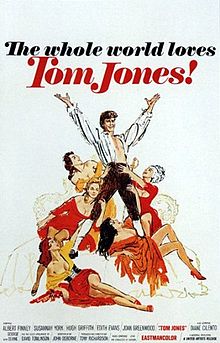
Cleaning Out The DVR #20: Tom Jones (dir by Tony Richardson)


(For those following at home, Lisa is attempting to clean out her DVR by watching and reviewing 38 films by this Friday.  Will she make it?  Keep following the site to find out!)

220px-Poster_-_Tom_Jones_01

Oh, how I wanted to love Tom Jones!

http://www.youtube.com/watch?v=NjEE_1U0-8s

No!  Not that Tom Jones.

I’m talking about Tom Jones, the British film from 1963.  Based on a novel by Henry Fielding, Tom Jones was a huge box office success and it was one of the few comedies to ever win the Oscar for best picture.  Whenever you watch a documentary about the British invasion of the early 60s, chances are that you’ll see at least a clip or two from Tom Jones.  The film (or perhaps I should say the film’s box office success) is a part of 60s pop history, right up there with The Beatles on The Ed Sullivan Show and Sean Connery shooting that guy in cold blood in Dr. No.

Up until last night, I had heard about Tom Jones but I had never seen it.

And I really wanted to love it.

The film takes place in 18th century England and it tells the story of young Tom Jones (Albert Finney).  It starts with a lengthy sequence that plays out like a silent film, complete with title cards.  Upright Squire Allworthy (George Devine) comes home and discovers that a baby has been left in his bed.  He assumes that the child was born to two of his servants and declares that he will raise Tom Jones to be a good and worthy man.

Two decades later, Tom Jones has grown up and now he’s being played by Albert Finney (who, it must be said, was quite a handsome man when he was young).  Because Tom is good-looking and kind-hearted, every woman in England lusts after him.  But Tom is in love with innocent Sophie Western (Susannah York).  However, Sophie is a member of the upper class and Tom is a “bastard,” at a time when that actually means something.

Indeed, Sophie’s aunt and uncle (played by Edith Evans and Hugh Griffith) demand that Sophie have nothing to do with Tom Jones.  They decide that she will marry Blifil (David Warner, young but already typecast as a villain).  Through clever lies and manipulations, Blifil convinces Squire Allworthy that Tom has turned bad and must therefore be exiled from his home.  Does Blifil want to get rid of Tom just so he can marry Sophie or is it possible that there’s more to Blifil’s scheming?

Before we get the answer to that question, we spend a while following the exiled Tom as he wanders around England and attempts to prove himself worthy of Sophie.  Along the way, Tom serves briefly in the army, gets into numerous fights, and has several affairs.  One of those affairs is with Mrs. Walters (Joyce Redman), who he briefly thinks might be his mother.  Eventually, Tom ends up as the lover to the decadent Lady Bellaston (Joan Greenwood).  Through Blifil’s scheming, he also ends up framed for attempted murder and facing the gallows…

And, as melodramatic as that may all sound, Tom Jones is definitely a comedy.  It doesn’t take itself seriously and there’s hardly a single scene that isn’t played for laughs.  Director Tony Richardson goes out of his way to make sure that you never forget that you’re watching a movie.  There are freeze frames.  There’s plenty of characters around to supply sarcastic commentary.  There’s even a few cases of fourth wall breaking.

As I watched Tom Jones, it was hard for me not to compare it to Stanley Kubrick’s Barry Lyndon.  After all, both films take place during the same period of time and both deal with a young man making his way through European society.  I would even argue that, in its way, Barry Lyndon is far more satirical than Tom Jones.  The main difference between the two films is that Barry Lyndon is all about subtext whereas everything that happens in Tom Jones happens right on the surface.

As I said, I really wanted to like Tom Jones but, seen today, the entire film seems to be trying a little bit too hard.  Tony Richardson’s direction is so manic that it gets a bit exhausting after a while.  That said, I can understand why the film was such a success when it was first released.  I’m sure in 1963 — after having to deal with decades of pompous costume dramas — viewers probably found Tom Jones to be a breath of fresh air.  Not only was it a British film released at a time when all things British were in style but it was also a film that, by the standards of 1963, dealt frankly with sex.  In short, Tom Jones is definitely a film of its time.  If it doesn’t hold up as well today, that’s because it wasn’t made for 2016.  It was made for 1963.

And obviously, if the judgment of the Academy is to be trusted, Tom Jones was the perfect film for 1963.  That said, I would have given best picture to another British film, From Russia With Love.