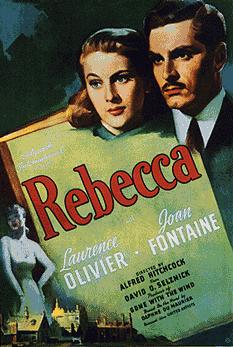
REBECCA is unquestionably a cinematic masterpiece. I remember watching it for the first time in a high school film class, enthralled as much by its technical aspects as the story itself. This was Alfred Hitchcock’s first American film, though with a decidedly British flavor, and his only to win the Best Picture Oscar. There’s a lot of film noir shadings to this adaptation of Daphne DuMaurier’s Gothic novel, as well as that distinctive Hitchcock Touch.
“Last night I dreamt I went to Manderley again”, begins Joan Fontaine’s narration, as the camera pans down a dark road overgrown with brush and weeds, fog rolling in all around, as we come up on the once majestic castle called Manderley, now lying in ruins. This first shot was all done with miniatures, another wonderful example of Hitchcock’s innovative use of the camera, looking and feeling totally believable (take that, CGI!). Flashbacks bring us to when Fontaine’s character, who’s…
Well, here we are, less than a week into Embracing the Melodrama, Part II, and I’m already running behind! The plan, as I mentioned back on Monday, is to review 128 melodramatic films over the next three weeks. And, even though I know that sounds a like a lot, I had it all planned out so that I’d be able to get all that done in just 21 days. All I had to do was make sure that I reviewed 6 films a day.
And …
Well, life happened.
But no matter! It may now take me 3 and a half weeks to review 128 films but that’s no great tragedy. And besides, regardless of how long it takes, I’ve got some pretty good films scheduled.
Take, for instance, the 1940 best picture winner Rebecca.
Rebecca is a film that all women can relate to. The heroine is played by Joan Fontaine. I say “heroine” because we never actually learn the character’s name, nor do we learn much about her background. When we first see her, she’s defined by her job, which is to basically be a paid companion to a wealthy woman. Later, she’s defined by her whirlwind romance with the brooding and aristocratic widower Maxim de Winter (Laurence Olivier). When, after two weeks, they get married, she becomes known as the second Mrs. de Winter. She becomes defined by both who she married and who she is not.
She’s not Rebecca, the first Mrs. de Winter.
As soon as Maxim takes his new wife to his estate, the second Mrs. de Winter discovers that she’ll always live in the shadow of the deceased Rebecca. Everyone she meets describes Rebecca as being a vibrant, lively figure — in other words, the complete opposite of the meek second Mrs. de Winter. The coldly imperious housekeeper, Mrs. Danvers (Judith Anderson), has perfectly preserved Rebecca’s room and makes little attempt to hide the scorn that she feels for the second Mrs. de Winter. Even worse, once they return to the estate, Maxim reveals himself to be moody and tempermental. With the help of the manipulative Mrs. Danvers, the second Mrs. de Winter becomes convinced that Maxim will never love her as much as he loved Rebecca.
Making things even more complicated, a man claiming to be Rebecca’s cousin comes by the house when Maxim is away. Jack Flavell (played by George Sanders, at his most serpent-like) suggests that there may have been more to Rebecca’s death than the second Mrs. de Winter was originally told…
Rebecca is a classic film, for many reasons. It’s well-acted, with Fontaine, Olivier, Anderson, and Sanders all bringing their characters to vibrant life. It’s a gothic romance. It’s a thriller. It’s a mystery. It is the epitome of old Hollywood style. But, for me, the main reason that Rebecca is a classic is because it tells a story to which almost everyone can relate. Every relationship that I’ve ever had, I’ve always been curious and occasionally even jealous of who came before me. There’s nothing more intimidating than living in the shadow of someone who you will never get a chance to meet personally. The second Mrs. de Winter’s insecurities are everyone’s insecurities and, in some fashion or another, we’ve all had a Mrs. Danvers in our life. The second Mrs. de Winter’s struggles are our struggles and, as she grows stronger, the viewer grows stronger with her.
Alfred Hitchcock is one of the most influential and acclaimed filmmakers of all time but he never won a directing Oscar. Rebecca was the only one of his films to win Best Picture. Producer David O. Selznick brought Hitchcock over from England to direct Rebecca and it’s been reported that Hitchcock resented Selznick’s interference. (And, while Rebecca is undoubtedly a good film that was directed by Alfred Hitchcock, it’s not exactly a Hitchcock film in the way that Shadow of a Doubt, Rear Window, or Vertigo are Hitchcock films.) As a result, Hitchcock subsequently made it a point to edit future pictures in camera so that the studios would not be able to re-edit his films.
But, whether you consider it to be a Hitchcock picture or a Selznick production, Rebecca remains a wonderfully watchable melodrama.


 Through the Shattered Lens