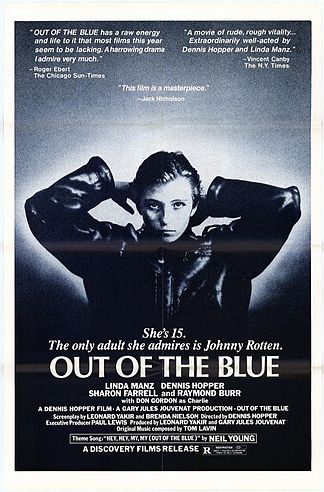
Embracing the Melodrama Part II #64: Out of the Blue (dir by Dennis Hopper)


Out_of_the_Blue_Film“Subvert normality.”

— Cebe (Linda Manz) in Out of the Blue (1980)

The 1980 Canadian film Out of the Blue opens with a terrifying scene.  Don Barnes (Dennis Hopper), drinking a beer and playing with his daughter while driving a truck, crashes into a school bus.  The bus is full of children, many of whom are seen being thrown into the air as the truck literally splits the bus in half.

Don is sent to prison.  His wife, Kathy (Sharon Farrell), becomes a drug addict.  His daughter, Cebe (Linda Manz), grows up to be an angry and alienated teenager.  Cebe spends her time either aimlessly wandering around her economically depressed hometown or else ranting about the phoniness of society to anyone who will listen (and quite a few who won’t).  Much like the killer cops in Magnum Force, all of her heroes are dead.  Occasionally, she sees a pompous therapist (Raymond Burr) whose liberal humanism turns out to be just as empty as the reactionary society that Cebe is striking out against.  Cebe’s heroes are Elvis, Sid Vicious, and her father.

When Don is finally released from prison, he returns home and he announces that he’s straightened out his life.  He promises that he’ll stay sober and he’ll be a good father.  That, of course, is all bullshit.  Soon, Don is struggling to hold down a job and spending his time drinking with his friend Charlie (Don Gordon).  Anyone who has ever had to deal with an alcoholic father will be able to painfully relate to the scenes where Don goes from being kind and loving to demonic in a matter of seconds.

Eventually, it all leads to a violent ending, one that is powerful precisely because it is so inevitable.

Out of the Blue is one of my favorite films, one that I relate to more than I really like to admit.  Directed in a raw and uncompromising manner by Dennis Hopper, Out of the Blue is a look at life on the margins of society.  And while some would argue that not much happens in the film between the explosive opening and the equally explosive ending, nothing needs to happen.  The power of the film comes not from its plot and instead from the perfect performances of Linda Manz, Dennis Hopper, Sharon Farrell, and Don Gordon.  Only Raymond Burr feels out of place but there’s a reason for that.

As much as I love Out of the Blue as a movie, I love the story of its production as well.  Originally, Out of the Blue was to be your typical movie about a rebellious teen who is saved by a patient and compassionate counselor.  Dennis Hopper was originally just supposed to co-star.  However, after the shooting started to run behind schedule, the film’s original director was fired.  Hopper talked the producers into letting him take over as a director.

This was the first film that Hopper was allowed to direct since the 1971 release of the infamous flop, The Last Movie.  Hopper, who was then best known for his drug use and his alcoholism, promised to be on his best behavior.  However, he then proceeded to secretly rewrite the entire film.

When Raymond Burr showed up to shoot his scenes, he was under the impression that he was still the star of the film.  Hopper essentially proceeded to shoot two separate films.  One film followed the original script and starred Raymond Burr.  The other was Hopper’s vision.  When it came time to take all of the footage and edit together the film that would be called Out of Blue, only two of Burr’s scenes made it into final cut and, in both of those scenes, Burr’s character is portrayed as being clueless.

Out of the Blue is not a happy film but it’s a good one.  More people need to see it.

Netflix Noir #3: Crime of Passion (dir by Gerd Oswald)


CrimepassionPosterThe third Netflix Noir that I watched was 1957’s Crime of Passion.

In Crime of Passion, Barbara Stanwyck plays Kathy Ferguson, a San Francisco-based advice columnist.  She is approached by two homicide detectives who request her help tracking down a fugitive who they think might read her column.  Charlie (Royal Dano) is aggressive and outspoken.  When he first meets Kathy, he tells her, “You’re work should be raising a family and having dinner ready when your husband comes home from work.”  His far more passive partner is Detective Bill Doyle (Sterling Hayden).

Kathy writes a column that convinces the fugitive to turn herself in.  (The power of Kathy’s column is shown in an amusing montage where woman after woman is seen reading the column aloud.  Significantly, no men are seen to ever read anything that Kathy has written.)  The resulting fame leads to Kathy getting a job offer in New York.

However, before Kathy can leave, she gets a phone call from Bill.  He asks her out on a date and, one scene later, they’re getting married in the shabby office of a justice of the peace.  Kathy sacrifices her career to be a suburban housewife.

From the minute that Kathy first looks at the small and anonymous house and the boring neighborhood that she’ll be sharing with Bill, it’s obvious that things are not going to work out well.  Even though Kathy even tells Bill, “I hope all your socks have holes in them and I can sit for hours darning them,” the life of domestic servitude is not for her.

Every day, she stays home while Bill goes to work.  At night, she reluctantly plays hostess to the constant gatherings of Bill’s colleagues and their wives.  The women stay in one room while the man gather in another.  Kathy is quickly bored with the inane chattering of the other wives but whenever she tries to go into the other room, she finds herself treated like an unwanted intruder.

And worst of all is the fact that Bill has absolutely no ambition of his own.  He’s got his house.  He’s got his wife.  He’s got his friends.  And he doesn’t feel that he needs anything else.

Kathy takes it into her own hands to advance Bill’s career, first by having an affair with Bill’s boss (Raymond Burr) and finally by trying to find a spectacular crime that Bill can solve.  And, as the suburbs continue to drive her mad, Kathy is not above creating a few crimes on her own…

In many ways, Crime of Passion reminds of another 50s film, Nicholas Ray’s Bigger Than Life.  Both films use the conventions of melodrama to present a surprisingly subversive look at the horrors of suburban conformity.  Unfortunately, Crime of Passion never quite reaches the heights of Bigger Than Life, largely because Sterling Hayden gives such a dull performance as Bill that you never believe that Kathy would have married him in the first place.  (The film would have been far more impressive if Bill had started out as an apparently dynamic character whose dullness was then revealed after Kathy married him.)  However, Barbara Stanwyck is well-cast as Kathy and Raymond Burr plays up his character’s ambiguous morality.  If nothing else, Crime of Passion is one of those film to show anyone who is convinced that nothing subversive was produced in the 1950s.

Film Review: A Cry In The Night (dir by Frank Tuttle)


cryinthenight01f

Thanks to TCM, I’ve gotten the chance to discover a lot of old films that I, otherwise, would have probably never even heard about.  One of those films is A Cry In The Night, a low-budget, 1956 crime story that I randomly came across last month.

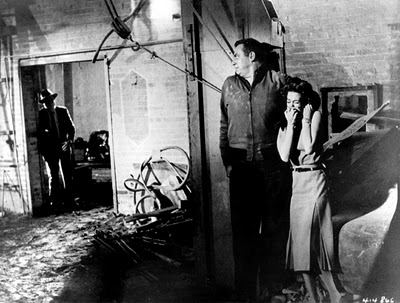
Harold Loftus (Raymond Burr) has issues.  He lives in a shack, he’s totally dominated by his overbearing mother, and he spend most of his time secretly peeping at couples who are parked at the local lover’s lane.  When he comes across Liz (Natalie Wood) and her boyfriend Owen (RIchard Anderson), he overpowers Owen and kidnaps Liz.  Now, Owen must work with Liz’s overprotective policeman father, Dan (Edmond O’Brien), to track down Harold and Liz.  Making things difficult is the fact that Dan blames Owen for the kidnapping and simply cannot bring himself to accept that his daughter was actually “one of those girls” who spent her Saturday night sitting in a car and sharing chaste kisses with her boyfriend.

(Seriously, the film made it sound like this was the worst possible thing that a girl could do with her time.  I’m not sure if Dan was supposed to come across like a reactionary or if this was just a case of the film having been made in 1956.  Personally, if that’s what the 50s were like, I’m glad I wasn’t born until the 80s.)

As directed by Frank Tuttle, A Cry In The Night tells its story in a stark, no-nonsense, semi-documentary manner.  (There’s even narration at the beginning and end of the film.)  O’Brien bellows his way through the role and Anderson’s colorless performance does little to make Owen seem like any less of a wimp.  However, Raymond Burr makes for a disturbingly plausible pervert and Natalie Wood is well-cast as Liz.  The film came out a year after Rebel Without A Cause and, watching her performance in A Cry In the Night, you can tell why Natalie Wood was Hollywood’s favorite vulnerable teenager.

I have to admit that I love films like A Cry In The Night, not so much because they’re great films (and, while always watchable, A Cry In The Night is certainly not a great film), but because they’re totally a product of their time.  As opposed to the big budget extravaganzas that were churned out by the Hollywood studio system during the 50s and 60s, low-budget B-movies like A Cry In The Night were designed to exploit contemporary headlines and contemporary concerns and, therefore, provide a lot of insight into what was going on with the American psyche at the time.

A Cry In The Night combines several themes that ran through the majority of the films of the period.  In the role of Harold, Raymond Burr is the epitome of the 1950s weirdo.  As opposed to the normal, all-American boys who make out with their girls in cars, Harold can only bring himself to lurk about and attempt to catch a peek of what normal society does on Saturday night.  When he kidnaps Liz, he’s not only threatening Natalie Wood, he is by extension attacking America itself.  Meanwhile, Liz’s boyfriend comes across like the type of intellectual liberal who probably cast two ballots for Adlai Stevenson while her father is definitely an Eisenhower man.   Boyfriend and father do not get along at first but what’s important is that they set aside their difference so that they can vanquish the other.  By the end of the film, the father is willing to invite the boyfriend to dinner and the boyfriend has learned that sometimes, you have to be willing to fight.

For those of you who keep crying about how the solution for all of America’s problems lie in bipartisan compromise, A Cry In The Night is the film for you!

For the rest of us, A Cry In The Night is an occasionally entertaining time capsule.