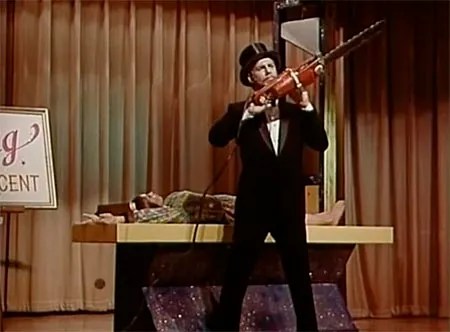
First released in 1970, Herschell Gordon’s Lewis’s The Wizard of Gore tells the story of Montag The Magnificent (Ray Sager), a magician who has a rather macabre stage show.
After lecturing his audience about how everyone secretly wants to see blood and violence, he selects a female volunteer from the audience. Both the woman and the rest of the audience are hypnotized. Montag’s tricks all involve mutilating his volunteers. One volunteer is chainsawed. Another gets a metal spike driven into her brain. Another is drilled by a giant punch press. (Like seriously, how does one store a giant punch press?) The hypnotized audience only sees Montag using his various instruments of torture but they don’t see the wounds or the blood or the intestines. (The movie audience is a bit less lucky.) The victim is hypnotized into not realizing that she has essentially been murdered but, when the hypnosis wears off after the show, they promptly drop dead, mysteriously mutilated in the same way that everyone saw Montag miming on stage.
Naturally, the police arrest Montag and the movie ends.
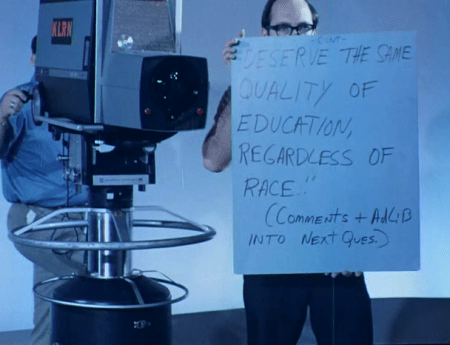
No, actually, it doesn’t. Even though it’s obvious that Montag is the murderer and that he’s hypnotizing people, the police don’t arrest him because his hypnotized audience swears that Montag didn’t really hurt anyone during his stage act. However, television host Sherry (Judy Cler) and her lunkhead boyfriend, Jack (Wayne Ratay), both come to believe that Montag is the killer and they try set up a plot to expose him on national television, Montag can’t hypnotize people through the television …. can he!? And if he can do that, who is to say that he hasn’t hypnotized the people in the theater who would have been watching The Wizard of Gore when it was first released?
The Wizard of Gore appears to have been Herschell Gordon Lewis’s attempt to comment on his own status as a director who was notorious for making gory films. (His 1963 film, Blood Feast, is often referred to as being the first gore film.) Montag is a monster who appeals to his audience’s desire to see something extreme and forbidden. For all of Montag’s evil, he can only exist and get more victims because people are willing to watch him torture strangers. Lewis was not exactly known for being a particularly artful director but the shots of Montag’s victims screaming in terror while Montag’s audience silently and unemotionally watches are about as close to a genuinely powerful moment as you’re likely to find in a Herschell Gordon Lewis film. The Wizard of Gore, with its commentary on the gore genre that Lewis himself largely invented, is one of Lewis’s more self-referential films. And with it’s trick ending and shots of people suddenly collapsing with their intestines literally spilling out of them, it’s also one of Lewis’s stranger films and that’s saying something when you consider just how many odd films Lewis made over the course of the 60s and 70s. (There’s a reason why one of his better films was called Something Weird.) The Wizard of Gore is definitely a Lewis film, with his trademark stiff actors and non sequitur dialogue giving the whole thing a dream-like feel.
There’s a scene in Juno where Jason Bateman tells the film’s title character that Herschell Gordon Lewis is a superior filmmaker to Dario Argento and that The Wizard of Gore is scarier than Suspiria. As soon as I heard that, I knew his character was going to turn out to be a sleaze and I was right. The Wizard of Gore is a historically interesting film, especially for those who love the old grindhouse films. But it’s no Suspiria.
 Through the Shattered Lens