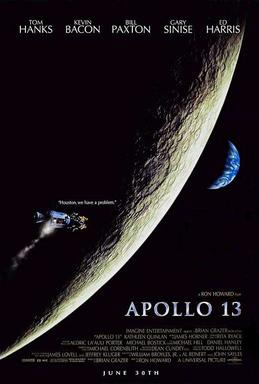
Lisa Reviews An Oscar Nominee: Apollo 13 (dir by Ron Howard)


Apollo_thirteen_movie

I just finished watching the TCM premiere of the 1995 Best Picture nominee, Apollo 13.  Of course, it wasn’t the first time I had seen it.  Apollo 13 is one of those films that always seems to be playing somewhere and why not?  It’s a good movie, telling a story that is all the more remarkable and inspiring for being true.  In 1970, the Apollo 13 flight to the moon was interrupted by a sudden explosion, stranding three astronauts in space.  Fighting a desperate battle against, NASA had to figure out how to bring them home.  Apollo 13 tells the story of that accident and that rescue.

There’s a scene that happens about halfway through Apollo 13.  The heavily damaged Apollo 13 spacecraft is orbiting the moon.  Originally the plan was for Apollo 13 to land on the moon but, following that explosion on the craft, those plans have been cancelled.  Inside the spacecraft, three astronauts can only stare down at the lunar surface below them.

As Commander Jim Lovell stares out the craft’s window, we suddenly see him fantasizing about what it would be like if the explosion hadn’t happened and if he actually could fulfill his dream of walking on the moon.  We watch as Lovell (and, while we know the character is Jim Lovell, we are also very much aware that he’s being played by beloved cinematic icon Tom Hanks) leaves his foot print on the lunar surface.  Lovell opens up his visor and, for a few seconds, stands there and takes in the with the vastness of space before him and making the scene all the more poignant is knowing that Tom Hanks, before he became an award-winning actor, wanted to be a astronaut just like Jim Lovell.  Then, suddenly, we snap back to the film’s reality.  Back inside the spacecraft, Lovell takes one final look at the moon and accepts that he will never get to walk upon its surface.  “I’d like to go home,” he announces.

It’s a totally earnest and unabashedly sentimental moment, one that epitomizes the film as a whole.  There is not a hint of cynicism to be found in Apollo 13.  Instead, it’s a big, old-fashioned epic, a story about a crisis and how a bunch of determined, no-nonsense professionals came together to save the day.  “Houston,” Lovell famously says at one point, “we have a problem.”  It’s a celebrated line but Apollo 13 is less about the problem and more about celebrating the men who, through their own ingenuity, solved that problem.

That Apollo 13 is a crowd-pleaser should come as no surprise.  It was directed by Ron Howard and I don’t know that Howard has ever directed a film that wasn’t designed to make audiences break into applause during the end credits.  When Howard fails, the results can be maudlin and heavy-handed.  But when he succeeds, as he does with Apollo 13, he proves that there’s nothing wrong with old-fashioned, inspirational entertainment.

Of course, since Apollo 13 is a Ron Howard film, that means that Clint Howard gets a small role.  In Apollo 13, Clint shows up as a bespectacled flight engineer.  When astronaut Jack Swiggert (Kevin Bacon) mentions having forgotten to pay his taxes before going into space, Clint says, “He shouldn’t joke about that, they’ll get him.”  It’s a great line and Clint does a great job delivering it.

Apollo 13 is usually thought of as being a Tom Hanks film but actually, it’s an ensemble piece.  Every role, from the smallest to the biggest, is perfectly cast.  Not surprisingly, Bacon, Bill Paxton, Gary Sinise, Kathleen Quinlan, and Ed Harris all turn in excellent performances.  But, even beyond the marquee names, Apollo 13 is full of memorable performances.  Watching it tonight, I especially noticed an actor named Loren Dean, who played a NASA engineer named John Aaron.  Dean didn’t get many lines but he was totally believable in his role.  You looked at him and you thought, “If I’m ever trapped in space, this is the guy who I want working to bring me home.”

Apollo 13 was nominated for best picture but it lost to Mel Gibson’s film Braveheart.  Personally, out of the nominees, I probably would have picked Sense and Sensibility but Apollo 13 more than deserved the nomination.
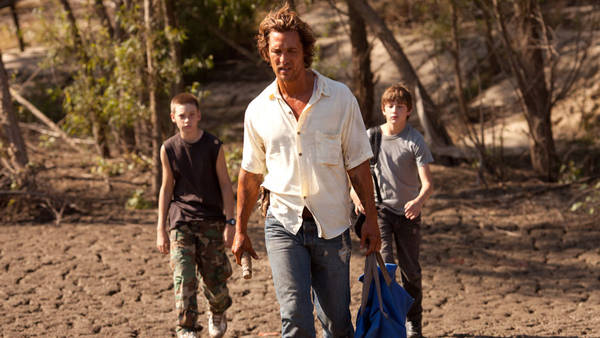
Lisa’s Homestate Reviews: Arkansas and Mud


Mud

When it comes to Arkansas, people seem to automatically think of two things.  Arkansas is the former home of Bill and Hillary Clinton and it’s also the state that accused three teenage boys of committing horrific acts of murder, largely on the basis of the fact that one of the boys used to dress in black and listen to heavy metal music.  Between the state’s largely rural image and repeat showings of Paradise Lost on HBO, Arkansas does not exactly have the best reputation.

Myself, I have a lot of childhood memories of Arkansas.  Some of them are good and some of them aren’t so good. My grandmother lived in Fort Smith so, even when my family was living in another state, we would still always find the time to come visit her every summer.  As well, I had (and still have) cousins spread out all over the state.  Almost every road trip that I’ve ever taken has involved at least a few stops in Arkansas.  When I think about Arkansas, I don’t think about the Clintons or Damien Echols.  Instead, to me, Arkansas is where I used to get excited whenever I saw we were approaching grandma’s house and where my mom once grabbed me right before I stepped on a snake that was hidden in the high grass that surrounded my cousin’s farm.

As often as I visited Arkansas while I was growing up, I also actually lived there twice.  I don’t remember the first time, because I was only two years old at the time, but my family spent 3 months living in Ft. Smith before going back to Texas.  Then five years later, we returned to Arkansas and, over the course of 19 months, we lived in Texarkana, Fouke, Van Buren, North Little Rock, and, finally, Ft. Smith once again.

Originally, for Arkansas, I was planning on reviewing The Legend of Boggy Creek, a 1974 psuedo-documentary that deals with a bigfoot-like creature that was said to live near the town of Fouke.  It made perfect sense as not only was The Legend of Boggy Creek filmed in Arkansas but it was produced by an Arkansan as well.  It remains one of the most financially successful independent films of all time and, because it’s presented as being a documentary, it features authentic Arkansans in the cast.  Even more importantly, my family actually lived in Fouke from August of ’93 to May of ’94.  I’ve been down to Boggy Creek!  (Though, to the best of my memory, the monster never made an appearance while we were living in Fouke.)

But then I thought about it and something occurred to me.  The Legend of Boggy Creek is not that good of a movie.  I watched it a few weeks ago and, once I got passed the fact that it was filmed in a town that I have vague memories of living in back when I was seven years old, I found the film itself to be almost unbearably dull.

So, instead of unleashing my snark on a 40 year-old exploitation film, I’m going to use this opportunity to recommend another film that was shot in Arkansas.  This film, however, was one of the best films of 2013.  It’s a film that, if you haven’t watched it yet, you owe it to yourself to see.

It’s a film called Mud.

Directed by Jeff Nichols (who previously gave us the excellent Take Shelter), Mud takes place in the town of DeWitt, Arkansas.  Two teenage boys, Ellis (Tye Sheridan) and Neckbone (Jacob Lofland) spend their days going up and down the Arkansas River.  Ellis, the more introspective of the two, dreams of escaping his homelife with an abusive father (Ray McKinnon) and a compliant mother (Sarah Paulson).  Quietly watching over the two boys is Tom (Sam Shepard), an enigmatic older man who lives across the river from Ellis’s family.

One day, Ellis and Neckbone come across a mysterious man living on a small island.  The man’s name is Mud (Matthew McConaughey) and he tells them that he’s waiting for his girlfriend, Juniper (Reese Whitherspoon).  Mud explains that he killed a man who once pushed her down a flight of stairs while she was pregnant.  Ellis and Neckbone agree to help Mud, secretly supplying him with food and delivering notes from him to Juniper.

However, the father (Joe Don Baker) of the man who Mud killed has arrived in town as well.  He’s brought an army of mercenaries with him and, each morning, he gathers them together for a quick prayer and then sends them out to track down and kill Mud…

Mud is a wonderful film, one that is full of visually striking images and excellent performances.  (If Dallas Buyers Club hadn’t come out later that same year, Matthew McConaughey could have just as easily been nominated for his charismatic and sympathetic performance here.)  Even more importantly, the film is full of authentic local culture and color.  If, decades from now, someone asked me what Arkansas was like in the early 21st Century, Mud is the film that I would show them.

Much as how Richard Linklater can capture Texas in a way that a non-Texan never could, Mud is fortunate to have been directed by a native of Arkansas.  Watching Mud, it quickly becomes obvious that Jeff Nichols knows and understands Arkansas and, as such, he presents an honest portrait of the state.

Every state should hope to inspire a film as well-made and entertaining as Mud.