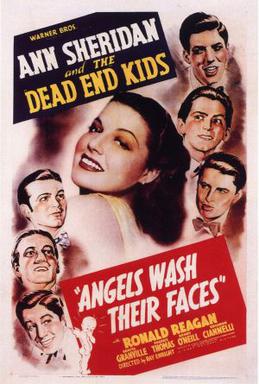
Angels Wash Their Faces (1939, directed by Ray Enright)


Gangster William Kroner (Bernard Nedell) and his henchman Martino (Eduardo Ciannelli) frame teenager Gabe Ryan (Frankie Thomas) for setting several buildings on fire.  Because Gabe has just gotten out of reform school and is a member of a local neighborhood gang, they know that no one will believe him or his sister, Joy (Ann Sheridan).

What Kroner and Martino did not count on were the Dead End Kids (Billy Halop, Bobby Jordan, Leo Gorcey, Gabriel Dell, Huntz Hall, and Benard Punsley).  They’re not going to sit by while the adults send their friend to jail.  Plus, one of their friends was killed in one of the fires.  The kids are out for revenge and sympathetic district attorney Pat Remsen (Ronald Reagan) is on their side.

As a publicity stunt, the city is holding an election for “Kid Mayor.”  The Kid Mayor gets to run the city for a week.  What could go wrong?  Billy Halop decides to run for Kid Mayor so that he can order the arrest of Kroner and then beat a confession out of him.

Angels Wash Their Faces was one of the last of the studio-made Dead End Kid films.  After this one, they would be sent down to Poverty Row and their films would be more obviously comedic.  Angels Wash Their Faces starts out as a juvenile delinquent drama, with Gabe struggling to rebuild his life and keep on the right track.  Then it becomes a goofy comedy, with Billy Halop running for mayor and unleashing vigilante justice on the bad guys.  I’m not sure that any city would actually give the “kid mayor” the power to lock people up.  Whoever came up with the idea of a kid mayor should be run out of politics.

On the positive side, Ann Sheridan is beautiful.  Future president Reagan is his usual friendly self.  On the negative side, the movie, overall, lacks the edge that made the first few Dead End Kids films memorable and the Dead End Kids themselves seem to be pretty much interchangeable.  Huntz Hall would have made a better mayor.


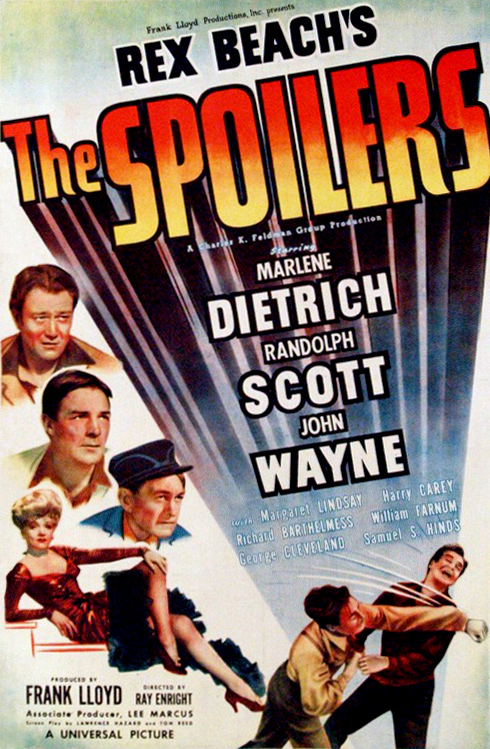
Yukon Gold: THE SPOILERS (Universal 1942)


gary loggins's avatarcracked rear viewer

What’s this?? A “Northern” Western set in 1900 Alaska Gold Rush territory starring my two favorite cowboys, John Wayne and Randolph Scott ? With the ever-enticing Marlene Dietrich thrown in as a sexy saloon owner? Count me in! THE SPOILERS is a big, brawling, boisterous film loaded with romance, action, and, most importantly,  a sense of humor. It’s the kind of Hollywood entertainment epic that, as they say, “just don’t make ’em like that anymore”. I’ve never been quite sure who “they” are, but in regards to THE SPOILERS, they’re right – and more’s the pity!

Rex Beach’s popular 1906 novel had been filmed three times before (1914, 1923, 1930), and would be one more time after (in 1955), but with The Duke, Rugged Randy, and La Dietrich on board, this has got to be the best of the bunch. Even though audiences were more than familiar with the story…

View original post 697 more words

Screwball Comedian: Joe E. Brown in ALIBI IKE (Warner Brothers 1935)


gary loggins's avatarcracked rear viewer

We’re about a quarter of the way through the baseball season, so let’s take a trip to the ballpark with Joe E. Brown in ALIBI IKE, a 1935 comedy based on a story by Ring Lardner, one of the best baseball writers of the early 20th Century. Brown, known for his wide mouth and comical yell, is an admittedly acquired taste; his “gosh, golly” country bumpkin persona is not exactly what modern audiences go for these days.  But back in the 30’s he was one of Hollywood’s top box-office draws, specializing in sports themed comedies  revolving around wrestling (SIT TIGHT), track and field (LOCAL BOY MAKES GOOD), swimming (YOU SAID A MOUTHFUL), polo (POLO JOE), football ($1,000 A TOUCHDOWN), and racing (boats in TOP SPEED, airplanes in GOING WILD, bicycles in SIX DAY BIKE RACE).

ALIBI IKE is the final chapter in Brown’s “baseball trilogy”. The first, 1932’s FIREMAN, SAVE MY CHILD, found him…

View original post 493 more words

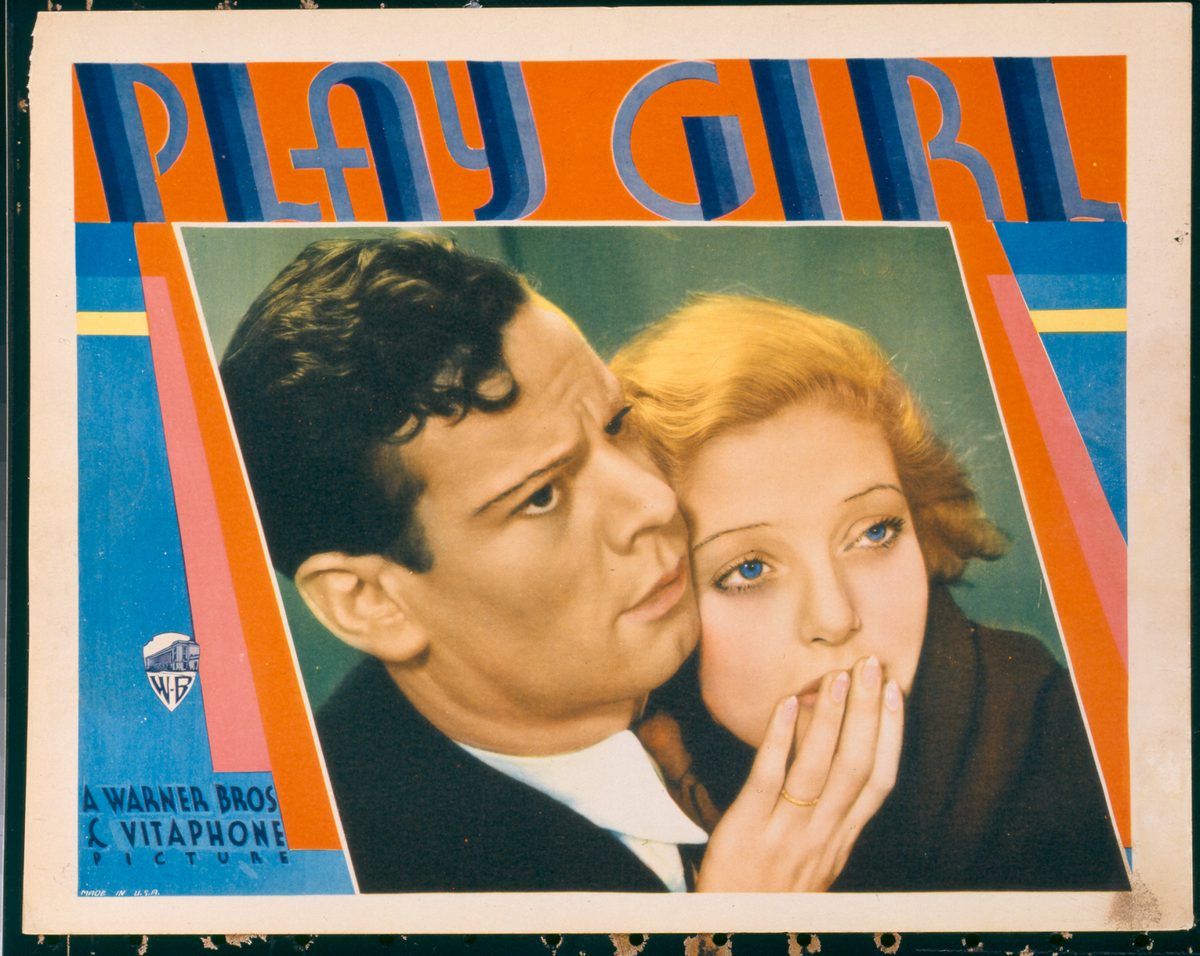
Pre Code Confidential #7: PLAY-GIRL (Warner Brothers 1932)


gary loggins's avatarcracked rear viewer

playgirl1

One of the many fun things about Pre-Code films is seeing how they get away with racy dialog without being overly explicit. The risqué double entendres fly freely in PLAY-GIRL, starring Loretta Young as an independent woman who ends up marrying a degenerate gambler, winding up pregnant and husbandless until the conclusion. The story didn’t really matter to me; it was the innuendo-laden script that kept me interested.

That saucy script was written by Maurine Dallas Watkins, who wrote the play “Chicago”, later adapted into the 1942 film ROXIE HART with Ginger Rogers, and then turned into Bob Fosse’s smash Broadway musical CHICAGO, which in turn became the Oscar winning Best Picture of 2002. Ms. Watkins was a former crime reporter for the Chicago Tribune, and based her play on the murder trial of “jazz babies” Beulah Annan and Belva Gaertner. Hollywood beckoned, and she wrote screenplays for UP THE RIVER (the film…

View original post 453 more words

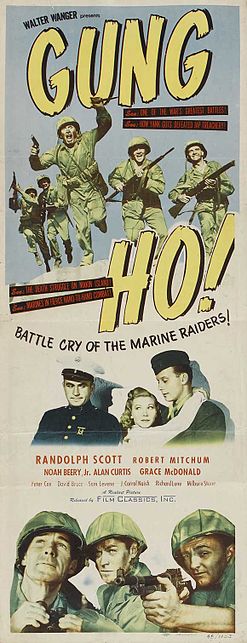
The Fabulous Forties #17: Gung Ho! (dir by Ray Enright)


Gunghopos

The 17th film in Mill Creek’s Fabulous Forties Box Set was the 1943 war film, Gung Ho!

Gung Ho!, which is filmed in a documentary style and features a narrator, opens with a series of job interviews.  A tough lieutenant (J. Carrol Naish) is recruiting Marines to serves in a special unit, one which will only take on the most hazardous of assignments.  The narrator reminds us that the interviews are taking place just a few weeks after the attack on Pearl Harbor and we listen as each interviewee is asked whether or not he is okay with killing members of the Japanese army.

Some of the interviewees hesitate and some don’t but ultimately, all of them are okay with killing.  One (Rod Cameron) explains that he’s already a murderer, having killed someone back in Kentucky.  Another says that he fought in the Spanish Civil War and that he sees his service as being a continuation of the fight against fascism.  Another Marine (Alvan Curtis) says that he’s an ordained minister but he’s willing to do what has to be done.  A Marine named Pig Iron shows up and, since he’s played by a young Robert Mitchum, we know that he’ll get things taken care of.

And then we get to the final interviewee.  He doesn’t have a big role in the film but his one line makes a big impression.  When asked why he doesn’t mind the idea of killing, he replies, “I just don’t like Japs.”

AGCK!

That’s a line that would definitely not make it into a modern version of Gung Ho!  Or, if it did, it would be followed by the interviewee being admonished and then kicked out of the office.  But Gung Ho! was made in 1943, at the height of World War II and in the shadow of Peal Harbor.  As uncomfortable as it may make us today, “I just don’t like Japs,” was probably Gung Ho‘s big applause line when it was originally released.

And really, that’s the main value of a film like Gung Ho!  It’s a well-made but predictable war film but ultimately, it’s most important as a time capsule.  If you want to know the truth about an era’s culture, as opposed to what you may want the truth to be, look at the art.  Read the books.  Watch the movies.  You may not always like what you find but you owe it to yourself to do so.

Anyway, as far the rest of Gung Ho!, it plays out exactly as you would expect.  Under the eye of Lt. Commander Thornwald (Randolph Scott), the men train for combat.  They visit Pearl Harbor and see the sunken remains of ships that are still smoking after being bombed.  And finally, the men fight the Japanese on an island.  Some survive.  Many more of them die.  And the fight continues.

Gung Ho! will probably be best appreciated by fans of war films, which admittedly I am not.  That said, it is an interesting time capsule of 1943 America.  Plus, it features Robert Mitchum!  Admittedly, it’s a small role but he does get two great scenes and … well, he’s Robert Mitchum!  How can you not enjoy watching Robert Mitchum?

And guess what?  You can watch Gung Ho! below!

http://www.youtube.com/watch?v=WwOFTAzW30E