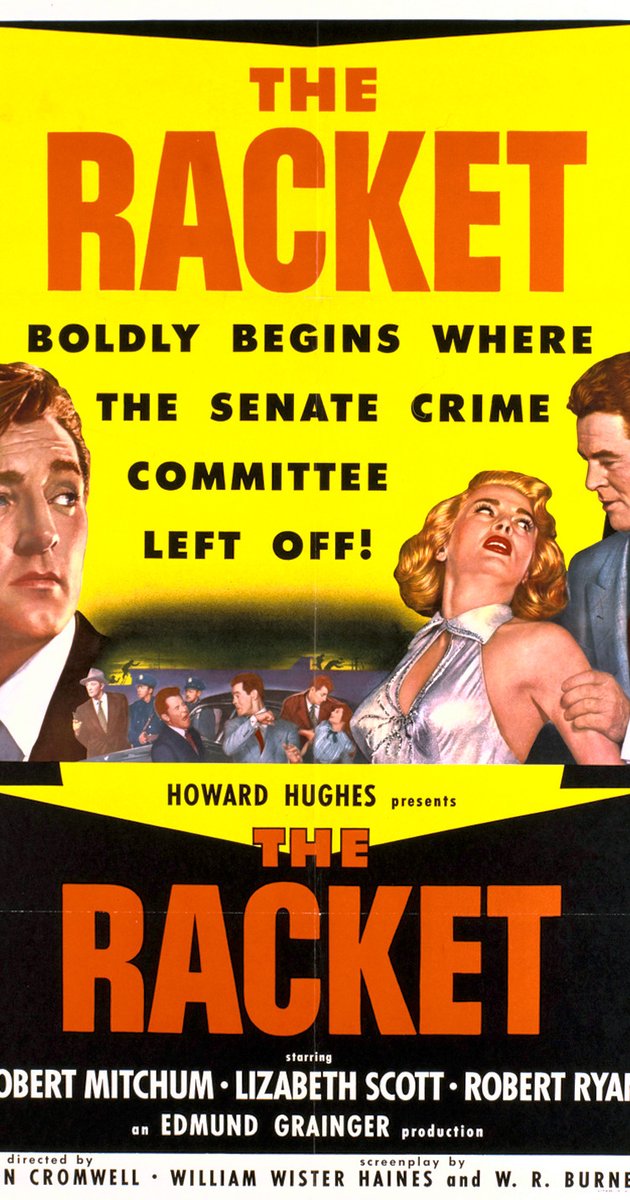
A solid film noir cast headed by Robert Mitchum , Robert Ryan , and Lizabeth Scott ; and a lineage that dates back to both a Broadway smash and an Oscar-nominated original can’t save THE RACKET from rising above minor status. Once again, tinkering behind the scenes by RKO honcho Howard Hughes, this time under pressure from Hollywood censorship czar Joseph I. Breen, scuttles a promising premise that coulda been a contender into an average movie.
City crime boss Nick Scanlon is an old-school hood whose violent ways don’t jibe with the modern-day syndicate. Capt. Thomas McQuigg, “an honest cop” who’s a no-nonsense guy, is determined to take him down. But the city’s rife with tainted politicians, making McQuigg’s job that much harder. Scanlon’s got a headstrong kid brother named Joe dating a “cheap canary” named Irene, and McQuigg plans on using him to get to Nick. Add a crooked DA, a…
Thanks to TCM’s 31 Days of Oscar, I now have several movies on my DVR that I need to watch over the upcoming month. Don’t get me wrong — I’m not complaining. I’m always happy to have any reason to discover (or perhaps even rediscover) a movie. And, being an Oscar junkie, I especially enjoy the opportunity to watch the movies that were nominated in the past and compare them to the movies that have been nominated more recently.
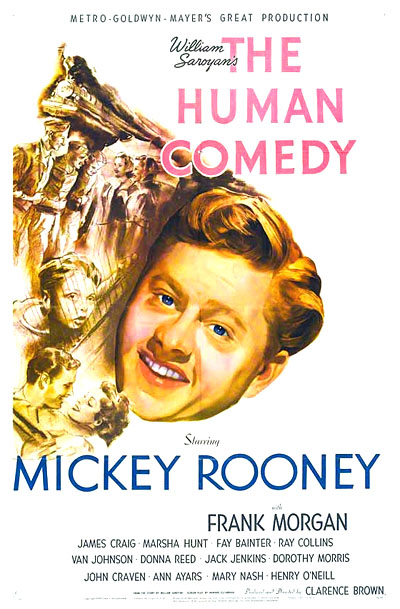
For instance, tonight, I watched The Human Comedy, a film from 1943. Along with being a considerable box office success, The Human Comedy won on Oscar (for Best Story) and was nominated for four others: picture, director (Clarence Brown), actor (Mickey Rooney), and black-and-white cinematography. The Human Comedy was quite a success in 1943 but I imagine that, if it were released today, it would probably be dismissed as being too sentimental. Watching The Human Comedy today is something of a strange experience because it is a film without a hint of cynicism. It deals with serious issues but it does so in such a positive and optimistic manner that, for those of us who are used to films like The Big Short and Spotlight, a bit of an attitude adjustment is necessary before watching.
And yet that doesn’t mean that The Human Comedy is a bad film. In fact, I quite enjoyed it. The Human Comedy is a time capsule, a chance to look into the past. It also features a great central performance, one that was quite rightfully nominated for an Oscar. As I watched Mickey Rooney in this film, I started to feel guilty for some of the comments I made when I reviewed Mickey in The Manipulator last October.
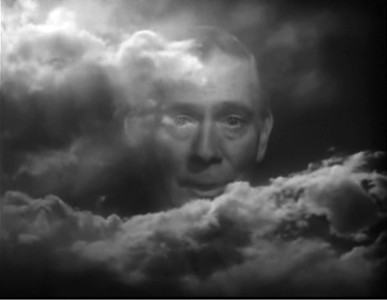
The Human Comedy opens with an overhead shot of the small town of Ithaca, California. The face of Mr. McCauley (Ray Collins, who you’ll recognize immediately as Boss Jim Gettys from Citizen Kane) suddenly appears in the clouds. Mr. McCauley explains that he’s dead and he’s been dead for quite some time. But he loves Ithaca so much that his spirit still hangs around the town and keeps an eye on his family. Somehow, the use of dead Mr. McCauley as the film’s narrator comes across as being both creepy and silly.
But no sooner has Mr. McCauley stopped extolling the virtues of small town life than we see his youngest song, 7 year-old Ulysseus (Jack Jenkins), standing beside a railroad track and watching a train as it rumbles by. Sitting on the cars are a combination of soldiers and hobos. Ulysseus waves at some of the soldiers but none of them wave back. Finally, one man waves back at Ulysseus and calls out, “Going home, I’m going home!” It’s a beautifully shot scene, one that verges on the surreal.
That opening pretty much epitomizes the experience of watching The Human Comedy. For every overly sentimental moment, there will be an effective one that will take you by surprise. The end result may be uneven but it’s still undeniably effective.
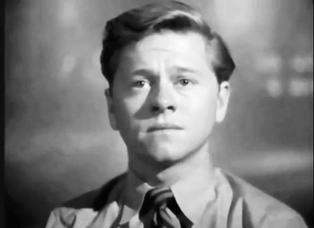
The majority of the film deals with Homer McCauley (Mickey Rooney). Homer may still be in high school but, with his older brother, Marcus (Van Johnson), serving overseas and his father dead, Homer is also the man of the house. Homer not only serves as a role model for Ulysseus but he’s also protector for his sister, Bess (Donna Reed). (At one point in the film, she gets hit on by three soldiers on leave. One of them is played by none other than Robert Mitchum.) In order to bring in extra money for the household, Homer gets a job delivering telegrams.
In between scenes of Homer in Ithaca, we get oddly dream-like scenes of Marcus and his army buddies hanging out. Marcus spends all of his time talking about how much he loves Ithaca and how he can’t wait for the war to be over so he can return home. One of his fellow soldiers says, “I almost feel like Ithaca is my hometown, too.” Marcus promises him that they’ll all visit Ithaca. As soon as the war is over…
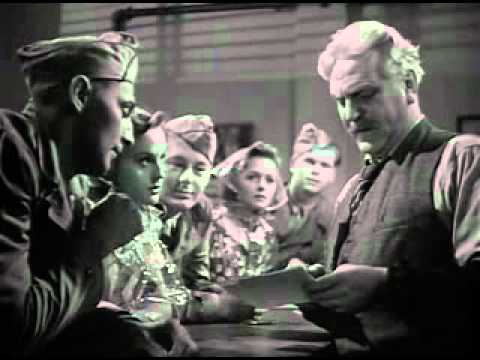
With World War II raging, Homer’s job largely consists of delivering death notices (and the occasional singing telegram, as well). Telegraph operator Willie Grogan (Frank Morgan) deals with the burden of having to transcribe bad news by drinking. Homer, meanwhile, tries to do his job with compassion and dignity but one day, he has to deliver a telegram to his own house…
The Human Comedy is an episodic film, full of vignettes of life in Ithaca and Homer growing up. There’s quite a few subplots (along with a lot of speeches about how America is the best country in the world) but, for the most part, the film works best when it concentrates on Homer and Mickey Rooney’s surprisingly subdued lead performance. By today’s standards, it may seem a bit predictable and overly sentimental but it’s also so achingly sincere that you can’t help but appreciate it.
The Human Comedy was nominated for best picture but it lost to a somewhat more cynical film about life during World War II, Casablanca.
I’ve seen The Best Years Of Our Lives on TCM a few times. There’s a part of me that always wishes that this film was dull, in the way that many best picture winners can be when watched through modern eyes, or in any other way overrated. The Best Years Of Our Lives won the Academy Award for Best Picture of 1946 and in doing so, it defeated one of my favorite films of all time, It’s A Wonderful Life. A part of me would love to be able to say that this was one of the greatest injustices of cinematic history but, honestly, I can’t. The Best Years Of Our Lives is an excellent film, one that remains more than worthy of every award that it won.
The film deals with veterans returning home from World War II and struggling to adjust to life in peacetime. That’s a topic that’s as relevant today as it was back in 1946. If there’s anything that remains consistent about human history it’s that there is always a war being fought somewhere and the man and women who fight those wars are often forgotten and abandoned after the final shot has been fired. The returning veterans in The Best Years Of Our Lives deal with the same issues that our soldiers have to deal with today as they return from serving in Iraq and Afghanistan.
The Best Years Of Our Lives follows three veterans as they return home to Boone City, Ohio. As they try to adjust to civilian life, their loved ones struggle to adjust to them.
Teresa Wright and Dana Andrews
Fred Derry (played by Dana Andrews) is a self-described former soda jerk. (To be honest, I’m really not sure what a soda jerk was but it doesn’t sound like a very fun job.) During the war, he was a captain in the air force. He returns home with several decorations and few marketable skills. During the war, he was good at bombing cities but there’s not much that can be done with that skill during peacetime. Nearly penniless, Fred takes a job selling perfume at a department store. He spends his days trying to control her temper and not give into his frustration. At night, he’s haunted by nightmares of combat.
Teresa Wright and Virginia Mayo
Meanwhile, his wife, Marie (Virginia Mayo), finds herself resenting the fact that Fred has come home. She married him while he was in flight training and, as quickly becomes obvious, she’s less enamored of Fred now that he’s just another civilian with a low-paying job. (She continually begs him to wear the uniform that he can’t wait to take off.) The Best Years Of Our Lives is a film full of great performances but Virginia Mayo really stands out. I have to admit that, whenever I watch this film, I find myself envious of her ability to both snarl and smile at the same time.
Teresa Wright, Myrna Loy, Fredric March, and Michael Hall
Al Stephenson (Fredric March) was a bank loan officer who served as an infantry sergeant. (It’s interesting to note that the educated and successful Al was outranked by Fred during the war.) Al returns home to his loving wife, Milly (Myrna Loy), his daughter Peggy (the beautiful Teresa Wright), and his son, Rob (Michael Hall). At first, Al struggles to reconnect with his family and he deals with the tension by drinking too much. Rehired by the bank, he approves a risky loan to a fellow veteran. After the bank president (Ray Collins, a.k.a. Boss Jim Gettys from Citizen Kane) admonishes Al, Al gives a speech about what America owes to its returning veterans.
Meanwhile, Peggy has fallen in love with Fred. When Milly and Al remind her that Fred is (unhappily) married, Peggy announces, “I am going to break that marriage up!” It’s a wonderful line, brilliantly delivered by the great Teresa Wright.
Harold Russell
Marriage is also on the mind of Homer Parrish (Harold Russell). A former high school quarterback, Homer was planning on marrying Wilma (Cathy O’Donnell) as soon as he finished serving in the Navy. During the war, he lost both his hands and now he’s returned home with metal hooks. Homer locks himself away from the world. When he finally does talk to Wilma, it’s to show her how difficult life with him will be. Wilma doesn’t care but Homer does.
Harold Russell won an Academy Award for his performance here. Russell was not a professional actor. Instead he was a veteran and a real-life amputee. Watching his performance today, it’s obvious that Russell was not an experienced actor but the natural charm that enchanted the Academy still shines through.
Harold Russell, Dana Andrews, and Fredric March
It’s been nearly 70 years since The Best Years Of Our Lives was first released but it remains a powerfully honest and surprisingly dark film. All three of the veterans deal with very real issues and, somewhat surprisingly, the film refuses to provide any of them with the type of conventional happy ending that we tend to take for granted when it comes to movies made before 1967. As the film concludes, Fred is still struggling financially. Homer is still adjusting to life as an amputee. Al is still drinking. All three have a long road ahead of them but they’re all making progress. None of them will ever be the same as they were before the war but, at the same time, they’re all working on making new lives for themselves. They haven’t given up. They haven’t surrendered to despair and, the film suggests, that is triumph enough.
The Best Years Of Our Lives is a great film and a great best picture winner. It’s just a shame that it had to be released the same year as It’s A Wonderful Life.
Okay, yes, it is May Day and apparently, that’s a big deal to a certain class of political activist. But, let’s be honest — political causes are forgotten from decade to decade. However, a great film lives forever.
And, for me, today is all about one of the greatest films ever made.
71 years ago today, on May 1st, 1941, Orson Welles’s masterpiece Citizen Kane was first released to a movie-going public that wasn’t quite ready for it. And that was their loss because Citizen Kane has proven itself to be one of those rare films that remains just as entertaining and fascinating the 100th time you watch it as it was the first time.
One of my fondest memories is of the first time I saw Citizen Kane in film class. As I sat there listening to our professor drone on about the historical importance of what we were about to see, I was fully prepared to watch Citizen Kane and dismiss it — as I had so many other critically beloved films — as just being another overrated, academically-embraced movie.
“After all,” I thought as the movie started, “I already know Rosebud is a sled* and I haven’t even seen the freaking film. What’s the point?”
And as the film played out in the darkened auditorium, I soon discovered exactly what the point was. The point was that Citizen Kane is one of the greatest and most watchable films ever made. It’s that rare “important” film that’s actually fun to watch. It didn’t matter that I already knew what Rosebud was. In fact, I didn’t even think about it. I was too busy enjoying Joseph Cotten’s sly turn as Jedadiah Leland and the sleazy, pragmatic villainy of Ray Collins as “Boss” Jim Gettys. I was too busy cringing in a combination of sympathy and embarrassment as poor Susan Kane (Dorothy Comingore) made her disastrous operatic debut. I sat there and I was transfixed by a flawless cast that brought a vibrant life to even the smallest of roles. (My personal favorite was Paul Stewart’s wonderfully cynical performance as Raymond the Butler.) But most of all, I sat there in awe of the talent of Orson Welles. At that time, I knew little about Welles’ subsequent career troubles. I just knew that I was watching a masterpiece.
I wish I could write more (because there’s so much more to say about this film) but now’s my time to curl up on the couch in front of the TV and watch one of the greatest films ever made…
—
* And don’t you even think of going, “How about a spoiler warning!?” about that whole Rosebud comment. Seriously, if you didn’t already know that Rosebud was a sled then I have nothing to say to you.




 Through the Shattered Lens