Film Review: Kid Blue (1973, directed by James Frawley)


KidBlueFor the past week and a half, I have been on a major Warren Oates kick.  The latest Oates film that I watched was Kid Blue, a quirky western comedy that features Warren in a small but key supporting role.

Bickford Warner (Dennis Hopper) is a long-haired and spaced-out train robber who, after one failed robbery too many, decides to go straight and live a conventional life.  He settles in the town of Dime Box, Texas.  He starts out sweeping the floor of a barber shop before getting a better job wringing the necks of chickens.  Eventually, he ends up working at the Great American Ceramic Novelty Company, where he helps to make ashtrays for tourists.

He also meets Molly and Reese Ford (Lee Purcell and Warren Oates), a married couple who both end up taking an interest in Bickford.  Reese, who ignores his beautiful wife, constantly praised Greek culture and insists that Bickford take a bath with him.  Meanwhile, Molly and Bickford end up having an affair.

Bickford also meets the local preacher, Bob (Peter Boyle).  Bob is enthusiastic about peyote and has built a primitive flying machine that he keeps in a field.  The town’s fascist sheriff, Mean John (Ben Johnson), comes across Bob performing a river baptism and angrily admonishes him for using “white man’s water” to baptize an Indian.

Bickford attempts to live a straight life but is constantly hassled by Mean John, who suspects that Bickford might actually be Kid Blue.  When Bickford’s former criminal partner (Janice Rule) shows up in town and Molly announces that she’s pregnant, Bickford has to decide whether or not to return to his old ways.

Kid Blue is one of a handful of counterculture westerns that were released in the early 70s.  The film’s biggest problem is that, at the time he was playing “Kid” Blue, Dennis Hopper was 37 and looked several years older.  It’s hard to buy him as a naïve naif when he looks older than everyone else in the cast.  As for Warren Oates, his role was small but he did great work as usual.  Gay characters were rarely presented sympathetically in the early 70s and counter-culture films were often the worst offenders.  As written, Reese is a one-note (and one-joke) character but Warren played him with a lot of empathy and gave him a wounded dignity that was probably not present in the film’s script.

Kid Blue plays out at its own stoned pace, an uneven mix of quirky comedy and dippy philosophy.  Still, the film is worth seeing for the only-in-the-70s cast and the curiosity factor of seeing Dennis Hopper in full counterculture mode, before he detoxed and became Hollywood’s favorite super villain.

o_kid-blue-dvd-dennis-hopper-warren-oates-5cdc

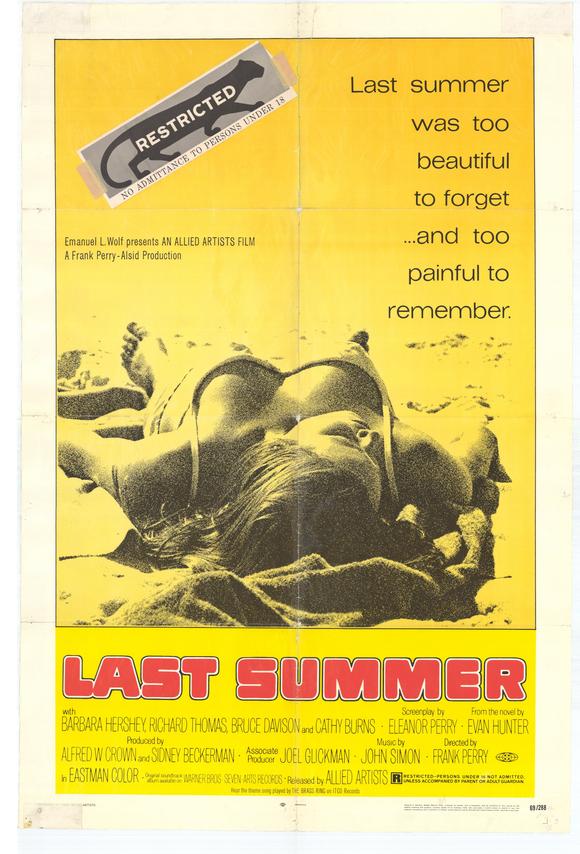
Embracing the Melodrama #24: Last Summer (dir by Frank Perry)


last-summer-movie-poster-1969-1020204164

Let’s close out today’s series of melodrama reviews by taking a look at an unfairly obscure film from 1969, Last Summer.  Directed by Frank Perry (who also directed at least part of The Swimmer before getting into an argument with Burt Lancaster), Last Summer is a film about four teenagers who make the mistake of hanging out with each other during one fateful summer.

Peter (Richard Thomas) and his best friend Dan (Bruce Davison) meet Sandy (Barbara Hershey) on the beach.  Sandy recruits them into helping her take care of a seagull with a broken wing and soon, the three of them are inseparable.  The sexually inexperienced Peter and Dan are both attracted to Sandy while Sandy shown proves herself to have a casually destructive streak.  The two boys are so infatuated with Sandy that they even forgive her after she gets bored with the seagull and kills it.

Eventually, Rhoda (Catherine Burns, who was Oscar-nominated for her performance) starts to hang out with the three of them.  Overweight and shy, Rhoda is, at first, an awkward addition to the group but soon, she and Peter start to grow close.  Sandy, who was previously more interested in Dan until she realized that Peter was losing interest in her, reacts by looking for more and more ways to humiliate the insecure Rhoda.  Eventually, they set Rhoda up on a blind date with a shy Puerto Rican man, a cruel prank which quickly goes wrong.

When Rhoda eventually stands up to her three new “friends,” it leads to a disturbing finale that it is all the more effective specifically because it is so inevitable.

I have to admit that I have a weakness for out-of-control youth films, largely because — while I never went as crazy as Sandy or made as many mistakes as Rhoda — I still had my moments back when I was in high school.  In ways both good and bad, I could relate to the two female leads of Last Summer.  There have been times in my life when I’ve felt like the intellectual and naive Rhoda and then there’s been other times when I’ve felt like the beautiful and self-assured Sandy.  For the most part, I’m usually prouder of myself when I feel like Rhoda but I have a lot more fun when I feel like Sandy.  While the two boys largely remain ciphers, Last Summer is worth seeing for the outstanding performances of Barbara Hershey and Catherine Burns.  Combined with Frank Perry’s atmospheric direction (you can literally see the layers of ennui and humidity clinging to some of the scenes), the end result is an effectively creepy coming-of-age film.

For some unknown reason, Last Summer appears to one of those rare Oscar-nominated films that has never been released on DVD or Blu-ray.  However, it does occasionally show up on TCM and I would suggest keeping an eye out for it.

Last Summer 1969 Thomas Hershey Davidson

(Incidentally, California Scheming — was was released earlier this year — is pretty much an unacknowledged remake of Last Summer, right down to the bit with the seagull.  California Scheming is actually not a bad film.  It’s certainly deserves better than some of the online reviews that it’s received.)