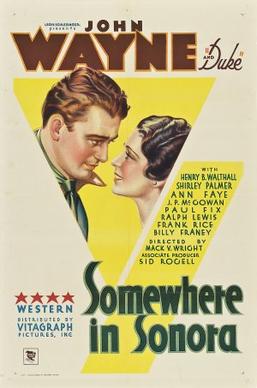
Somewhere In Sonora (1933, directed by Mack V. Wright)


After stagecoach rodeo racer John Bishop is framed for causing a competitor to have an accident, he’s hauled off to jail.  Fortunately, Bishop’s boss, Bob Leadly (Henry B. Walthall), comes through for Bishop and helps him escape from the jail.  To thank Bob, Bishop heads down to Mexico to search for Bob’s son, Bart (Paul Fix).  The last that Bob heard, Bart was running with an outlaw gang called “The Brotherhood of Death.”  The only way get out of the Brotherhood of Death is to die.

By an amazing coincidence both Bart and Bishop’s girlfriend, Mary (Shirley Palmer), are in the Mexican town of Sonora.  To try to get Bart to return home, Bishop goes undercover and infiltrates the gang.  Once inside, Bishop discovers that gang leader Monte Black (J.P. McGowan) is planning on robbing the silver mine that belongs to Mary’s father.

This is a John Wayne B-western, typical of the poverty row productions that he was making before John Ford cast him as the Ringo Kid in Stagecoach and made him into a star.  This one features the usual horse chases and bar fights and John Wayne gives a solid-enough performance in the lead role.  The most interesting thing about it is that, even though it’s a western, it’s set in modern times.  I guess frontier days lasted longer in some parts of the county than in others.

John Wayne’s horse, Duke, appears in this picture and shows again that he was the most talented of all the horse actors in the 30s.  He earned his co-starring credit.

Horror on the Lens: The Avenging Conscience (dir by D.W. Griffith)


Hi there and welcome to October!  This is our favorite time of the year here at the Shattered Lens because October is our annual horrorthon!  For the past several years (seriously, we’ve been doing this for a while), we have celebrated every October by reviewing and showing some of our favorite horror movies, shows, books, and music.  That’s a tradition that I’m looking forward to helping to continue this year.

This year, we’re getting things started with a movie that has been called “the first American horror film.”  In 1914, D.W. Griffith released The Avenging Conscience, a melodrama that was based on Edgar Allan Poe’s The Tell-Tale Heart and Annabel Lee.  In this film, The Nephew (Henry B. Walthall) falls in love with the Sweetheart (Blanche Sweet).  However, the Uncle (Spottiswoode Aiken) is opposed to the relationship, mostly because the Sweetheart is a “common” woman.  Despite having been raised by the Uncle, the Nephew snaps and murders him.  The Nephew then finds himself tortured not just by his own guilt and fear but also by vivid hallucinations.  This is a film that invites us to come for the murder and stay for the reminder that “Thou Shalt Not Kill.”

Like a lot of the films of the silent era, it will require a bit of patience on the part of modern viewers.  It takes a while to get going but the surreal imagery and Henry B. Walthall’s increasingly unhinged performance make it worth sticking with.  If nothing else, the film’s historical significance makes it one worthy to be seen by all serious horror fans.

Enjoy!

Horror on the Lens: Dante’s Inferno (dir by Henry Otto)


Today’s horror on the lens comes to us from 1924!  In Dante’s Inferno, a businessman visualizes Dante’s trip to Hell while little realizing that his behavior is going to lead him to the same destination.

There’s a lot different prints of this film floating around.  The original version ran for 60 minutes.  The version below was a 49-minute version that was released on VHS.  At the time of its release, it’s vision of Hell was considered to be so frightening and definitive that clips of this film were actually used in other films that depict Hell.  In fact, Ken Russell used clips from this film in 1980 to depict a drug-induced hallucination in the film, Altered States.

The quality of the upload is not the best (again, largely because it was taken from an old VHS tape) and it’s impossible not to cringe at the character of the butler (whose portrayal, sadly, is typical of how African-Americans were regularly portrayed in films up until the 1960s) but this is still a bit of cinematic history.