Decade of last.fm scrobbling countdown:
46. Agalloch (653 plays)
Top track (147 plays): Odal (Demo), from The End Records Sampler: At the End of Infinity [Echoes & Thoughts of Wonder] (2002)
Featured track: Limbs, from Ashes Against the Grain (2006)
Throughout the first decade of this century, Agalloch stood at the forefront of some of the most progressive movements in metal. They were the product of a new generation of musicians exceptionally well informed on musical trends happening outside of their own genre. Citing such diverse influences as Katatonia, Ulver, and Godspeed You! Black Emperor, they endowed their first major release, Pale Folklore in 1999, with an entirely unique sound. Bleak neofolk guitar and piano merged with black metal as the two most dominant styles to paint a beautiful and desolate snowy landscape that demands the listener’s full attention from start to finish. The folk felt, to me at least, just as influenced by neofolk artists far beyond the metal spectrum like Current 93 and Death in June as by Ulver’s Kveldssanger.
The Mantle in 2002 took this diversity a step further, incorporating post-rock proper as a central structural theme for most of the album. But it was Ashes Against the Grain, in 2006, that really solidified their place as one of the most significant metal bands of the era. It got back to the heavier influences that The Mantle had left behind, offering a seamless fusion of folk, post-rock, and metal that would inspire dozens of bands in the years to follow. As a band first born of black metal, their developed sound helped pave the way for a new era in experimental bm that broke the restraints of the 1990s. These restraints, of course, had long been shattered by Ulver, with Enslaved and ex-Emperor frontman Ihsahn following close behind, but these artists’ credentials as legendary musicians were well established while formulaic black metal was still the norm. Agalloch, alongside Alcest, appeared to me as the next generation, born into a much broader gene pool of music and taking full advantage of their situations. As the seven years since Ashes Against the Grain have shown, progressive and post-black metal was the new wave–and perhaps one of the most outstanding waves in the history of metal in general. I can’t tell you whether Agalloch directly influenced the bands that followed them or not, but their open-minded ability to appreciate black metal for its unique sensory qualities without giving in to the corpse-paint drenched exclusiveness of its accompanying culture drastically expanded the genre’s exposure.
I would say today that Pale Folklore is my favorite Agalloch album, though Ashes struck me the most when I first heard it. The version of the song I’ve played the most in Agalloch’s library though does not appear on any of their albums. It was the first track I ever heard by the band–an edited pre-release version of Odal from The Mantle that The End Records had featured on a free sampler cd. The song is not appreciably different from its studio album variant, but it cuts out sizable chunks of the intro and outro to create a much more repeatable track. Odal immediately struck me as deliciously similar in atmosphere to Matt Uelmen’s Tristram from the Diablo series, and I am often inclined to put the two on repeat together. I’ll leave you with a video of the finalized cd version of the song:
This is embarrassing. Here it is 2013, and my 2012 collection consists of only 38 albums, the majority of which I’ve listened to twice at best. I never heard the new Neurosis. I never heard the new High On Fire. Hell, forget metal, I didn’t even listen to the new Shins and Godspeed albums. I can’t offer an experienced, informed opinion now the way I could at the end of 2011. But I’ve been posting up some sort of album of the year list somewhere for over a decade now, and I’ll be damned if I let the fact that I didn’t really listen to any albums in 2012 stand in my way.
Or something like that. Here we go.
10. Dawnbringer – Into the Lair of the Sun God (track: IV)
It’s not often I get into a standard heavy metal album, but Dawnbringer did everything right in 2012. The songs rock along with a bit of an Iron Maiden drive to them, the power and black metal tendencies are tastefully incorporated to enhance the drive without altering the vibe, and the vocals know their limit. If it sounds a bit generic, don’t let that fool you. Not too many bands can pull this off without giving into the temptation to be more “epic” or “extreme” than they really are. Dawnbringer pull it off without the flare–without ever going over the top–and their accessibility places Into the Lair of the Sun God among the best of the year.
9. Korpiklaani – Manala
I wouldn’t say Hittavainen was the heart and soul of Korpiklaani, but he was an essential component. The band would be at a total loss without Jonne Järvelä, and their consistent line-up over the years has contributed enormously to their success, but Juho Kauppinen’s accordion aside, the folk instrumentation was almost all a product of Hittavainen. When he left due to health issues after Ukon Wacka in 2011, I feared it was the end of an era. Korpiklaani never missed a beat recovering from the loss in 2012. In addition to picking up the highly qualified Tuomas Rounakari as their new violinist, Jonne Järvelä stepped up to fill in the void by recording the mandolin, flute, and whistle tracks. I think I can hear some nuance differences between his and Hittavainen’s playing style, but it might just as well be in my head; Manala sounds like a Korpiklaani album through and through. I don’t like it as much as Karkelo and Ukon Wacka–it’s a bit heavier, too much so for my taste in folk metal–but in the greater sphere of Korpiklaani’s discography it is certainly composed and performed to par.
8. Ensiferum – Unsung Heroes
Ensiferum took a lot of slack for this album. I think a lot of people wanted to hear the over-the-top bombast that worked so effectively on Victory Songs, but in my opinion that was already growing stale on From Afar. Unsung Heroes is down to earth in a way they haven’t been since the 2001 self-titled debut, and I love it. They’re heading in exactly the direction I’d hoped for, and with the exception of the ugly mistake that is the album’s 17 minute closing track, Power Proof Passion, Unsung Heroes does not sound at all like a band past their prime. If they continue to push in the direction of tracks like Pohjola, they’re in position to trump Victory Songs and follow up Unsung Heroes with their best album to date.
7. Wodensthrone – Curse
I wish I’d taken the time to review this album earlier in the year, because I haven’t listened to it since the summer, and their flavor of epic black metal isn’t the sort of thing you can fully absorb in a quick last-minute listen. This is an album that can move nowhere but up in my charts over the months to follow, but for the time being I am content to place it somewhere in the middle. While busting out black metal that’s just as grim and unforgiving as the 1990s greats, Wodensthrone manage to infuse a tremendous amount of emotion that speaks of something beautiful hidden beneath the chaos. It’s buried a bit deeper than say, Femundsmarka by Waldgeflüster last year, but the feeling is similar.
6. Vattnet Viskar – Vattnet Viskar EP (song: Weakness)
If someone were to ask me what black metal sounded like in 2012, I might hand them this EP. It’s kind of cool getting to say that, because one of their members is a regular at the music forum where I get most of my recommendations. I wouldn’t have guessed back in March that they would be signed to Century Media by the end of the year, but I’m stoked to hear it. The whole notion of post-black metal has taken on a number of different flavors in these formative years, and Vattnet Viskar expand the genre by incorporating a lot of the all-encompassing guitar tones I associate with post-rock acts like Mono and This Will Destroy You. Top-notch stuff that’s really at the forefront of an emergent genre I’ve been anticipating for years.
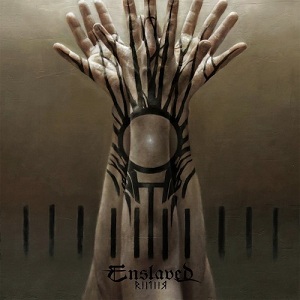
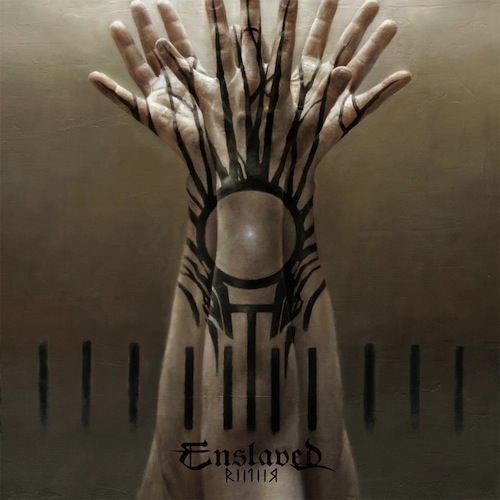
5. Enslaved – RIITIIR
How Enslaved have aged so well is beyond me, but their last three albums have been their best three albums, and 22 years after the formation of this band they remain at the forefront of metal. Their viking-infused progressive black sound of late has done as much to shape the future of the genre as any new-found participant in the current popular trend towards black metal that has been taking shape over the past four years. RIITIIR is another outstanding output by the one classic early 90s black metal band that has managed to weather the ages unscathed.
4. Blut aus Nord – 777: Cosmosophy
The review I wrote of 777: Cosmosophy last month was one of the most thorough I’ve done all year, and there is nothing I care to say about the album that I haven’t said already. It is outstanding in its own right, but it does not feel like an entirely complete finale to their already classic 777 series. The first and third tracks, breathtaking though they may be, don’t seem to sufficiently progress from where the second album in the trilogy, The Desanctification, left off. The second track moreover, Epitome XV, is the weakest link on all three albums. The last two tracks compensate greatly by concluding in proper form, and I certainly think Cosmosophy is excellent. It can only be said to have “shortcomings” in so far as I expected it to be the best album of 2012. Fourth place isn’t too bad.
3. Torche – Harmonicraft (song: Reverse Inverted)
Calling Torche metal at this point is really pushing the limits of the definition. Since their early days writing crushing stoner anthems, they have evolved into a bizarre amalgamation equal parts metal and pop. But it’s not just the uniqueness of the happy, smiley-face hammers Harmonicraft beats you down with that makes it so appealing. Torche have become by all rights the heirs of the 1990s. These guys have more in common with the Smashing Pumpkins than they do with any of their stoner metal contemporaries. This is the sort of thing that 15 years ago we could have just labeled “alternative rock” and gone on enjoying without any need for classifications. While forging an entirely unique, original sound of their own, Torche have managed to capture a song-writing ethos that has been dead for a generation, and Harmonicraft is the cleanest breath of fresh air I’ve inhaled in years.
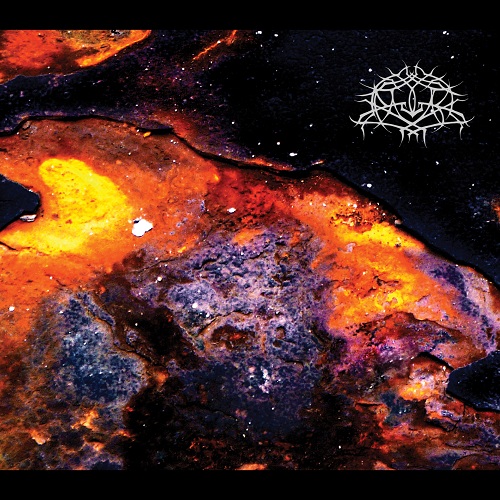
2. Krallice – Years Past Matter (song: Track 2)
Krallice is my favorite band making music today, and I dare say last year’s Diotoma might be my favorite album by any band ever. Seldom if ever has a band followed up such a masterpiece with something of equal worth, and I was shocked that Krallice had the energy left to release anything at all this year. Years Past Matter is an outstanding post-black metal outing in the vein of Dimensional Bleedthrough. The tracks took longer than usual to grow on me, and usual for Krallice entails dozens of listens, but the payout is always worth the time, and the slow process of appreciation is enjoyable in its own right. Mick Barr and Colin Marston’s dual tremolo is the grand ultimate ear-candy, and so long as they never compromise their commitment to that they will probably remain my favorite band. (Track 3 is my favorite song on Years Past Matter so far, but it was not available on youtube. Track 2 is a worthy substitute.)
1. Panopticon – Kentucky (song: Killing the Giants as They Sleep)
The fact that I didn’t review this album is almost embarrassing, because much like Aesthethica by Liturgy last year, it is an album that absolutely demands a thorough investigation to properly appreciate. I can’t easily tell you why I placed it this high, because frankly I don’t know yet myself. When I first read that a Louisville, Kentucky-based band called Panopticon had released a bluegrass black metal album, all sorts of thoughts ran through my head. Kentucky sounds like none of them. Do ignore the cliche “blackgrass” labels; while Austin Lunn listened to plenty of bluegrass in the process of recording this, he does not actually incorporate the genre as we might think of it. Instead he interweaves traditional Appalachian folk–not bluegrass particularly–as distinct tracks separated from the black metal. What folk does emerge in the bm is more akin to Waylander, and certainly far from “bluegrass”. That’s not a bad thing, just an–I think–important distinction to be made, because otherwise we might be left searching for genre stereotypes which simply aren’t present here. What Kentucky really accomplishes is a merging of a musical themes which perfectly juxtapose a beautiful landscape and a totally destitute human condition. The first half of “Killing the Giants as They Sleep” for instance generates landscape imagery with a degree of effectiveness similar to Femundsmarka by Waldgeflüster. (Have I referenced that album twice now? I think it’s time I paid it another visit.). You take a look around, take a deep breath, and really appreciate the natural beauty that surrounds you. About half way through the dialogue begins, and the explosion around 9:15 serves to draw you fully into the atrocities taking place here, both in the exploitation of workers and the desecration of the environment.
I don’t think Austin Lunn intended to make any sort of political statement here, but in succeeding so comprehensively to depict elements of Appalachia and its outskirts, he effectively did so. At a time when the working class of America is inexplicably becoming staunch supporters of big capital, this album hits a bulls-eye on all of the thoughts that have been forefront on my mind of late. His bleak renditions of union anthems like “Which Side Are You On?”, recently covered with such optimism by the likes of Dropkick Murphys, strike me as a painfully realistic reminder that the entire notion of equality as an American ideal is becoming antiquated.
But that might be seen as secondary. Wherever our ideas may lead us, Kentucky is the sort of album that inclines us to form them. It’s an album that makes me think. Like Aesthethica by Liturgy and Diotima by Krallice last year, it forces me to set aside my mundane daily routines and really engage the human experience. That alone, all other considerations aside, suffices to render it my favorite album of 2012.
I was pretty shocked when Krallice released Years Past Matter this August. If I remember an interview with the band I watched correctly, their first three albums–Krallice, Dimensional Bleedthrough, and Diotima–had all been written by Mick Barr and Colin Marston at roughly the same time. A very clear progression distinguished each, and by Diotima significant influence by drummer Lev Weinstein and bassist Nick McMaster was apparent, but the foundation had been there all along. I expected a rather lengthy break between Diotima and their next release, as I figured the band would be working more from scratch at that point. Instead, Years Past Matter appeared on the scene just a little over a year later.
The surprise worked out rather nicely, because I didn’t have time to build up unrealistically high expectations. Diotima was the best new album I’d heard in a decade, and I really doubted Krallice would be able to top it any time soon. They didn’t, and that’s just fine, because Years Past Matter is still outstanding.
I feel like it is a somewhat subdued work in comparison, far less explosive and dynamic than Diotima. Almost every Diotima track had a total mind-fuck moment or two: The intro track, Inhume at the beginning and at 5:25, Diotima at 5:35 and 8:50, Telluric Rings at 2:55, 6:40 and 10:35, Dust and Light at 4:45. I’ve yet to find any moment on this album where the music slaps me upside the head with a brick and makes me stair wide-eyed mouthing “holy fucking shit”. That being said, last.fm claims I’ve listened to Diotima over a hundred times. Krallice isn’t the sort of band you can fully appreciate on short notice.
It also seems like the drumming and bass have reverted to the secondary roles they had on Krallice and Dimensional Bleedthrough, not function as equal players in the manner of Diotima. There were a lot of instances on Diotima, especially on Inhume, where I think the drumming actually managed to trump the guitars in delivery. That might not be a matter of performance so much as production, and it’s worth noting towards this end that my dear, beloved cd player in my 2005 Nissan Sentra finally passed away this summer. I swear its stock model had better sound quality than any high-end sound system I have ever heard. It might just be the case that these elements on Years Past Matter feel slightly less overwhelming because my shoddy computer headset fails to do them justice.
But in light of the lofty and exclusive pedestal I place Diotima upon, these are modest complaints. Over all Years Past Matter feels a lot like Dimensional Bleedthrough to me. That was an album which, unlike their 2008 debut, I completely failed to appreciate initially. It wasn’t until Diotima had raised my opinion of the band through the roof that I began to revisit Dimensional Bleedthrough and really recognize its quality. I’m not going to make the same mistake with Years Past Matter, but it’s going to take more than the few dozen listens I’ve given it so far to really grasp its full worth. The myriad subtle complexities only become apparent bit by bit over time, and in the absence of Diotima’s explosiveness there is little to immediate grasp hold of. Like Dimensional Bleedthrough, the songs progress slowly and require a substantial attention span to fully engage. What works so well for both that album and Years Past Matter is that the atmosphere they generate makes for ideal background music. You can let it play all evening without ever growing tired, and when you do temporarily tune in what you encounter is always outstanding. My experience with these albums has been one of a gradual piecing together of the parts I happen to engage, building up over countless rewarding listens into a big picture that I know by heart from start to finish.
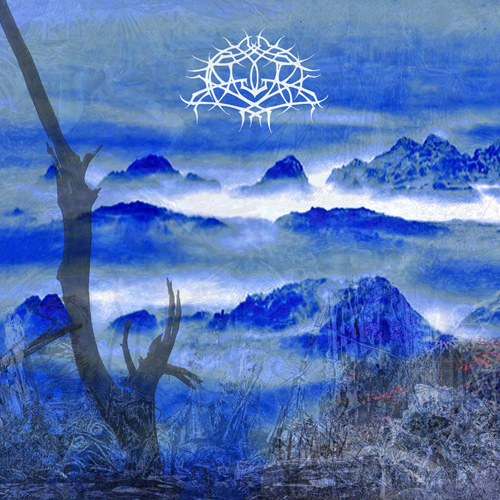
The physical presentation of the album actually adds a lot too. Along with one of the most compelling album covers I’ve seen in a while, Years Past Matter offers no printed lyrics or meaningful track titles. I haven’t gotten a chance to try and decipher any of the lyrics as sung, but I don’t think they are meant to play an essential role in the songs the way they do on Diotima. The feeling is more of some abstract, dehumanized vision of outer space. This isn’t so much a change in the sound–the vibe I get from it is essentially the same as on Dimensional Bleedthrough–but it places the music in a slightly different context from the outset.
If you don’t care for what you’re hearing on first listen, this band probably isn’t for you. Their unique take on black metal has remained fairly consistent throughout the years. But if you do appreciate the technical precision and the overall atmosphere, don’t be too quick to write off their song-writing. What may sound meandering at first will in time coalesce into a brilliantly crafted song. The big picture is a lot more accessible on Krallice and especially Diotima, but it was there to be had on Dimensional Bleedthrough too; I just tried too hard at that time to extract it. Years Past Matter has been a great experience for me this year because I’m not trying at all. I’m enjoying the ride and letting the full vision of their songs emerge naturally over time.
Norway’s Enslaved formed as a black metal band in 1991. That means Grutle Kjellson and Ivar Bjørnson have been playing together for at least 21 years. Most–I’d say the vast majority–of bands are pretty washed up by the 20 year mark. But Enslaved is a fluke. An anomaly. They stand on the cutting edge of the metal scene today, and their last three albums have been phenomenal.
Thoughts Like Hammers
Maybe some of it stems from their age. Bjørnson and Kjellson were 13 and 17 respectively when they began releasing demos as Enslaved. It’s hard to imagine a 20+ year old band whose founding members are in their mid-30s, but that’s what you get here: two artists in their creative prime.
RIITIIR’s aptly-named opening track, “Thoughts Like Hammers”, starts out with a bit of incoherent chaos before busting into a crushing viking metal plod that immediately answers any question as to whether RIITIIR is going to follow the same path as Vertebrae and Axioma Ethica Odini. The relatively new viking-prog-black mix they’ve landed on is faultless, and about the only thing they could do wrong is change it. RIITIIR picks up right where Axioma Ethica Odini left off.
It would be kind of odd to speak of post-viking metal when so few bands have defined the original style in the first place. But what makes Enslaved perhaps the best metal band to ever make a late-career venture into the world of progressive rock is their impeccable ability to maintain all of their heavy metal credentials. Kjellson’s growls are some of the most distinct and cutting in the scene, and there can never be any question about the band going soft. The lofty progressive movements are lush with sound in just the sort of way that has made viking metal bands like Enslaved and Týr consistently great throughout the years. Their juxtaposition of uplifting musical sweeps and crushing, dark passages transition flawlessly, with none of the grating clash of styles that you might hear in bands inclined to force the issue.
RIITIIR
As for how RIITIIR matches up to Vertebrae and Axioma Ethica Odini, I think RIITIIR maintains the much needed improvement in production quality that distinguished Axioma from its predecessor. The major riffs and choruses are just as instantly memorable. I think Axioma had perhaps a stronger black metal side to it, but the difference is slight. What I really feel in RIITIIR more than the other two is the consistent drive–a sort of all-embracing power that gives the album no down time to speak of. Even the slowest folk interludes are exceptionally well constructed to fit the context of their songs and maintain a tense, brooding atmosphere.
My immediate impression of RIITIIR is that it’s the best album to date from a band that has at this point thoroughly proven their standing among perhaps the top ten metal bands making music today. I don’t really need to go into exceptional detail on this one; it’s exactly what they did on their last two albums, only even better. Don’t let this year-end contender pass you by.
It’s not really a coincidence that the two genres of music I’ve listened to most over the years are black metal and post-rock. Something about tremolo guitar very consistently inspires me, and these are the two styles that most frequently and effectively utilize it. But post-rock is one of the most diverse styles of music on the market, and if it employs techniques found in black metal to capture its most intense moments, its other reaches are inexhaustible. It’s characterized more by the effect it produces in the listener than by the means it employs towards this end, and tremolo guitar just happens to be the best–certainly not the only–technique suited for it. The effect it produces is, you might say, a general sense of awe.
When we speak of post-black metal we’re suggesting a branching out from something that is much more locked in place. Technically black metal means tremolo guitar and blast beats, plain and simple. Thematically it goes a bit beyond post-rock, exploring and reveling in a very wide array of human emotions which, to conform to a cultural misconception, might be generally described as negative. Sometimes a post-black metal tag suggests bands that break out from tremolo and blast beats but stick to the same “negative” themes, as in say, Agalloch. Sometimes a post-black metal tag suggests something more like “progressive black metal” which finds creative new ways to employ blast beats and tremolo picking, like Ihsahn or Krallice.
Obviously musical classifications are dubious, sometimes illogical, and only really practical as a shorthand for “you might like this band if you like x”. But with a great deal of discretion they may also be employed to track the general evolution of music–the emergence of new methods and themes, the passive and active influences of any of these upon another, etc–and to predict where it is headed next.
Violet
Deafheaven are a brand new band out of San Francisco. They haven’t been releasing demo tapes unnoticed for a decade like a lot of “new” bands; they only just formed in 2010, and Roads to Judah is their debut album. It was the logical next album for me to review, in a sense. I love Krallice, I was told if you like Krallice check out Liturgy, Liturgy’s popularity lead me to reconsider Wolves in the Throne Room, and a broader consideration for “popular” black metal meant the next band to listen to was Deafheaven. (I would imagine I’ll be completing this path by checking out Ash Borer some time next week.)
Now, stylistically none of these four bands have very much in common. Furthermore, I am standing by my opinion that Wolves in the Throne Room are overrated, mediocre, and generic. But Krallice, Liturgy, and Deafheaven all deserve acute attention. Each, in very different ways, is completely redefining black metal. Krallice are doing so by pretty much perfecting everything I’ve ever loved about the style. Liturgy are doing so by embracing a subtle theme within it. Deafheaven, the band I am exploring now, are something of a grand amalgamation of pre-existing genres of music which have often shaken hands but never before so fully embraced each other. As regards my opening observations, they could just as easily be described as “blackened post-rock” as “post-black metal.”
I think the significance of this has been obscured by people calling them shoegaze black metal. Yes, one of their guitarists, Nick Bassett, was in a shoegaze band prior to Deafheaven (Whirr), but you can’t honestly tell me you hear it in this music. Post-rock is greatly in debt to shoegaze in a lot of ways, but it’s not the same thing, and you can’t tell me this sounds more like The Jesus and Mary Chain than Mono. Not that shoegaze black metal isn’t itself a creative new genre, the fact that Alcest already did it (though Neige denies any direct influence) and a lot of bands copies him drastically downplays its significance. But calling Deafheaven shoegaze is like calling it classic rock, because, you know, somewhere down the line The Who influenced metal. No, this is an amalgamation of post-rock and black metal. That is why it’s on the cutting edge. That is why there’s no obvious term with which to describe it.
I’m not sure exactly what all to take from it. Violet doesn’t inspire me in the way that a lot of black metal does, but that’s not to say it falls short. I almost want to say I’d have to see them live to fully appreciate them. I mean, very few post-rock bands deliver on their studio albums. With the exceptions of Explosions in the Sky and Godspeed! You Black Emperor I almost always have to see a post-rock band in concert to appreciate them, and even then no matter how much they blow me away I don’t necessarily enjoy their albums. I get the same vibe from the four opening minutes of Violet that I get from bands like Mono and This Will Destroy You–a pleasant bore through my stereo and a total mindfuck live. You have to feel this sort of music encompassing you and see the musicians creating it to fully take it in.
Language Games
The second track, Language Games, is much more accessible and immediately appealing. What’s more, it progresses into something which feels an awful lot like screamo to me, most notably in the emotionally tortured screams laid over a simple undistorted melody at 3:50 and the drum roll that follows. I wouldn’t be the first to describe Deafheaven as a screamo black metal crossover, and they are, after all, on Converge frontman Jacob Bannon’s record label, Deathwish Inc. Am I then to call this blackened post-screamo? That’s fucking stupid. I think what you can really take from Deafheaven is something a little more inspiring. Like Liturgy, it is a grand realization of hidden trends growing within music in general, and as such it fits no “genre” tags at all until more bands come along that sound like it.
Whatever you want to call Liturgy’s sound, I’ve been pointing out signs of it for a while now, here in an Ulver song, there in an Alcest song, and many other places besides. As regards Deafheaven, black metal and post-rock have always shared a bit in common, and I would argue that screamo is no foreigner either. It’s a word I’ve been hesitantly coughing up to describe more and more black metal recently. Ars Poetica by Drudkh bewildered me with its likeness to Envy, I explicitly noted a post-rock/screamo vibe at the end of The Puritan’s Hand by Primordial, and I pointed out similarities in Altar of Plagues as well, to name a few. Deafheaven took up a growing theme and ran with it.
Unrequited
Deafheaven are definitely at the top of my bands to see live list, and Roads to Judah is an exceptional album, but it’s kind of a downer in so far as none of the tracks deeply move me. I can get into the vibe but I can’t latch on to any particular moment. It’s significance for me is more in what it accomplishes as the most pronounced and maintained example of a combination of stylistic crossovers long in the making.
But let’s end this on a cautionary note. To suggest black metal broke out of its shell in 2011 would be ridiculous. If I turn to Sagas by Equilibrium in 2008, Ballade cuntre lo Anemi francor by Peste Noire in 2009, Luna by Boris in that same year (the Chapter Ahead Being Fake split with Torche), or Blut aus Nord right now, I can find plenty of examples of older bands doing much more progressive (and impressive) things with black metal than what you’re hearing on Roads to Judah. Deafheaven (and Liturgy for that matter) feel pretty immature when competing in the big leagues. The uniqueness of these bands arises from their willingness to shout out something previously only whispered, not from their having perfected anything. (Mind you I am not suggesting they sound remotely similar.)
This act of shouting is only one of many features which have given rise to a lot of derision. With Deafheaven boldy embracing screamo, Liturgy sounding like the Neutral Milk Hotel of black metal, and both bands dressing like trendy assholes, it’s no wonder “hipster” denunciations are flying right and left. “Emo” and “black metal” go together like two gay cowboys at a Texas Republican convention. But really, the more we admit that black metal has always been a little emo the more we detract from the power of subtlety, and there’s some legitimate concern that their appearance is more likely to catch on than their performance. Liturgy and Deafheaven are both great, and some really shitty bands are going to follow in their wake. But it was there all along. This was all bound to happen.
Krallice began as a joint project between Colin Marston of Behold… The Arctopus and Mick Barr of Orthrelm some time in 2006 or 2007. My very limited experience with both of these bands has left the unpleasant taste in my mouth of haphazard noise for its own sake–barely coherent avant-garde math rock which never has and never will excite me. Inexplicably, with their powers combined the two have produced some of the most beautifully constructed songs I have ever heard. Their self-titled debut in 2008, especially the opening track Wretched Wisdom, completely blew my mind in a way that no other band has accomplished since, taking the still formative genre of post-black metal and practically perfecting it in one shot.
Their second album, Dimensional Bleedthrough, never quite moved me the way their self-titled did, and while I listened to it aplenty when first released, it was soon forgotten. I was nevertheless quite excited to try out Diotima, released this past April, and within the first, well, really five seconds or so, I knew something had changed. By the end of its 70 minutes I had experienced one of the finest masterpieces of metal ever written.
(untitled intro)/Inhume
There’s a lot to be said even of the two minute introduction leading in to Inhume. Never mind that ten minute tracks is their norm, the introduction (they didn’t even bother naming it) is an incredible song in its own right. Diotima begins with a nuclear bomb, the chain reaction of which never ends. The desperate melody is more emotionally driven than anything on Dimensional Bleedthrough, calling to mind their first release, but the intensification of the drumming established on Dimensional Bleedthrough persists. It’s a perfect merging of all of their first two album’s finest qualities–beautiful song-writing on the one hand and intensity on the other–and I enter Inhume a deer in the headlights.
There is barely room to breathe before the next song slams a frantic vision of shapes and patterns into your brain that disturb and terrorize. It overwhelms you with ordered chaos. It’s never inaccessible, never obscure, but rather all too comprehensible. Often I speak of the importance of listening to an album in two states of mind, first passively, appreciating its aesthetics, and then attempting to analyze what’s really going on. On Diotima these experiences are one and the same. The drumming locks your eyelids in place, wide open, and the guitars assault your rationality.
Inhume is followed by The Clearing, and the album begins to calm down. The song initially picks up where Inhume leaves off, but before long the sensory overload fades into something more dark and moody. Mick Barr offers up his tortured, otherworldly black metal vocals for the first time on the album, and Nicholas McMaster’s bass lines and rhythmic death metal vocals become a little more pronounced. The song goes on to repeat a pattern of ascending chords which periodically break, here into a moving melody, there into a brutally bassy grind. Rather than ultimately coalescing into something grand, it ends in the midst of gloom, Barr and McMaster trading off screeches and growls in something dark, sinister, and perhaps a bit unfulfilling.
The mood of the ending is a bit unpleasant, but in so far as it leaves the listener discouraged, it’s perfectly placed to be followed by the album’s most uplifting track, Diotima.
Diotima
This album is more or less brilliant from start to finish, but two songs stand miles above the rest. The fourth track, Diotima, is one of them. It begins in the depths of The Clearing’s conclusion, with some bizarre creation in the form of tremolo guitar bubbling and boiling forth from the pit. The guitar battles against slow, brooding drums and vocals to find its way out of this miasma, and finally, around 5:30, it breaks free. The amorphous creation briefly stands alone, a vision of volatile beauty in perpetual motion, but before long the bass and drums begin to slowly creep up from beneath, ready to collide and set off a chain reaction which, well, might be the most incredible minute of music I have ever experienced.
The song is barely half over when this movement comes to an end, and the rest is experienced in a state of shock and enlightened awe. Something of a return to Inhume’s overwhelming combination of constantly fluctuating guitars and consistently warp speed drumming characterizes what immediately follows, and then a sort of death metal breakdown paves the way for the tracks final explosion, which never actually ends, instead fading off into the distance.
The fifth song, Litany of Regrets, is the only really questionable inclusion on the album. It consists of fourteen minutes of oscillating guitars and a single sustained drumline, breaking only infrequently and never for more than a few seconds. I could try to dig for some deeper complexity to it, but frankly if 20-some listens haven’t converted me nothing ever will. It’s the only track I ever skip, and I feel no inclination to speak at length about it. In reviewing the album just as in listening to it, I just find myself impatiently anticipating Diotima’s other exceptional masterpiece, Telluric Rings.
Telluric Rings
Unfortunately, the studio cut of this track seems to have been recently removed from youtube. I’m not sure what’s up with that, but out of respect for the band (especially since all other tracks were left up) I will hold off uploading my own copy of it until I find out why it’s gone missing. None of the live recordings are quite sufficient to pick up all of the subtitles I intend to describe, but it’s nice to display some of their visual intensity, and you really ought to buy this album anyway.
This song sweeps you off your feet in the first second–a beautiful, captivating flow of sound perfectly paced to mesmerize. The perfect bend in the midst of tremolo picking around the 25 second mark just blows my fucking mind. Diotima might sport my favorite moment on the album, but Telluric Rings is by far my favorite song over all. At no point, not for a single second, does it ever let go. The lyrics to the opening movement might make no sense to me, but they are somehow beautiful, and more discernible than most of the album. “The eye seeks a desert. / The anchorite sits, pensive, / thought encumbered. / Pillars of cracked rock and the catarrhs of coarse winds”.
The first transition begins about 2 and a half minutes in, allowing a few seconds of obvious escalation in which to wave goodbye. There is a bit of sadness in its coming. You sense correctly that the bliss of the first movement will never return. But the moment the actual transition ends and the second movement begins your attention involuntarily shifts focus. The violence and brutality of what follows is overwhelming. Here again the song is paced to perfection, indescribably captivating in its new form. McMaster’s vocals reach their finest on the album with the rhythmic belting out of “where lie old dreams of caverned maws and light in gulfing void.“
The next transition happens far more abruptly. Around 6:40 the guitars explode in pure desperation, perhaps the most emotional moment on the album save the title track, underscored and amplified by a creative baseline.
At 9 minutes, everything stops. The band all hang their heads, and nothing on the stage moves save Colin Marston’s fingers. A twisted melody drowns itself in distortion. There is nothing beautiful here–nothing like the solo guitar segment of Diotima. This is just pure morbid foreboding. You know it will break, it does break, and well, enjoy.
Dust and Light
Diotima’s final track, Dust and Light, is also its most difficult. It leaves nothing of the bad taste of Litany of Regrets, but neither is its quality immediately apparent. The beginning is a very fitting comedown from Telluric Rings. Mick Barr’s vocals and the blast beats which soon arise are distant now, dissolving in a pure and beautiful haze. The sense of ascension does not last forever, however. The song undergoes three transition beginning around 4:45, first into something more direct, then into something more typically violent and aggressive, and finally into another sort of haze starkly different from the first. No longer is the music dissolving into something greater. Now it is just combusting, breaking apart into a cloud of its own sundered particles. And thus it ends. Perhaps the final lyrical line best explains this song: “Acknowledge divinity’s mortality.“
Hands That Pluck is highly erratic black metal cum indie post rock, dubious yet seldom disappointing, as presented by your inconspicuous next door neighbor. Or something like that. The pictures of Andrew Curtis-Brignell scattered across the internet range from creepy skinhead to a guy fully immersed in modern trends, thick frame glasses and all. What he pretty much never looks like is a black metal artist. His music follows a similar trend, full of uncharacteristic oddities, sometimes for the better and sometimes for the worse
Profane Inheritors
The only sustained features you’re going to find on the opening track are a tendency towards constant moody transitions and rather awkward, out-of-place vocals that do not necessarily work. The further details are unique to the track at hand. Given that the album is about 124 minutes long, it would be beyond my means or particular desire to take a close look at each one. At any rate, if you think you have swallowed all Hands That Pluck has to offer in one attentive listen you’re probably not giving it enough credit. Much of it teeters on a narrow pinnacle, ready to fall into an endless brilliant void on one side or a festering trash heap on the other at any moment. There are tracks I have marked off as exceptional on one listen and found entirely meritless on the next, and vice versa. Most, on any given listen, will stand their ground and leave you uncertain.
The opening track, Profane Inheritors, reflects that. The deep, shouted vocals dominate the raw black metal over which they are layered, and before long the music winds down to give them undivided center stage. A dissonant solo here, another vocal solo there, and then suddenly you realize the song has gotten really intense. Encased in the music’s peculiarity, the crushing sort of post-metal ending emerges while you’re still trying to figure out what’s going on, and perhaps just as you give in and start to really enjoy it the song transitions again, into a minimalist ambient outro.
A well-crafted song, or a jumble of random movements masking nonsense in some faux-esoteric mishmash? The truth is I think most of the album is a combination of both, and if you accept that the artist isn’t trying to bullshit you but doesn’t always quite pull off his emotional intentions faultlessly, you might be well on your way to appreciating Hands That Pluck.
The Sea of Grief Has No Shores
Because it’s by no means perfect, but neither is the artist arrogantly throwing out random notes and believing himself to have created a masterpiece. It’s something you should listen to with an ear for what the artist is trying to create, not what he necessarily always does, and sometimes (or if you’re better off than I, every time) the message gets through to create a highly moving song, peculiarly emotional for its style.
Or at least peculiarly emotional for black metal. Stylistically in general terms, the album is an equal mix of black metal, post-rock/metal, and ambient sounds, and never so much an amalgamation of the three as a timeshare. That is, I find it misleading to describe Hands That Pluck as post-black metal. It is post-rock and black metal. Sometimes entire songs divide them, sometimes he jumps back and forth between the two right and left, but both are too dominant in their pure forms to call it post-black.
The post-rock is the more coherent side of his sound, and the more consistently appealing. It furthermore sheds light on a sense of awareness which lends credence to his more spasmodic moments. The Sea of Grief Has No Shores is the sort of song that reminds you, if the other tracks leave you in doubt, that he really has some vision in mind. What you might have liked in Profane Inheritors did not transpire merely by chance.
Ninety-Three
You can listen to Hands That Pluck a dozen times and take an entirely different experience out of it every time, but let whatever strikes you at a given moment be the prize. Don’t dig too deep, or you might end up chasing the wind. There’s more to it than you will be able to take in in one sitting, but not necessarily as much as your initial bewilderment might lead you to believe, nor as little as a skeptic might first assume. The vocals are his biggest stumbling block, and I’m inclined to say they’re downright bad, but they’re not a game ender, and behind them I think he pulls off a good song more often than not.
This will be Andrew Curtis-Brignell’s final full release under the Caïna monicker, though a split with White Medal is still to come. It is his fourth album, the first coming in 2006. It should be interesting to see where his musical inclinations take him from here. It is definitely his less black metal, more post-rock/metal moments, such as the majority of Ninety-Three, that appeal to me most, but if it’s the post-whatever that draws me into Hands That Pluck (and makes the ending of this current track so awesome), it’s the black metal that makes the album stand out as something original. All of the immediate “high” points of Hands That Pluck I can compare to a dozen different bands. The album as a whole stands alone, an entirely unique work. It can phase from immediately accessible and borderline catchy to completely obscure at a whim, and while its finest moments in either form are certainly enjoyable, none of them stand out quite enough to consistently move me. It’s only when taken as a whole, I think, that you’ll be able to get sense of his bigger picture.
I don’t know, I feel no compulsion to listen to this in its entirety a dozen times over, and I think that’s what it would take to really appreciate it. At the same time, the fact that I feel no such compulsion speaks against it; I am not convinced that the payoff would be sufficient. The more work you put into appreciating something, the higher your expectations rise, and I get the feeling Hands That Pluck is ultimately a bit on the average. I definitely recommend listening to the entire thing a few times, because with the right disposition you might find it amazing. Me, I’ll be moving on.




 Through the Shattered Lens