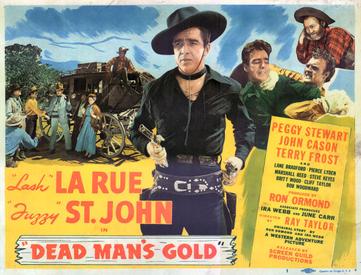
 Jim Thornton (Britt Wood) has discovered a gold mine so he writes to his old friends, Lash LaRue (Lash La Rue) and Fuzzy (Al St. John), asking them to come help him guard it. When Lash and Fuzzy arrive, Jim is nowhere to be found. With the help of Jim’s niece (Peggy Stewart), they discover that Jim’s been murdered. It doesn’t take a genius to realize that the murder was carried out by Conway (Jason Cason) and his men and that’s a good thing because a genius is something you will never find in a Lash La Rue western. However, Lash suspects that Conway was following someone else’s orders. He and Fuzzy set up a trap to reveal the true identity of the mastermind.
Lash dresses in all black and often uses a whip instead of a gun but this is still a standard B-western. Historically, it’s important because it was the first movie that La Rue made with producer Ron Ormond. Ormond later went from producing Lash La Rue films to directing them and Lash’s career never really recovered. (Ormond, whose non-Lash LaRue films included Mesa of Lost Women and If Footmen Tire You, What Will Horses Do?, was never much of a director.) Fortunately, Dead Man’s Gold was directed by the dependable Ray Taylor, who keeps the action moving and crafts an adequate if not exactly memorable western.
There is one cool scene in Dead Man’s Gold, in which Lash uses his whip to knock a shot glass out of a bad guy’s hand. Let’s see The Lone Ranger do that!

 Through the Shattered Lens