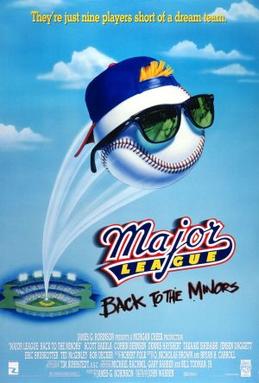
I Watched Major League: Back To The Minors (1998, Dir. by John Warren)


Roger Dorn (Corbin Bernsen), the former third baseman for the Cleveland Indians, is the new owner of the Minnesota Twins.  There’s a hotshot hitter playing for the Buzz, the Twins’s Minor League affiliate.  Downtown Anderson (Walton Goggin) can hit the ball over the fences but he still needs to learn about teamwork before he’ll be ready to move up to the majors.  Roger recruits an old friend, an aging pitcher named Gus Cantrell (Scott Bakula), to manage the Buzz and mentor Downtown.  Under Gus’s leadership, the Buzz starts winning games.  Even some former Indians, like Pedro Cerrano (Dennis Haysbert) and Taka Tanaka (Takaaki Ishibashi), are recruited to play for the Buzz.  When the manager of the Twins, Leonard Huff (Ted McGinley), insults Gus and the Buzz over dinner, Gus challenges the Twins to an exhibition game, the minors against the majors.  Huff accepts the challenge.

I had always heard that Major League: Back To The Minors was the worst of three Major League films but I liked it.  It wasn’t as good as the first one but it wasn’t as boring as the second one.  A lot of it has to do with the cast, who give it their all.  Walton Goggins is great as the cocky Downtown Anderson but really, all of the actors playing entire team did a good job.  They’re all misfits, of course.  I especially liked Doc (Peter Mackenzie), a medical student-turned-pitcher who has the slowest fastball in the game.  This movie had a little of the warmth and insider humor that made the first Major League film so special.  It’s an underdog story, with the minor league players proving that they’re just as good as the spoiled players in the big leagues.

I didn’t find the idea of an exhibition game between the Twins and the Buzz to be believable.  In the movie, they actually play two games against each other and they both take place during the regular season.  When did they find the time to play each other?  I guess they gave up one of their travel days but it still doesn’t seem like something that would happen.

I enjoyed this movie more than I thought I would.  It helped that I love baseball.  And I love the minor leagues, even if they don’t get the same respect as the majors.  Some of the best baseball I’ve ever seen has been in minor league games.  They may not have the huge contracts but they’ve got the talent, they’ve got something to prove, and they’ve got the love of the game.

Film Review: Atlas Shrugged Part Three (dir by J. James Manera)


In 2014, the Atlas Shrugged trilogy came to a close with Atlas Shrugged Part III: Who Is John Galt?  As you can probably guess from the title, this is the movie that finally revealed the elusive character of John Galt.

Unfortunately, after all the time spent discussing the character over the past two movies, there’s really no way that the actual John Galt could possibly live up to all the hype.  John Galt, the man who stopped the motor of the world and who is the world’s greatest living engineer, turns out to be a sensitive lumberjack type who has founded his own scenic village in Galt’s Gulch.  He’s manly and handsome and chivalrous and he’s a bit dull.  Kristoffer Polaha, who plays the character, is a perfectly pleasant and likable actor but there’s nothing about his screen presence or his performance that suggests that he’s the man who has figured out how to save civilization from the regulatory state.  As a character, Galt works best as a literary creation, someone who the reader can imagine for themselves.  When seen on screen, he’s a bit of a letdown.

Taking over the role from Taylor Schilling and Samantha Mathis, Laura Regan plays Dagny Taggart as an overworked businesswoman who really needs a vacation.  (Of the three actresses who played the character, only Mathis was credible as the dynamic Dagny of Ayn Rand’s original novel.)  Having crashed her plane in the mountains at the end of the second film, Dagny is nursed back to health by John Galt and the inhabitants of Galt’s Gulch.  Dagny is shocked to discover that most of her old friends are now living in Galt’s Gulch.  As they explain, they’re on strike and they’re no longer going to serve a government that is looking to control and ultimately destroy them.  Unfortunately, the film presents Galt’s Gulch as being a bit of a dull place, one that is not even livened up the presence of pirate Ragnar Danneskold (Eric Allan Kramer).  It’s the type of place where Dagny can visit the local farmer’s market and recuperate in a taste-fully decorated bed and breakfast, all while falling in love with her hunky host.  If the first two Atlas Shrugged films now feel somewhat prophetic, the third one feels like a Libertarian-themed Hallmark movie.

Atlas Shrugged: Part III feels a bit rushed.  Apparently, no one from the cast and crew of either the first or the second film returned to work on Atlas Shrugged: Part III and it feels quite a bit different from the previous two films.  Whatever one may think of the way the first two films presented the effects of government regulation, they were effective because they specifically showed the consequences.  The audience actually saw two trains collide due to incompetent management.  The audience saw the government showing up and forcefully taking over Rearden Metal.  The third film relies on a narrator, one who tells us what happened instead of letting us see it with our own eyes.  We hear about a bridge collapsing but we don’t see it.  We hear about union thugs forcefully taking over a factory but we don’t see them.  We hear about out-of-control government bureaucrats but, as opposed to the first two films, we don’t really get to spend much time with them and, when we do, they’re far more cartoonish in their villainy than they were in the first two films.  John Galt does get to deliver his speech to the world but it’s in a truncated form and the film’s decision to then cut to Sean Hannity, Glenn Beck, and Ron Paul all praising the speech on television not only goes against the film’s depiction of a country where public dissent is suppressed but it also reminds the audience that the film’s outlook has more in common with Fox News than Ayn Rand.

As previously mentioned, the third film has a totally different cast from the first two films.  Greg Germann is enjoyably over-the-top as the unhinged James Taggart but, otherwise, the new cast fails to make much of an impression, with some of them only showing up for a few brief seconds before disappearing from the story.  Rob Morrow plays Hank Rearden but is only seen for less than a minute.  By sidelining one of the book’s most important characters, Atlas Shrugged: Part III also drops the whole storyline about Hank’s affair with Dagny.  While I guess that makes it easier for the film to then have Dagny and John Galt hook up, it still feels a bit unfair to the people who actually watched the entire trilogy.

Considering that both Parts I and II have improved with the passage of time, Part III is a rather disappointing ending for the trilogy.  Upon watching, John Galt would probably be disappointed but not surprised.