October True Crime: My Father’s Shadow: The Sam Sheppard Story (dir by Peter Levin)


On July 3rd, 1954, Marilyn Sheppard was murdered in her bedroom.

The wife of a prominent neurosurgeon, Marilyn Sheppard was bludgeoned to death in her own bedroom.  Her husband, Sam Sheppard, claimed that he had fallen asleep on a downstairs couch and was woken up by the sound of his wife screaming.  Sheppard said that, when he ran upstairs to the bedroom, he saw a bushy-haired man in the shadows.  The man hit Sheppard, knocking him out.  When Sheppard came to, he saw the man fleeing the house and chased after him.  The two fought outside and again, Sheppard was knocked out.

The police did not believe Sam Sheppard’s story and, after days of headlines that flat out accused him of being the murderer, he was arrested and charged with murdering his pregnant wife.  The press had a field day with the story and the trial was frequently described as being a circus.  Sheppard’s case was damaged by the revelation that he had cheated on his wife multiple times.  Contemporary accounts of the trial portrayed Sheppard as being cocky and arrogant.  As the jury was not sequestered, they saw every tabloid headline about Sheppard.  After deliberating for four days, the jury found Dr. Sam Sheppard guilty of murdering his wife.  He was sentenced to prison.

Sheppard would stay in prison until 1966.  During that time, his mother committed suicide, his father died of an ulcer, and his former father-in-law also chose to end his own life.  Sheppard’s original attorney died in 1961 and his appeals were taken over by a young lawyer named F. Lee Bailey.  In 1966, Bailey argued before the U.S. Supreme Court that Sheppard was denied due process due to the jury not being sequestered.  The Supreme Court agreed and granted Sheppard a new trial.  This time, with the flamboyant Bailey defending him, Sheppard did not testify and the defense focused on the lack of any real evidence that would suggest Sheppard had lied about the Bushy-haired Man.  Sheppard was acquitted.

Today, if Sam Sheppard is remembered, it’s for inspiring The Fugitive, a show about a doctor wrongly accused of murder.  (The show aired while Sheppard was still in prison.)  The majority of online posts and articles that I’ve read about Sam Sheppard have always focused on the retrial and usually end with Sheppard leaving prison.  It’s rare that Sheppard’s life after prison is discussed,  That’s probably because it’s a very sad story.

Sheppard may have been acquitted but he had also just spent 12 years in prison and he came out a changed man.  Sheppard tried to return to practicing medicine but his surgical skills had deteriorated to the extent that two of his patient died after he nicked an artery.  Facing multiple wrong death suits, he resigned from the only hospital that had been willing to give him a job.  He became a professional wrestler and was known as “Killer” Sam Sheppard at some of his matches.  He was also an alcoholic.  Less than four years after getting out of prison, he was dead at the age of 46.

1998’s My Father’s Shadow: The Sam Sheppard Story features Peter Strauss as Dr. Sheppard and Henry Czerny as his namesake son.  The film alternates between flashbacks to Dr. Sheppard’s life and scenes set in the 90s that focus on his son’s attempts to definitively clear his father’s name.  The film suggests that the murder was actually committed by Richard Eberling (John Colicos), who worked as a handyman and a window washer at the Sheppard home and who, when he was arrested for burglary several years after the murder, was discovered to have some of Marilyn Sheppard’s jewelry in his possession.  In the 80s, Eberling was convicted of murdering another one of his clients.  Eberling himself died in prison, the same year that this movie aired.

It’s a big story and My Father’s Shadow tries to do a lot in just 90 minutes.  Sometimes, it tries to do too much.  The flashbacks are occasionally a bit difficult to keep track of.  Sam Sheppard’s son goes from being a military school brat to a long-haired hippy so suddenly that, from a narrative point of view, it’s a bit distracting.  Overall, though, this is an effective look at an interesting story and it features two excellent performances from Strauss and Czerny.  It may not be the definitive telling of Sam Sheppard’s story but it’s a good place to start.
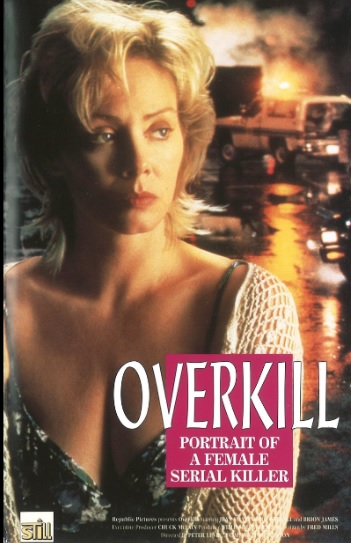
October True Crime: Overkill: The Aileen Wuornos Story (dir by Peter Levin)


Made for television in 1992, Overkill: The Aileen Wuronos Story opens with Aileen (Jean Smart) and her friend, Tyria Moore (Park Overall), hitchhiking their way through Florida.  Aileen is outspoken and unpredictable, quick to lose her temper with anyone who doesn’t give her a ride or money and also very possessive of Tyria.  Tyria is naïve and a bit spacey, though she is smart enough to have figured out that Aileen is financing their trip through sex work.

Of course, if you’ve seen Monster, you already know the story of Aileen and Tyria and you also know that Aileen is eventually going to end up in a lot of trouble and Tyria is going to be pressured to betray her.  Monster made it clear that Aileen and Tyria were a romantic couple and it even suggests that, for all of her crimes, Aileen sincerely loved Tyria.  Overkill, probably due to being a made-for-television movie from the 90s, treats Aileen and Tyria’s relationship a bit more ambiguously.  While Aileen is portrayed as being very possessive and very protective of Tyria, their relationship is portrayed as being more of a roommate situation than a romantic one.  Indeed, Aileen is often portrayed as being almost stalkerish in her behavior towards Tyria.  Aileen comes across as being much more interested in Tyria than Tyria is in Aileen.

While Aileen and Tyria travel across Florida, men are turning up dead up and down the interstates.  The victims were all shot and they were all middle-class, white professionals.  Most of them are found in circumstances that suggested that they had picked someone up and that person subsequently shot and then robbed them.  When Detective Brian Munster (Brion James) suggests that all of the men could have fallen victim to a female serial killer, his colleagues are skeptical.  Everyone knows that serial killers are always men.  But Munster continues to insist that the murderer must be a woman and soon, he comes to suspect that the killer could be Aileen.  However, all of the evidence that Brian has is circumstantial and it won’t be enough to get a conviction.  He and the member of his investigative team start to watch Aileen, waiting for her to make a mistake that will give them what they need to make an arrest….

After she was convicted of murdering seven men, Aileen Wournos claimed that the police always knew that she was the one committing the murders but that they didn’t arrest her because they wanted to reap the publicity from pursuing America’s first female serial killer.  As evidence, she cited this movie and it must be admitted that this movie does feature a lot of scenes of Munster and his detectives waiting for Aileen to make her next move.  That said, one would think that Overkill would be the last movie that Aileen would want to bring attention to because the film essentially presents Aileen Wournos as being a petulant and trashy psychopath who turned to crime because she was too stupid to do anything else with her life.  If Monster portrayed Aileen as being someone who had been so damaged by society that she could no longer function, Overkill portrays Aileen as being someone who uses her childhood trauma as a convenient excuse for her own antisocial tendencies.

Overkill is a considerably more simplistic portrayal of Aileen’s crimes than Monster.  That said, Jean Smart does a good job in the role and is convincingly angry at the world.  Overkill is more about the effort to catch Aileen than Aileen herself and character actor Brion James, who usually played villains over the course of his career (like Leon in Blade Runner and the killer in The Horror Show), makes for a convincingly no-nonsense cop.  Overkill is a well-made and well-acted film, even if it does ultimately feel a bit shallow in its storytelling.

After The French Connection: Popeye Doyle (1986, directed by Peter Levin)


In this made-for-television movie, a pre-Married With Children Ed O’Neill takes over the role that won Gene Hackman an Oscar.

Popeye Doyle (played by O’Neill) is a hard-drinking, hard-living Irish police detective working out of New York City.  Along with his more emotionally stable partner, Tony Parese (Matthew Laurence), Doyle spends his time busting drug dealers, going on stakeouts, and chasing junkies through the mean streets of NYC.  When Jill, a beautiful young model (Audrey Landers) turns up dead, everyone assumes that it was an overdose.  Doyle, however, has his doubts.  All of her friends say that Jill never used drugs and, when Popeye searches her apartment, he doesn’t find any evidence that would point to her being junkie.  Instead, he finds tapes that Jill made for various wealthy men.  Convinced that Jill was murdered, Popeye is soon investigating the type of powerful people who are not used to being investigated.

In 1986, someone at NBC thought it would be a good idea to launch a series based on The French Connection.  Since Gene Hackman was busy making movies and hadn’t come anywhere close to appearing on television since losing the role of the father on The Brady Bunch to Robert Reed, the role of Popeye was given to Ed O’Neill.  At that time, O’Neill was an unknown who had appeared in a handful of plays, two movies, and one Red Lobster commercial.  The movie, Popeye Doyle, was meant to serve as a pilot for the proposed television series.  Needless to say, the film did not lead to a series.  If it had, Ed O’Neill probably wouldn’t have been available to take the role of Al Bundy on Married With Children.

O’Neill is probably the main reason that anyone today would want to see Popeye Doyle, which is otherwise a routine cop movie.  Except for a few scenes where he seems to be trying too hard to imitate Hackman’s iconic performance, O’Neill brings authentic working class swagger to the role.  He drinks too much, he often says the wrong thing, and he pisses off all the right people.  There are some scenes where O’Neill seems to blend right in with the pilot’s gritty visual style.  (It was shot on location in Ed Koch-era New York.)  There are other scenes where he gets so manic that he seems to be a man possessed.  In the scene where he watches Candy Clark do an impromptu striptease, O’Neill as Doyle gets so excited that you worry about him.  Interestingly, Doyle wanders through the film dressed like a slob and acting like a schlub but every beautiful woman he meets wants to have sex with him.  In that regard, it is easy to imagine the movie as being some sort of elaborate daydream that Al Bundy had while selling shoes.

As for the events in The French Connection, they’re mentioned briefly at the start of the movie, when a reporter asks Doyle about that time he accidentally shot and killed a federal agent.  Popeye Doyle still has many scenes that are meant to remind viewers of the first film.  There’s a stakeout scene, where Doyle and Parese sit out in the cold while their target enjoys a nice night.  There’s a scene where Doyle works undercover as a bum.  And, of course, there’s a car chase, though it’s nowhere near as exciting as the one from The French Connection.

Popeye Doyle has never been officially released on DVD (or even VHS), though it is available on YouTube.