I recently watched the 1993 best picture nominee The Piano and all I can say is that it is going to be a struggle to put into words just how much I loved this film.
Taking place in the 19th century, The Piano tells the story of Ada (Holly Hunter), a Scottish woman who hasn’t spoken since she was 6 years old. Like many things in this enigmatic film, the reason why Ada stopped speaking is never clearly stated. What is known is that she communicates through sign language and by playing her piano. While Ada is usually a black-clad and somber figure, she comes to life when she plays the piano. Ada also has a daughter named Flora, the result of a brief affair that Ada had with one of her teachers. Unlike her mother, Flora (played by 10 year-old Anna Paquin, long before True Blood) is rarely silent and delights in telling elaborate lies about how her father died.

Ada’s father sells her into marriage to a New Zealand frontiersman named Alisdair (Sam Neill), a man who Ada has never even met. When Ada and Flora first arrive in New Zealand, they are dropped off on the beach and forced to wait a night until Alsdair can meet them. In the film’s most hauntingly beautiful scenes, Ada plays her piano on that beach while Ada dances in the surf. It’s during those scenes that The Piano reveals three of its greatest strengths: the lush cinematography of Stuart Dryburgh, the haunting score composed from Michael Nyman, and the fact that Hunter and Paquin are totally believable as mother and daughter. Not only is it easy to imagine Paquin growing up to look like Holly Hunter, but the two actresses even manage to perfectly imitate each other’s gestures and facial expressions. Most of the reviews that I’ve read of The Piano tend to emphasize the film’s focus on the conflict between the sensual and repressed but to me, the film works just as well as an exploration of the strong bonds that naturally exist between mothers and daughters. I’m not ashamed to admit that when I look at the picture above, I reminded of how, when I was Flora’s age, I also used to hide behind my mom whenever I saw anyone that I didn’t know coming our way.
When Alisdair does finally show up to take them to their new home, he proves to be a rather cold and distant figure. It would have been very easy for the film to portray Alisdair as being a completely heartless villain but, as played by Sam Neill, Alisdair is potrtayed as being less a traditional villain and more as just being a painfully unimaginative man who is incapable of understanding why Ada’s piano is so important to her. To Ada, the piano and its music equals the life and freedom that she’s not allowed to experience. To Alisdair, the piano is simply a bulky object that will not fit into his small house. Over Ada’s objections (luckily, Flora is on hand to translate her sign language), Alisdair first leaves the piano on the beach and then agrees to sell it to Baines (Harvey Keitel), another white settler who — unlike Alisdair — is comfortable with the natives and their customs.
Baines, however, allows Ada to come over to his hut and play the piano. He offers to give the piano back to her — key by key — if she agrees to continue to come to his hut and play while he watches and “pleasures” himself. Reluctantly, Ada agrees but soon, she and Baines are falling in love.
Needless to say, when Alisdair finds out what has been going on at Baines’s hut, he is not happy. As he largely considers to be his property, bought and paid for, he also feels that he has the right to decide whether or not she’s capable of playing her piano…
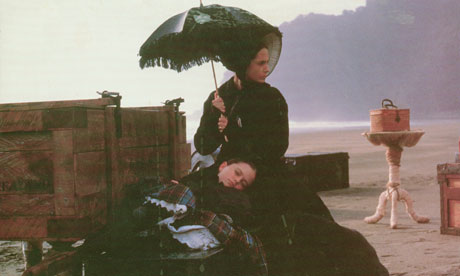
The Piano is a simply an amazing and visually sensual film that is blessed with excellent lead performances from Hunter, Keitel, Neill, and Paquin. As directed by Jane Campion, The Piano plays out as both a delirious homage to gothic romanticism and a feminist parable about the way that even women who aren’t mute are still punished for expressing their honest desires.
And, of course, there’s that amazing score:
 Through the Shattered Lens