Film Review: Exodus (dir by Otto Preminger)


First released in 1960 and based on a novel by Leon Uris, Otto Preminger’s Exodous is two films in one.

The first half of the film takes place in Cyprus in the days immediately following World War II.  A young war widow named Kitty (Eva Marie Saint) is sightseeing when she learns of the Karaolos Internment Camp, where the British are interning thousands of Jewish refugees who demand to be allowed to go to the land that will eventually become the State of Israel.  Kitty visits with General Sutherland (Ralph Richardson), who oversees the camp and who is rumored to secretly be Jewish because of his relatively benevolent attitude towards the internees.  Disgusted by the anti-Semitism displayed by many of the British officers (one of whom is played by Kennedy in-law Peter Lawford), Kitty volunteers at the camp and learns about the Holocaust from those who survived it.  She also meets Ari Ben Caanan (Paul Newman), a former officer in the British army.  Ari manages to get control of a cargo ship, one that is renamed Exodus.  Six hundred refugees stage a hunger strike, vowing that they will willingly starve to death rather than be returned to Europe.

The second part of Exodus takes place in what will become the modern State of Israel.  It follows Ari, Kitty, and several of the passengers of the Exodus as they adjust to life and continue to fight for a land of their own, despite the opposition of the British and much of the rest of the world.  Karen (Jill Haworth) is a young woman who searches for her father, a brilliant man who has been driven into a nearly catatonic state by the horrors of the Holocaust.  Dov Landau (Sal Mineo) is an explosives expert who survived Auschwitz as a Sonderkommando and who was repeatedly raped by the guards at the camp.  Dov joins the Irgun, a paramilitary organization that the British consider to be terrorists.  Leading the Irgun is Ari’s uncle, Akiva (David Opatoshu), and Dov soon finds himself being targeted by both the British and the Arabs who, despite the moderating efforts of men like Taha (John Derek, who would later direct Ghosts Can’t Do It), want to violently force the Jews out of the land.

Legend has it that, after a private screening on Exodus, comedian Mort Sahl turned to director Otto Preminger and said, “Otto, let my people go.”  And it’s true that Exodus is a very long film.  Preminger, who started out making film noirs like Laura, spent the latter part of his career making “important” epics and, like many Golden Age directors struggling to compete with television and the 60s counterculture, he tended to make long, star-studded films that dealt with current events and which pushed the envelope just enough to be controversial without actually being radical.  However, I would argue that the three-hour running time of Exodus is justified.  To understand why Ari, Dov, Karen, and the other passengers of the Exodus would rather risk their lives by staying in what will become the State of Israel, one has to understand both what they went through to get there and also the anti-Semitism that they faced even in post-World War II Europe.  If Exodus were made today, it would be a mini-series.  Since it was made in 1960, it was instead a 3-hour film with an intermission.

Exodus holds up relatively well, with the sprawling action anchored by the presence of a cast of familiar faces.  Paul Newman and Eva Marie Saint bring a good deal of movie star glamour to scenes that would have otherwise just been dry exposition.  The film’s heart truly belongs to Jill Haworth and Sal Mineo, both of whom bring two life characters who have very differing views of the world.  Karen remains an optimist, one who is convinced that people can live together.  Dov, fueled by his own guilt and anger, has no room for negotiations and compromises.  Mineo received his second and last Oscar nomination for his performance in Exodus, though he lost to Peter Ustinov’s showy turn in Spartacus.  Exodus itself was clearly made with a hope for Oscar glory.  While Exodus did pick up a handful of nominations, it was left out of the five movie Best Picture slate.  The Academy only had room for one historical epic and they went for John Wayne’s The Alamo.  The eventual winner was The Apartment, the best of the nominated films.  (Indeed, even if Exodus had taken the Alamo’s spot, The Apartment would still be the best of the nominees.)  The Oscars aside, Exodus remains a good example of the type of epic filmmaking that once defined the Hollywood studios.

Cleaning Out The DVR Yet Again #40: Melinda (dir by Hugh A. Robertson)


(Lisa recently discovered that she only had about 8 hours of space left on her DVR!  It turns out that she’s been recording movies from July and she just hasn’t gotten around to watching and reviewing them yet.  So, once again, Lisa is cleaning out her DVR!  She is going to try to watch and review 52 movies by the end of 2017!  Will she make it?  Keep checking the site to find out!)

melinda

I recorded Melinda off of TCM on November 13th.

First released in 1972, Melinda is technically a murder mystery.  Frankie J. Parker (Calvin Lockhart, giving a brilliant performance) is a popular radio DJ in Los Angeles.  When we first see Frankie, he’s driving his expensive sportscar through a poor neighborhood.  It’s a neighborhood that he knows well but, as opposed to those around him, he’s made it out.  He’s handsome, slick, and more than a little arrogant.  When he arrives at a local gym, he looks at himself in a mirror and says, “I shouldn’t say it … but I am a pretty motherfucker.”  Frankie’s a student in a taekwondo class taught by Charles Atkins (Jim Kelly).  Charles gives Frankie a hard time about not giving back to the community.  Frankie blows off his concerns.  To be honest, we really should dislike Frankie but he’s so damn charming.  As played by Calvin Lockhart, Frankie has one of those irresistible smirks, the type of the lights up the screen.

One night, Frankie meets the mysterious Melinda (Vonetta McGee) and spends the night with her.  He thinks that it’s just going to be another one night stand but Melinda tells Frankie that he has the potential to be more than he realizes.  Touched, Frankie goes to work and resolves to be a better person.  Then he returns home and discovers that Melinda has been murdered!

The rest of the film deals with Frankie’s attempts to discover who murdered Melinda.  It turns out that Melinda had underworld connections and mob boss Mitch (Paul Stevens) is desperate to recover something that Melinda had in her possession when she died.  But honestly, the whole murder subplot is a MacGuffin (if you want to get all Hitchcockian about it).  Ultimately, Melinda is a character study of Frankie Parker and how, over the course of solving Melinda’s murder, he learns that there’s more to life than just looking out for himself.

Though Melinda was obviously made to capitalize on the blaxploitation craze of the early 70s, it’s actually far more low-key than most of the better known films in the genre.  (Or, at least it is until the karate-filled finale.)  Perhaps because it was directed by a black man and written by noted black playwright Lonne Elder III, Melinda is far more interested in exploring what makes its characters who they are, as opposed to just putting a gun in their hand and having them shoot up the screen.  Frankie Parker emerges as a fascinating character.

Mention should also be made of the performance of Rosalind Cash, who plays Terry, Frankie’s ex.  Cash gets an absolutely amazing scene where, while attempting to convince a bank employee that she’s Melinda so that she can get into Melinda’s safe deposit box, she tells off a rude teller.  It’s such a good scene and Cash delivers her lines with such fury that you find yourself forgetting that the teller was actually correct in her suspicion that Terry wasn’t actually who she said she was.

Melinda is probably one of the best films that hardly anyone has ever heard of.  Keep an eye out for it.

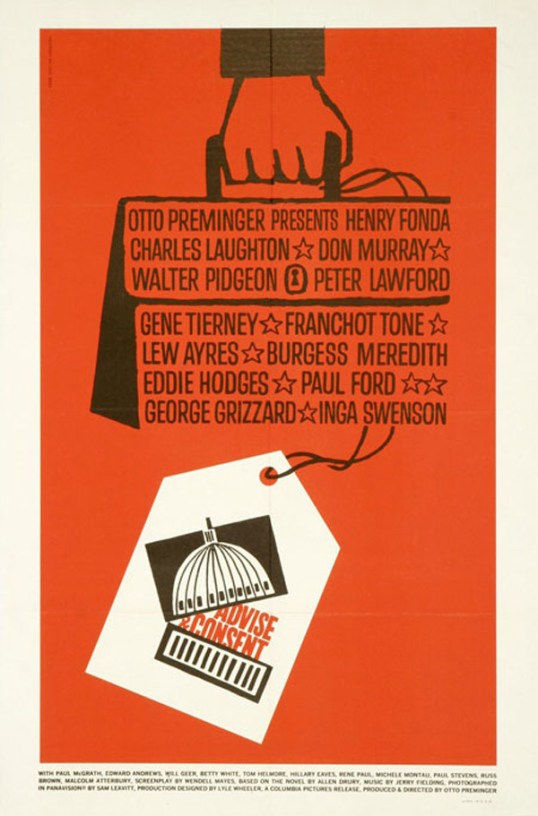
Shattered Politics #17: Advise & Consent (dir by Otto Preminger)


Advise-&-Consent-(1)

In case you hadn’t heard, U.S. Sen. Barbara Boxer has recently announced that she’s retiring in 2016.  For the first time in decades, there’s going to be an open senate seat in California.  There’s been a lot of speculation about who might run for the seat and, for the most part, it’s all been the usual political suspects.  The state’s attorney general is running.  A few congresspeople might run.  Token billionaire Tom Steyer is thinking of getting into the race.

What disappoints me is that, as of right now, it doesn’t look like any celebrities are planning on running.  You know what would have made the Golden Globes perfect?  If George Clooney had announced his candidacy while accepting his Cecil B. DeMille award.  (At the very least, it might have given Amal something to smile about, as opposed to just sitting there with a condescending smirk on her face.  Seriously, what’s up with that?)  But even beyond George Clooney, there’s all sorts of celebrities who could run.  Charlie Sheen lives in California, after all.  Jeff Bridges might not be able to run in Montana but what about California?

I was discussing this with a friend of mine who suggested that Betty White should run because who could vote against Betty White?  Speaking for myself, I could easily vote against Betty White but I do think there would be something appropriate about Betty White serving in the U.S. Senate.  After all, in 1962, she played a senator in Otto Preminger’s political epic, Advice & Consent.

White played Sen. Bessie Adams of Kansas and was only given a few minutes of screen time.  She’s one of many performers to show up in Advise & Consent‘s version of the U.S. Senate.

For instance, Walter Pidgeon plays Sen. Bob Munson, who is the Senate majority leader and, as a result, the closest thing that this sprawling film has to a central character.  His job is to make sure the President’s agenda is pushed through Congress.

And then there’s Peter Lawford, as Sen. Lafe Smith, who always has a different girl leaving his hotel room.  When Advise & Consent was made, Lawford was President Kennedy’s brother-in-law.  Interestingly enough, one of Kennedy’s former girlfriends — actress Gene Tierney — shows up in the film as well, playing Bob Munson’s lover.

George Grizzard plays Sen. Fred Van Ackerman, who is about as evil as you would expect someone named Fred Van Ackerman to be.  Grizzard gives one of the better performances in the film, which just goes to prove that it’s more fun to play an evil character than a good one.

Don Murray is Sen. Brigham Anderson, a senator who is being blackmailed by Van Ackerman’s lackeys.  Despite being happily married to Mabel (Inga Swenson), Anderson is leading a secret life as a gay man.  The scene where Anderson steps into a gay bar may seem incredibly tame today but it was reportedly very controversial back in 1962.

And finally, there’s Sen. Seabright Cooley.  You may be able to guess, just from his overly prosaic name, that Cooley is meant to be a southerner.  That, of course, means that he wears a white suit, is constantly fanning himself, and speaks in lengthy metaphors.  Sen. Cooley is played by Charles Laughton, who overacts to such a degree that I’m surprised that there was any oxygen left over for anyone else.

All of these senators have been tasked with deciding whether or not Robert Leffingwell (Henry Fonda) will be the next secretary of state.  Fonda, not surprisingly, is the epitome of urbane liberalness in the role of Leffingwell.  However, Leffingwell has a secret.  Back in the 1930s, Leffingwell was a communist.  When Sen. Cooley introduces a witness (Burgess Meredith) who can confirm this fact, Leffingwell offers to withdraw as the nominee.  However, the President (Franchot Tone) refuses to allow Leffingwell to do so.  Instead, with the help of Van Ackerman, he tries to pressure Anderson into supporting Leffingwell’s nomination.

This, of course, leads to melodrama and tragedy.

As far as literary adaptations directed by Otto Preminger are concerned, Advise & Consent is better than Hurry Sundown while being nowhere to close to being as good as Anatomy of a Murder.  It’s a film that is occasionally entertaining, often draggy, and, if just because of all the different acting styles to be found in the cast, always interesting to watch.

And, for what it’s worth, Betty White makes for a convincing senator.  So, perhaps the people of California should watch Advise & Consent before voting for Tom Steyer…