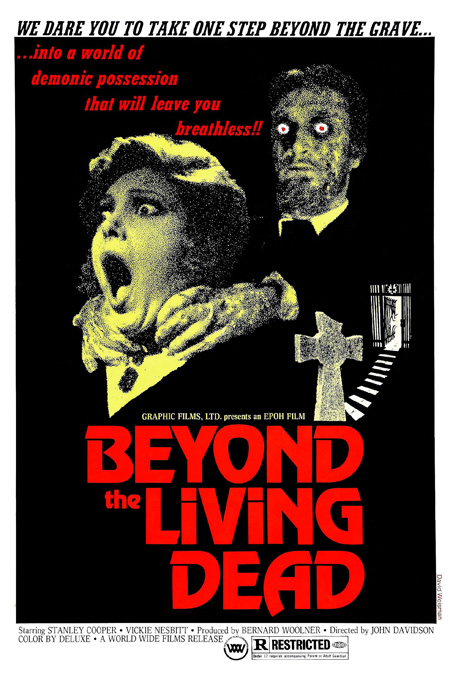
Horror Film Review: Beyond The Living Dead (dir by Jose Luis Merino)


First released in 1973 and also known as The Hanging Woman, Beyond The Living Dead is a Spanish horror film that is just incoherent enough to be intriguing.

Having inherited the estate of his uncle, Serge Chekhov (Stelvio Rosi) arrives in the town of Skopje and is stunned to discover that, even though it’s only 6:00 in the evening, there’s no one in the streets.  Everyone has retired to their homes.  Even after Serge stumbles across a woman hanging in the cemetery, no one is willing to open their doors when he pounds on them.  Serge finally finds his uncle’s place, where he discovers that the hanging woman was the daughter of his uncle’s widow, Countess Nadia Minalji (Maria Pia Conte).  While Serge speaks to the police (who seem to view Serge as being the most likely suspect), Nadia retreats to her room, performs a black magic ceremony, and sends out a mental summons to Igor (Spanish horror great Paul Nashcy), a gravedigger who is also a necrophile and who has a huge collection of photographs of naked corpses in his shack.

Once Serge is finally able to convince the police that he’s not a murderer, he helps them when they chase Igor around the village.  Later, Serge returns home and is promptly seduced by Nadia.  The next morning, Nadia’s servant, Doris (Dyanik Zurakowska), begs Serge not to fire her and her father, Prof. Droila (Gerard Tischy).  It turns out that Prof. Droila has a laboratory in the house’s basement where he’s been doing experiment on how to reanimate the dead.  Serge has Doris undress for him and then, once she’s crying, he tells her that he already talked to the professor and agreed to allow him and his daughter to remain.  WHAT THE HELL, SERGE!?

Got all that?  I hope so because the film only gets stranger from there, with multiple murders occurring and Serge falling in love with Doris just as quickly as he fell in love with Nadia.  As Igor stumbles around the village and peeps through people’s windows, Nadia holds a séance and eventually, a few decaying zombies show up.  The plot is nearly impossible to follow, which is actually something that I tend to find to be true with a lot of Spanish horror films that were released during the Franco era.  Making movies full of murder and nudity under a puritanical regime leads to a certain narrative incoherence.  That said, the film plays out at such a strange pace and contains so many bizarre red herrings that it does achieve the feel of a particularly vivid dream.

Today, Beyond The Living Dead is best-remembered for Paul Naschy’s memorably weird performance as Igor.  Naschy originally turned down the role, thinking that it was too small.  The director allowed Naschy to rewrite the script to make Igor more interesting and it was Naschy who came up with the idea of making Igor not just a grave robber but also a necrophile.  For English-speaking audiences, it can be hard for us to judge Naschy as an actor because we usually only see him in poorly dubbed films.  (The English-language version of Beyond The Living Dead was apparently dubbed by a group of cockney voice actors.)  But Naschy definitely had an imposing physical presence and this film makes good use of it.

Full of atmospheric visuals and surprisingly effective gore effects, Beyond The Living Dead does capture the viewer’s imagination, as long as one is content to not worry too much about trying to make much sense of it!

International Horror Review: The Werewolf and the Yeti (dir by Miguel Iglesias Bonns)


This 1975 Spanish film is known by several titles.  In Spain, it was called La Maldicion De La Bestia.  In some other European countries, it was released as either Night of the Howling Beast or Hall of the Mountain King.  In the United States, it was released under the title The Werewolf and the Yeti.

Regardless of which title you see the film under, this is the eighth of 12 films in which Paul Naschy starred as Waldemar Danisky.  Waldemar was a Polish nobleman who, in film after film, transformed into a werewolf so that he could battle some other monster.  What set the Danisky films apart from other horror franchises is that each film was totally unrelated to the one that came before it.  Every film featured Danisky getting transformed into a werewolf for the first time and the majority of them ended with Danisky dying.  Even though Naschy was playing the same character, each film seemed to take place in a separate universe.  Apparently, regardless of the reality that he found himself in, Danisky was always destined to become a werewolf.  Talk about rotten luck!

Despite their bizarre lack of continuity, Naschy’s werewolf films were popular across Europe and, to a lesser extent the United States.  Of course, in America and the UK, they were only released in badly dubbed versions.  Indeed, the plot was often changed during dubbing depending on where the film was set to be released.  As a result, it’s difficult to fairly judge both Naschy and his films.  Paul Naschy had a definite physical presence but it’s rare that anyone ever heard his real voice.  In most of the Danisky films that I’ve seen, Naschy seems to play Danisky as if he is in a permanently bad mood.  But, I guess if your entire existence revolved around getting turned into a werewolf every year or so, you’d be in a bad mood too.

In this film, Waldemar Danisky is an explorer who is romantically involved with the daughter of Professor Lacombe (Josep Castillo Escalona).  Lacombe is planning on leading an expedition into the Himalayas, despite the presence of pirates, warlords, and Yeti!  Danisky warns Lacombe against attempting it but, in the end, he still agrees to serve as the expedition’s guide.  Unfortunately, this film’s version of Waldemar Danisky isn’t very good at his job and he soon gets separated from the expedition.  The professor and his daughter are captured by a group of mountain pirates who torture them and make plans to sell them into slavery.  Meanwhile, Danisky stumbles across a cave that is inhabited by two women who also happen to be …. WEREWOLVES!  It’s not long before Danisky gets bitten and finds himself transformed into a werewolf.  He uses his new werewolf powers to kill the women in the cave and then he heads off to rescue the professor.  It’s a good thing that Waldemar’s a werewolf because it turns out that the pirates have a …. YETI!

Yes, this is a weird and incoherent film.  Of course, that’s the main reason why it’s hard not to enjoy this silly little film.  It’s quickly paced and, like many of Naschy’s film, it operates on its own strain of dream logic.  The most interesting thing about the film is that no one is particularly shocked to discover that Waldemar Danisky has been transformed into a werewolf and Danisky himself seems to accept it as having been inevitable.  One gets the feeling that the expedition watched a few Paul Naschy films before heading to the Himalayas and, as a result, they knew exactly what to expect.  As I mentioned above, it’s hard to judge Naschy as an actor because his films were so poorly dubbed.  But, you can judge him as a werewolf and he really puts his heart into fighting that Yeti.  Waldemar Danisky is the werewolf that you want on your side.

¡Viva Naschy!

International Horror Review: The Mark of the Wolfman (dir by Enrique López Eguiluz)


The 1968 Spanish film, The Mark of the Wolfman, is a strange one.

Just try to keep this straight:

In Eastern Europe, two gypsies accidentally bring back to life a feared werewolf named Imre Wolfstein.  (Beware any supernatural creature who has an ironic name.)  Wolfstein proceeds to terrorize the countryside, attacking both the good and the bad alike.  He also finds the time to attack a Polish nobleman named Waldemer Danisky (Paul Naschy).  Danisky survives the attack but now he’s a werewolf!  Unlike Wolfstein, Danisky is not happy about being a werewolf, especially when he discovers that he’s been killing innocent people while transformed.  So, Danisky decides to go to a local scientist named Dr. Janos Mikhelov (Julian Ugarte).  Unfortunately, it turns out that Dr. Mikhelov is a vampire and so is his wife!  They’ve got special plans for both of the werewolves!

The Mark of the Wolfman was the first of many films in which Naschy would play Count Danisky.  They were extremely popular in Europe and Paul Naschy became a big star in Spain.  In fact, he was sometimes called the Spanish Lon Chaney and given that Naschy often talked about how The Wolf Man (starring Lon Chaney, Jr.) was one of his favorite films when he was a child, that undoubtedly brought him a lot of pleasure.  And indeed, Naschy’s performance as Danisky did owe a bit to Lon Chaney Jr’s performance as Larry Talbot.  They’re both tortured souls, desperately seeking an escape from their curse and continually being brought back to life against their will.  The main difference between the two was that Danisky never got quite as whiny as Talbot.  Whereas Lon Chaney Jr. played Larry Talbot as being just a big dumb lug, Naschy played Danisky as being a far more aggressive character.  Danisky wasn’t just depressed over being a werewolf.  He was pissed off about it.

The plot of Mark of the Wolfman may sound complicated but, by the standards of Naschy’s other films, it’s actually rather straight-forward and uncomplicated.  Of course, it can be difficult for an American to judge Naschy’s films because many of them were never released here in the United States and those that were can usually only be found in poorly dubbed and crudely edited versions.  For instance, Mark of the Wolfman was released in the United States as Frankenstein’s Bloody Terror, despite the fact that neither Frankenstein nor his monster were anywhere to be found in the original film.  However, the distributors needed a film to go on a double bill with another Frankenstein movie.  To justify the title change, narration was added to the start of the film that established that Wolfstein was a descendant of Frankenstein.  Apparently, the price for playing God was to be cursed with lycanthropy.  It’s actually kind of charming in a drive-in sort of way.

Even if you know nothing about the subsequent career of Paul Naschy or the many sequels that followed this film, The Mark of the Wolfman holds up well as an entertaining horror film.  It’s only 88 minutes long and it manages to pack drunken gypsies, tortured werewolves, devious vampires, and a dungeon into its brief running time.  As a result, it’s never boring. Visually, the film is a treat, with the camera swiftly moving across the wilderness or tracking through gothic castles.  (Mark of the Wolfman was originally filmed in 3D and, watching the film, I found myself thinking that it probably looked pretty damn impressive to audiences in 1968.)  Because the version that I saw was badly dubbed into English, it wasn’t always easy to judge the performances but Naschy played Danisky with a properly haunted look.

The Mark of the Wolfman is an enjoyable work of Spanish horror, one that undoubtedly helped to revitalize Spanish horror just as assuredly at the Blind Dead and Jess Franco.

Horror On The Lens: Los Monstruos del Terror (dir by Tulio Demicheli, Hugo Fregonese and Eberhard Meichsner)


For today’s Horror on The Lens, we have a Spanish film that was originally made in 1969 and given an international release in 1970.  In the United States, it was released under several different names: Monsters of Terror, Assignment: Terror, and Dracula vs. Frankenstein.

Despite the title, this film really isn’t about Dracula fighting Frankenstein.  There is, of course, a Frankenstein monster in the film and there is a vampire who, in some versions of the film, is referred to as being Dracula and, in other versions, is referred to by a lot of other names.  (What’s he called in the version below?  You’ll have to watch to find out.)

What this film is about is Waldemar Danisky, a tragic werewolf who was played by Paul Naschy in a series of films.  In this, his third appearance, Waldemar and a host of other monsters are brought back to life by aliens who are looking to take over the Earth.  Fortunately, Waldermar is a werewolf with a conscience and battles not only the aliens but the other monsters as well.

Yes, it’s all a bit silly and really doesn’t make much sense but you really owe it to yourself to watch at least one Paul Naschy film before this October ends..

http://www.youtube.com/watch?v=qbWf8nboSxQ


6 Trailers for Cinco De Mayo


Hola and happy Cinco De Mayo!  I’m not sure if Cinco De Mayo is as big a deal up north as it is down here in the Southwest but today is going to be one of the few Saturdays that I don’t go to the movies.  Instead, I will be observing this day with friends, family (I am a fourth Spanish), and cerveza.  But first, here’s the latest edition of Lisa Marie’s Favorite Grindhouse and Exploitation Trailers…

(Be warned: Some of these trailers are a tad bit more explicit than some of the other trailers that I’ve featured as a part of this series.  Watch with caution.)

1) Tombs of the Blind Dead (1971)

This is one of the first of the great Spanish horror films. 

2) Return of the Evil Dead (1973)

The Blind Dead returned in this gory and violent sequel.  One of my prize possessions is my Blind Dead box set, which was released (in the shape of a coffin, no less) by Blue Underground.

3) Vampyros Lesbos (1971)

This is the German trailer for Vampyros Lesbos, directed by the infamous Jess Franco.  Just try to guess what this film is about…

4) Oasis of the Living Dead (1981)

In a career that has spanned over 500 films, Jess Franco has dealt with not only lesbian vampires but zombies as well…

5) Night of the Bloody Apes (1969)

From Rene Cardona comes this surprisingly bloody films about what happens when an ape’s heart is transplanted into a normal human being.  Fortunately, there’s a wrestler around to save the day…

6) The Werewolf Vs. The Vampire Woman (1970)

Finally, let’s end things with a Paul Naschy film, shall we?

6 Trailers To Kick Off A Horrific October


Well, here it is October 1st and you know what that means. It’s time for horror, horror, and more horror.  This edition of Lisa Marie’s Favorite Grindhouse and Exploitation Trailers is dedicated to just that.  So, without further ado, let’s jump into the world of ghosts, zombies, maniacs, and Paul Naschy…

1) Terror Train (1980)

Though this appears to be a fairly standard old school Jamie Lee Curtis slasher film, I like this trailer a lot.  The opening shots of the train are nicely ominous, the shots of winter are perfectly matched with the trailer’s grim atmosphere, and it’s interesting to see Ben Johnson in one of these films.

2) Bloody Birthday (1981)

I love this trailer solely for that final shot with the birthday cake.

3) The House Where Evil Dwells (1982)

Despite the odd looking crab-thing that shows up about halfway through, this is a creepy little trailer.

4) The Hunchback of the Morgue (1973)

Can you believe it took me over 60 entries before I finally included a Paul Naschy film?  Better late than never…

5) Flesheater (1988)

This film was directed by Bill Hinzman, best known as the graveyard zombie from Night of the Living Dead.

6) Lair of White Worm (1988)

Agck!  Snake people!