Late Night Retro Television Review: Pacific Blue 2.15 “Black Pearl”


Welcome to Late Night Retro Television Reviews, a feature where we review some of our favorite and least favorite shows of the past! On Tuesdays, I will be reviewing Pacific Blue, a cop show that aired from 1996 to 2000 on the USA Network!  It’s currently streaming everywhere, though I’m watching it on Tubi.
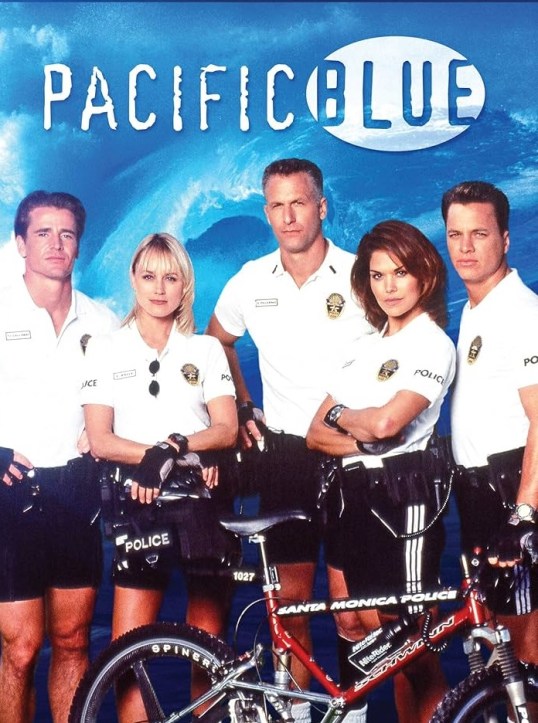
This week, the bicycle mayhem continues.

Episode 2.15 “Black Pearl”

(Dir by Terence H. Winkless, originally aired on January 5th, 1997)

TC arrests a woman named Alana (Angela Shelton) on drug and assault charges, just to discover that she’s an undercover DEA agent.  TC fears that Alana is in over her head and he tells Alana’s superior, Enright (John Michael Bolger) that he needs to pull her out of the operation.  Enright is like, “Whatever, bicycle boy.”

And, to be honest, I think Enright kind of has a point.  Why are the bicycle cops always trying to tell other law enforcement agencies what to do?  Every episode, either TC or Palermo and Chris gets a really angry look in their eyes and starts barking out orders at people they barely know.  It’s bad enough that they ride bicycles.  Do they have to act like a bunch of self-righteous pricks as well?

Speaking of bicycles, Victor has to get recertified to be a bike cop.  Uh-oh, sounds like Victor could lose his job!  Even worse, Victor’s partner in this episode is Chris so not only is Victor in danger of getting fired but he has to spend an entire week listening to Chris put him down.  Seriously, there are few characters in the history of television that I dislike as much as I dislike Chris Kelly.  Chris is the type who dismisses everyone’s problems before then launching into her hundredth monologue about how much it sucks going from being an Air Force pilot to a bike cop.

Victor trains with Hans Rhey.  In this episode, everyone is like, “Oh my God, Hans Rey!”  I had no idea who Hans Rey was.  I looked him up after this episode and apparently, he was a superstar on the bicycle circuit.  Hans does a lot of clunky bike tricks  As was so often the case withe professional athletes who played themselves on shows like this, he wasn’t much of an actor.  If anything, this episode reminded me of how stupid most people look riding their bicycles in the middle of the street.

Victor gets recertified.  Alana ends up dead.  Presumably, TC’s upset but since the actor playing him was only capable of one fascial expression, it can be hard to tell.  In the end, the real tragedy remains how dorky everyone looks on the bicycles.

Playing Catch Up: Welcome to New York (dir by Abel Ferrara)


Welcome_to_New_York_(2014)

Gerard Depardieu is naked a lot in Welcome to New York and I know you’re probably being snarky and sarcastically thinking, “Well, then I’m definitely going to track down this film…” but actually, the frequent display of Depardieu’s body gets to the heart of what makes his performance so memorable.  Playing an extremely unsympathetic role, Depardieu doesn’t hide the character’s depravity from the audience.  He reveals every inch of the character, from his flabby body to his empty soul.  It takes courage to bring such an unsympathetic character to life and talent to keep the audience watching and fortunately, Depardieu has both of those.

Welcome to New York opens with Depardieu (as himself) talking to a group of reporters and explaining why he’s decided to play a character based on Dominique Strauss-Kahn in Abel Ferrara’s upcoming movie.  It’s an interesting way to start, both because it features Depardieu’s scornful opinion of politicians and because it leaves no doubt that, even if Depardieu’s character has been renamed Devereaux, Welcome to New York is directly based on the Dominique Strauss-Kahn case.

(Dominique Strauss-Kahn, of course, was the wealthy French socialist who many thought was going to be the next President of France until he was arrested after raping a hotel maid in New York City.  As a wealthy and well-connected white man, he was acquitted of raping the maid, who neither wealthy, well-connected, or white.   Throughout the trial, the usual collection of elitists complained about how Americans just didn’t understand French culture but, ultimately, Strauss-Kahn’s political career was ended by the scandal.)

Welcome to New York closely follows the facts of the Strauss-Kahn case.  Wealthy banker and politician Devereaux is in New York on business.  When he meets his daughter and her boyfriend, he spends the entire lunch asking them about their sex life.  When he returns to his hotel, he and his business associates hire a group of prostitutes and have one of the most depressing orgies ever captured on film.

I have to admit that during these first part of the film, I was often tempted to turn off Welcome To New York.  No, it wasn’t that the film was too explicit.  Instead, my problem was that Devereaux was such a dull character.  Devereaux has a lot of sex during the first third of the film but, at no point, does he seem to enjoy it.  Instead, he is detached from everything happening around him and it doesn’t exactly make for compelling viewing.

But, as the film played out, I realized that we weren’t supposed to find Devereaux in any way compelling.  Instead, Devereaux is portrayed as a hollow and empty shell.  For him, sex is all about entitlement and power.  After his is arrested for raping the hotel maid, Devereaux appears to be more surprised than anything else.  Rather than feeling regret at being caught or even fear that he might be convicted, Devereaux seems to be shocked that a man of his wealth would be held responsible for his actions.

After Devereaux is arrested, the film’s pace picks up a bit.  Devereaux’s wife, Simone (Jacqueline Bisset), flies to New York and takes over her husband’s defense.  It’s not that Simone feels that Devereaux has been wrongly accused.  In fact, Simone really doesn’t seem to care much for her husband in general.  However, Simone is determined that Devereaux is going to be the next president of France and she certainly has no intention of allowing some American criminal case to stand in his way.  Bisset gives a chilling performance as the almost fanatically driven Simone.

Soon, Devereaux is under house arrest and staying at a rented house.  (For these scenes, Welcome to New York filmed in the same house that Strauss-Kahn stayed at during his trial.)  It’s while locked away in the house that Devereaux finally starts to realize that he has gone too far.  It’s in the house that Devereaux remembers the man he was once was and is forced to confront the man that he has become.

Welcome to New York is not always an easy film to watch but, thanks to Depardieu and Bisset’s ferocious performances, it’s a film that will reward patient viewers.