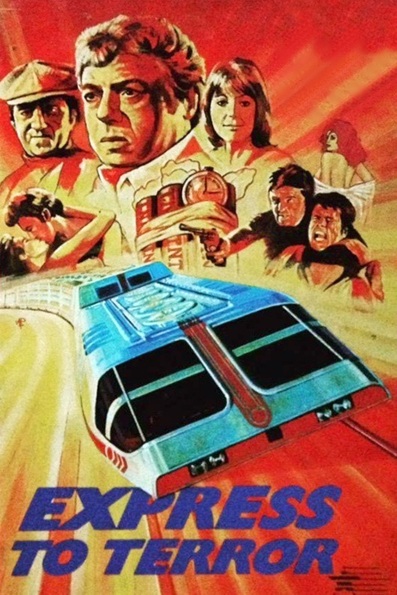
Icarus File No. 24: Express to Terror (dir by Dan Curtis)


The year was 1979 and Fred Silverman, the president of NBC, had an idea.

How about a television series in which each week’s episode would depict a different group of passengers going on a trip?  The passengers would all be dealing with their own stories, some of which would be dramatic and some of which would be humorous.  With any luck, some of them might even fall in love over the course of their journey!

To keep the audience interested, the show would also feature a cast of regular characters, the crew.  Edward Andrews would play the captain, a sensible and by-the-book type.  Robert Alda played Doc, the doctor who was also a bon vivant.  Patrick Collins was the goofy purser.  Nita Talbot played Rose, the perky director of entertainment.  Michael DeLano was the bartender who always had the best advice for the passengers….

Does this sound familiar?

If you think that it sounds like Fred Silverman just ripped off The Love Boat …. well, you’re wrong.  The Love Boat took place on a boat.  Supertrain took place on a train.

At the time that Supertrain went into production, it was the most expensive television production of all time.  Before the pilot film was even shot, NBC had spent ten million dollars on the Supertrain sets.  Not only was a fake train built but two models were also constructed for the shots of the train moving through the countryside.  At the time, the assumption was that the costs would be easily covered by the money that NBC stood to make from broadcasting the 1980 Summer Olympics.  Unfortunately, Jimmy Carter decided that the U.S. would be boycotting the Olympics as a way to protest Russia’s invasion of Afghanistan.  The only thing that kept NBC from going bankrupt was that the BBC was apparently run by someone even more incompetent than Fred Silverman.  The BBC paid $25,oo per episode for the rights to air Supertrain in the UK.  Supertrain proved to be such a disaster that the BBC never actually aired the episodes that they had purchased.

1979’s Express to Terror was the pilot to Supertrain.  (It was later released in some territories as a stand-alone film.)  Directed by horror impresario Dan Curtis (who was also brought in to produce the series), Express to Terror opens with an apparently drunk Keenan Wynn playing the role of railway baron Winfield Root.   Winfield loudly announces to a group of nervous investors that he has created ” an atom-powered steam turbine machine capable of crossing this country in 36 hours!”  A few months later, Supertrain sets off from New York to Los Angeles.

The main thing that one notices about the train is that it’s incredibly tacky.  For all the money that Winfield Root (not to mention NBC) poured into the thing, it looks awful.  The cabins are bland and also seem to be constantly shaking as the train rumbles over its tracks.  Whereas The Love Boat featured glorious shots of passengers enjoying themselves on an open-air deck, Express to Terror features a lot of shots of passengers trying to squeeze their way through narrow and crowded hallways.  There’s a disco car, which sounds like fun but actually looks like a prom being held in a locker room.  There’s a swimming pool but you can’t really lay out by it because it’s on a train.  Winfield is among the passengers and he continually refers to the train as being “Supertrain” in conversation, which just sounds dumb.  “The next person who stops Supertrain,” he announces “will be walking to L.A!”

The main drama features Steve Lawrence as Mike Post, a Hollywood agent with a gambling problem who thinks that someone on the train is trying to kill him.  Actually, the assassin is after a different Mike Post (Don Stroud) but that Mike Post is a criminal who, after entering the witness protection program, changed his name to Jack Fisk.  The criminal Post is hoping that the agent Post will be killed by mistake.  The criminal Mike Post has a girlfriend named Cindy (Char Fontane) who falls in love with the agent Mike Post.  Fred Williamson appears as a football player-turned-assassin.  George Hamilton plays a Hollywood executive.  Don Meredith is the alcoholic best friend of the agent Mike Post.  Stella Stevens is on the train as a diva.  So is Vicki Lawrence, playing a naive innocent.

Express to Terror tries to mix comedy and drama but it doesn’t really work because the “Good” Mike Post doesn’t really seem to be worth all the trouble.  Steve Lawrence gives a mind-numbingly bad performance in the role and, as a result, “Good” Mike Post really isn’t any more sympathetic than “Bad” Mike Post.  The main problem is that “Good” Mike Post comes across as being a coward and there’s only so much time that you can watch a coward act cowardly before you lose sympathy for him.  Being scared is one thing.  Being so dumb that accidentally gets your fingerprints on a knife that’s just been used to kill a man is another thing.

As for the members of the crew — the captain, the doctor, the bartender, and such, they take a back seat to the drama of the two Mike Posts.  It’s a bit odd because no one on the train — not even Winfield Root — seems to be that upset by the fact that one of their passengers is murdered while the train is going through a tunnel.  You would think that everyone would be worried about the future of Supertrain at that point.  A murder is not good for publicity but Winfield Root is oddly unconcerned about it.  I swear, light rail people are almost as heartless as bicyclists!

Of course, the worst thing about Express to Terror is that it promises terror but it doesn’t deliver.  When I see a the word “terror” in a film directed by Dan Curtis, I expect a little terror!  Other than Steve Lawrence’s overacting, there really wasn’t anything particularly terrifying about Express to Terror.

As for Supertrain, it ran for nine episodes and was promptly canceled.  Fred Silverman left NBC and spent the rest of his career as an independent producer.  Supertrain’s tracks got too close to the sun and they nearly took down a network.

Previous Icarus Files:

  1. Cloud Atlas
  2. Maximum Overdrive
  3. Glass
  4. Captive State
  5. Mother!
  6. The Man Who Killed Don Quixote
  7. Last Days
  8. Plan 9 From Outer Space
  9. The Last Movie
  10. 88
  11. The Bonfire of the Vanities
  12. Birdemic
  13. Birdemic 2: The Resurrection 
  14. Last Exit To Brooklyn
  15. Glen or Glenda
  16. The Assassination of Trotsky
  17. Che!
  18. Brewster McCloud
  19. American Traitor: The Trial of Axis Sally
  20. Tough Guys Don’t Dance
  21. Reach Me
  22. Revolution
  23. The Last Tycoon

Film Review: The FBI Story (dir by Mervyn LeRoy)


In 1959’s The FBI Story, veteran FBI agent Chip Hardesty (James Stewart) delivers a lecture to a group of new FBI recruits.  He tells them the story of both the FBI and his time as a member of the agency.  Somewhat implausibly, it turns out that Chip was involved with nearly every major FBI operation, as we discover while watching this flashback-filled, episodic film.

Battling the Ku Klux Klan in the Deep South?  Chip was there.

Investigating the Oklahoma Indian murders?  Chip was not only there but he was also the one who solved them through handwriting analysis!  (Decades later, the crimes and the investigation would serve as the basis of Martin Scorsese’s Killers of the Flower Moon.)

During the public enemy era, Chip was there.  He was there when Baby Face Nelson killed several unarmed FBI agents, including Chip’s best friend (Murray Hamilton).  He was there when John Dillinger was gunned down in Chicago.  He was there when my distant ancestor “Pretty Boy” Floyd was killed in Ohio.  He wasn’t there when J. Edgar Hoover personally arrested Alvin Karpis or when “Machine Gun” Kelly said, “Don’t shoot, G-Man!” but Chip still makes sure to tell the recruits about it.  He also talks about the gunfight that killed Ma Barker, presented her as being a machine gun-toting madwoman.

Chip investigates subversives during World War II and helped to round up Americans of German and Japanese descent during the internment era.  (Chip insists that they weren’t rounded up because of their ancestry but because the FBI had gotten reports that they might be disloyal.)   When the war wraps up, Chip turns his attention to fighting the international communist conspiracy and good for him.  (Communism sucks!)

Strangely enough, it appears that Chip also tells the recruits a good deal about his personal life because we certainly do see a lot of it.  Chip marries a librarian named Lucy (Vera Miles), who struggles with the demands of being an FBI agent’s wife but who ultimately accepts that Chip has to do his duty.  Sometimes, Lucy wants Chip to quit and sometimes, Chip is tempted to get out.  But they always remember that Chip and the FBI have a job to do.  They raise a family.  They lose a son at Iwo Jima.  Their faith in God and country remains undiminished.

The FBI Story was made with the full cooperation of the FBI, with J. Edgar Hoover personally approving the script and making suggestions.  Hoover even appeared as himself in the film, accepting a report about an airplane bombing with a grim look on his face.  At one point, Chip is prepared to quit the FBI until he hears a speech from Hoover and he’s so inspired that he keeps his resignation letter tucked away in his suit pocket.  Since this film came out in 1959, there’s no details of the FBI tapping the phones of Martin Luther King or Hoover collecting dirt on his political opponents.  Instead, The FBI Story is pure propaganda, your reminder that law enforcement never makes mistakes and civil liberties can be always be sacrificed for the greater good.

It’s simplistic propaganda and it’s overlong and it promotes a few falsehoods as facts.  (Despite what the film says, Pretty Boy Floyd had nothing to do with the Kansas City Massacre and most historians agree that Ma Barker was not the criminal mastermind that Hoover made her out to be after she was caught in the crossfire between her sons and law enforcement.)  The film rather casually dismisses the concern over the World War II internments of American citizens.  To me, something like that is a big deal but the film insists to us that it was all blown out of proportion.  That’s the one moment when not even the film itself seems to be totally sold on what it’s selling.

Fortunately, the film stars the ever-reliable James Stewart, who brings his natural mix of charm and gravity to the role of Chip Hardesty.  Stewart was a bit too old to play Chip as a bumbling young man in the early part of the film but, as the character grows up, so does Stewart’s performance.  The scene where he and Vera Miles learn that his son has been killed in combat feels like it’s from a different and far better movie.  I guess my point here is that James Stewart was one of those actors who could make even questionable material watchable and that’s certainly what he does with The FBI Story.  The FBI, at a time when Hoover was aging and the excesses of the McCarthy era had left many Americans uneasy about the government, decides to borrow James Stewart’s credibility to boost their own.  You may not like the FBI but how can you not love Jimmy Stewart?

The FBI Story came out the same year as one of Stewart’s best films, Anatomy of a Murder, a film that was a complicated as The FBI Story was simplistic.  Stewart gives one of his best performances in Anatomy of a Murder, playing the type of character that Chip Hardesty probably wouldn’t want to have much to do with.  With these two films, Stewart showed us both sides of the American justice system, the men who are tasked with enforcing the law and, even more importantly, the men who are tasked with making sure that law was enforced fairly.  Whichever side your on, you have to be happy to have Jimmy Stewart there.

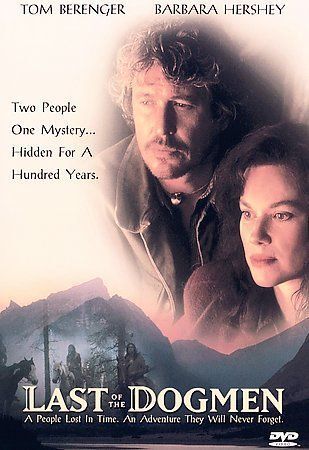
LAST OF THE DOGMEN – One of my favorites!


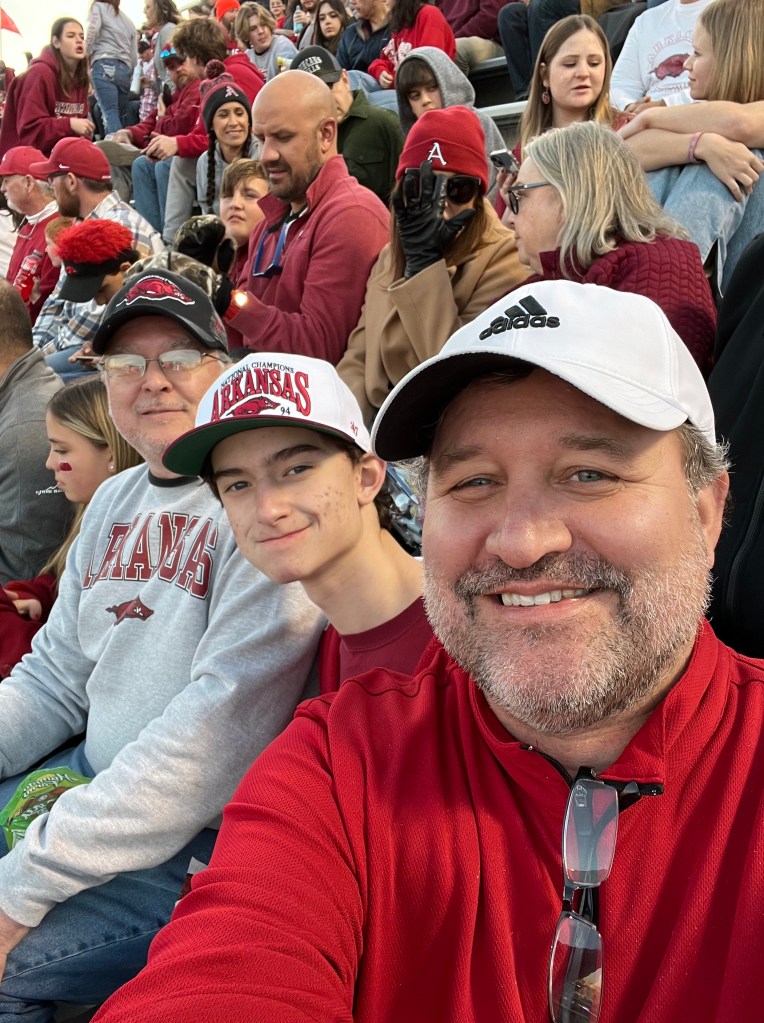
I don’t hear a lot about LAST OF THE DOGMEN, the 1995 modern day western starring Tom Berenger, Barbara Hershey and Kurtwood Smith. I love the movie, and I have for years. My buddy Chuck, his son Carter, and I recently drove up the hill to Fayetteville to watch the Arkansas Razorbacks play football. We had a great day! We ate at the Catfish Hole for lunch and then watched the Razorbacks beat Louisiana Tech 35-14. It was fun (See picture below for the happy crew). We had about a 3-hour drive home so we were talking about things we both love, like the Andy Griffith Show. Out of nowhere, Chuck said, “Do you want to know a movie I love? It’s called the LAST OF THE DOGMEN.” It was the last thing I was expecting to hear. I also love the movie. We talked about it and had a good time, but I made a mental note to watch it again soon. So here we are. 

LAST OF THE DOGMEN opens with Sheriff Deegan (Kurtwood Smith) trying to find three escaped convicts in Northwest Montana. Deegan calls in the best tracker he knows, Lewis Gates (Tom Berenger), to go into the mountains to find the convicts. The two men have a history as Gates was married to the sheriff’s daughter, and the daughter died. The sheriff clearly doesn’t like Gates and blames him for his daughter’s death, but he knows he’s the man for the job. With Gates and his genius dog Zip right on their tails, the convicts are mysteriously killed by a group of men on horses who shoot them with arrows. Gates see the men riding off through a fog and is convinced they are Indians. He ends up seeking out the help of Native American historian Lillian Sloan (Barbara Hershey) to help him understand what he may have seen. He’s able to convince Lillian to ride into the mountains with him because he needs a translator if he actually finds anyone, and the two head off into the Oxbow. After a week of roughing it, they’re about to give up when they suddenly find themselves surrounded by the Indian dog soldiers. They’re taken as prisoners to the Indian camp, where the leader of the dog soldiers, Yellow Wolf, has a sick son. It seems he was shot by one of the escaped prisoners. Gates heads back to town to get penicillin for the son, which ultimately saves his life. Gates and Lillian spend some time getting to know and respect this isolated Cheyenne tribe. Meanwhile, Sheriff Deegan, unable to forgive Gates for the death of his daughter, gathers a group of men and they head into the Oxbow to find Gates. Will the Indians be able to have peace and live their lives like they did in the 19th century, or will they be discovered and forced to live out the fates of their ancestors? Well, if you haven’t seen it, just watch and enjoy!

As I said earlier, I’m a big fan of LAST OF THE DOGMEN. I was initially interested in the movie because I like Tom Berenger as a leading man. His SHOOT TO KILL with Sidney Poitier is a big time personal favorite. I also like him in PLATOON, SOMEONE TO WATCH OVER ME, BETRAYED, MAJOR LEAGUE, SHATTERED, SNIPER and THE SUBSTITUTE. He had been a big sex symbol earlier in his career. By the time of this film, he’s getting a little too old and heavy to be a sex symbol. In THE LAST OF THE DOGMEN, he’s actually very funny, and I really enjoy watching him have fun on screen. I’ll also go ahead and say that I’ve never been a huge fan of the actress Barbara Hershey, but she keeps showing up in movies I love. Outside of this, she’s also in HOOSIERS, and it’s one of my favorites. While there’s something about her I don’t really like, she is pretty good, and I do like her chemistry with Berenger. When they finally share a big smooch towards the end of the film, I liked it. And what can I say about Gates’ Australian cattle dog Zip? He’s an integral part of the story and saves Gates & Lillian’s asses on multiple occasions. At one point in the story, Lillian says “it’s disconcerting to know that the smartest member in our expedition is a dog!” It’s true!

I think the thing I like the most about the LAST OF THE DOGMEN is the idea that a group of Cheyenne Indians could be living out their lives the way they did a century ago. Something about that is romantic and magical to me, and it gave me an emotional interest in the film. Isn’t that why we really love movies? The best ones can reach into our souls and find something that’s valuable to us. I love the idea of Cheyenne Indians living out their heritage and protecting it at all costs. There’s something simple and meaningful about that. Director Tab Hunter really leans into this emotional truth. It’s the only film he would direct, and it seems to share the one message that meant the most to him. Most of us would give anything to have an opportunity to share with the world who we really are. Hunter got that opportunity and shared this movie. That’s pretty cool to me.