The TSL Grindhouse: Caligula: The Ultimate Cut (dir by Tinto Brass)


How many cuts do we need of a bad movie?

Caligula is a film with a long and storied history.  In the mid-1970s, Penthouse publisher Bob Guccione wanted to follow the lead of his rival, Hugh Hefner, and get into the movie business.  His plan was to make an explicit adult film with high production values, one that could be sold as a mainstream feature film.  He decided that the infamously decadent Roman Emperor Caligula would be the subject of his film.  In order to give the project some gravitas, he accepted scripts from both Lina Wertmuller and Gore Vidal.  Ultimately, he chose to go with Vidal’s script because Vidal’s name had more cultural cachet than Wertmuller’s.  It certainly wasn’t because he liked Vidal’s script, which Vidal later said featured a lot of gay sex but only one scene of heterosexual coupling.

With the promise that Caligula would be a classy production that would push the boundaries of cinematic sex without actually being pornographic, Guccione was able to bring together a truly impressive cast of actors.  Malcolm McDowell agreed to play Caligula.  Helen Mirren was cast as Caligula’s wife, Caesonia.  John Gielgud took on the role of Nerva the philosopher while Peter O’Toole was cast as the diseased Emperor Tiberius.  Guccione offered directing duties to John Huston and Lina Wertmuller.  In the end, no matter how much money he was willing to spend or how distinguished a cast he had assembled, Guccione could not find a prominent, mainstream director who was willing to work with him.  Guccione ended up hiring a director he knew little about, an Italian arthouse filmmaker named Tinto Brass.

Brass proceeded to rewrite Vidal’s script.  Brass’s version of the film featured more sex and less politics.  Guccione was happy about that until he discovered that Brass’s plan was to direct the sex scenes to be grotesque and disturbing.  To his horror, Guccione discovered that Brass was essentially parodying the type of film that Guccione wanted him to direct.  Even when Guccione insisted that the latest “Penthouse pets” be cast in the film, Brass tried to keep them in the background.  As Guccione’s demands grew, Brass responded by refusing to emphasize the ornate and very expensive sets that Guccione had paid to have created.  A working ship was built but Brass reportedly chose to put it in a small warehouse so that there would never be room to get a full shot of it.  Guccione responded by taking the film away in post-production and inserting several hardcore sex scenes, which upset the members of the cast who did not sign on to appear in a pornographic film.

As for the film itself, it must be said that Caligula is probably one of the most historically accurate portrayals of ancient Rome.  The city was said to be a mix of dirty streets and ornate palaces and Caligula certainly captured the mix of beauty and sordid decadence that was the Roman Empire.  The film’s plot actually sticks very closely to what was written about Caligula by Roman historians like Suetonius.  Helen Mirren and Malcolm McDowell both give strong performances, even if McDowell later claimed the film ruined his career by typecasting him as a perverse villain.  Peter O’Toole is memorably grotesque as Tiberius.  Exploitation vets John Steiner and Teresa Ann Savoy also make an impression in their roles and one gets the feeling that they both understood what type of film they were appearing in, even if the bigger names in the cast did not.  There are moments of shocking grandeur and visual beauty to be found in Caligula and also moments of such total ugliness that they are difficult to watch.  In many ways, Caligula is what Guccione wanted.  It’s a big, expensive film that tests boundaries and features explicit sex.

But, Good God, is it ever boring!  Seriously, the scene where Caligula visits Tiberius in Capri goes on forever.  Despite McDowell’s strong performance, Caligula is not a particularly compelling character.  He becomes emperor and then he goes mad.  For over two hours, Caligula does one terrible thing after another and there’s only so long that you can watch it before you just want someone to hurry up and kill him.  The film suggests that Caligula was rebelling against the Roman establishment but, in the end, who cares?  He kills his friends.  He has sex with his sister.  In the film’s most disturbing scene, he rapes a bride and then fists the groom.  It just goes on and on and it gets old pretty quickly.

Still, there’s always been a lot of debate over whether or not it would be possible to make Caligula into a good film.  Bob Guccione claimed that he saved the film.  Tinto Brass disagreed and his director’s cut, which takes out Guccione’s hardcore inserts, is considerably better-paced than the Guccione version but the nonstop ugliness still gets rather boring.

That brings us to the latest version of Caligula, the Ultimate Cut.  Assembled without the input of Tinto Brass or the deceased Bob Guccione, Caligula: The Ultimate Cut played at Cannes in 2023 and was given a limited release by Drafthouse Films in 2024.  It was largely assembled out of unused footage and alternate takes.  I’ve read that not a single fame from the original version of Caligula is in The Ultimate Cut but I don’t think that’s quite true.  (The scene with the giant beheading machine appears to be the same footage that appeared in the original version.)  Caligula: The Ultimate Cut removes all of Guccione’s hardcore footage but it also downplays a lot of Brass’s directorial flourishes as well.  Instead, The Ultimate Cut is said to much more closely follow Gore Vidal’s vision of the film.

Is the Ultimate Cut any good?  It definitely looks better than the previous version of Caligula.  The restoration makes Rome into a very colorful city.  There’s a bit more humor to McDowell’s performance in the Ultimate Cut.  While his version of Caligula still becomes a monster (and the wedding rape is still included in the film), he starts out as a clown whose mission is to humiliate the Roman establishment in much the same way that Tiberius used to humiliate him.  In The Ultimate Cut, Caligula is much more of an anarchist.  At the same time, the Ultimate Cut features a bit less of John Steiner as the duplicitous Longinus and that’s a shame because Steiner’s performance was one of the best in the original version.  As well, Helen Mirren’s performance is stronger in the original version than in The Ultimate Cut.  The alternate takes that were used in The Ultimate Cut often seem to favor McDowell over Mirren.

That said, The Ultimate Cut is still a bit of an endurance test.  Caligula’s meeting with Tiberius still goes on forever and the nonstop evil of his reign still gets a bit dull after a while.  It turns out that Caligula the Anarchist is no more compelling than Caligula the Madman.  Brass and even Guccione may have had a point with the original version of CaligulaCaligula is a film that requires a truly sordid and shameless sensibility to be interesting.

In the end, it’s hard not to feel that all of this could have been avoided if Gemellus had been named emperor.
The Films of Dario Argento: The Stendhal Syndrome


The Stendhal Syndrome is a real thing.

First noted by the author Stendhal, Stendhal Syndrome is something that happens when one is confronted by a sight that they never expected to see in person.  Usually, it’s a work of great art that triggers the condition and the viewer becomes so overwhelmed by the sight of it that they’re left disorientated and even dizzy.  People have reported it happening while visiting museums or historical cities.  Recently, a few teenagers made the news when they claimed to have felt the syndrome’s symptoms while at a Taylor Swift concert.

I know that it’s a real thing because I’ve actually experienced Stendhal Syndrome.  I was in Florence, the summer after I graduated from high school.  One minute, I was fine and even feeling a little bratty, as one does when they’re 18 and they have their entire future ahead of them.  But then I looked up at the sky and I saw the skyline of Florence, with its mix of the ancient and the modern and I suddenly became aware that I was in one of the oldest cities in the world and that I was standing on a street that had existed for centuries and I was looking at buildings and statues and paintings that most people would never get a chance to see in person and suddenly, the entire world seemed to be spinning around me.  I had to actually sit down for a few minutes to catch my breath because I was so overwhelmed with emotion.  My sisters assumed I was having an asthma attack but, even then, I understood that I was feeling something far different.  At that moment, history become very real for me and I understood that I existed in the same universe as every great artist and writer.  We were all a part of the same existence.

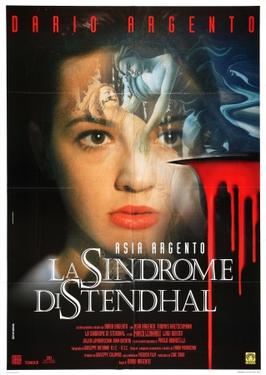
Dario Argento’s 1996 film, The Stendhal Syndrome, also takes place in Florence and features Asia Argento as Anna Mani, a police detective who is sent to the city to capture a serial killer.  When Anna visits a museum, she is overwhelmed by what she sees.  When she looks at Botticelli’s The Birth of Venus, she hears the wind that blows Venus’s hair.  When she views Bruegel’s Landscapes With The Fall Of Icarus she, perhaps significantly, becomes Icarus and flies through the air before crashing into the water below, where she shares a passionate kiss with a fish.  In the museum, Anna faints.  She drops her purse, giving Alfredo Grossi (Thomas Kretschmann) time to not only steal her gun but also the key to her hotel room.

Dazed and not even sure of who she is, Anna returns to her hotel.  A copy of Rembrandt’s The Night Watch turns into a doorway, which she steps through.  Finding herself on a rainy city street, Anna is reminded that she’s a detective and that she’s in Florence to catch a vicious killer.  When Anna steps back into her room, she discovers that she’s not alone.  Alfredo grabs her, rapes her, and abducts her.  Anna manages to escape and runs through the streets of Florence while a naked and blood-covered Alfredo screams in the night, which is one of the most disturbing scenes that Dario Argento has ever given us.  Alfredo continues to stalk Anna while Anna goes through some changes herself, buying a blonde wig and pursuing a relationship with a French art student (Julien Lambroschini).

The Stendhal Syndrome was the first of Argento’s film to feature CGI, not just in the scenes in which Anna enters the paintings but also in scenes where were literally follow the pills that she’s taken down her throat and where a bullet is seen to enter the face of one of Alfredo’s victims.  (Alfredo looks through the resulting bullet holes and winks at Anna on the other other side.)  Sometimes, the CGI is effective and sometimes it’s a bit too cartoonish for its own good.  At its most effective, the CGI inspires us to wonder if Anna is seeing reality or if she’s still trapped in her Stendhal Syndrome-inspired fantasy world.  The scene where disturbing graffiti comes to life may not exactly look real but it’s still undeniably effective.  At other times, the special effects just come across as being a bit self-indulgent on Argento’s part.

The film is at its best when it concentrates on the cat-and-mouse game between Anna and Alfredo.  As played by Thomas Kretschmann, Alfredo is one of the most terrifying characters to ever appear in an Argento film, a handsome and seemingly charming man who is actually fueled by pure evil and hate.  Alfredo is a villain who takes a definite pride in his ability to hide his true nature from the rest of the world.  At first, Anna seems almost too physically frail and emotionally open to be believable as a police detective but she soon proves herself to be far tougher than anyone realizes.  Anna, it turns out, has secrets of her own.  Shot roughly around the same time that Asia Argento was being victimized by Harvey Weinstein, the scenes where Alfredo attacks Anna are difficult to watch, as they should be.  Dario Argento took a lot of criticism (particularly from his former partner, Daria Nicolodi) for casting his daughter in a role where she is assaulted but the film itself is fully on Anna’s side.

The second half of the film loses its way a bit, though I can’t go into too much details without spoiling the plot.  Several of the first half’s intriguing ideas are abandoned.  Asia Argento gives a strong performance during the second half of the film, one that features some of her bravest and most revealing work.  That said, despite the strength of Asia’s performance, many of Anna’s actions still don’t make sense no matter how much the film tries to convince us that they do.  That said, the final scenes still carries an impact.

In the end, the film uses Stendhal Syndrome as a gimmick.  If you want to see a realistic film about Stendhal Syndrome, you’re probably out of luck because it’s not a condition that’s easy to capture cinematically.  But, as a thriller, The Stendhal Syndrome holds up well.  This is an uneven film but ultimately, what does work outweighs what doesn’t.

The (Reviewed) Films of Dario Argento:

  1. The Bird With The Crystal Plumage
  2. Cat O’Nine Tales
  3. Four Flies on Grey Velvet
  4. Deep Red
  5. Suspiria
  6. Inferno
  7. Tenebrae
  8. Phenomena
  9. Opera
  10. Two Evil Eyes
  11. Trauma

Spring Breakdown #1: Midnight Express (dir by Alan Parker)


Since it’s currently Spring Break, I figured that I would spend the next two weeks reviewing films about people on vacation.  Some of the films will be about good vacations.  Some of the films will be about bad vacations.  But, in the end, they’ll all be about celebrating those moments that make us yearn for the chance to get away from it all.

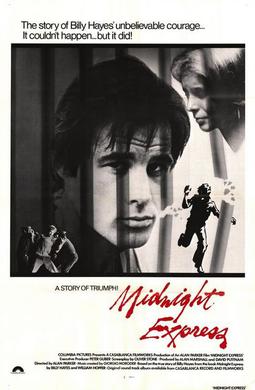
Take Midnight Express, for instance.  This 1978 film (which was nominated for six Oscars and won two) tells the story of what happens when a carefree college student named Billy Hayes decides to spend his holiday in Turkey.

When the film begins, Billy Hayes (played by Brad Davis), is at an airport in Turkey.  He’s preparing to return home to the United States.  His girlfriend, Susan (Irene Miracle), informs him that Janis Joplin has just died.  When Billy responds by making a joke, Susan accuses him of not taking anything seriously.  What Susan doesn’t realize is that Billy actually has a lot on his mind.  For one thing, he’s got several bricks of hashish taped around his waist.  He purchased it from a cab driver and he’s planning on selling it to his friends back in the United States.  Unfortunately, Billy’s not quite as clever as he thinks he is.  Because of recent terrorist bombings, the Turkish police are searching everyone before they board their plane.  Billy finds himself standing out in the middle of the runway with his hands up in the air, surrounded by gun-wielding Turkish policemen.

Billy finds himself stranded in a country that he doesn’t understand, being interrogated by men whose language he cannot speak.  An enigmatic American (Bo Hopkins) shows up and assures Billy that he’ll be safe, as long as he identifies the taxi driver who sold him to the drugs.  Billy does so but then makes the mistake of trying to flee from the police.  In the end, it’s the American who captures him and, holding a gun to Billy’s head, tells him not to make another move.

Soon, Billy is an inmate at Sağmalcılar Prison.  He’s beaten when he first arrives and it’s only days later that he’s able to walk and think clearly.  He befriends some of the other prisoners, including a heroin addict named Max (John Hurt) and an idiot named Jimmy (Randy Quaid).  Billy watches as the prisoners are tortured by the fearsome head guard (Paul L. Smith) and listens to the screams of inmates being raped behind closed doors.  After being told that his original four-year sentence has been lengthened to a 30-year sentence, Billy starts to degenerate.  When Susan visits, Billy end up pathetically masturbating in front of her.  When another prisoner taunts Billy, Billy bites out the man’s tongue, an act that we see in both close up and slow motion.  If Billy has any hope of regaining his humanity, he has to escape.  He has to catch what Jimmy calls the “midnight express…..”

Midnight Express is a brutal and rather crude film.  Though it may have been directed by a mainstream director (Alan Parker) and written by a future Oscar-winner (Oliver Stone), Midnight Express is a pure grindhouse film at heart.  There’s not a subtle moment to be found in the film.  The camera lingers over every act of sadism while Giorgio Moroder’s synth-based score pulsates in the background.  When Billy grows more and more feral and brutal in his behavior, it’s hard not to be reminded of Lon Chaney, Jr. turning into The Wolf Man.  The film may be incredibly heavy-handed but it’s nightmarishly effective, playing out with the intensity of a fever dream.

As for the cast, Brad Davis wasn’t particularly likable or sympathetic as Billy.  On the one hand, he’s a victim of an unjust system, betrayed by his own country and tortured by another.  On the other hand, Billy was an idiot who apparently thought no one would notice all that hash wrapped around his chest.  That said, Davis’s unlikable screen presence actually worked to the film’s advantage.  If you actually liked Billy, the film would be unbearable to watch.  Before Davis was cast, Dennis Quaid and Mark Hamill were both considered for the role.  If either of those actors has been cast, Midnight Express would be too intense and disturbing to watch.  For instance, it would be depressing to watch Dennis Quaid rip a man’s tongue out of his mouth.  You would be like, “No, Mr. Quaid, you’ll never recover your humanity!”  But when Brad Davis does it, you’re just like, “Eh.  It was bound to happen sometime.”

For more effective are John Hurt and Bo Hopkins.  Hurt and Hopkins both have small roles but they both make a big impression, if just because they’re the only two characters in the film who aren’t either yelling or crying all of the time.  While everyone else is constantly cursing their imprisonment, Hurt is quietly sardonic.  As for Hopkins, we’re supposed to dislike him because he’s with the CIA and he sold out Billy.  But honestly, no one made Billy tape all that hash to his chest.  Finally, you’ve got Randy Quaid and Paul L. Smith, who both glower their way through the film.  Smith is wonderfully evil while Randy Quaid is …. well, he’s Randy Quaid, the loudest American in Turkey.

Midnight Express was such a success at the box office that it caused an international incident.  There’s not a single positive Turkish character to be found in the entire film and it’s impossible not to feel that the film is not only condemning Turkey’s drug policies but that it’s also condemning the entire country as well.  The Turkish prisoners are portrayed as being just as bad as the guards and even Billy’s defense attorney comes across as being greedy and untrustworthy.  Watching the film today can be an awkward experience.  It’s undeniably effective but it’s impossible not to cringe at the way anyone who isn’t from the west is portrayed.  In recent years, everyone from director Alan Parker to screenwriter Oliver Stone to the real-life Billy Hayes has apologized for the way that the Turkish people were portrayed in the film.

Despite the controversy, Midnight Express was a huge box office success and it was nominated for best picture.  It lost to another controversial film about people imprisoned in Asia, The Deer Hunter.


Embracing the Melodrama #49: Scarlet Diva (dir by Asia Argento)


Scarlet Diva

I’ve always loved Asia Argento because, as both an actress and a public personality, she is tough, hard, and sexy all at the same time.  She’s not one of those actresses who feels the need to hide who she really is.  Watching her on-screen, you realize that she doesn’t give a fuck whether you like her or not.  Instead, she’s going to do whatever it is that she wants to do and, if you’re lucky, you might get to watch.  Some hold her responsible for the erratic output of Dario Argento’s post-Opera career but those people far too often fail to take into account that Asia, with her naturally off-center presence, has often been the most interesting thing about Dario’s later films. (Say what you will about Trauma, The Stendhal Syndrome, and Mother of Tears, they’re all better with Asia than without her.)  Asia Argento is one of those talented actresses who could never have played Ophelia because no one would ever believe that she would so easily drown.  Instead, she’d simply pull herself out of the water and then go kick Hamlet’s ass for being so indecisive.

In the year 2000, Asia Argento made her directorial debut with the underrated Scarlet Diva.  In Scarlet Diva, Asia plays Anna Batista, a 24 year-old Italian actress who, having won both acclaim and awards in Italy, is now being tempted with offers to come out to Hollywood.  Over the course of this frequently (and intentionally) disjointed film, Anna is forced to deal with the dark reality of being young, rich, and famous.  (Yeah, yeah, I know you’re rolling your eyes but just calm down…)  After being told that she’ll costar with De Niro, she finds herself playing Cleopatra in a hilariously bad movie that does not co-star Robert De Niro.  She meets a sleazy producer (Joe Coleman) who invites her to his hotel room and then promptly undresses and demands that she “earn” a part in his next film.  Anna runs from him and the naked producer chases after her with the camera focused (in close-up) on his hairy ass all the way.  While dealing with all of that, Anna also find time to visit her best friend in Paris, just to discover that she has spent the last two days bound and gagged in bed.  She also buys drugs underneath a highway overpass and suffers from frequent dream sequences and flashbacks to growing up with her mentally unstable mother (played by Asia’s real-life mother, Daria Nicolodi).

And yet, during all of this, Anna can still find happiness because she thinks that she’s in love with rock star Kirk Vaines (Jean Sheperd, playing a role that was written for Vincent Gallo).  When Anna discovers that she’s pregnant, she decides not to have her usual abortion and instead to keep the baby.  However, when Kirk reacts to Anna’s news with indifference, it leads to one of the longest (and most emotionally raw) running sequences that I have ever seen, as the pregnant Anna flees down the streets of Rome…

asia_argento_-_scarlet

Just to judge from the movies that various actor have made about the trials of being a star, fame is a special sort of Hell, the type that is dominated with surreal dream sequences and frequent claustrophobia.  That’s certainly true of Scarlet Diva, which is perhaps one of the most self-indulgent films ever made.  And yet, it’s that very self-indulgence that makes Scarlet Diva so much more watchable and, in its own way, likable than most debut films from actors-turned-directors.  For all the drama and pain that Anna goes through, Asia Argento seems to understand just how narcissistic this film truly is and, in a few scenes, it’s evident that she’s gently mocking her own “poor me” self-indulgence.

Ultimately, Asia seems to be saying that Anna (and probably, at the time she made this film, Asia herself, since she has said that this film is partially autobiographical) is her own worse enemy.  Hence, this film — which was made with an admirable lack of concern about going too far or for being TMI — is a massively cathartic work for all of the rest of us who are also occasionally our own worst enemy.

Yes, Scarlet Diva may be a self-indulgent, narcissistic film.  It’s also a very brave and honest film that deserves a lot more praise and attention than it has received.

Scarlet Diva