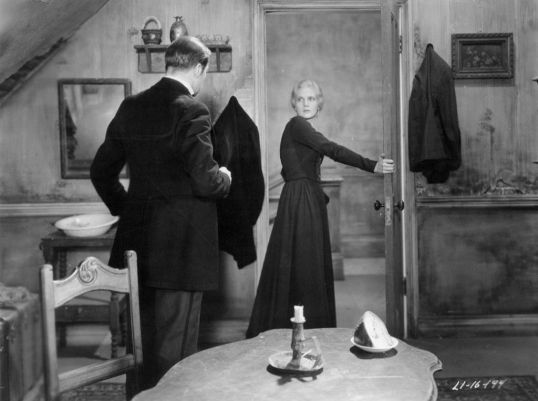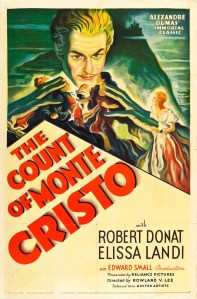
The Count of Monte Cristo (dir. by Roland V. Lee)


Note that this maybe a bit brief and off tangent. This may be one of the first reviews I’ve written for a film created well before my time. I won’t have as many movie references or personal anecdotes to add here.

I love the story of The Count of Monte Cristo. At the time of this writing, it can be found on both Amazon Prime and on Tubi.

Written in 1844 by Alexandre Dumas, it’s a tale of revenge and depending on which version you watch, there’s also a bit of redemption to it. Though it’s adapted numerous times on stage and screen, I’m familiar with 3 main movie versions. You have the modern 2002 version from Kevin Reynolds, starring Jim Caviezel, Henry Cavill and Guy Pearce. There’s the 1975 TV Movie (my personal favorite), directed by David Greene and starring Richard Chamberlain, Donald Pleasance, Tony Curtis and Kate Nelligan. And finally, we have the classic 1934 rendition, directed by Donald V. Lee and starring Robert Donat, Elissa Landi, Sidney Blackmer and Louis Calhern. Most audiences may know of the film from the references made of it in 2005’s V for Vendetta.

The Count of Monte Cristo is the story of Edmund Dantes (Robert Donat, The 39 Steps) , a sailor who has everything going for him. He’s the newly minted Captain of the Pharaon, a title bestowed to him after the original captain died during a voyage near the island of Elba. Before the original Captain passes, he gives Edmond a letter to be delivered to an individual who will make himself known. This promotion and the letter also draws the jealous eyes of the would be Captain Danglars (Raymond Walburn, Christmas in July). Edmond has the heart of the lovely Mercedes de Rosas (Elissa Landi, The Yellow Ticket), but not the affections of Mercedes’ Mother (Georgia Caine, Remember the Night), the Madame de Rosas. Together with Fernand Mondego (Sidney Blackmer, Rosemary’s Baby), they often try to convince Mercedes to find someone better.

During the party for his wedding, Edmond meets the letter’s recipient and makes the delivery. Shortly afterward, both this man and Edmond are arrested. We learn the man is the father of The King’s Magistrate, Renee de DeVillefort (Louis Calhern, Julius Caesar). Choosing to protect his father (now considered a Bonapartist), DeVillfort puts on the blame on Dantes. With Mondego and Danglars as co-conspirators, they send Dantes to the dreaded Chateau D’if, an Alcatraz-like prison on the sea. To make things worse, after Napoleon is defeated, Edmond’s captors list him as deceased and his name is struck from the prison record. Dantes spends nearly 15 years in the Chateau, falling out of everyone’s memory. During his time, he discovers and befriends the Abbe Faria (O.P. Heggie, Anne of Green Gables), another prisoner who teaches Dantes various topics of the world. The Abbe also shares the secret of the De Sparda Treasure, hidden away just off the island of Monte Cristo. Edmond eventually escapes the Chateau D’If, acquires the treasure and returns to the Paris as the mysterious Count of Monte Cristo.

The film has fine performances throughout, given the time frame. Donat’s Dantes is quite naive prior to the imprisonment, but as the Count, I felt he brought a lot of style and class to the character. It was much like watching an old serial of The Batman or The Shadow. Another major surprise (for me, anyway) was Sidney Blackmer as Mondego. I’ve only ever seen Blackmer as the old and strange Roman Castavet in Roman Polanski’s Rosemary Baby, so it was very interesting to see him in his prime. There’s a nice duel between Mondego and Dantes that showcased Blackmer’s athleticism as well as his acting. I also enjoyed Walburn’s Danglars, who felt like a weasel you’d find in a classic Disney animated film.

Visually, for a black and white film, there’s some good use of light and shadow here, particularly during the dimly lit scenes in the Chateau D’If and the face off between the Count and Mondego.

How Edmond chooses to face his enemies was interesting. A bit of scandal for one, greed for another and a full-on courtroom drama for a third. I thought the court case element was bit much, but given where the story was going, it made sense. Overall, The Count of Monte Cristo is a wonderful classic with great pacing throughout.
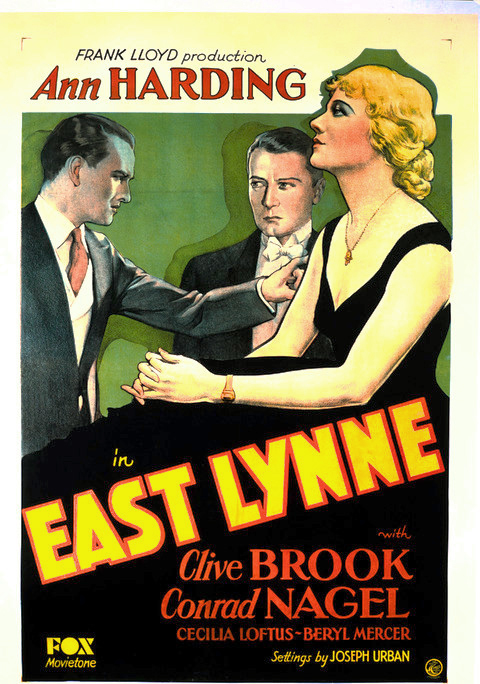
Lisa Reviews An Oscar Nominee: East Lynne (dir by Frank Lloyd)


In the history of the Academy Awards, East Lynne is a curiosity.

Released in 1931, East Lynne was one of the five films to be nominated for Best Picture at the fourth annual Academy Awards.  Best Picture was the only nomination that East Lynne received, which of course leaves you to wonder just what exactly was so good about it.  Why was it nominated as opposed to something like A Free Soul, which received nominations for Best Actress and Director and which won the Best Actor Oscar for Lionel Barrymore?  East Lynne was a success at the box office but so were The Public Enemy, Little Caesar, and Scarface.  None of those classic gangster films made much of an impression with the Academy but all of them are better remembered today than East Lynne.

One reason why East Lynne has fallen into obscurity is because it’s not an easy film to see.  There is only one complete print of East Lynne still in existence.  It’s housed at the UCLA’s Instructional Media Lab but it can only be viewed by appointment.  There are, however, a few bootleg copies on DVD.  The picture is grainy.  The sound is inconsistent.  Even worse, the bootleg is missing the last 12 minutes of the film.  Still, for those of us who don’t live near UCLA, that bootleg copy is the only convenient way to watch East Lynne.

That’s how I watched it.  (I also looked up how the film ended so I know where the story eventually led, despite those missing 12 minutes.)  Having now seen the film, I can now say that it makes even less sense that the film was nominated because it’s pretty bad.  I can only imagine that it received its nomination as a result of Fox Film Corporation (which would later merge with 20th Century Pictures to be come 20th Century Fox) demanding that its employees vote for it.

Based on a Victorian novel that had already been filmed several times during the silent era, East Lynne tells the story of Lady Isabella (Ann Harding), a British noblewoman who marries a stuffy attorney named Robert Carlyle (Conrad Nagel).  From the beginning it’s an awkward marriage.  Isabella is sociable and popular and wants to enjoy life.  Carlyle is a humorless jerk.  Not even the fact that they live in a nice mansion called East Lynne provides much comfort.

When Isabella accepts a kiss from a cad named Captain William Levinson (Clive Brook), Isabella’s sister-in-law uses it to drive a wedge between Isabella and Carlyle.  Carlyle, being a jerk, kicks Isabella out of the house and takes custody of their child.  Now viewed as being a figure of scandal, Isabella goes abroad with Levinson.  (Since this is a pre-code film, going abroad amounts to going to a then-racy show in Vienna.)  However, through a series of improbable events, Levinson ends up dead and Isabella ends up very slowly going blind.  However, Isabella is determined to see her child just once more before losing her sight so it’s up to her to convince a maid to sneak her back into East Lynne late at night….

And then the bootleg version of the film ends!  Now, I did my research and I discovered — here’s your SPOILER ALERT — that the film apparently ends with a blind Isabella stumbling over a cliff and her husband realizing too late that maybe he was kind of a jerk.  I’m kind of sorry that I didn’t get to see that.  I may have to book a flight to UCLA.

Anyway, from what I did see, East Lynne is a creaky old film.  This is one of those films where you can tell that the cast was still adjusting to the new sound era.  Ann Harding’s screen presence is a bit too insubstantial to keep the film’s melodramatic story grounded and neither Conrad Nagel nor Clive Brook seem to be worth all of the trouble that Isabella goes through.  Frank Lloyd’s direction is painfully slow and stagy, though things do pick up briefly when the action moves to Vienna.  Worst of all, the film is pretty much on Carlyle’s side.  He’s a jerk, the movie says, but Isabella should have made more of an effort to keep him happy.  Welcome to 1931!

East Lynne lost the best picture race to Cimarron, which was another fairly forgettable film.  Though there were plenty of good films to choose from in 1931, it doesn’t appear that the Academy nominated any of them.  Of course, that wouldn’t be the last time that would happen.


Horror Scenes That I Love: The Monster Meets The Blind Man In Bride of Frankenstein


Today’s horror scene that I love comes from 1935’s Bride of Frankenstein!

In this scene, directed by James Whale, the Monster (Boris Karloff) meets his first friend, a blind hermit played by O.P. Heggie.  It’s a scene that features Karloff at his best and it’s still touching, even if it is kind of hard to watch it without thinking about Peter Boyle accidentally burning down Gene Hackman’s shack in Young Frankenstein.

Horror Film Review: The Bride of Frankenstein (dir by James Whale)


brideoffrankposter

1935‘s The Bride of Frankenstein is usually described as being a sequel to Frankenstein, but I think it would be better to call it a continuation.  In much the same way that all modern YA adaptations seem to be split into two parts, Universal split Mary Shelley’s Frankenstein into two separate films.  The bare basics of The Bride of Frankenstein‘s plot — the monster learns to talk and demands that his creator build him a mate — can all be found in the original novel.

(Of course, in the original novel, the monster somehow learns how to speaks like an Oxford grad and Dr. Frankenstein destroys the female monster before bringing her to life.  The monster responds by killing Elizabeth.  Seriously, Frankenstein is a dark book.)

Bride of Frankenstein features one of my favorite openings of all time.  Lord Byron (Gavin Gordon) and Percy Bysshe Shelley (Douglas Walton) are praising Mary Shelley (Elsa Lanchester) and the story that she’s told about how a dedicated scientist played God and created life.  Mary informs them that she’s not finished and then proceeds to tell them the rest of the story.  It’s a great opening because it lets us know that the rest of what we’re seeing is taking place directly inside of Mary’s mind.  It frees the film from the constraints of realism and allows director James Whale to fully indulge his every whim, no matter how bizarre.  When you’re inside someone else’s imagination, anything can happen and that’s certainly the feeling that you get as you watch The Bride of Frankenstein.

The Bride of Frankenstein opens with that burning windmill and a wounded Henry Frankenstein (Colin Clive) being carried back to his wife, Elizabeth (Valerie Hobson, replacing Mae Clarke).  Gone is the original film’s coda, in which Elizabeth announces that she’s pregnant.  And why shouldn’t it be gone?  It felt awkward in the first movie and, like any good writer, Mary Shelley is fixing her story as she goes along.

While Henry is recovering, he is approached by a former mentor, Dr. Pretorious (Ernest Thesiger).  Dr. Pretorious is undoubtedly an eccentric and definitely a little bit crazy but he believes in Frankenstein’s work.  In fact, Dr. Pretorious has even created life on his own!  He’s created a bunch of tiny people that he keeps in several glass jars.  They’re impressive but, sadly, they’ll never conquer the world.  Pretorious wants Frankenstein to, once again, work with him to create life.  As Pretorious explains it, it’s time to usher in a new age of “God and monsters!”

(Interestingly enough, one of Pretorious’s henchmen is played by Dwight Frye, who previously played Frankenstein’s henchman, Fritz, in the first film.  Frye dies in both films.  Reportedly, Universal bestowed upon him the nickname, “The Man of a Thousand Deaths.”  It can perhaps be argued that Dwight Frye was both the Steve Buscemi and the Giovanni Lombardo Radice of Universal horror.)

Meanwhile, the monster (Boris Karloff, credited with just his last name because, just four years after Frankenstein and the Mummy, he was already an icon) has survived the burning windmill.  He’s lonely, he’s afraid, and he actually kills more people in The Bride of Frankenstein than he did in Frankenstein.  And yet, he’s still the film’s most sympathetic character.  With everyone constantly trying to kill him, you can understand why the monster is quick to attack every human being that he sees.  He’s almost like a dog who, after years of abuse, automatically growls and bears his teeth at anyone that he sees.

And yet, the monster does eventually find a friend.  A blind hermit (O.P. Heggie) invites the monster into his own home.  (Of course, the hermit does not know who the monster is.  He just assumes that monster is a normal man who does not know how to speak.)  As time passes, the hermit teaches the monster how to say a few words and also tells the monster that there is nothing worse than being lonely.  The monster learns that “Friend good.”  The monster even learns how to smoke a cigar and Heggie and Karloff play these roles with such warmth (Bride of Frankenstein is not only the film where the Monster learns to talk, it’s also the one where he learns to smile) that you really start to dread the inevitable scene where everything goes wrong.

And that scene does arrive.  Two hunters stop by the hermit’s shack and immediately attack the Monster.  The Monster flees.  The shack burns down.  The hermit is led away from his only friend, apparently destined to be lonely once again.

Eventually, of course, the Monster does get his bride.  The Bride is such an iconic character that it’s easy to forget that she only appears in the final ten minutes of the film.  Elsa Lanchester plays both Mary and the Bride.  She screams when she sees the Monster.  “We belong dead,” the Monster replies and my heart breaks a little every time.

So, which is better?  Frankenstein or The Bride of Frankenstein?  I don’t think it’s necessary to choose one or the other.  To use a metaphor that might be appreciated by Henry and Dr. Petorious, Frankenstein is the brain while The Bride of Frankenstein is the heart.  They’re two good films that, when watched together, form one great film.