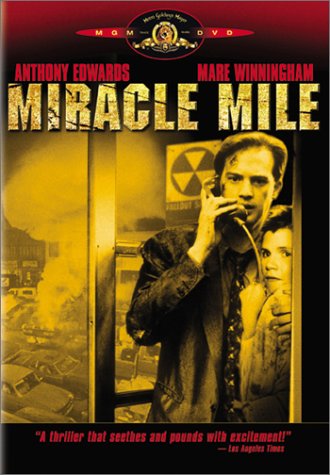
Last night, as I was watching the 1988 film, Miracle Mile, I found myself thinking about the fact that this film literally could not be made today.
No, it’s not because the film itself is about the treat of nuclear war. Though nuclear war may no longer be as much of a cultural obsession as it apparently was back in the 80s, the fact of the matter is that the U.S., Russia, the UK, France, and China all still have nuclear weapons. Pakistan, India, and North Korea all claim to have nuclear weapons. It’s believed that Israel also has a few. Iran is apparently working on developing an arsenal. It’s estimated that there are currently 13,865 nuclear weapons in existence, 90% of which are divided between the U.S. and Russia. That’s not even counting the threat of a terrorist group setting off a nuclear device. In short, the threat of nuclear war is still very much a real one.
Instead, what truly makes Miracle Mile stand out as a film of its time, is the fact that almost the entire plot revolves around the character of Harry (played by Anthony Edwards) answering a Los Angeles pay phone at four in the morning.
Why is Harry answering a pay phone at 4 in the morning? It’s because, earlier, he met Julie (Mare Winningham) at the La Brea Tar Pits and they fell instantly in love. After spending most of the afternoon together, they made a date to meet at the local diner where Julie worked as a waitress. Julie’s shift ended at midnight. Harry went home to get a quick nap before picking her up. Unfortunately, a power failure — one that was largely caused by Harry carelessly tossing away a cigarette — resulted in Harry’s alarm not going off. At midnight, while Julie was standing outside the diner, Harry was asleep.
Harry doesn’t wake up until well-past 3 a.m. After hastily getting dressed, Harry drives down to the diner. When he arrives, he bumps into a tree and three rats fall off the branches and land on his car, which is a bit of an ominous omen. (After watching the movie, I did a Google search and discovered that it’s actually not uncommon for rats to hang out in palm trees after dark. I had no idea. I’m glad I don’t live near any palm trees.)
By the time Harry arrives, Julie’s already gone. From the payphone outside the diner, Harry calls Julie and leaves an apologetic message on her answering machine. (Julie sleeps through it.) Within minutes of Harry hanging up, the pay phone rings again. Harry answers it, expecting to speak to Julie. Instead, he finds himself talking to a panicked soldier who was trying to call his father but who dialed the wrong area code. The soldier says that a war is about to break out and that everyone is going to die. Suddenly, Harry hears what sounds like a gunshot. Another voice gets on the phone and tells Harry to go back to sleep and forget about the call.
Of course, the reason why this story couldn’t take place in 2020 is pretty obvious to see. No one uses pay phones anymore. If the movie were made today. Harry would have just Julie on his own phone and then waited for her to call him back. The soldier would never have misdialed his father’s area code. Harry never would have gotten the message that the world was about to end and most of the subsequent events in Miracle Mile never would have happened. Harry would have just sat in the diner and had a cup of coffee and waited for Julie to call until the inevitable happened. In 2020, that would have been the movie.
So, let’s be happy that this film was made in 1988. during the time when pay phones were everywhere, because Miracle Mile is an excellent film. Miracle Mile starts out as a romantic comedy, with Anthony Edwards and Mare Winningham making for an incredibly adorable couple. Then, after Harry answers that pay phone, the movie grows increasingly grim as Harry desperately tries to make his way to Julie and arrange for the two of them to board a plane that a mysterious woman (Denise Crosby) has charted for Antarctica. The problem, of course, is that in order to reach Julie, Harry is going to need the help of the type of people who are typically up and wandering around at 4 in the morning in Los Angeles. Several people die as Harry tries to make it to Julie and, smartly, the film doesn’t just shrug off their deaths. For the majority of the film, Harry isn’t even sure if there’s actually going to be an attack and it’s possible that he’s not only panicking over nothing but that he’s causing others to panic as well. People are dying because of that phone call and Harry doesn’t even know whether it was real or not. Even when full scale rioting breaks out, Harry doesn’t know if it’s because the world’s ending or because of a bad joke that he took seriously. Transitioning from romantic comedy to dark comedy, Miracle Mile eventually becomes a nightmare as it becomes obvious that, even if Harry does reach Julie, escaping the city is not going to be easy. The sun is rising and the truth is about that phone call is about to revealed….
Miracle Mile is a film that will get your heart racing. On the one hand, Anthony Edwards and Mare Winningham have such a wonderful chemistry and they’re both just so damn likable that you want them to find each other and stay together. Even if it means running the risk of being incinerated in a nuclear explosion, you want Harry and Julie to be with each other. At the same time, you watch the movie with the knowledge that, even if they do manage to reunite, it might not matter because the world’s going to end. Remarkably, almost everyone who Harry talks to about the phone call believes him when he says that a war is about break out. Almost all of them have a plan to escape and, as a viewer, you get so wrapped up in the film that it’s only later that you realize that none of their plans made any sense. Hiding out in Antarctica? How exactly is that going to work? Antarctica’s not exactly a place to which you impulsively move. If there is truly no way to escape the inevitable, perhaps we should just be happy that Julie and Harry found love, even if it was right before the apocalypse.
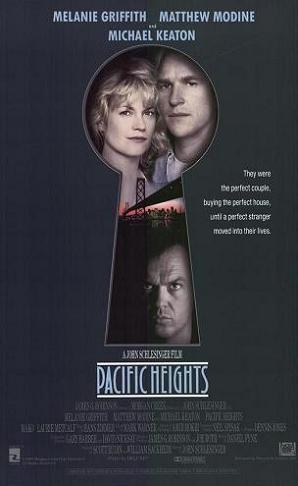 Michael Keaton is the tenant from Hell in Pacific Heights.
 Through the Shattered Lens