Lisa Reviews An Oscar Nominee: The Russians Are Coming, The Russians Are Coming (dir by Norman Jewison)


russians_are_coming

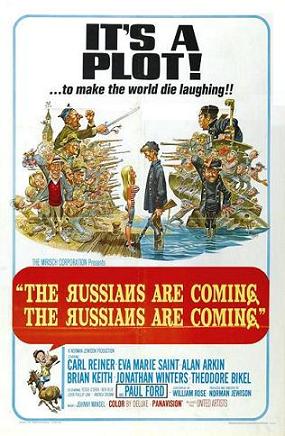
Earlier tonight, I watched a 1966 film called The Russians Are Coming, The Russians Are Coming.  

It’s a cheerful comedy about what happens when the captain (played by Theodore Bikel) of a Russian submarine decides that he wants to take a look at the United States.  Though he was only planning to look at America through a periscope, he accidentally runs the submarine into a sandbar sitting near Gloucester Island, which itself sits off the coast of Massachusetts.  The captain sends a nine man landing party, led by Lt. Yuri Rozanov (a youngish Alan Arkin, making his film debut and receiving an Oscar nomination for his efforts), to the island.  Their orders are simple.  Yuri and his men are too either borrow or steal a boat that can be used to push the submarine off the sandbar.  If they run into any locals, they are to claim to be Norwegian fisherman.

Needless to say, things that don’t quite go as planned.  The first Americans that Yuri and his men meet are the family of Walt Whitaker (Carl Reiner), a vacationing playwright.  Walt’s youngest son immediately identifies the Norwegian fisherman as being “Russians with submachine guns.”  When Walt laughingly asks Yuri if he’s a “Russian with a submachine gun,” Yuri produces a submachine gun and promptly takes Walt, his wife (Eva Marie Saint), and his children hostage.

Yuri may be a Russian.  He may officially be an enemy of America.  But he’s actually a pretty nice guy.  All he wants to do is find a boat, keep his men safe, and leave the island with as little drama as possible.  However, the inhabitants of the island have other plans.  As rumors spread that the Russians have landed, the eccentric and largely elderly population of Gloucester Island prepares for war.  Even as Police Chief Mattocks (Brian Keith) and his bumbling assistant, Norman Jonas (Jonathan Winters), attempt to keep everyone calm, Fendall Hawkins (Paul Ford) is organizing a militia and trying to contact the U.S. Air Force.

Meanwhile, Walt’s babysitter, Allison (Andrea Dromm) finds herself falling in love with one of the Russians, the gentle Alexei Kolchin (John Phillip Law).

As I said at the start of this review, The Russians Are Coming, The Russians Are Coming is a cheerful comedy, one with a rather gentle political subtext, suggesting that the majority of international conflicts could be avoided if people got to know each other as people as opposed to judging them based on nationality or ideology.  There’s a rather old-fashioned liberalism to it that probably seemed quite daring in 1966 but which feels rather quaint today.  Sometimes, the comedy gets a bit broad and there were a few times that I found myself surprised that the film didn’t come with a laugh track.  But overall, this is a well-acted and likable little movie.

As I watched The Russians Are Coming, The Russians Are Coming (and, as someone who is contractually obligated to use a certain number of words per review, allow me to say how much I enjoyed the length of that title), I found myself considering that the film would have seemed dated in 2013 but, with all the talk of Russian hacking in the election and everything else, it now feels a little bit more relevant.  Not a day goes by when I don’t see someone on twitter announcing that the Russians are coming.  Of course, if the film were released today, its optimistic ending would probably be denounced as an unacceptable compromise.  Peaceful co-existence is no longer as trendy as it once was.

Another interesting thing to note about The Russians Are Coming, The Russians are Coming: though the film was written by William Rose (who also wrote another example of mild 1960s feelgood liberalism, Guess Who’s Coming To Dinner), it was based on a novel by Nathaniel Benchley.  Benchley was the father of Peter Benchley, the author of Jaws.  It’s easy to see the eccentrics of Gloucester Island as distant cousins of the inhabitants of Amity Island.

As previously stated, The Russians Are Coming, The Russians Are Coming was nominated for best picture but it lost to the far more weighty A Man For All Seasons.
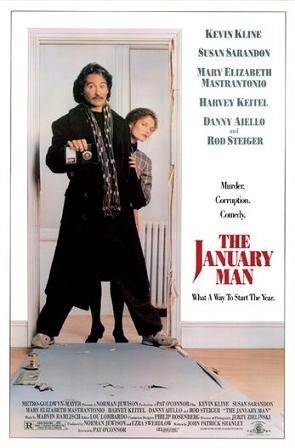
In Praise of Alan Rickman: The January Man (1989, directed by Pat O’Connor)


JanuarymanposterLast week, when the world first learned of the death of the actor Alan Rickman, it was shocking to realize just how many great roles he had played.  He made his feature film debut as Hans Gruber in Die Hard.  He played Colonel Brandon in Sense and Sensibility, Severus Snape in the Harry Potter movies, the Sheriff of Nottingham in Robin Hood: Prince of Thieves, Hilly Kristal in CGBG and Marvin the Paranoid Android in Hitchhiker’s Guide to the Galaxy.  He even played Leonard Nimoy Alexander Dane in Galaxy Quest.  But the first time I ever saw Alan Rickman, he was playing Ed the Painter in The January Man.
As The January Man begins, the new year is barely a day old and already Manhattan is in a panic.  Over the past 11 months, a serial killer has terrorized the city, killing one woman per month.  His latest victim, Allison Hawkins (Faye Grant) was murdered on New Year’s Eve.  Now, it’s January and everyone in New York City is waiting for the killer to strike again.

Mayor Flynn (Rod Steiger, bellowing his lines as only an Oscar-winning “great” actor can) is upset because Allison was a friend of his daughter, Bernadette (Mary Elizabeth Mastrantonio).  Flynn orders the police commissioner, Frank Starkey (Harvey Keitel), to put his brother on the case.  Nick Starky (Kevin Kline) was the best detective in New York but Frank framed him on corruption charges.  Now, Nick is working as a fireman and does not want to return to police work.  However, Nick tells Frank that he will investigate the murders on one condition: Nick wants to make dinner for Frank’s wife (and Nick’s former lover), Christine (Susan Sarandon).

After cooking an octopus for Christine, Nick works the case.  His unorthodox methods get on the nerves of Capt. Alcoa (Danny Aiello, bellowing almost as much as Rod Steiger) but also wins him the heart of Bernadette.  Helping him investigate the case (and repainting his office) is his neighbor, Ed (Alan Rickman).  Ed is not only a painter but he’s also a computer expert who figures out exactly where the killer is going to strike next.

The January Man was Alan Rickman’s second film and followed his debut in Die Hard.  Other than sharing a similarly sarcastic sense of humor, Ed the Painter is the exact opposite of Hans Gruber.  Gruber was a murderer who would do anything for money.  Ed is an artist who wants only to paint and hang out with Nick Starkey.

When I first saw The January Man, I was seven years old and I was on an airplane flying to London.  I was too young to really understand what was happening in the movie but I knew that Ed was my favorite character because he was the one who got all the funny lines and he spoke with a British accent.  When he told one of his models “Don’t molest anything,” I thought it was hilarious even though I did not really understand what he was talking about.  (Years later, I would watch The January Man on HBO and I would discover that Ed made his living painting nudes and that Bernadette and Nick were having sex, all information that was edited out of the airplane version.)

After I heard that Rickman had died, I rewatched The January Man for the first time in years.  I discovered that The January Man is a terrible movie that tries to unsuccessfully to mix slapstick comedy with brutal serial killer action but Alan Rickman still gives a really good performance, the best in the film.  (A close second would be Mary Elizabeth Mastrantonio, whose smile lights up every scene in which she appears.  She married the movie’s director so at least she got something good out of appearing in The January Man.)  That Alan Rickman is one of the film’s few bright spots is a testament to his talent as an actor.  Alan Rickman was such a great actor that he even made The January Man watchable.

Alan Rickman

RIP, Alan Rickman.

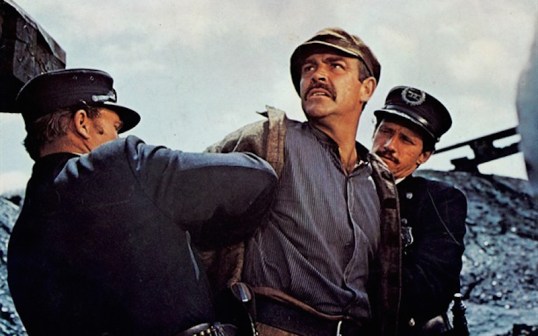
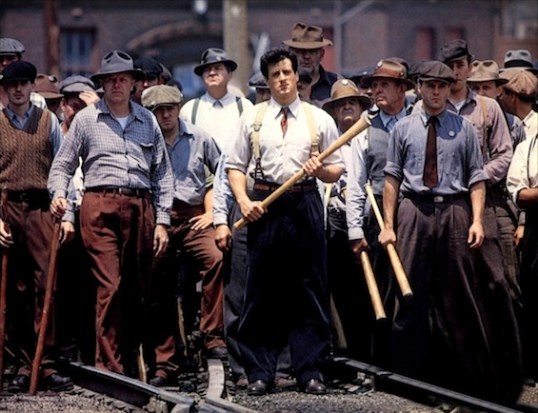
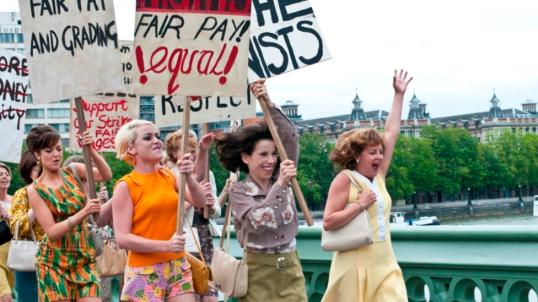
4 Shots From 4 Films: Salt of the Earth, The Molly Maguires, F.I.S.T., Made in Dagenham


4 Shots From 4 Films is just what it says it is, 4 shots from 4 of our favorite films.  As opposed to the reviews and recaps that we usually post, 4 Shots From 4 Films is all about letting the visuals do the talking.

Since it’s Labor Day, this edition of 4 Shorts From 4 Films has a theme!  All four of these shots come from films about labor!

4 Shots From 4 Films

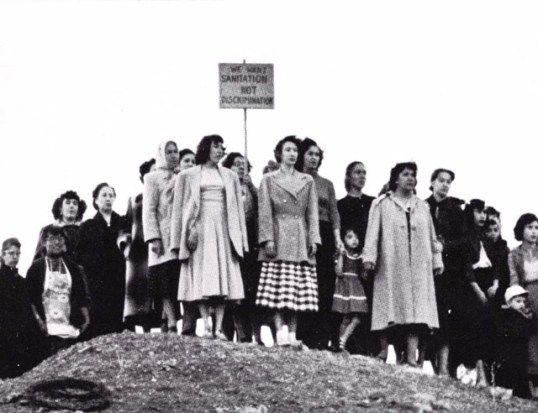
Salt of the Earth

Salt of the Earth (1954, directed by Herbert J. Biberman)

The Molly Maguires (1970, directed by Martin Ritt)

The Molly Maguires (1970, directed by Martin Ritt)

F.I.S.T. (1978, directed by Norman Jewison)

F.I.S.T. (1978, directed by Norman Jewison)

Made in Dagenham (2010, directed by Nigel Cole)

Made in Dagenham (2010, directed by Nigel Cole)


Dance Scenes That I Love: Simon Zealotes/Poor Jerusalem from Jesus Christ Superstar


Today, Arleigh and Pantsukudasai have left town to attend the Anime Expo and I find myself momentarily alone here at the TSL Bunker, curled up on the couch in my beloved Pirates t-shirt and Hello Kitty panties, and cursing my asthma.  As I lay here, it occurs to me that it’s been a while since I’ve shared a “scene that I love” here on the site.  So, why not rectify that situation now?

Norman Jewison’s 1972 film version of Jesus Christ Superstar is a film that I’ve been meaning to review for a while but for now, I just want to share my favorite scene from that film, the performance of Simon Zealotes/Poor Jerusalem.

There’s several reasons I love that scene but mostly it just comes down to the fact that it captures the explosive energy that comes from watching a live performance.  Larry Marshall (who plays Simon Zealotes) has one of the most fascinating faces that I’ve ever seen in film and when he sings, he sings as if the fate of the entire world depends on it.  That said, I’ve never been sold on Ted Neely’s performance as Jesus but Carl Anderson burns with charisma in the role of Judas.
 
Mostly, however, I just love the choreography and watching the dancers.  I guess that’s not that surprising considering just how important dance was (and still is, even if I’m now just dancing for fun) in my life but, to be honest, I’m probably one of the most hyper critical people out there when it comes to dance in film, regarding both the the way that it’s often choreographed and usually filmed.  But this scene is probably about as close to perfect in both regards as I’ve ever seen.  It goes beyond the fact that the dancers obviously have a lot of energy and enthusiasm and that they all look good while dancing.  The great thing about the choreography in this scene is that it all feels so spontaneous.  There’s less emphasis on technical perfection and more emphasis on capturing emotion and thought through movement.  What I love is that the number is choreographed to make it appear as if not all of the dancers in this scene are on the exact same beat.  Some of them appear to come in a second or two late, which is something that would have made a lot of my former teachers and choreographers scream and curse because, far too often, people become so obsessed with technical perfection that they forget that passion is just as important as perfect technique.  (I’m biased, of course, because I’ve always been more passionate than perfect.)  The dancers in this scene have a lot of passion and it’s thrilling to watch.