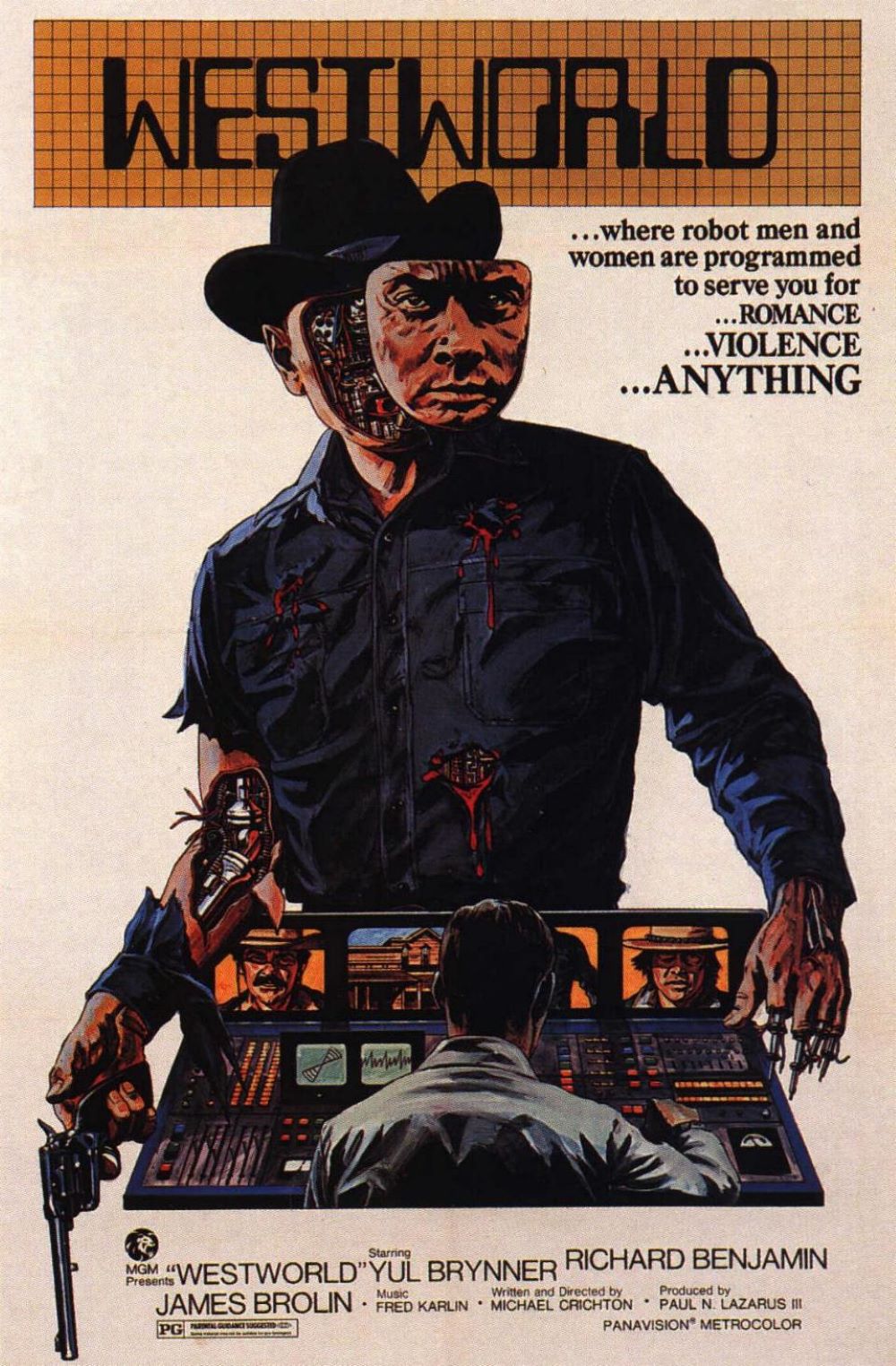
“There’s no way to get hurt in here, just enjoy yourself.” — John Blane
Michael Crichton’s Westworld (1973) is a pioneering sci-fi thriller that uniquely melds futuristic technology with classic Western motifs to explore the dark side of immersive fantasy. The film is set in Delos, a high-tech amusement park divided into three themed worlds—Roman, Medieval, and Western—where guests can live out their fantasies with lifelike androids programmed to serve them. The story focuses on friends Peter Martin (Richard Benjamin) and John Blaine (James Brolin), who embark on a vacation to Westworld, only to find the androids malfunctioning with deadly consequences.
One of Westworld’s greatest strengths lies in its compelling premise. The concept of a theme park filled with near-human robots designed for guests’ amusement feels both visionary and deeply relevant even decades later. It touches on early concerns about the dangers of AI, the ethics of escapism, and how technology could spiral out of control. The film’s gradual shift from playful adventure to tense horror keeps the viewer engaged, illustrating how quickly paradise can turn into a nightmare. Yul Brynner’s portrayal of the robotic Gunslinger is especially memorable, embodying a calm yet unstoppable menace that has echoed through decades of genre cinema. His near-silent, mechanical stalking of the protagonists in the film’s thrilling climax defines the archetype of the relentless android assassin.
Technologically, Westworld was groundbreaking for its era. It featured some of the first uses of computer-generated imagery to simulate the Gunslinger’s “robot vision,” providing a novel and eerie perspective that laid the groundwork for the visual language of future sci-fi films. The movie’s restrained approach to horror and suspense—which leans heavily on atmosphere and tension rather than gore—remains effective. The juxtaposition of idyllic fantasy and mechanical terror gives Westworld a unique texture that feels both nostalgic and fresh.
However, the film is not without flaws. Its pacing is uneven—while the first half indulges in leisurely world-building and character interactions, it can feel slow and unfocused, weighing down the narrative momentum. The characters, particularly Peter and John, are somewhat archetypal and underdeveloped, serving more as audience surrogates than fully fleshed-out individuals. This limits emotional investment in their plight, which could have deepened the film’s impact. Some dialogue and scenes feel dated or clichéd, something Crichton himself acknowledged by deliberately shooting certain sequences as cinematic clichés to evoke a stylized old-movie atmosphere.
The tonal shift from lighthearted theme-park romp to suspenseful thriller, while intriguing, feels abrupt and uneven in spots. The horror elements emerge forcefully in the second half but are preceded by a comparatively slow start that may test some viewers’ patience. The film’s logic around the park’s safety and the androids’ malfunctioning is also inconsistent—what begins as programmed fantasy behavior suddenly becomes lethal with little explanation or foreshadowing. These plot holes can detract from the immersion if one is seeking tightly reasoned sci-fi.
World-building is another area where Westworld shows its age; the other park zones like Romanworld and Medievalworld are barely touched on, serving more as exotic backdrops than dynamic settings. The film lightly explores AI ethics and humanity’s hubris but refrains from delving deeply into philosophical questions, which later adaptations and works inspired by the film would expand upon more thoroughly. The 1970s social attitudes reflected in the cast and scenarios can also feel outmoded to modern sensibilities.
Despite these issues, Westworld remains a cult classic and a fascinating artifact of sci-fi cinema history. Its influence is enormous, seeding ideas that blossomed into franchises like The Terminator, Jurassic Park, and the HBO Westworld series. It stands as Michael Crichton’s directorial debut and an early example of a film grappling with human-machine interaction and the consequences of technological spectacle.
Westworld is a smart, ambitious blend of sci-fi, Western, and horror that captivates with its high-concept premise, pioneering visuals, and iconic villainy. While its uneven pacing, thin character development, and occasional logical gaps reveal its age, these flaws do little to diminish its charm and significance. For genre fans, it’s an essential watch—both as a suspenseful thriller and a creative blueprint for many modern tales of technology run amok. It’s a film that showcases the thrilling promise and lurking threat of immersive fantasy, wrapped in the dust and desolation of the Wild West.
 Through the Shattered Lens