Film Review: Boom! (dir by Joseph Losey)


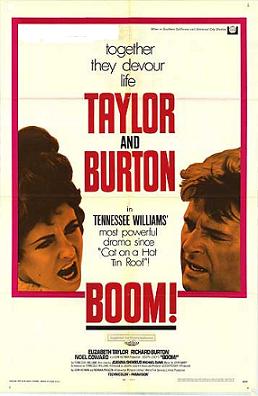
“Boom!” says poet Chris Flanders (Richard Burton) in the 1968 film of the same name. Boom, he goes on the explain, is the sound of life being lived. Every minute that we’re reminded that we’re still alive is a “Boom!” It’s the type of thing that 18 year-old artists say to get laid, though the film treats Chris’s comment with an almost supernatural reverence.

Chris has just shown up on an island that’s owned by Flora Goforth (Elizabeth Taylor), who is the richest woman in the world and who is apparently dying of one of those diseases that makes you lie in bed and yell a lot. Flora lives on the island with an entourage that includes a secretary named Miss Black (Joanna Shimkus) and a head of security named Rudi (Michael Dunn). Rudi is a dwarf and he dresses like a Nazi and often does a stiff-armed salute, just in case we missed the fact that he’s supposed to be a fascist. Why exactly Flora, who were supposed to sympathize with, would employ a Nazi, we never really find out. The film seems to think that there’s something extremely daring about casting a person of short statue as the head of Flora’s security though, ultimately, it’s about as profound as uttering “Boom!” every few minutes.

Anyway, Flora is dying but she’s also dictating her autobiography. It turns out that she’s rich because she married a lot of wealthy men, all of whom died and left her all of their money. Flora’s always in a bad mood but things improve a little when Chris mysteriously shows up on the island and starts saying, “Boom!” all the time. Flora and Chris have several conversations about life and the meaning of it all, the majority of which are full of obscure statements and half-baked attempts at being profound. The dialogue is pretentious but it’s also not very memorable, which is a shame. One can survive being pretentious but being forgettable is simply unforgivable.

Eventually, a friend of Flora’s shows up. Famed playwright Noel Coward plays The Witch of Capri, a flamboyant friend to the rich and famous. He loves to gossip and has a bitchy comment for every occasion. One could argue that Coward is merely playing himself, though one imagines that the real-life Coward could have also come up with a few genuinely witty lines. The Witch informs Flora that Chris has a habit of showing up at the bedside of rich women right before they die. Some people think that Chris is a gigolo while others believe Chris to be …. THE ANGEL OF DEATH!

(Dramatic music)

Which is it? Don’t worry, the answer is revealed by the end of the movie. Of course, it takes a while to get to the end. Boom! is two hours long but it feels much longer. Storywise, Boom! feels like it would be ideal as a 30-minute episode of some old anthology show but director Joseph Losey keeps the story moving at a very slow pace and there are so many dramatic pauses and unnecessary zoom shots that the film itself becomes a bit of an endurance test. Just when you think the movie is finally going to get moving, Chris says, “Boom!” or there’s an extreme close-up of Flora’s ring and everything slows down again.

Boom! is one of the many films that Richard Burton and Elizabeth Taylor made together in the 60s. Unfortunately, both actors are miscast in the lead roles. Flora is described as being old and sickly. Elizabeth Taylor was in her 30s and appeared to be in robust health during the shooting of the film. Chris Flanders is supposed to be in his 20s and a seeker of truth and enlightenment. Burton was in his 40s and looked like he was in his 60s. He spends most of the film looking and sounding as if he’s just come off a weekend bender, which makes him look all the more ludicrous when he hears the ocean and says, “Boom!”

On the plus side, the film is lovely to look at. Flora’s house is big and beautiful. The island scenery is gorgeous. Flora’s costumes are ludicrously ornate but still, they are what you would want to see an international movie star wearing in 1968. As such, the film is always nice to look at. In fact, perhaps the best way to watch Boom! is to turn down the sound so you don’t have to listen to any of the dialogue.

Boom! was based on a Tennessee Williams’s play called The Milk Train Doesn’t Stop Here Anymore. The filmmakers decided to change the name to Boom! and I really can’t blame them for that. This was Elizabeth Taylor’s third film to be based on a Tennessee Williams play. Unfortunately, it matched neither the critical nor the commercial success of Cat On A Hot Tin Roof or Suddenly, Last Summer.

Boom!
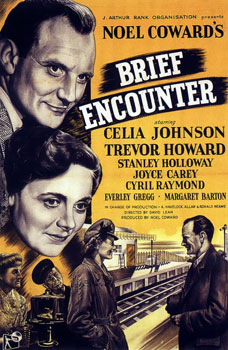
Love on the Shattered Lens: Brief Encounter (dir by David Lean)


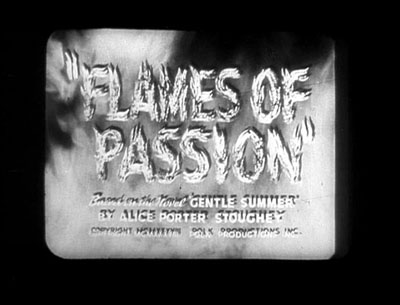
Flames of Passion is a British film from 1938.  I’ve seen the trailer but I’ve never actually seen the film and that’s kind of a shame because it’s a really good trailer.  Not only does it feature romance and adventure but it’s apparently based on a novel called Gentle Summer.  As someone who is fascinated by the power of a good title, I have to give credit to whoever changed that one.  Flames of Passion is far more intriguing than Gentle Summer.

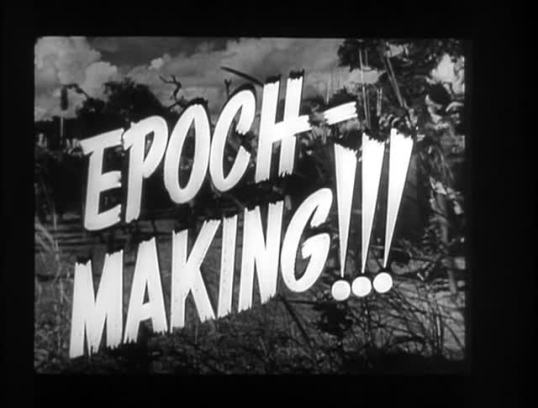
Another reason that I want to see Flames of Passion is because it was apparently “Epoch-Making!!!”  In fact, they say so right in the trailer:

Unfortunately, I’ll never get a chance to actually see Flames of Passion.  As you probably already guessed, it’s a fictional film.  (I’m going to guess that “Epoch-Making” gave it away.)  It’s a fake film that plays a very important role in real film, the 1945 classic Brief Encounter.

Taking place in Britain shortly before the start of World War II, Brief Encounter tells the story of two people.  Laura Jesson (Celia Johnson) is respectable, middle class, and middle aged.  Every Thursday, she takes the train into a nearby town where she does the shopping and catches a matinee.  Alec Harvey (Trevor Howard) is a doctor who rides the train every Thursday so that he can help out at a local hospital.  Dr. Harvey volunteers at the hospital because that’s the type of person that he is.  He also volunteers, one Thursday, to help Laura get a piece of dirt out of her eye.

The next Thursday, Laura and Alec run into each other again.  They have coffee.  A week later, they have lunch.  A week after that, they go to the movies and they see the trailer for Flames of Passion.  Laura and Alec enjoy each other’s company and they quickly find themselves growing very close to one another.  The only problem is that, occasionally, Laura’s friends see the two of them together.  Laura knows how quickly gossip can be spread.

Actually, that’s not the only problem.  There’s actually an even bigger problem that neither Laura nor Alec know how to deal with.  Both of them are married and both of them have children.  In fact, Laura would appear to have the type of life that a lot of people would envy.  She has a nice home.  She has wonderful children.  She has a husband named Fred (Cyril Raymond) and there’s no doubt that Fred loves her.  Fred’s a good man but he’s boring, safe, and set-in-his-ways.  He’s the type who, when Laura mentions that she’s made a male friend and that she goes to the movies with him, barely looks up from the newspaper.

What is Laura to do?  She soon finds that her life is now centered around those Thursday meetings with Alec but are they worth the risk of losing her family?  And when Alec tells her that he’s been offered a job in South Africa, Laura realizes that she will soon no longer even have Thursday to which to look forward.

Brief Encounter is an interesting film.  From the minute that Alec and Laura meet, you know that they’re destined to fall for each other but nothing else about the film plays out in the way that you would expect it to.  As much as being a love story, it’s also a story about two people who have reached a point in their lives where they’ve reached the halfway mark of their lives and now they’re asking, “Is this it?”  It’s not just that Laura is attracted to Alec, though she certainly is.  It’s also that she knows that Alec represents what is probably her last chance to do something grand and romantic with her life.  Once Alec leaves, it’ll mean accepting her life as it is, with the good and the bad things that go along with it.

The film’s dialogue is as erudite and witty as you would expect from a cinematic adaptation of a Noel Coward play and David Lean keep the action moving along at a brisk pace.  Celia Johnson and Trevor Howard are absolutely perfect as the two would-be lovers, with Johnson especially giving a powerful and sympathetic performance.  (If you don’t tear up during Laura’s final scene with Alec, you may want to check to see if you have a heart.)  It helps that neither one of them was a traditionally glamorous movie star.  (Trevor Howard may have been handsome but he was no Cary Grant.)  They come across as being very real people and it’s easy to imagine them being very happy together.  They’re such decent people that they even feel guilty for walking out on Flames of Passion, which Laura apparently did not feel was a particularly good movie.  Watching Brief Encounter, you wish that Alec and Laura could have met earlier but you are happy that they at least had their Thursdays.

Lisa Reviews An Oscar Nominee: In Which We Serve (dir by Noel Coward and David Lean)


“This is the story of a ship….”

The 1942 British war film, In Which We Serve, opens with footage of the HMS Torrin, a destroyer, being constructed in a British shipyard.  When the Torrin is finally finished, the men who worked on it cheer as it leaves on its maiden voyage.  The film then abruptly jumps forward to the year 1941.  The Torrin is sinking, the victim of German bombers.  The surviving members of her crew float in the ocean, holding onto debris and watching as their home for the past few years capsizes and slowly goes underneath the surface of the water.  Even as the Torrin sinks, German planes continue to fly overhead, firing on the stranded men and killing several of them.

As the men fight to survive both the ocean and the Germans, they remember their time on the Torrin.  Captain Kinross (Noel Coward, who also wrote the script and co-directed the film) thinks back to 1939, when he was first given command of the Torrin.  He remembers the early days of the war and the time that he spent with his wife (Celia Johnson) before leaving to do his duty.  As the captain of the ship, Kinross was a tough but compassionate leader.  He expected a lot out of the men but he also came to view them as his second family.  Meanwhile, Shorty Blake (John Mills) thinks about his wife and his newborn son back in London.  Everyone on the Torrin has left their families behind.  Some of them even lose their loved ones during the war, victims of the relentless German Blitz.  But, even as they float in the ocean, everyone continues to fight on, knowing that there will be bigger ships to replace the Torrin and that Britain will never surrender.

In 1942, British film producer Anthony Havelock-Allan approached Noel Coward and asked him if he would be interested in writing the screenplay for a morale-boosting propaganda film.  Coward agreed, on the condition that he be given complete control of the project and that the film deal with the Royal Navy.  Though one might not immediately think that the author of drawing room comedies like Easy Virtue and Private Lives would be the obvious choice to write a war film, Coward’s family actually had a long tradition of serving in the Navy and Coward based a good deal of the film’s action on the wartime exploits of his friend, Lord Mountbatten.  Though there was initially some concern about Coward’s insistence that he should play the lead role on top of everything else, the Ministry of Information fully supported the production of In Which We Serve.

However, Corward knew that he would need help directing the film.  He asked his friend, John Mills, for advice and Mills suggested that Coward should bring in, as co-director, “the best editor in Britain,” David Lean.  Though Lean was initially only meant to handle the action scenes, Coward quickly discovered that he didn’t particularly enjoy all of the detail that went into directing a film.  As a result, David Lean ended up directing the majority of the film.  This would be Lean’s first film as a director and he would, of course, go one to become one the top British directors of all time.

(Also of note, frequent Lean collaborator Ronald Neame served as the film’s cinematographer.  Neame later went on to have his own career as a director.  In 1972, Neame directed another film about a capsized ship, The Poseidon Adventure.)

As for the film itself, In Which We Serve is an unapologetic propaganda film, carefully crafted to inspire the British people to support the war effort and also to win over the sympathy of American viewers.  (During the film’s production, America had finally entered the war but there were still skeptics, at home and abroad.)  Along with being a war film, In Which We Serve is also a rather touching and heartfelt tribute to the strength and determination of the British people.  Though it’s a rather grim film at times and it doesn’t shy away from the fact that lives are going to be lost in the battle to defeat Hitler, it’s also a rather inspiring film.  The sacrifice will be great, In Which We Serve tells us, but it will also be worth it.  The entire ensemble — including future director Richard Attenborough, making his film debut as a frightened sailor — does an excellent job of creating memorable characters, some of whom only appear for a few fleeting moments before meeting their fate.

In Which We Serve was a box office hit in both the UK and the US.  It was Oscar-nominated for Best Picture of the year, though it ultimately lost to another film about World War II, Casablanca.

Cleaning Out The DVR, Again #11: Cavalcade (dir by Frank Lloyd)


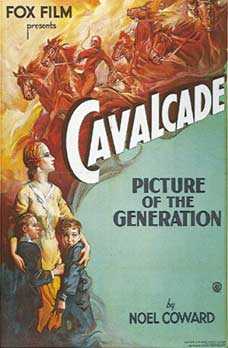
Cavalcade_film_poster

So, I’ve been cleaning out the DVR for the past week.  Fortunately, I’m going to be off work for this upcoming week, which should give me a lot of extra film-watching time.  That’s a good thing because I’ve got 36 movies that I’ve recorded on the DVR since Thursday and, over the past seven days, I’ve only watched 13 of them!  That’s 23 movies to go and I hope to be finished by the end of the next week.

The 11th film that I found on my DVR was the 1933 film, Cavalcade.  I recorded it off of FXM on April 3rd.

The main reason that I recorded Cavalcade was because it was the 6th film to win the Oscar for Best Picture.  Now, I have to admit that I wasn’t expecting much from Cavalcade.  It’s a film that many Oscar historians tend to list as being one of the lesser best picture winners.  Cavalcade is often unfavorably compared to the films that it beat — movies like I Am A Fugitive From A Chain Gang, A Farewell To Arms, Little Women, and The Private Life of Henry VIII.  Cavalcade was the first British to ever win the Best Picture and its victory is often cited as the beginning of the Academy’s love affair with British productions.

And really, Cavalcade couldn’t be more British if it tried.  Based on a play by Noel Coward, Cavalcade follows two families through several decades in British history.  One family is wealthy and is anchored by a patriarch who is knighted in the Boer War.  The other family is lower middle class, anchored by a patriarch who starts out as a butler but who eventually manages to open up his own pub.  Through the eyes of these two families, we view what, in the 1930s, was recent British history.

For modern viewers, it may be helpful to watch Cavalcade while consulting Wikipedia.  For instance, the film starts with the two father figures preparing to leave to fight in the Boer War and I’m sorry to admit that I really wasn’t totally sure what that was.  I had to look it up in order to discover that it was a war that the British fought in South Africa.

But you know what?  That’s not really a complaint.  I may not have known what the Boer War was before I started the film but that had changed by the time that I finished watching Cavalcade.  Several times, I’ve mentioned on this blog how much I love history but watching Cavalcade made me realize that I still have more to learn.  Even more importantly, it encouragds me to learn.  That’s always a good thing.

Certain other historical events were more familiar.  As soon as I saw the title card announcing that the date was 1914, I knew that I would soon be seeing a World War I montage.  And, as terrible as World War I was (though, naturally, the film refers to it as being “the Great War,” and, for a few moments, I considered the fact that there was a time when nobody thought there would ever be a second world war), I was actually kind of happy for the montage because it got the characters out of the drawing room and out of the pub.  Cavalcade is a very stagey film.  Though there are a few attempts to open up the action, you’re always very aware that you’re essentially watching a filmed play.

Of course, the film’s best historic moment comes when a recently married couple goes on their honeymoon.  We see them standing on the deck of a cruise ship, talking about how much they love each other and how wonderful life will be.  They then step to the side and we see the name of the ship: RMS Titanic.

In many ways, those dismissive Oscar historians are correct about Cavalcade.  It’s stagey and it’s old-fashioned and some of the performances are better than others.  But, dammit, I liked Cavalcade.  As the upper class couple, Diana Wynyward and Clive Brook made for a likable couple and they got to exchange some sweet-natured dialogue at the beginning and the end of the film.   Add to that, it was a film about history and I love history.

Cavalcade is hardly a perfect film and it probably didn’t deserve to win best picture.  But it’s still better than its reputation suggests.

Cleaning Out The DVR #5: Around The World In 80 Days (dir by Michael Anderson)


Last night, as a part of my effort to clean out my DVR by watching and reviewing 38 movies in 10 days, I watched the 1956 Best Picture winner, Around The World In 80 Days.

Based on a novel by Jules Verne, Around The World In 80 Days announces, from the start, that it’s going to be a spectacle.  Before it even begins telling its story, it gives us a lengthy prologue in which Edward R. Murrow discusses the importance of the movies and Jules Verne.  He also shows and narrates footage from Georges Méliès’s A Trip To The Moon.  Seen today, the most interesting thing about the prologue (outside of A Trip To The Moon) is the fact that Edward R. Murrow comes across as being such a pompous windbag.  Take that, Goodnight and Good Luck.

Once we finally get done with Murrow assuring us that we’re about to see something incredibly important, we get down to the actual film.  In 1872, an English gentleman named Phileas Fogg (played by David Niven) goes to London’s Reform Club and announces that he can circumnavigate the globe in 80 days.  Four other members of the club bet him 20,000 pounds that he cannot.  Fogg takes them up on their wager and soon, he and his valet, Passepartout (Cantinflas) are racing across the world.

Around The World in 80 Days is basically a travelogue, following Fogg and Passepartout as they stop in various countries and have various Technicolor adventures.  If you’re looking for a serious examination of different cultures, this is not the film to watch.  Despite the pompousness of Murrow’s introduction, this is a pure adventure film and not meant to be taken as much more than pure entertainment.  When Fogg and Passepartout land in Spain, it means flamenco dancing and bullfighting.  When they travel to the U.S., it means cowboys and Indians.  When they stop off in India, it means that they have to rescue Princess Aouda (Shirley MacClaine!!!) from being sacrificed.  Aouda ends up joining them for the rest of their journey.

Also following them is Insepctor Fix (Robert Newton), who is convinced that Fogg is a bank robber.  Fix follows them across the world, just waiting for his chance to arrest Fogg and disrupt his race across the globe.

But it’s not just Inspector Fix who is on the look out for the world travelers.  Around The World In 80 Days is full of cameos, with every valet, sailor, policeman, and innocent bystander played by a celebrity.  (If the movie were made today, Kim Kardashian and Chelsea Handler would show up at the bullfight.)  I watch a lot of old movies so I recognized some of the star cameos.  For instance, it was impossible not to notice Marlene Dietrich hanging out in the old west saloon, Frank Sinatra playing piano or Peter Lorre wandering around the cruise ship.  But I have to admit that I missed quite a few of the cameos, much as how a viewer 60 years in the future probably wouldn’t recognize Kim K or Chelsea Handler in our hypothetical 2016 remake.  However, I could tell whenever someone famous showed up on screen because the camera would often linger on them and the celeb would often look straight at the audience with a “It’s me!” look on their face.

Around The World in 80 Days is usually dismissed as one of the lesser best picture winners and it’s true that it is an extremely long movie, one which doesn’t necessarily add up to much beyond David Niven, Cantinflas, and the celeb cameos.  But, while it may not be Oscar worthy, it is a likable movie.  David Niven is always fun to watch and he and Cantinflas have a nice rapport.  Shirley MacClaine is not exactly believable as an Indian princess but it’s still interesting to see her when she was young and just starting her film career.

Add to that, Around The World In 80 Days features Jose Greco in this scene:

Around The World In 80 Days may not rank with the greatest films ever made but it’s still an entertaining artifact of its time.  Whenever you sit through one of today’s multi-billion dollar cinematic spectacles, remember that you’re watching one of the descendants of Around The World In 80 Days.