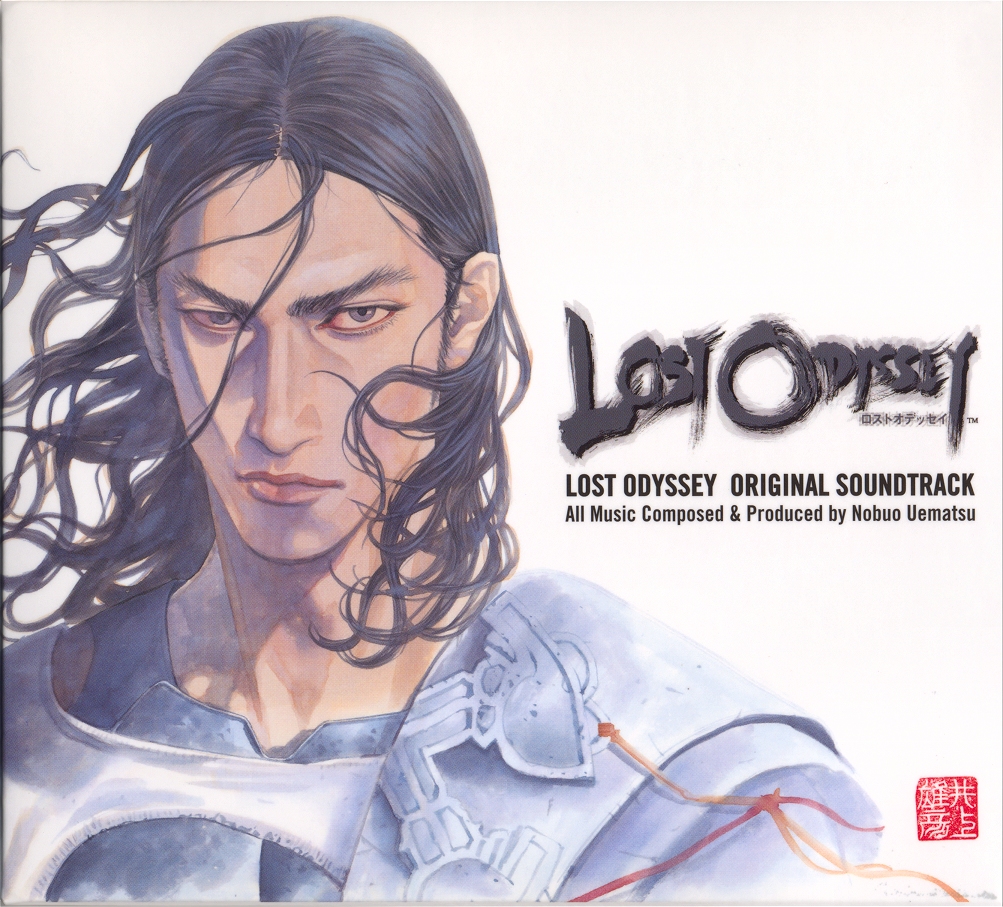
“Neverending Journey” by Nobuo Uematsu from Lost Odyssey is one of those tracks that just pulls you right into the game’s vibe without trying too hard. It kicks off super chill with soft strings and light woodwinds, creating this mellow, reflective mood like you’re wandering through old memories that won’t fade. The orchestral start feels patient and open, giving every note space to settle in before things pick up.
Then comes that smooth shift where the electric guitar riffs crash in — bold, distorted, and full of grit, but it flows naturally from the gentle opening. It’s like Uematsu’s flipping the switch from quiet nostalgia to raw determination, blending classical swells with rock edge in a way that screams the game’s themes of endless struggle. The guitar doesn’t steal the show; it amps up the emotion, turning introspection into something with real forward drive.
That mix is why the track sticks with you — Uematsu nails the immortal wanderer’s paradox, weary but unbreakable. From serene strings to guitar-fueled resolve, it captures Kaim’s story perfectly, making you feel the weight and hope of a journey with no end. It’s a standout that proves game music can hit as deep as any epic soundtrack.
After necromoonyeti helped rekindle memories of days, weeks and months playing Final Fantasy and listening to it’s soundtrack I thought it was only appropriate that the latest “Song of the Day” comes from that very series.
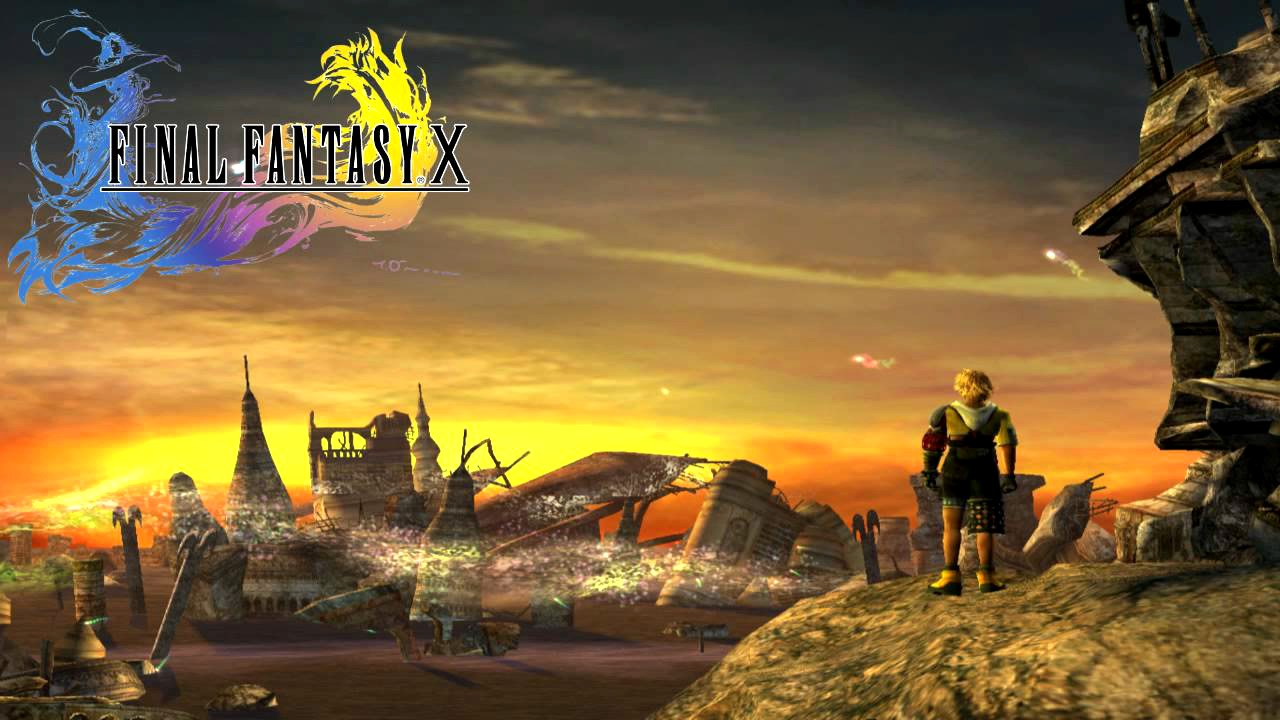
“To Zanarkand” is the theme to Final Fantasy X. An entry in the venerated rpg franchise that has been underrated since it came out in 2001. While the game never reached the sort of acclaim and fan devotion as earlier entries like Final Fantasy IV and Final Fantasy VI (I’m of the few that thought Final Fantasy VII was average, at best) this tenth entry still managed to include a soundtrack that was some of composer Uematsu Nobuo’s best work.
This piano solo version takes the original song and brings it down to it’s emotional core. The other versions are just as powerful, especially the full orchestra version, but the simplicity of the piano solo conveying the themes of loss, sorrow and redemption that the game’s narrative was built on works best for me.
VGM Entry 68: Final Fantasy VI
(Thanks to Tish at FFShrine for the banner)
Square released quite a number of games for the Super Nintendo, but everyone looked forward above all else to their annual blockbuster, appearing in the latter half of the year, from 1993 until 1995. Secret of Mana was the first of these. Final Fantasy VI was the second.
There is only one logical place to begin a discussion of the music of Final Fantasy VI.
And that would be at the beginning. Final Fantasy VI did not begin like other games. Sure, it was by no means the first to fade out on the title screen and play through an introduction to the plot, but this was different in a lot of respects. It provided barely any background to the story. Ok, there was a devastating war 1000 years ago in which the destructive art of “magic” was lost, and an emerging industrial revolution is beginning to recover remnants of that past. That’s all you directly get. The rest plays out more like a movie. You get hints and clues to what’s going on–a new face here, a key term there–but you’re left curious rather than informed. The intro to this game doesn’t set the plot; it sets the mood. (The revised English translation tragically lost sight of this, such that the original SNES “Final Fantasy III” is really the only port of the game worth playing.)
Nobuo Uematsu’s music went hand in hand with this approach. There is no opening anthem–no catchy piece to hum along to. The sinister organ, the harp-like transition, the windy sound effects, and ultimately the opening credit music all flow from one point to the next, breaking only for the sake of the cinematic experience, not because a particular track is over or the next scene has new “bgm”. Final Fantasy VI had perhaps the first really cinematic introduction for a video game.
It might be argued that Nobuo Uematsu revolutionized the use of music in video games from the very opening sequence, but nothing made this more apparent than the events at the Jidoor Opera House, where an odd twist in the plot leads the cast of heroes to become involved in a backstage operation during a musical performance. Not only does the opera take place in the backdrop as you work your way through the mission, but as part of the plot device the heroine Celes takes on the lead female roll in the show. Events transition back and forth between action behind the scenes and the live show, and part of the outcome is determined by your ability, as a player, to regurgitate Celes’ lines from the script.
The video I’ve linked here includes the first two songs in a four-part performance. What makes this sequence so important for the history of gaming music is that Nobuo Uematsu’s amazing score plays a direct role in the plot and gameplay. While the simulated pseudo-vocals might sound silly in hindsight, this was also a real first in gaming music in its day. Square’s sound team might not have possessed the technology to incorporate real words, but nothing prevented them from displaying them as part of the script. As an odd consequence, one of the first video games to make extensive use of lyrics had no vocals.
Uematsu’s third major accomplishment, the indisputable quality of his score aside, was to completely derail the limits of acceptable song length. Granted Commodore 64 artists had been busting out 6-8 minute epics back in the mid-80s, the standard by and large still remained firmly below the 3 minute mark. If we take the opera as a single piece (it’s divided into four tracks), Final Fantasy VI had three songs that pushed 20 minutes.
“Dancing Mad” probably remains today the longest final battle music ever written, with the original ost version clocking in at 17 minutes and 39 seconds. This might seem excessive if you haven’t played the game, but within its context nothing less could have possibly sufficed. Kefka was pretty much the greatest video game villain of all time (Luca Blight from Suikoden II might surpass him), and Final Fantasy VI might have had the most apocalyptic plot in the series. Sure, series fans had saved the world from imminent destruction five times before and plenty more since, but Zeromus, Exdeath, they were just icons of evil. In Final Fantasy VI, Square’s obsession with mass destruction finally found a human face. Kefka’s psychopathy was something you could buy into. He was entirely capable of emotion even as he slipped progressively further into insanity. He just attached no moral value to life. Where enemies before and since sought to destroy the world for destruction’s sake, Kefka was in it for the experience of the ultimate tragedy. For once it actually made sense for a final boss to let the heroes creep up on him; the whole agenda would have been pointless if no one was there to experience it with him.
Both visually and musically, the final battle of Final Fantasy VI was beautiful. Nothing else–certainly no 1-2 minute fight theme–would have been appropriate in the context of the story.
VGM Entry 54: Final Fantasy V
(Thanks to Tish at FFShrine for the banner)
Square had a fresh set of games to offer in 1992, and I will turn to them next.
Final Fantasy Mystic Quest has amusing origins. After assessing the disparity in RPG sales between the Japanese and North American markets, Square concluded that Americans were just too dumb for Final Fantasy V, so they made the ultra-simplified Mystic Quest instead and commissioned Ryuji Sasai to compose a hard rock soundtrack for it.
Well, I don’t know if Sasai was actually specifically tasked to mix in heavy metal, but it would be funny if he was. And thankfully he did, because it’s really this game’s only redeeming quality. I wasn’t quite 10 years old when I played it, and I remember it boring the shit out of me.
Any stylistic similarities between Final Fantasy Mystic Quest and Final Fantasy Legend III are lost in the change of medium. The things that made Sasai a god among musicians on the Game Boy just weren’t options here. Most of the music is instead pretty generic. The title theme for instance, the first track in this mix, is appropriate and entirely forgettable. It’s in the combat sequences that Sasai really gave his all and salvaged the game from total despair. The regular battle music (2:03) could fly as a final boss theme in any other game, while the last castle (3:58) and final boss battle (8:36) hit even harder. But the real prize winner here is the regular boss battle music (6:39). This track just begs to be covered by a power metal band.
Yeah, it’s got nothing on Final Fantasy Legend III, but to a piss-poor attempt at a video game Sasai at least contributed some slight redeeming value. Then there’s Final Fantasy V.
As you listen through the Final Fantasy V soundtrack, one thought that might cross your mind is “Heh, this kind of sucks.” Yes, yes it does. Here is the track list for this compilation:
(0:00) Prelude
(1:08) Final Fantasy
(1:56) Dear Friends
(2:41) Ahead On Our Way
(3:35) Lenna’s Theme
(4:18) Battle Theme
(5:00) Royal Palace
(5:34) What?
(6:08) Home Sweet Home
(7:00) The Airship
(7:30) Four Warriors in the Dawn (Galuf’s Theme)
(8:03) Moogle’s Theme
(8:49) Go Go Boco!
(9:32) Fanfare
Quality is all relative. Compared to the average SNES game, Final Fantasy V might be stellar, but Nobuo Uematsu in 1992 ought to be held to a higher standard. To his credit, I think this was more of an experimentation than a creative flop. In that grey area between heavy NES restrictions and full orchestration, there was probably a lot of freedom to branch out from the styles that were perhaps expected of Uematsu. Máire Breatnach had recently arranged the Final Fantasy IV soundtrack into Celtic Moon, and Uematsu surely had some hand in that. I think perhaps he was going for something a little more folk oriented here and it just didn’t quite hit the mark. You can hear it in the Final Fantasy Main Theme (1:08). Trumpets and the feeling of a string orchestra are replaced by a simple harp at first, and as other instruments join in it never ascends into the illusion of an orchestra, remaining essentially a three-piece set.
But the use of a trumpet is more odd than rewarding in this instance, and the string tone measures out like chords on a keyboard, failing to create the illusion of the real deal. Songs like Royal Palace (5:00) are pleasant in concept, but the programmed loop nature of each track is just too apparent to make me feel like I’m listening to anything more than some MIDI imitation. There’s nothing remotely natural about the harp or synthy strings here; a real orchestra would never play this. It’s not that the music needed to feel orchestrated, but Uematsu employs the sort of instruments for which orchestration is expected. Home Sweet Home (6:08) is a good counter example. The strings that come in later still make too many hard stops to sound natural, but overall the arrangement manages to avoid counter-intuitive instrumentation, and it pays off.
Another good example, Harvest, doesn’t appear in this compilation. Here once again Uematsu avoids ‘orchestral’ instrumentation and lets his folk vibe play out uncontested. It’s one of the few instantly appealing tracks in the game, and I can’t help but think that had this instrumentation been the rule and not the exception, Final Fantasy V would have been a lot better off.
VGM Entry 44: Final Fantasy IV
(Thanks to Tish at FFShrine for the banner)
Supposedly the sound team at Square was so overburdened when it came to scoring Final Fantasy IV that they occasionally camped out in sleeping bags at the office. Or so claim Nobuo’s rather zanny liner notes for the game’s official soundtrack, dated “April 13, 1991, 1:30 a.m. (in the office, naturally)”. Whatever the veracity of this, the end result was probably the best game soundtrack composed up to that time.
Nobuo Uematsu must have been waiting a long time for this. “Prelude” received its main melody to finally become the song we think of today. “Prologue” (Main Theme) got an epic introduction to overtake the recently revamped Dragon Quest theme. Hell, something approaching real orchestration was possible!
The process of adjusting to the Super Nintendo took a lot of time and energy, and it didn’t get any easier. Nobuo Uematsu has stated that Final Fantasy VI was his most challenging score, and one can imagine a perfectionist’s realization that Super Nintendo sound, though vastly superior to the Nintendo, was still sufficiently limited for the possibility of excruciatingly sampling every option. Perhaps that’s why Final Fantasy IV and Final Fantasy VI especially turned out so great; lacking the sense of unrestrained freedom of true orchestration, attention to detail was taken to painstaking extremes. Perhaps. I don’t know.
The track list for the sample above is:
“Prelude”(0:00)
“Prologue” (0:55)
“Red Wings” (1:35)
“Main Theme” (Overworld) (2:16)
“Into the Darkness” (3:00)
“Fight 1” (3:32)
“Mystic Mysidia” (4:31)
“The Airship” (5:20)
“The Big Whale” (5:50)
“Theme of Love” (6:27)
“Palom & Porom” (7:11)
“Chocobo-Chocobo” (7:38)
“Land of Dwarves” (8:12)
“Epilogue” (8:37)
“Fanfare” (9:24)
It’s something of a testament to how amazing Final Fantasy IV really is that garudoh’s ten minute sampler does not even include the vast majority of my personal favorites. And since I am at liberty to write these articles however the hell I want to, I present you with my top five Final Fantasy IV tracks, roughly in order:
#5: Fabul
The music of Fabul could not possibly be better suited for its role in the game. Here you’ve got an isolated, well fortified castle guarded by monks, which are pretty much ninjas and way cooler than Edge anyway. And there’s nothing friendly about this town. It’s been a long, long time, but I recall never exactly feeling welcome there, and I certainly shouldn’t after all the trouble. “Fabul” isn’t just appropriately oriental, it’s also pretty grim. There’s a sense of foreboding about it which perfectly captures the events your arrival foretells.
#4: The Lunarians
“The Lunarians” was my favorite Final Fantasy IV track as a kid. I remember pounding away at it for hours on my mother’s piano, which must have been especially grating since I’ve never taken a piano lesson in my life. This isn’t some ‘light in the darkness’ track. The pretty melody is completely haunting, and that forcefully struck deep note is entirely complimentary to it. No, there’s no sort of contrast here. This song captures a beautiful and dangerous mystery.
#3: The boss battles
Yes I know I’m cheating. Final Fantasy IV is packed full of outstanding fight music. The final battle, featured above, is the most dramatic of the lot–as well it should be–but only barely. “The Fierce Battle” also does wonders for capturing a heightened sense of danger and urgency. Really, though the whole multiple tiers of combat music thing was probably done before, Final Fantasy IV has to be one of the first games to make effective use of it. “Fight 2“, the standard boss tune, emerges out of the same brief introduction as the basic combat theme (see garudoh’s mix) and steps the action up a notch with faster drumming, more pronounced bass, brass accents, and a more central role for the strings. “The Fierce Battle” goes farther still, allowing the brass to share center stage with the strings, except unlike in “Fight 1“, the brass melody lines here actually feel like the real deal. The track comes off as very orchestral to me, and intense in a way that just wasn’t possible prior to the SNES. “The Final Battle” mixes the best of each world and contributes a rock beat to top off the job.
#2: Troian Beauty
This appropriately titled song might just be a simple waltz helped along by harp arpeggios, but that’s precisely why it works. It’s just a beautiful song–a real stroke of genius from an artist of whom we expect such feats. It’s one of the most frequently covered Final Fantasy songs you’ll find (I even stumbled across a banjo rendition), as it translates well into nearly any arrangement. It’s one of my personal favorite songs to cover, using Kabukibear’s version. If you’re not familiar with his arrangements, this is a great place to start.
My favorite Final Fantasy IV song of all might be a little anticlimactic, as it’s featured in the garudoh compilation, but I hope you’ll give it some consideration before writing it off as a relatively generic song in relation to the tracks accompanying it.
#1: Red Wings
If I was ever to form a video game cover band, and I’ve been kicking around the idea since I was old enough to pick up a guitar, “Red Wings” would definitely be my top priority. Just imagine the possibilities for subtle intensification in this song. Sure, Uematsu’s version might only be a minute long, but I could see this building up into a ten minute marathon, starting out with that martial snare and climaxing with an Atsuo-intense drumset massacre, with room for all kinds of instrumental variation in between. Ok, maybe that’s my vision for the song and not the song itself, but I think Uematsu lays out a prototype for something truly epic here.
VGM Entry 41: Game Boy
(Thanks to Tish at FFShrine for the banner)
I nearly forgot to address the Game Boy. Released in April 1989, by the end of 1990 it was already pushing 100 titles. Perhaps production was easy and inexpensive, I don’t know, but this was a system that shot off at lightning speed. In consideration of all of the great music chiptune artists are making on the Game Boy today, I made a diligent effort to listen to a good 80 or so of these early titles. I figured there had to be a ton of hidden gems out there, but there really weren’t.
It’s actually really surprising how completely ho-hum the vast, vast majority of early Game Boy soundtracks were. Even those you might expect to be leading the pack, Castlevania: The Adventure (Konami, 1989, Dracula Densetsu in Japan) and Super Mario Land (Nintendo, 1989) for instance, offered next to nothing worth noting. Those which did peak my interest were often quite obscure. Fist of the North Star: 10 Big Brawls for the King of Universe (Electro Brain Corp., 1990) for instance has no identifiable composer. I searched long and hard to no avail.
This game supposedly stunk, and perhaps the music was not held in very high regard because of this. I thought it was a pretty solid effort. The Game Boy’s bass tones are very full and encompasing, capable of giving a song a great deal of depth. Very few musicians actually put this to use, but whoever composed Fist of the North Star had an ear for it. The way the extended bass notes compliment the melody reminds me a lot of Ryuji Sasai’s approach on my favorite Game Boy soundtrack, which we’ll be getting to here in another year.
The title track to Battle Bull (SETA, 1990), composed by Takayuki Suzuki, strikes me for its ability to pack in such a big sound. It is stylistically exactly the sort of thing I set out to find. It’s a shame there seems to be only one song here, because Suzuki turns out to be one of the few Game Boy composers who really understood how to make the most of the system. In retrospect after looking a few years ahead, this is easily one of the best Game Boy songs I have ever heard.
Square’s SaGa series became a nearly annual event following the first instalment, Makai Toushi SaGa, released for the Game Boy in December 1989. The first three were known in North America as the Final Fantasy Legend series–a title chosen in the hopes that familiarity would boost sales. I know the strategy worked for me. But the series did share at least one thing in common with Final Fantasy, at least initially. Nobuo Uematsu was commissioned to compose it. Despite what you might read, I am fairly confident that he composed Final Fantasy Legend in its entirety. At least, the liner notes displayed by vgmdb.net claim this. Final Fantasy Legend II, released the following December, was a joint effort, with Kenji Ito tackling about half of the tracks.
I am only going to present the original Final Fantasy Legend here out of consideration of space, but the sequel is about equal in quality and worth checking out. Nobuo Uematsu did an excellent job of carrying over his style onto the Game Boy, and a few tracks, like the introduction and the victory fanfare, would become series staples. The only noteworthy RPG series for the Game Boy to the best of my knowledge, the Final Fantasy Legends boasted a much larger song selection than most other Game Boy games at the time, and the consistant high quality really put to shame most of the competition.
Nobuo Uematsu and Kenji Ito really definitively proved that the dearth of good Game Boy music was a consequence of negligent composers, not system restraints. Uematsu was as new to the Game Boy as anyone else when he composed his first work for it, and, as you can plainly hear, that was a simple enough challenge to overcome. Much like the first three Final Fantasy soundtracks, the music of the first two SaGas did not so much conform to the system as force the system to conform as much as possible to a multi-platform vision of what an RPG ought to sound like. The music of Final Fantasy Legend you are hearing here certainly bears a distinctly Game Boy sound in so far as it was impossible not to, but the music neither capitalizes on the systems strengths nor succumbs to its difficulties. It really just sounds like Uematsu doing his thing in the early years.
Gargoyle’s Quest (Capcom, 1990) was pretty amazing. It was created by Harumi Fujita, the original arcade composer of Bionic Commando, and Yoko Shimomura, a new name to the business who you’ll be hearing plenty more of in the future. It is also a part of the Ghosts’n Goblins series, which you’ve heard pleanty of already.
Gargoyle’s Quest does everything right. The decision to abandon percussion altogether did wonders for enhancing the semi-classical melodies. The songs are consistantly well-written, and the melodies are often permitted to run wild, with no stagnation and no breaks in the actual presence of sound. The Game Boy had by far the most beautiful tones of the chippier-sounding systems–that is, pre-SNES/Genesis/Amiga–and they always seem to ring out to their fullest in states of perpetual transition. I don’t know, maybe I’m superimposing what worked best for Gargoyle’s Quest onto what worked best for the Game Boy in general, but it seems like this is the sort of system where you can never have too many notes.
But if that’s stretching matters, I would at least say that the Game Boy is a system on which boldness almost always profits. It’s a shame that Tim Follin didn’t, to the best of my knowledge, write any Game Boy music. But anyway, Gargoyle’s Quest, one of the best soundtracks the system would ever know, was certainly not lacking in it. I might never be able to really put my finger on the features that so strongly attract me to this system, but you’re hearing a lot of them right now. You can hear the soundtrack in its entirety here, once again compliments of explod2A03.
Funny that, for all I just said, my favorite Game Boy soundtrack of this 1989-1990 period is soft and simple Yakuman (Nintendo, 1989), a mahjong game composed by Hirokazu Tanaka and only released in Japan. A frequently occurring figure in my articles, Tanaka’s game audio history goes all the way back to monotone bleeps in the 1970s. His role as a major composer would rapidly fade after 1990, but he was partly responsible for such esteemed works as Metroid, Mother, Earthbound, Dr. Mario, and the Nintendo ports of Tetris. He also composed Super Mario Land for the Game Boy, which I find quite dull. Go figure.
Well, that wraps up my thoughts on the first two years of the Game Boy. Honorable mention goes to Maru’s Mission (Jaleco, 1990, composer again unknown) and Burai Fighter Deluxe (Taxan, 1990/1991), composed by Nobuyuki Shioda. And really I was a bit harsh on Castlevania: The Adventure. I don’t care for it, but it’s not bad.
VGM Entry 39: End of the NES era (part 1)
(Thanks to Tish at FFShrine for the banner)
Games would continue to be made for the NES long after the release of the Super Nintendo, but its glory days had come and gone. Already by 1990, the system was starting to sound a little stale, and even the most impressive compositions faced an enormous burden in keeping pace with video game music at large on a hopelessly outdated system.
Koichi Sugiyama certainly didn’t produce much of interest. The improved rendition of the main theme aside, Dragon Quest IV (Enix, 1990) was not a particularly memorable soundtrack. It has no faults per se. It certainly had nothing approaching the annoyance of the original Dragon Quest‘s combat theme. But no amount of listening to the tracks beyond the main theme here has revealed the slightest hint of anything special. It’s a soundtrack secure in its simplicity. The music is wholly appropriate for an RPG, never clashing with the style of gameplay, but it also adds nothing to the experience save pleasant background music. I’ve heard plenty worse by RPG composers with much more diverse sound systems to work with, but it definitely feels to me as though this one stands out more for the fact that “Dragon Quest” and “Koichi Sugiyama” are attached to it than for its own worth.
Final Fantasy III (Square, 1990) was a somewhat different situation. It’s got a lot more emotion to it, and frankly it might constitute Nobuo Uematsu’s finest compositions on the NES, but in the context of its place in time it can be pretty hard to appreciate. Here’s a track list for the video:
(0:00) Prelude
(0:56) Crystal Cave
(1:54) Jinn the Fire
(2:43) Chocobo Theme
(3:20) The Invincible
(4:11) Battle
(5:06) Last Battle
(5:59) The Boundless Ocean
(6:59) Fanfare
Nobuo Uematsu definitely climaxed as a specifically NES composer on Final Fantasy III. “Battle” and “Last Battle” express a full appreciation for the NES as an instrument, and the rapid-fire accompaniments in both, but especially the latter, are some of the most powerful on the system. The SID-like sound on “Crystal Cave” and “Last Battle” adds a new dimension to the songs which would have been unthinkable for Uematsu a mere three years prior, while “The Invincible” is a practically perfect arrangement. If Final Fantasy might best be defined as lovely compositions poorly arranged, Final Fantasy III was definitely the full package.
The problem, and the reason it took me setting the game aside and coming back to it weeks later to be able to really appreciate it, is that this was 1990. Amidst the Sega Genesis/Mega Drive, the Commodore Amiga 500, and the NEC PC Engine/TurboGrafx-16, the NES just sounded terrible; it was no longer novel and it was way behind the times. Nintendo’s lengthy development paid off, as things turned out, but a lot of early 1990 releases better suited for the SNES suffered from the delay.
Resting somewhere between these two in quality was Castlevania III: Dracula’s Curse (Konami, 1989). I have seen no less than five musicians credited with the composition. Hashing out who all among Hidenori Maezawa, Kenichi Matsubara (Castlevania II), Yoshinori Sasaki, Jun Funahashi, and Yukie Morimoto were really responsible for the music might be a fun task, but I only have the time for so many such projects. For whatever it’s worth, Hidenori Maezawa, Jun Funahashi and Yukie Morimoto are the three most frequently credited names. Consisting of a long list of virtual unknowns, this is one of those scores for which “Konami Kukeiha Club” might be the most appropriate accreditation.
One thing that strikes me as interesting here is how the drums and bass feel like they’ve borrowed from Batman (Sunsoft, 1989) by Nobuyuki Hara and Naoki Kodaka, especially considering I felt Hara an Kodaka themselves might have been inspired in part by the Castlevania series before I ever heard Castlevania III specifically. This connection, or at least the possibility of Batman‘s drum and bass influencing Castlevania III, is virtually impossible. As it turns out both games were actually released on the exact same day: December 22, 1989. (I had originally thought Castlevania III was released in 1990, hence my placing it in this post, but it’s close enough.)
The game has some pretty impressive original tracks, especially “Beginning” (0:00) and “Mad Forest” (1:10), not to mention a new rendition of “Vampire Killer” (5:49). The overall sound is a lot less classical and a lot more peppy than previous Castlevania titles, though I think that can be forgiven in light of the good, consistent job they did with it. Again, the soundtrack only took a while to grow on me due to its historical context. It was most certainly technologically behind the times, but there wasn’t much the Konami sound team could do about that.
VGM Entry 31: RPGs in ’88
(Thanks to Tish at FFShrine for the banner)
Nobuo Uematsu and Koichi Sugiyama were both at work in 1988, recording installments of the Final Fantasy and Dragon Quest series respectively. They both maintained their own standards, remaining at the forefront of RPG and adventure style music on the NES.
Final Fantasy II (Square, 1988) was actually a big improvement over the original. Nobuo Uematsu’s fundamental style hadn’t changed (and I would argue that it still hasn’t), but I feel like on this game he really mastered how to effectively arrange his works for the NES. I mentioned that Final Fantasy‘s arrangement felt like a finished product compared to some other genre-related games released that year, but in Nobuo’s later NES works you can start to get the feeling that the original Final Fantasy was also a sort of work in progress. It incorporated a number of slightly distorted tones which really gave his soft, subtle melodies an air of technological primitivism.
On Final Fantasy II you hear none of that. The overall sound is a lot more smooth. It’s immediately apparent in the “Main Theme” following “Prelude” in this sample. The main melody, here carried by a very soft and pretty tone, is precisely the sort of sound for which he employed a grittier, more mechanical tone in the first game. Since Final Fantasy II was released on the Famicom, not the FDS, I can’t imagine that there was any change in the platform’s capacity. I think, rather, he took some lessons from his earlier shortcomings on the production end of the spectrum.
Final Fantasy II was the first game to feature the famous “Chocobo” theme (1:40), and “Main Theme” (0:53), “Tower of Mages” (not here featured), and “Ancient Castle” (2:42) are all particularly noteworthy, but I think it’s the improved arrangement which really makes the soundtrack shine.
Dragon Quest III (Enix, 1988) is a little harder for me to assess, as I’ve somehow completely failed to acquire full soundtracks for this series. What I’ve heard seems like more of the same old, which is absolutely fine. Koichi Sugiyama seems to have continued to focus on rearranging earlier works rather than composing wholly new ones, and he had a decent amount of success in doing so. I’m not going to talk at length about a score I really know nothing about, but I thought it worth throwing out there again.
As I hope I’ve by now established though, the NES had by no means a monopoly on this style of video game music. Takahito Abe and Yuzo Koshiro’s work on Ys I is a soundtrack I’ve frequently cited, and its follow-up, Ys II: Ancient Ys Vanished – The Final Chapter (Nihon Falcom), was yet another fine 1988 sequel.
But the music here is pretty hard to come by. Takahito Abe was not a part of the sound team this go around, and Mieko Ishikawa took on the bulk of the load, with Yuzo Koshiro providing some of the more up-beat tracks, such as the one here sampled. Ishikawa isn’t a musician I’ve come across too often up to this point, but she was credited alongside Koshiro and Abe on Sorcerian, and I gather she was involved in future Ys titles. I suppose I should have featured one of her songs and not Koshiro’s, but I can’t find enough of it out there to get a good feel for it. There’s a nice sample of the song Tender People up on youtube that might give you an idea. It lacks Takahito Abe’s gentle touch, but it’s quite pretty nevertheless.
A lot of the difficulty in digging out Ys II tracks (at least in the short period of time I can allot it) stems from a remake of the game having been released for PC Engine / TurboGrafx-16 in 1989, a mere one year later. That release, Ys I & II, featured some outstanding new arrangements from Ryo Yonemitsu, but its success denies us easy access to Ishikawa’s original PC-8801 work. As far as Koshiro is concerned, some of his upbeat tracks come off quite well, but I feel like he lacked restraint on this album and ended up with a sound that just didn’t quite suite the type of game he was composing for. It’s a problem which Koshiro would thoroughly overcome over the next three years, adding such stark stylistic distinctions to his name as ActRaiser (Enix, 1990) and Streets of Rage (Sega, 1991).
Above all else in the RPG/adventure world of 1988 though, I’m most impressed by how my new-found hero Kenneth W. Arnold manages to maintain the high standards he set back in 1983.
This guy’s music blows me away every time I hear it, and his work on Ultima V: Warriors of Destiny (Origin Systems, 1988) is no exception. It’s atmospherically perfect. “Engagement and Melee” might be a simple song, but could it have been any more appropriate for a tense medieval battle? It doesn’t deliver with speed and aggression, but rather with a vision of the distant fantasy world it represents. The distortion sounds archaic in the best of ways.
There are a lot of different versions of it floating around out there, as best I understand because Apple II music is nearly impossible to rip and requires some creative liberty. But I did manage to nab a replica of the original Apple II sound as it was meant to be heard through a Mockingboard sound card, and I present these samples to you now. (Thanks again to Apple Vault.)
The aesthetics here never fail to impress me. The sound quality in “Greyson’s Tale” is exploited flawlessly, using every potential adverse limitation to the music’s advantage. The distortion and the fairly minimalistic, distinctly medieval compositions paint every ideal image you’ve ever had a of a fantasy world. There’s something not quite clear and not quite safe about all of it.
In “Dream of Lady Nan” the distorted bass is so forceful you can feel the vibrations, and the melody is crystal clear, creating an unnatural juxtaposition that’s completely haunting. I normally avoid encouraging the free download of potentially copyrighted material, but in consideration of the fact that the owners of this material have nothing to lose and everything to gain from it being distributed, I highly recommend you go download all of Kenneth W. Arnold’s works in Ultima III-V. You can find them in their ideal form at this link.
Ultima V: Warriors of Destiny. It’s not quite on par with Ultima III and Ultima IV in my opinion, and the tracks don’t loop quite as flawlessly as they used to, but it maintains the series’ standing in a complete league of its own, beyond comparison to the contemporary best efforts of Nobuo Uematsu and company. If there were other soundtracks out there like it, well, I would very much like to hear them.
VGM Entry 27: PC-8801
(Thanks to Tish at FFShrine for the banner)
If I want to cover every field, it would be a certain mistake to overlook the impact of the NEC PC-8801 during this time. I have incorporated a few titles into the mix already. Thexder (Game Arts, 1985) by Hibiki Godai was the first noteworthy soundtrack for the platform I’ve found making use of the Yamaha YM2203 sound chip. Xanadu Scenario II (Nihon Falcom, 1986), predominantly the work of Takahito Abe, and Ys I: Ancient Ys Vanished (Nihon Falcom, 1987) by Yuzo Koshiro the following year were developed for various platforms, but the PC-8801 seems to have been Falcom’s flagship. Unfortunately I’ve found it nearly impossible, between the language barrier and the myriad ports, to find suitable examples of most of Takahito Abe’s other PC-8801 works, and Yuzo Koshiro’s pre-1988 works seem to be just as obscure. But were they the only composers making the system shine?
Silpheed (Game Arts, 1986) was another product of Hibiki Godai, at least as best I can tell. The only credits I could find were for the 1988 MS-DOS port by Sierra On-Line, which list Hibiki Godai, Nobuyuki Aoshima, Fumihito Kasatani, and Hiromi Ohba. Since the majority of the other names in the credits are Americans, it’s quite possible that all four of these musicians had a hand in the original composition.
In a way, the music feels a little bland compared to that of the European musicians I’ve recently discussed. This is certainly a product of differences in sound chips, but I am at least a little inclined to believe that both the distorted nature of Commodore 64 and ZX Spectrum sound and the atmosphere of experimentation and bold composition that permeated European sound programming did in fact inspire better music than competing scenes managed to produce at the time. Even so, Silpheed has some exceptional songs–most notably the one beginning at 13:00–and it’s a good example of what Japanese computer gaming sounded like.
Or so I like to believe. Sorcerian (Nihon Falcom, 1987) is yet another Yuzo Koshiro and Takahito Abe collaboration, with Mieko Ishikawa additionally credited. Kenji Kawai is listed separately as the 1992 PC-Engine arranger, so for once we can at least make some distinction in that regard. But so long as the same names keep popping up, I can’t help but think I’m only getting a very small sample of a much larger field. And furthermore, the significance of the PC-8801 for these titles musically is not a given. Almost all of Nihon Falcom’s games were released across an enormous spread of systems which typically included at least the PC-8801, PC-9801, Sharp X1, and MSX2. As has been shown with Ys I: Ancient Ys Vanished, this entailed endless variation and reinterpretation of the central themes. “Dark Fact” almost seemed to evolve with every port, with no clear explanation as to whether Yuzo Koshiro changed his mind about how it ought to sound or port arrangers independently reinterpreted the music at every step, often basing their take on previous ports rather than the original.
If these composers knew that their songs would take so many forms, did they really write their music for the PC-8801 at all, or were they aiming for compositions which could function through a wide array of sound configurations? Or, if they were personally involved in the ports, did they perhaps gear their music towards a preferred system for which the game might not necessarily be released on first? No amount of exploring PC-8801 compositions has helped to clarify these questions.
The problem is compounded by a complete absence of credits for the vast majority of PC-8801 games. In the absence of a PC88 game library (I am eternally in debt to such sites as Lemon 64, World of Spectrum, and Lemon Amiga), I have absolutely no clue what Shinra Bansho (Nihon Telenet, 1987) is beyond the name of its developer. This is my second favorite PC-8801 soundtrack (after Snatcher, which I’ll be addressing later), but I haven’t a clue who wrote it. Perhaps Nihon implies Yuzo Koshiro and Takahito Abe, if they were the only house musicians, but since this is Nihon Telenet, not Nihon Falcom, and I have no idea what that distinction entails, it would be folly to ascribe any artist attribution.
I am entirely at the mercy of grad1u52 on youtube for finding PC-8801 music in the first place, as he is the only member taking active steps to preserve it, but the information he supplies for each game is unfortunately non-existent. Lots of other titles, the music for which is readily available, fall into this same boat.
The only substantial hint I can offer is that composers hardly ever freelanced at this time, and developers rarely boasted a large sound staff. If you can identify a developer’s house composer in the mid-80s, it almost always seems to be the case that they scored every release during their tenure. Square and Enix make a good case in point. Such obscure PC-8801 titles as Cruise Chaser Blassty (Square, 1986) and Jesus: Dreadful Bio-Monster (Enix, 1987) were composed by Nobuo Uematsu and Koichi Sugiyama respectively, not passed off to secondary musicians (not that Uematsu had succeeded in making a name for himself by 1986). Both soundtracks were second rate, with Uematsu sounding completely lost in a non-fantasy setting and Sugiyama cutting corners to the extent of including tracks from Dragon Quest, but that is quite besides the point. With the company consistently identifying the composer, there might still exist a means to figure these old, cryptically credited PC-8801 games out short of learning Japanese.
VGM Entry 22: Final Fantasy
(Thanks to Tish at FFShrine for the banner)
Final Fantasy also lacks much of a kick. Nobuo’s decision to not use any drums might have seemed surprising, had Koichi Sugiyama not done the same thing. Much like Sugiyama, Uematsu was able to craft songs which were memorable and struck a pleasant balance among the available tones. Both artists successfully mastered the positive aspects of the Nintendo’s cleaner tones.
Final Fantasy doesn’t need much of an introduction. It’s worth noting that it was fairly lengthy for its day, with nineteen full songs. Garudoh did a fine job of capturing all of the best tracks in this collection. The songs which appear here in order are:
(0:00) Prelude
(0:49) Final Fantasy Main Theme
(1:40) Overworld Theme
(2:17) Battle Theme
(3:08) Undersea Shrine
(3:46) Sailing
(4:33) Airship
(5:04) Gurgu Volcano
(5:49) Matoya’s Cave
(6:30) Temple of Chaos
(7:08) Funeral
(7:57) Victory!
I think it would be easy to be a little critical of Nobuo Uematsu’s work, considering how much better his later soundtracks became. One can easily point to later improvements in “Main Theme”, for instance, to say that the original was a little bland. But if you turn to tracks that were not improved upon in future games, “Gurgu Volcano” for example, you can tell that the originals were valuable in their own right. Where Zelda II felt to me like a prototype for a desired sound which the Nintendo was unable to produce, Final Fantasy feels like a finished project.
You will also probably get the distinct impression that Uematsu was inspired by Sugiyama. At least, I did, but this may simply be a consequence of the decision on the part of both musicians to not use a drum track. Uematsu actually had a slightly longer history of writing game music. Koichi Sugiyama started this career late in life, composing his first two game scores, Dragon Quest and Wingman 2, in 1986 at the age of 55. Uematsu’s first soundtrack, a DOS game called Genesis, came out in 1985. The difference is slight, but by the end of ’87 Sugiyama had only one more composition on the books–Dragon Quest II. In that same span of time Uematsu managed to accumulate a staggering repertoire of thirteen.
I couldn’t find samples from either artist’s first soundtrack, but if you listen to King’s Knight, a Square game composed by Uematsu and released for the MSX in 1986, you can tell that Final Fantasy was no epiphany. It might have been his first recognized and highly acclaimed work, but it was not his first good one.
Uematsu and Sugiyama were acquainted at an early stage though. In an interview on nobuouematsu.com, he states that “Koichi Sugiyama is a big boss of game music. I think he was the first person to really pay attention to my works.” Whether this came before or shortly after the release of Final Fantasy, the two were certainly aware of each other’s work.
My best guess is Sugiyama did influence Final Fantasy, but not in regards to song-writing. That talent came naturally to both of them. Rather, I get the feeling Uematsu may have taken some tips from Dragon Quest on how to effectively arrange these types of songs for the NES medium. I suppose if you got an opportunity to interview Uematsu it would be a petty question to ask, but I’m curious all the same.
Perhaps Nobuo Uematsu is still guilty in some capacity of letting the NES sound limitations get the better of him. The sort of stuff he made his career writing worked just fine in King’s Knight, but the NES just didn’t have the capacity to take it all in. Some of the best NES artists dealt with these limitations by allowing the system to dictate the musical style; they approached the NES as an instrument rather than a medium through which to present music existing independently of it. I suppose I’ve said that a lot at this point. Perhaps MSX2 version of Final Fantasy will make it a little more clear. Micro Cabin released the port in 1989, with their sound programmer Tadahiro Nitta handling the new arrangement, not Uematsu himself. Nevertheless, it sounds a lot better than the original in my opinion, and I think it might be a more honest interpritation of the music than Uematsu’s own finished product. If Uematsu had been composing for the MSX in the first place, his music would have made a lot more sense. But the counter argument is fairly obvious; if he hadn’t composed Final Fantasy for the NES the way he did, this MSX version would have never existed.


 Through the Shattered Lens