Today, the Shattered Lens wishes a happy birthday to actress Faye Dunaway.
In this scene from 1976’s Network, television executives Faye Dunaway and Robert Duvall discuss the best way to deal with Howard Beale and his falling ratings.
Today, the Shattered Lens wishes a happy birthday to actress Faye Dunaway.
In this scene from 1976’s Network, television executives Faye Dunaway and Robert Duvall discuss the best way to deal with Howard Beale and his falling ratings.
Everyone remembers the “Mad as Hell Speech” from Sidney Lumet’s 1976 satire, Network.
Personally, I think this scene below is just as good. Replace “tube” with TikTok and AI and you’ll have a pretty good explanation for why the world today is full of so many ignorant people who think they know more than they do.
(Usually, heavy-handed scenes annoy me. Fortunately, much like David Fincher with Aaron Sorkin’s script for The Social Network, Sidney Lumet knew the right directorial tone to take when translating Paddy Chayefsky’s script to the screen. One shudders to think of what Network would have been like with a less skilled director behind the camera.)
4 Or More Shots From 4 Or More Films is just what it says it is, 4 shots from 4 of our favorite films. As opposed to the reviews and recaps that we usually post, 4 Shots From 4 Films lets the visuals do the talking!
Today, we celebrate the anniversary of the birth of director Sidney Lumet, born 101 years ago on this date. It’s time for….
4 Shots From 4 Sidney Lumet Films
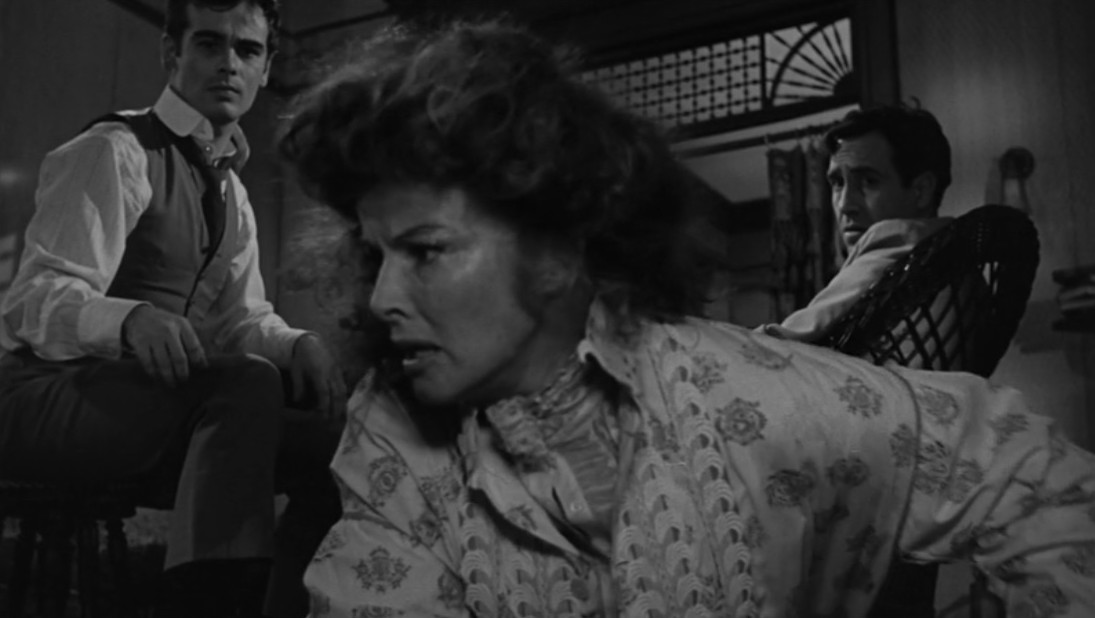
Long Day’s Journey Into Night (1962, dir by Sidney Lumet, DP: Boris Kaufman)
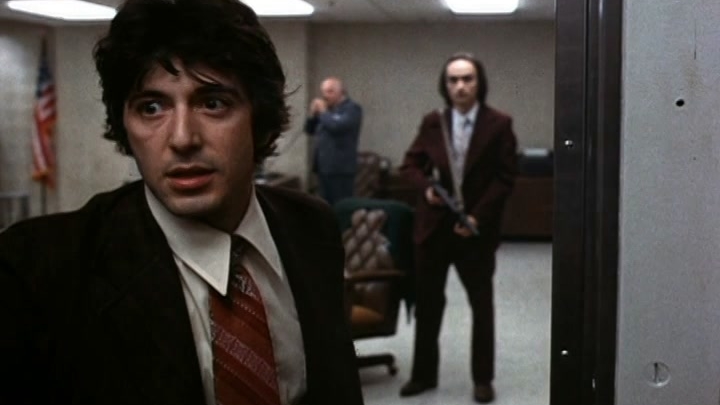
Dog Day Afternoon (1975, dir by Sidney Lumet, DP: Victor J. Kemper)

Network (1976, dir. Sidney Lumet, DP: Owen Roizman)
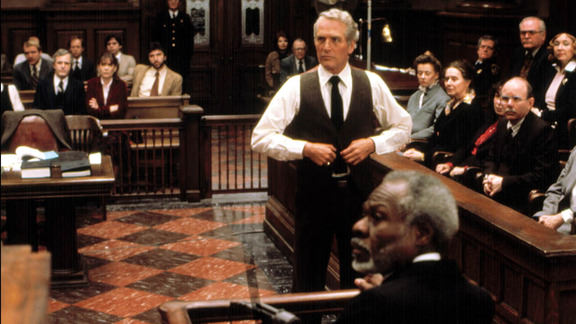
The Verdict (1981, dir by Sidney Lumet, DP: Andrzej Bartkowiak)
4 downer endings from 4 of my favorite films.
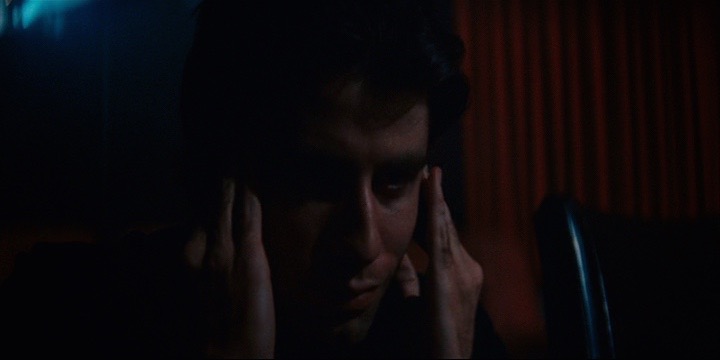
Blow Out (1981, dir. Brian De Palma)

The Parallax View (1974, dir. Alan J. Pakula)
Network (1976, dir. Sidney Lumet)

The Set-Up (1949, dir. Robert Wise)
With the recent passing of director, Sidney Lumet, I decided to watch one of Lumet’s best-known films, the 1976 best picture nominee Network.
Network tells the story of Howard Beale (played by Peter Finch). Howard is a veteran news anchor at a fictional television network. Because his ratings are in decline, Howard is fired. Howard reacts to this by announcing that he will commit suicide at the end of the next broadcast. Ironically, so many people tune in to see Howard kill himself that his ratings improve and Howard gets to keep his job under the watchful eyes of news director Max Shumacher (William Holden) and network executive Dianne Christiensen (Fay Dunaway).
At the same time, Max and Dianne are adulterous lovers. The course of the film’s narrative finds Max abandoning his wife (Beatrice Straight) and Dianne, who is described as a “child of the tube,” enthusiastically trying to produce an early reality television show starring a group of Marxist revolutionaries. They do this under the paranoid eyes of network president Frank Hackett (Robert Duvall) and Frank’s boss, the corrupt Arthur Jenson (Ned Beatty).
However, Howard Beale isn’t just an over-the-hill news anchor. He’s actually a seriously mentally ill man who hears voices and who starts to see himself as some sort of messiah. Eventually, this leads to a disheveled Howard giving a crazed speech in which he encourages viewers to yell, “I’m as mad as Hell and I’m not going to take it anymore!” Yes, this is the famous scene that is always used whenever some pompous media jackass wants to criticize the current state of television. Even though I think it’s one of the most overrated scenes in history, here it is:
Anyway, after this scene, Dianne starts to promote Howard as the “Mad Prophet of the Airwaves” and Max gets all outraged over how the news no longer has any integrity (bleh, Max is kinda full of himself) and eventually, Howard’s mad rantings get the attention of Arthur Jenson who has plans of his own for Howard. The whole thing eventually ends on one of those rather dark notes that’s impressive the first time you watch it but just seems more heavy-handed and clumsy with subsequent viewings.
As you might be able to tell from my review, I almost felt as if I was watching two different movies when I watched Network. For the first hour, the movie is a sharp and clever satire on the media. The characters are sharply drawn, the performance are full of nuance, and even the villainous Dianne is allowed a bit of humanity. And then, Howard gives his famous “mad as Hell” speech and the entire freaking film pretty much just falls apart as suddenly, all the characters start to act like cartoons. The film’s satire becomes so heavy-handed that you actually find yourself wanting to watch something mindless and brainless just because you know it would piss off self-righteous old Max. The actors stop acting and instead concentrate on shouting. Whatever humanity Dianne had been allowed suddenly vanishes and she just becomes yet another stereotypical “castrating bitch.” Max gets to spend a lot of time telling her why she’s worthless and it pretty much all comes down to the fact that 1) she’s under 40 and 2) she has a vagina. (Never mind the fact that Max has abandoned his wife, apparently men are allowed to be assholes.) By the time the 2nd half of the film ends, you don’t care about whatever the film’s message may have been. You’re just happy that everyone has finally shut up.
As I sat through the second half of this film, it soon became apparent to me why Aaron Sorkin has continually cited Network‘s screenwriter Paddy Chayefsky as a major influence. Chayefsky won an Oscar for writing Network and he’s constantly cited as one of the greatest screenwriters of all time but, quite frankly, his script isn’t that good. Much like Sorkin’s work, you’re aware of the screenplay not because of what the characters say but because they say so much. This is the type of film that is often wrongly called prophetic by bitter old men. This is largely because the script itself was written by a bitter old man. The only true insight one gets from this movie is the insight that the old will always view the young and the new as a threat.
And yet, even as the second half of the film collapses around us, Network still holds our attention. We’re still willing to stick around to see how all of this ends (and keep an eye out for a 17 year-old Tim Robbins who made his uncredited film debut at the end of Network). This has nothing to do with anything written by Paddy Chayefsky and everything to do with the direction of Sidney Lumet. I once read somewhere that you can’t make a good film out of a bad script. I’m not sure who said that though it has a definite William Goldman sound to it. Well, if nothing else, Network proves that this is not always the case.
To me, there is no more fitting tribute to Sidney Lumet than to say that he somehow managed to create something worthwhile out of Network.

Sad news came across the news wire this morning as it was confirmed that one of the most esteemed filmmaker in America has passed away at the age of 86. Sidney Lumet was considered by many as one of the best filmmakers of all-time. He definitely is one of the best, if not the best, American filmmaker of all-time.
Lumet was quite prolific as a filmmaker since he began to work behind the camera starting in 1957 with the classic drama 12 Angry Men and ending with his most recent work in 2007 with Before the Devil Knows Your Dead. In between these two films he would direct another 43 films with all of them received positively by critics and audiences everywhere. He was the consummate professional and never waited for the perfect project to come along. He always went into a film project because he either liked the script or, barring being in one which didn’t have a script he liked, it had actors he wanted to work with or he wanted to test his abilities as a filmmaker with new techniques.
Sidney Lumet began his career directing Off-Broadway plays and summer stock productions. He would soon move into directing tv shows in 1950. It would be his time as a tv director where turn-arounds between episodes were so short that a director had to work quite fast that he would earn the reputation as a filmmaker who didn’t spend too much time shooting too many takes of a scene. Lumet became known as a filmmaker who would shoot one to two takes of a scene and move onto the next. Another tool he learned as a tv director that served him well once he moved into film was to rehearse for several weeks with his actors the script before starting up actual production behind the camera.
It was in 1957 when he finally moved into filmmaking with 12 Angry Men (itself previously a teleplay for a TV drama) which would catapult him into prominence in the film community. The film was well-received and still considered by many as one of the most influential films of its kind as it highlighted social injustice in a time when such themes were not considered profitable by studios and the people who ran them. This was the film which would help build the foundation of Lumet’s filmmaking-style as he would continue to use filmmaking as a way to tell the audience about social injustices not just in his preferred film location of New York, but in America and the world, in general. Some of the best films in American history were done by him during the 1970’s when he would take the chaos and public distrust of long-standing public institutions in the US and crafted three of the finest films of the 70’s and America as it was during that decade with Serpico, Dog Day Afternoon and Network.
Sidney Lumet’s legacy as a filmmaker will continue to inspire young filmmakers long after his passing. He was a man who looked at filmmaking as an artform and not just a way to entertain the audience. His films never talked down or pandered to the very general public who watched them unlike some of the filmmakers working in the industry today. His legacy as being the consummate “actor’s director” meant that one didn’t need to be dictatorial with his cast and crew to create a great piece of filmmaking. That there were other ways to make a film and do it in such a way that everyone were still able to give their best without being alienated to do so.
My very first experience when it came to Sidney Lumet had to have been watching his Cold War classic, Fail-Safe, in high school history and it was one of those films which got me looking at film as something more than a form of entertainment. Here was a film that was entertaining but also one so well-made and acted that it’s ideas and themes were not lost. It opened up my eyes to the possibility of film as a medium that could be used to teach, raise issues to debate in society and highlight both the good and the bad of the human experience.
Sidney Lumet has made such an impact not just on those who were fans of films and grow up to become players in the industry, but also those people who would work in other fields of life whether they were lawyers, judges, police officers or politicians (professionals he would use over and over in his films throughout his career). Even Supreme Court Justice SOnia Sotomayor would look at Lumet as an inspiring figure in convincing her that she made the correct choice in choosing law as the path for her professional life.
I find it one of the most fitting tribute for Sidney Lumet that his time as a filmmaker and doing what he enjoyed doing the most became inspirational for people of all color, stripe and creed. This was a man who didn’t just take from the public but gave back just as much in the end. America has truly lost one of its best artists.
Serpico
The Hill
Dog Day Afternoon
Network
The Verdict
Before The Devil Knows You’re Dead
 Through the Shattered Lens